Saturday, October 8, 2022

Paperback Novelties: The Dell Great Mystery Library, 1957 to 1968 (?)

The Dell Great Mystery Library was an early attempt to "codify" great mystery fiction.  When it was launched in 1957 it was described as "an exciting new venture in softcover publishing, bringing you the world's most distinguished mystery fiction as determined by:

ANTHONY BOUCHER

author, editor and critic, recognized as America's foremost mystery authority

HUMPHREY BOGART

Academy Award-winning actor, and star of such motion picture mystery successes as 
The Maltese Falcon, The Big Sleep and The Desperate Hours

LOUIS UNTERMEYER

poet, biographer, essayist, anthologist and mystery fan

design by William Teason

Well, Anthony Boucher, natch, he was like the Otto Penzler or Martin Edwards of his day in the U. S., in terms of dominating the mystery criticism and reprint field, but the weird thing about this is that Humphrey Bogart died at the age of 57 on January 14, 1957--the same month in which the first three books in the Dell series were published!

It is a little hard to believe that the deeply terminally ill Bogart was spending his time selecting books for Dell's great mystery series, but this is what the publisher tells us.  His photo continued to appear on the back covers of the books in Dell series at least through number 7, six months after his death, with Dell assuring its readers that the late actor was still helping Boucher and Untermeyer to select the books!  

By numbers 9 and 10, however, Bogie's pic had been replaced with a new judge:

Boris Karloff

star of stage and screen. master of the spine-tingling art, whose hits include Frankenstein and Arsenic and Old Lace
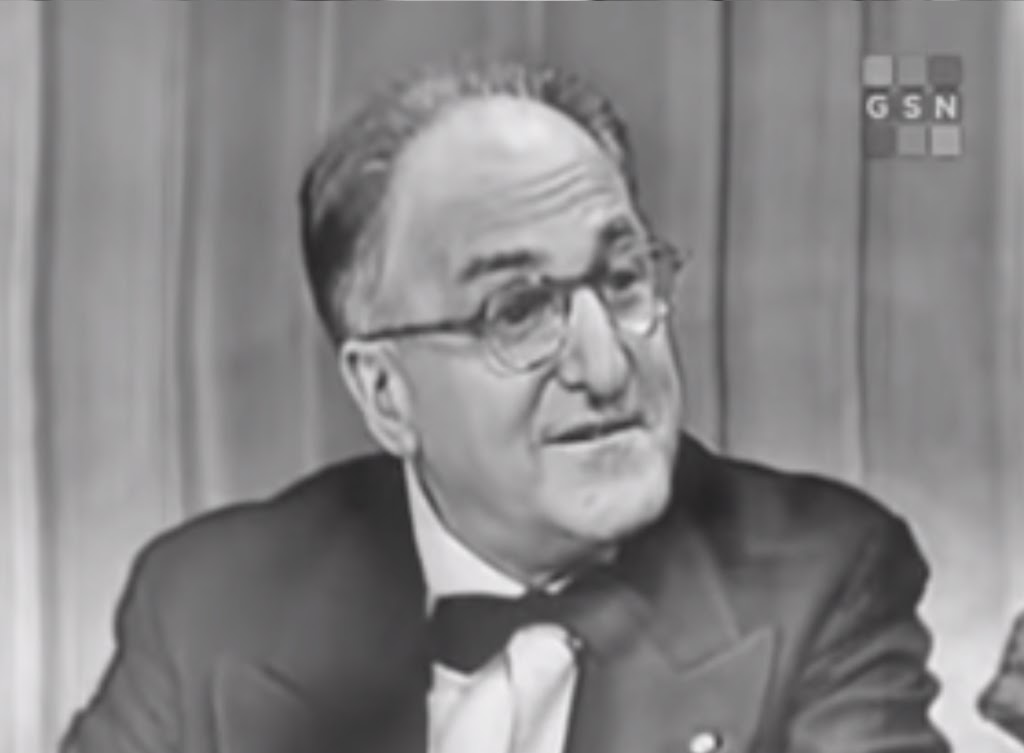
Red menace Louis Untermeyer insidiously 
subverting quiz show What's My Line?
As for Louis Untermeyer, he was a prominent Jewish public intellectual who had been blacklisted from television for having had Communist associations back in the Thirties.  Gasp!

In 1950 Untermeyer had been fired, due to pressure from right-wing organizations like the Catholic Veterans, from the popular TV quiz show What's My Line? and replaced with Bennett Cerf

Doubtlessly this made America vastly safer from the looming specter of the Red Menace.  (Cause Untermeyer's "line" was Communism, see?!)  So I suppose it was daring having him on the Dell panel of judges.  Anthony Boucher was a noted liberal and likely was sympathetic to his fellow essayist's plight.

Does anyone, by the by, really think it was anyone other than Anthony Boucher who was making all the selections?  This is yet another example of Boucher's great influence in the world of crime fiction in the Fifties and Sixties, as least in the U. S.

Cornell George Hopley Woolrich scores 
two titles in the top ten

Anyway, the first ten books in the series were all published in 1957.  These were, in order:

#1 The Bride Wore Black, by Cornell Woolrich (January)

#2 Trial by Fury, by Craig Rice (January)

#3 Laura, by Vera Caspary (January)

#4 A Puzzle for Fools, by Patrick Quentin (March)

#5 Warrant for X, by Philip Macdonald (April)

Vera Caspary gets a bigger font
#6 Headed for a Hearse, by Jonathan Latimer (May)

#7 The Circular Staircase, by Mary Roberts Rinehart (June)

#8 A Coffin for Dimitrios, by Eric Ambler (July)

#9  The Red Right Hand, by Joel Townsley Rogers (September)

#10 Phantom Lady, by William Irish (October)

A good list, I think, though with a distinctly American bias.  Macdonald, Ambler and Patrick Quentin are the only British authors, although the Quentin book is set in the States and the two men behind Patrick Quentin lived together in the States when the book was originally published,.  

Just three women made it onto the list (Craig Rice being a woman of course), but then this was the Fifties and the panelists were all men, so maybe this was not such a bad showing under the circumstances.  Still, you might have thought they would have stuck one woman on the panel, even if it was just for show.

The next ten books in the series were:

#11 Before the Fact, Francis Iles

#12 Sad Cypress, by Agatha Christie

#13 Fer-de-Lance, by Rex Stout

#14 Ride the Pink Horse, by Dorothy B. Hughes

#15 The Beast Must Die, by Nicholas Blake

#16 The Bellamy Trial, by Frances Noyes Hart

#17 Death of a Ghost, by Margery Allingham

#18 Background to Danger, by Eric Ambler

#19 The Mystery of the Dead Police (X v. Rex), by Philip Macdonald

#20 The Man in the Queue, by Josephine Tey

Which went a good way toward redressing the imbalance between American and British writers and a bit of the sex imbalance too.  As for other books in the series, at some point Dell stopped numbering them but here are the "twenties" titles:

#21 A Hole in the Ground, by Andrew Garve

#22 A Gentle Murderer, by Dorothy Salisbury Davis

#23 One More Unfortunate, by Edgar Lustgarten

#24 The Hound of the Baskervilles, by Arthur Conan Doyle

#25 The Red House Mystery, by A. A. Milne

#26 The Iron Gates, by Margaret Millar

#27 Journey into Fear, by Eric Ambler

#28 Bedelia, by Vera Caspary

#29 The Three Coffins, by John Dickson Carr

Did Dell number up to 30?  I do not know.  I am surprised it took Carr so long to make the cut, especially with Boucher being such a great Carr admirer and pal.  Of the first 29, then, we ended up with 15 books authored by English writers to 14 American/Canadian, as even a split as could be, and 11 books authored by women writers to 18 men.  

Authors with multiple titles are Eric Ambler (3), Cornell Woolrich/William Irish (2), Vera Caspary (2), Philip Macdonald (2).  More feminine domestic suspense than masculine hardboiled by far, even while the British Crime Queens are underrepresented (Christie, Allingham, Tey).  A couple of chestnut titles by the late oldsters Mary Roberts Rinehart and Arthur Conan Doyle, actually three if we count A. A. Milne's mystery or even four if we add The Bellamy Trial.

Some later, unnumbered ones are:

Evvie, by Vera Caspary

The Eighth Circle, by Stanley Ellin

The Second Man, by Edward Grierson

The Bad Seed, by William March

Someone Like You, by Roald Dahl

Kiss, Kiss, by Roald Dahl

Evelyn Piper, The Motive

The Promise of Murder (Melora), by Mignon Eberhart

Trial and Error, by Anthony Berkeley

The Hours before Dawn, by Celia Fremlin

How Like an Angel, by Margaret Millar

The Fiend, by Margaret Millar

No Next of Kin, by Dorothy Cameron Disney

Before I Die, Helen McCloy

The Pavilion, by Hilda Lawrence 

The Lodger, by Marie Belloc Lowndes

Sleep Long, My Love, by Hillary Waugh

Case Pending, by Dell Shannon

Nightmare, by Cornell Woolrich

This takes us up to forty-eight books.  Were there more?  Probably!

Vera Caspary makes it up to 3 titles, along with Margaret Millar and Cornell Woolrich, while Anthony Berkeley/Francis Iles scores 2.  That puts them at the top with Eric Ambler (3) and Philip Macdonald (2). Another chestnut is The Lodger and there are a couple of police procedurals in Sleep Long, My Love and Case Pending.  And lots of domestic suspense!  At this point Dell seemed to be overwhelmingly concentrating on books from more recent years, from the Sixties and Fifties.

After the first ten, Dell evidently decided the uniform cover design, by brilliant modernists Push Pin Studios, was too plain, so they hired more traditional illustrative artists.  

The beautiful Bedelia cover was done by William Teason, perhaps Dell's top paperback "gun" at the time.  The pics of the panel of judges disappeared from the back covers at some point, but I bet brainy Boucher was still in back of it all, pulling strings....

One tip-off to this being all Boucher is there is not a single Philo Vance mystery by S. S. Van Dine--Boucher definitely thought that was one series which served a good kick in the pance!

Wednesday, September 21, 2022

Butcher's Dozen: Robert Barnard's Thirteen Best Mystery Novels

When I returned to mystery reading in a huge way in 1989, after a six year hiatus when I gave them up, I read a lot of Sayers and Marsh and John Dickson Carr, as well as the stray Christies I had missed earlier, and I reread all the Sherlock Holmes tales.  Two of the first (if not the actual first) contemporary mystery writers I read in the Nineties were PD James and Ruth Rendell, along with Robert Barnard and Peter Lovesey.  With Barnard and Lovesey, I often read their mysteries as they were published: a new phenomenon for me.  

Robert Barnard as you may know died just over nine years ago at the age of 76, after the rapid onset of what I understand to have been dementia.  If you read online reader reviews of his last two or three books (especially the last one, A Charitable Body, published at the beginning of 2012), you will find increasingly critical comments about his work, as if there were something "off" about it.  I'm not sure his last one was even published in the UK, though his American publisher, Scribner, stuck with him to the end.

Robert Barnard published 45 mysteries novels between 1974 and 2012, along with three short story collections and a fine literary study of the work of Agatha Christie, A Talent to Deceive.  (Until his retirement in the early eighties, Barnard, a native Englishman, worked as a professor of English in Australia and Norway.)  I think his best period by far as a writer of mystery novels was roughly 1974 to 1995, as you will see from my "best" list below:

24 of his books were non-series standalones, while his series sleuths were cops Perry Trethowan (5 books) and Charlie Peace (13 books; Unholy Dying, Mistress of Alderly and Graveyard Position often aren't listed as CP books but they are) and, in an alternative mystery universe, a certain Wolfgang Amadeus Mozart (3 books).  I like Barnard's PT novels, one of which, Bodies, introduced Charlie Peace back in 1986, but I think his best work was with the early Peace novels and the nonseries ones.  (Admittedly, I haven't read the Mozart ones, published under the pseudonym Bernard Bastable, real life historical sleuths usually not being my thing, with certain exceptions like Peter Lovesey's Bertie.)

Best of Robert Barnard

Non-series Novels 10

Death of an Old Goat 1974 darkly funny flaying of Australian academics

A Little Local Murder 1976 classic village mystery and the episode of the Haydn records

Death on the High C's 1977 opera romp

Unruly Son 1978, aka Death of a Mystery Writer his first book published in the US, where he soon received three Edgar nominations from the Mystery Writers of America for best novel--he was belatedly but very warmly received in the US

Out of the Blackout 1984 first of his historical recreation mysteries, superbly rendered

cover by Barnard's English publisher
in his later years, Allison & Busby
A Corpse in a Gilded Cage 1984 hilarious fish out of water mystery; lots of social satire

The Disposal of the Living 1985, aka Fete Fatale back to village mystery setting, wonderfully done

The Skeleton in the Grass 1987 impressive 1930s period mystery

A Scandal in Belgravia 1991 another period mystery, shifting back and forth several decades a la Barbara Vine (though much shorter) with a speciality of his, the last page twist

Last Post 2008 another retrospective type mystery--a fine return to form by the Old Master before his rapid decline

I think Penguin was did some
kickass covers Barnard 
Charlie Peace Novels 3

A Fatal Attachment 1992 this and the next two all terrific village/provincial mysteries

A Hovering of Vultures 1995

The Bad Samaritan 1995

A few honorables: Blood Brotherhood 1977 Sheer Torture 1981 Death and the Princess 1982 Bodies 1986, Death in Purple Prose 1987 Death and the Chaste Apprentice 1989 A City of Strangers 1990, Masters of the House 1994 A Cry from the Dark 2003

More of the Art of Agatha: Further Examples of (Mostly) Exquisite Christie Paperback Art

William Teason, 1968
Readers of the book will know
how clever a cover this is

Mid-century Agatha Christie hardcover art was often deadly dull indeed, with the publishers seemingly relying on Christie's name alone to sell books (not a bad call either, that).  

However the paperback art for Christie's books was another case entirely.  I have already done posts on some of the superb artwork for Pocket done by Tom Adams and the lesser known Mara McAfee.  

Here are additional some examples of Christie paperback art: 

Works by William Teason, who did Christie covers for Dell from the Fifties into the Seventies

Some of the more surrealistic Christie covers Tom Adams did for the English publisher Fontana in the Seventies and a couple more of his wonderful Pockets I have found

Some examples of Bantam and Pocket paperback editions I purchased as a kid back in the Seventies and the Eighties with appropriately, my own pocket money

Those later Pockets bring back tremendous nostalgia for me, of a time when reading mysteries was really exciting, in a way it never has been quite since: the thrill as a kid of desperately trying to determine just whodunit--and usually never coming close succeeding!

Some of the surrealistic images from Tom Adams' wild Fontana covers
As weird as this Caribbean Mystery cover is, he did an even weirder one,
with just the old Major's glass eye!
Here Adams vividly depicts the murder scene in MMD and a pivotal moment in TMC.  Clever!
the back covers
Bantam had the rights to a small number of Christie titles in the Seventies,
including Death on the Nile.  On left it used  a Tom Adams Fontana design, on right a
rather dull depiction of the Seven Dials Mystery. 
I used this latter edition for a middle school book report back in 1978.
These later Pocket designs were rather minimalistic, but I always found the Ordeal
cover from 1976 rather sinister.  I remember trying to figure it out and being completely gulled.
William Teason, 1970 and 1969
He loved the skull motif and a variety of weapons.

presumed William Teason, the classic items composition design

William Teason

presumed William Teason

William Teason, 1959
a droll, ironic design

back cover

William Teason, 1965
Arthur Hastings on the letter from Emily Arundell
that draws him and Poirot into the case:
"It's exactly as  though a spider had got into an inkpot
and were walking over a sheet of notepaper!"

Monday, September 19, 2022

Butcher's Dozens:The Thirteen Best John Rhodes and the Thirteen Best Miles Burtons

Cecil John Charles Street was both John Rhode and Miles Burton, so it's cheating a bit to allow him two sets of bests, I suppose, but then we are talking 140 novels!  I think the man deserves it.

Best John Rhodes (all with Dr. Priestley)

The House on Tollard Ridge 1929 classic case of Rhodian murder gadgetry and some good spookery

The Davidson Case 1929 Early use of a famous gambit, which Dashiell Hammett thought unfair, with some interesting philosophical reflections 

The Claverton Affair 1933 classic poisoning case in gloomy house with spiritualism too

The Robthorne Mystery 1934 dares to use twins, in violation of Father Knox--can you go to Hell for that?

Poison for One 1934 another classic poisonings

Shot at Dawn 1934 the last word on tides

The Corpse in the Car 1935 yet another classic poisoning with some acute satire

Death on the Board 1937 classic multi-murder case with a multiplicity of ingenious murders, with some acute social commentary

Invisible Weapons 1938 a rare venture into locked rooms

The Bloody Tower 1938 family curses and rural squalor

Death at the Helm 1941 another classic poisoning, with serious treatment of love triangle

They Watched by Night 1941 classic wartime tale

Death in Harley Street 1946 death that is neither accident nor suicide nor murder???

Best Miles Burtons

The Secret of High Eldersham 1930 a classic treatment of the witchcraft theme

Where Is Barbara Prentice ? 1936 high  jiggery pokery with a body

Death in the Tunnel 1936 if you want to stage a railroad tunnel murder, this is the way to do it

Death Visits Downspring 1941--wartime mystery; the butler didn't do it but it was done to him

Murder M. D. 1943 (strong character interest in this one)

The Three Corpse Trick 1944 striking complexity in a tiny habitation

The Cat Jumps 1946 one of the early cat mysteries and a locked room situation

Situation Vacant 1946 Why do the secretaries keep dying in the village?

Death Takes the Living 1949 not his most brilliant plot but an interesting look with disgruntlement at post war England

Ground for Suspicion 1950 excellent postwar provincial mystery

Murder in Absence 1954 partially a cruise mystery, though it's a tramp steamer

The Moth Watch Murder 1957 notably unique specimen

Bones in the Brickfield 1958 excellent late village mystery involving a found dinosaur fossil

Some More Butcher's Dozens: The Thirteen Best Christies and Carrs

 I thought I'd try some more of these, after having done Mr. Symons.  These were much harder!

Best Agatha Christies

The Murder of Roger Ackroyd 1926 Poirot--the famous twist, plus good village satire and a great last line

The Murder at the Vicarage 1930 Marple--debut Miss Marple novel, she at her most vinegary, before Christie fluffified her--as a kid I didn't like this one much, but now I love the village satire and the solution is a classic gambit for her

Murder on the Orient Express 1934 Poirot--one of her classic solutions, one of the great train mysteries

The ABC Murders 1936 Poirot--classic serial killer mystery, the best one book with Hastings

Death on the Nile 1937 Poirot--possibly the most purely entertaining Christie--classic boat setting, brilliant solution, strong central characters

And Then There Were None 1939 nonseries--THE enclosed location mystery, perhaps the greatest mystery of them all

The Body in the Library 1942--classic return to St. Mary Mead, in one of her strongest depictions of the village, along with some well-rendered hotel types and another classic solution

Five Little Pigs 1942 Poirot--the best of the more "novelistic" Christies from the Forties, where the emphasis to the solution is based on characters--classic murder in the past treatment

A Murder Is Announced 1950 Marple--perhaps her greatest village mystery (not St. Mary Mead but Chipping Cleghorn)

Ordeal by Innocence 1958 nonseries--Christie deemed this one of her best and authors often get that judgment wrong (!), but this is notable as it looks forward to the rather gloomy, modern dysfunctional family mysteries of PD James and Ruth Rendell, with a solution turning on psychology

The Pale Horse 1961 nonseries with Ariadne Oliver--her best mod mystery, a fantastic mutrder plot with supernatural trimmings that owes a bit to Philip Macdonald

Endless Night 1967 nonseries--a classic psychological crime novel in the modern manner, with a well-rendered angryish young man

Curtain 1975 (written 1940s) Poirot--opinion divided on this one, but I think it's a classic performance, a brilliant finish for a great detective, though it's very much autumnal and the characters by design are a pretty unlikeable lot

Best John Dickson Carrs

The Three Coffins 1935 Fell--highly atmospheric and the locked room lecture, of course, though it gets a bit fiddly in the murders

The Arabian Nights Murder 1936 Fell--impressive essay in multiple narratives, onion like plot

The Burning Court 1937 nonseries--the classic mystery with supernatural undertones (overtones)

The Ten Teacups 1937 Merrivale--review here

The Crooked Hinge 1938 Fell--jaw-dropping solution, whether you buy it is up to you--classic claimant mystery

The Judas Window 1938 Merrivale--classic courtroom mystery, one of Merrivale's best performances

The Reader Is Warned 1939 Merrivale--the insidious idea of teleforce seems to take this in supernatural/sci-fi direction

Murder in the Submarine Zone 1940 Merrivale--classic wartime, shipboard mystery

The Man Who Could Not Shudder 1940 Fell--classic haunted house mystery

The Case of the Constant Suicides 1941 Fell--great Scottish setting with some more supernatural undertones and some lighthearted humor as well

She Died a Lady 1943 Merrivale--one of Carr's best examples of the serious, character-driven mystery from the Forties

He Who Whispers 1946 Fell--superbly shuddery and suspenseful, with providing some strong character interest

The Devil in Velvet 1951 nonseries--Carr's best historical, character driven with a very strong sense of interest and a sinister cameo by Scratch himself

Sunday, September 18, 2022

Butcher's Dozen: The 13 Best Julian Symons Crime Novels

Whenever I post something critical in some way of British author and critic Julian Symons, who died nearly three decades ago, I usually get met with some pushback to the effect of I shouldn't be criticizing Julian Symons, as it just isn't done apparently.  It would seem by doing so I am sowing disharmony in the vintage crime fiction community.  

I find this ironic since Julian Symons himself fearlessly criticized anyone and anything he felt like criticizing and was so ensconced that it never seemed to harm him in any way.  Sure, there was an effort to boot him from the Crime Writers Association, but I gather it gained little traction, and perhaps there were some offended Rex Stout fans, outraged by his criticism of the author and his biographer, who didn't buy Symons' books (though they probably had never done so in the first place); but this was small beer to the esteemed president of the Detection Club and New York Times and London Times columnist. 

What I regret is that some people seem to take my criticism of him personally on his behalf.  I will say again that it's not personal with me.  I like much of Symons' crime fiction and I find him rather a remarkable person indeed (far more so than I am).  Obviously he was a very important in the history of his crime fiction, both on account of his fiction writing and his highly personal criticism of the genre.  

If you were brought to reading crime fiction on account of his genre study Bloody Murder and it led you on to read John Franklin Bardin and Patricia Highsmith and that Face on the Cutting-Room Floor guy (or better yet, Patrick Quentin), that's all well and good.  I wasn't, and I find it a flawed book that contributed greatly to a flawed narrative of the history of crime fiction.  However, I don't "blame" Symons for altering the course of crime fiction.  Change was inevitable and not altogether a bad thing either.

Incidentally (or not), I have read all of Symons' crime novels and I have enjoyed many of them.  My personal favorites are, in chronological order:

Bland Beginning 1949--Symons' essay in Innes-Crispin literary detective fiction, brilliantly drawing on his own family background--not flawless but well carried out and rather charming--reread several months ago and will review here soon

The Thirty-First of February 1950--Symons' first uber-gloomy crime novel, but influential in its deathly seriousness and grim rejection of classic puzzle plotting--influenced by Dostoyevsky, and there's nothing gloomier than a 19th century Russian novelist!

The Narrowing Circle 1954--chosen by Symons' philosophical opponent Jacques Barzun for his 100 Classics of Detection--bears a certain debt to Kenneth Fearing's The Big Clock, but one of S's best examples of a classic mid-century mystery

The Colour of Murder 1957--another classic Symons downer, a study of a downtrodden victim embroiled in a murder case. winner of the CWA gold dagger. 

The Progress of a Crime 1960--a documentary style analysis of crime, trial and punishment, which acquainted the UK with the fact that they had police brutality in their country as well; won the MWA's Edgar

The Plain Man 1962--another classic-style mid-century mystery, on the order of Narrowing Circle

The End of Solomon Grundy 1964--another sardonic and ironic murder and trial case, I think better than Progress, but I suppose they didn't want to give him a second Edgar

The Man Who Killed Himself 1967--a dark but droll, twisty inverted mystery, in the manner of Francis Iles

The Players and the Game 1972--one of the classic serial killer novels--Symons wrote a lot of tosh around this time but this is good

The Blackheath Poisonings 1978--Symons' first venture into Victorian mystery, quite good but very gloomy--a classic Victorian family poisoning that likely draws some on his own family history

The Detling Secret 1982--another Victorian mystery, lighter than its predecessor but quite charming--Symons had charm when he chose to exert it

Death's Darkest Face 1990--Symons' venture into Barbara Vine territory and very good too--He died four years later and his last two books show a falling off in quality, but this is superb, one of his very best at age 78--sophisticated mystery at its best.  

Something Like a Love Affair 1992--an impressive though slim coda, this one a moving venture into Ruth Rendell domestic morbid psychology

Only one of these books has even been reviewed here, a decade ago now, but I will try to rectify that in the future.

Friday, September 16, 2022

More Great Moments in Julian Symons Crime Fiction History: The Criminal Case of His Cornell Woolrich Criticism

Not Julian Symons again!

One thing you know if you've read much Julian Symons mystery criticism: He really liked the work of Dashiell Hammett.  He devoted four whole pages to Hammett in the first (1972) edition of his genre survey Bloody Murder, a book which modestly runs to under 270 pages.

Symons liked Raymond Chandler too, though he avowed that "it must be said" that Chandler, lacking Hammett's "toughness," "comes off second best" in comparison with Hammett.  

All this has to be said," declared Symons redundantly after surveying Chandler's faults as he saw them--verily, Symons was a great sayer of things that that in his view had to be said--yet he allowed that Chandler "was a very good writer."  Fair enough!

What's striking to me, however, is how, Chandler aside, other hard-boiled or noir writers from the Thirties fared so vastly more poorly in comparison with Hammett and, indeed, were treated almost as negligible.  William Faulkner, a great writer but a crime fiction dilettante, gets an entire paragraph from Symons, but James M. Cain, W. R. Burnett and Jonathan Latimer are confined to one or two sentences apiece, as is Cornell Hopley-Woolrich, as Symons calls him, while many others go unmentioned.  Symons backhandedly credits Woolrich with "plots which dazzle by their ingenuity in the half-light of evening, but when the morning comes seem rather contrived," singling out for mention his novels Phantom Lady and The Bride Wore Black.  

At his death in 1968, four years before the first edition of Bloody Murder was published, Cornell Woolrich had become something of a forgotten man, though the great French director Francois Truffaut made films from two of his novels in 1968 and 1969.  His now long and steady rehabilitation began with the publication in 1971 of the Woolrich short fiction collection Nightwebs, edited by Francis Nevins, but one does not get the impression that Symons was acquainted with Nevins' anthology when he was drafting the first edition of Bloody Murder.  

However, in the final edition of Bloody Murder, published two decades after the first, Symons made clear he had read Nightwebs (or at least parts of it)--though the effect of it had only been to prompt him to become further dismissive of Woolrich.  People who are aware of Symons' dismissal of the "Humdrum" British detective novelists and some of Britain's Crime Queens (especially Dorothy L. Sayers) may yet be surprised to see the casual dismissiveness with which Symons writes of Woolrich, his great advocate Francis Nevins and the United States in general:

Cornell George Hopley-Woolrich (1903-1968)...is at present a cult figure in America, "one of the greatest suspense writers in the history of crime fiction," as one enthusiast mistakenly puts it....His best writing is in the novels he produced at great speed in the early forties, especially The Bride Wore Black (1940)…and Phantom Lady (1942), but the melodramatic silliness and sensationalism of many of his plots, and the continuous high-pitched whine of his prose--seen at its worst in the collection of stories Nightwebs (1971)--preclude him from serious consideration.

Doubtlessly all this "had to be said," but while my observation which follows here may not truly have had to be said, just let me say it anyway, borrowing a word from Archie Goodwin, as I recollect (at least the television version of Archie as played by Timothy Hutton): As a critic, Julian Symons can be a poop.  

What arrogance on his part!  One has to wonder what Nevins--the "enthusiast" to whom he patronizingly refers--did to provoke him.  I suppose praising Woolrich's writing so effusively.  

God knows I have my criticism of Nevins--mainly centering on his calumnies against Woolrich on a personal level and a general attitude which I deem antigay--but the man did do an incredible amount of work on the author and almost singlehandedly revived his work in the Seventies and Eighties.  For that he deserves some respect.  Symons could not even bring himself to name Nevins in Bloody Murder.  Pah!  Pfui!

The only effect of Nevins' work on Symons was to cause the critic to downgrade Woolrich further, damning his work as marred by "melodramatic silliness and sensationalism."  His comment about "the continuous high-pitched whine of his prose" is one of the nastiest cracks which Symons makes against another crime writer in Bloody Murder.

Certainly Woolrich is not a strictly "realistic" writer like Hammett supposedly is, but this sweeping dismissiveness seems manifestly unfair on Symons' part.  I don't really know how well read Symons was in Woolrich--all we really know, apparently, is that he read The Bride Wore BlackPhantom Lady and Nightwebs--but even a reading of some of the tales in Nightwebs (Did Symons not get past the first section?) shows that there is realistic detail to the stories, including a forthright treatment of police brutality and the  economic privation of the Depression.  

There is also emotional honesty and intensity, though I suppose this is what Symons dismisses as Woolrich's "high-pitched whine."  Certainly Symons is not the first person to criticize purple patches in Woolrich's passionate prose, though those particularly sneering words are unique.  

In the end I suppose Symons disliked the emotionalism and  artifice of the Woolrich tales, which owe a certain debt not only to Edgar Allan Poe but yet another great American writer, O. Henry.  Symons also never thought much of most of the between-the-wars Had-I-But-Known and mid-century domestic suspense writers (mostly women) with whom Woolrich shares an affinity, judging by Bloody Murder, where he deems few of them worthy of inclusion and serious discussion.

Conversely Symons upgraded Burnett and Cain in the last edition of Bloody Murder, crediting them despite limitations with making "considerable contributions to the American revolution in the crime story."  It is astonishing to me, however, that Symons could not see the same thing in the case of Woolrich, whose influence on noir in his own work and the many radio and film adaptations made from it seems patently obvious.  

Symons seems to have been blinded, not for the first time, by his own strong opinions, which conflict with his job as a genre historian.  Personally I don't like the writing of, say, Jim Thompson all that much, frankly, but his influence on the genre obviously was great, whatever I think of his work.  

But then Symons is dismissive of Thompson too.  He briefly shoehorns Thompson into a discussion of pulp writers from the Thirties, declaring that he was nothing "more than an efficient imitator of other writers in the genre."  Thompson, he incredibly concludes, lacks "individuality," making it difficult to tell his work from anyone else's!  This would shock Thompson's American fans, though being, I suppose, according to the Symons view, a bunch of naïve American cultists, what would they know?  At least Thompson fares better than David Goodis, who gets only two microscopic mentions in the final edition of BM.  (Neither is mentioned in the first edition.)  

As the years go by, I like Symons less and less as a crime fiction historian, though I do believe his due should be paid to him as a crime writer--he wrote some fine books and even some genre classics--and more generally as a critical essayist.  The problem with Symons as genre historian, it has to be said, is that he just could not or would not step back enough from his own personal biases.  Bloody Murder needed less of his opinions, in my opinion, and more objective history.  There, I've said it.