Sunday, May 28, 2023

Prince Albert in a Can: Out of the Dark/Child's Play (1964), by Ursula Curtiss and its film adaptation I Saw What You Did (1965)

To a great extent, children were neither seen nor heard in Golden Age detective fiction, though they certainly pop up in Dorothy L. Sayers' humorous short story Talboys, say, Margaret Cole's novel Scandal at School (1935), where the murderee is a blackmailing teenage girl, and Agatha Christie's Crooked House, where--well, I'd better not say more about that one!  

I have the impression that the depiction of children in crime fiction owes rather more to the Americans than the Brits, Americans like like Craig Rice with her classic Home Sweet Homicide and the various mid-century mistresses of domestic suspense, like Ursula Curtiss.  Indeed, Curtiss, the mother of five children, went so far as to base her 1964 crime novel Out of the Dark (Child's Play in England), on her own family.  

The book reads something like Shirley Jackson's popular domestic child-raising comedies, Life among the Savages and Raising Demons, crossed with a tale about a psychotic killer.  It's a rather weird combination, to my mind inadvertently making the case for keeping kids out of crime stories, unless they are themselves killers like the sociopathic tot in William March's The Bad Seed--tales of morbid psychology, in other words, where anything narsty goes.  

Tales about the mirthful doings of wacky kids, on the other hand, don't really mix well with murder, in my view.  But that is rather what we got here!

The basic scenario in Child's Play--the title I'm used to, and the better one I think--is clever, and it's not surprising the novel was adapted as a film by that great American impresario of horror schlock, William Castle.  In the novel a pair bored girls, "home alone" as it were, decide to make a series of prank phone calls to unsuspecting victims, and soon get in over their heads.

It's the old "Prince Albert in a can" ruse, I suppose you know that one?  It's where kids call a store asking if they have "Prince Albert in a can?,"  referring, don't you know, to the Prince Albert brand of tobacco.  If the victim unsuspectingly answers, "yes, we do" then the kids scream: "Let him out!"  Hilarity ensues.  I did this one myself, but disappointingly the person on the other end of the line anticipated me by saying, "No, we let him out.Stephen King used this bit in his horror novel It and it appeared as well in the television adaptation.  It's referenced in the Curtiss novel as well.

Let him out!
In the Curtiss novel, which is set in Albuquerque, New Mexico, the author's place of residence from 1960, the teen girl pranksters are Libby Mannering and her visiting friend from Chicago Kit Travers.  In the book Kit--a sort of urban sophisticate who seems older than her fourteen years (Libby is fourteen as well)--is the instigator of the phone calls, uttering to her victims, all for fun, the threatening line: "I know who you really are, and I saw what you did...."  

This lands the girls in trouble when they utter the line on the phone to a man who years ago got away with a terrible murder....

As I mentioned above, this is a classic suspense scenario and kudos to Curtiss for being the first, apparently, to use it. 

Unfortunately, however, from my perspective, Libby happens to have four younger siblings, three brothers and a baby sister, and their antics, lovingly dwelt upon by the author, undermine the suspense.  It seems that Curtiss, herself the mother of five children, based the kids in the book on her own.  She told the Albuquerque Journal that the novel "was written around the five Curtiss children, Katy, 15, John, Paul, Kieran and Mary, 8."  Based on the antics in this book I would say that the Curtiss children must have been quite the hellions!  More than a match for any mere murderer, indeed.

But the book is not a murder comedy either.  To me it's schizophrenic.  Early on there's a rather frightening depiction of the original murder that makes clear the killer is a very bad dude, a sociopathic type, and it should make us fear powerfully for the safety of the kids, but it really doesn't.  I could never really make myself believe Curtiss' brat pack was in true danger, despite the atmospherics. (The somewhat feckless Mannering parents are spending the night in Santa Fe and had gotten the kids an adult babysitter, who never shows.)  

Perhaps had Curtiss confined the cast of kiddie characters to just the two teenage girls, it might have worked better.  If three's a crowd, five is a calamity, at least as far as suspense is concerned.  The author's slightly earlier suspense novel, Hours to Kill, a superb study in terrifying isolation, is much stronger as pure suspense, I believe. 

                                                                        *******


Some reviewers voiced similar complaints about the book as mine, but on the whole the novel received boffo reviews (specially in England) and it became one of only two Curtis novels to be filmed.  The 1965 film version of Out of the Dark, entitled I Saw What You Did, is an interesting movie to thriller fans, though ultimately I think it is deeply flawed.  

It was directed by William Castle, the last film by him, I believe, that anyone ever talks about, though he would direct five more.  Its main stars were two teenage unknowns, Andi Garrett and Sara Lane, as Libby and Kit respectively.  (Lane was fifteen at filming; I'm not actually certain how old Garrett was.) 

Girls Night In

However, the main adult co-stars in the film were big movie stars then in their fifties: Joan Crawford, 58, and John Ireland, 50.  Both stars had drinking problems and if anything looked older than their ages.  It's stated a couple of times that John Ireland's character is, or looks like, around forty old, which is laughable, while Crawford, saddled with a horrendous beehive hairdo and some sort of costume jewelry collar contraption that looks like it was lifted from the Temple of Doom, is positively matronly.  (Originally Barbara Stanwyck was supposed to play the role, which would have been more plausible, though Stanwyck was only a year younger than Crawford.)  However, Joan and John still lend an air of needed seriousness to the film.  

John Ireland can't figure it out either.

Fifty-three year old actor Leif Erickson is in the film too, in the throwaway part of Libby's father, like Crawford and Ireland looking old for his age.  The only other sizeable part belongs to nine-year-old Sharyl Locke, as Tess Mannering, Libby's baby sister.  Libby's three brothers from the book, all have been expunged, surely a necessary move for cohrency's sake.  However, little Sharyl does enough mugging for all of them.  

more glamorous days
Joan Crawford and John Ireland in the 
melodrama Queen Bee, from 1955
For the film, it must be noted, is as schizophrenic as the book, if not more so.  The teenage actresses have been much criticized as terrible, but I don't know that this is such a fair charge.  Basically they are tasked with playing a pair of silly teenage girls and at that job I think they succeeded well enough.  (Andi Garrett gets a bit goofy at times though.)  

The biggest problem I had with the film is the godawful silly sitcom music on the soundtrack, which made the film seem like more like a wacky episode of the contemporary "identical cousins" sitcom, The Patty Duke Show.  The lightness of the portions with the kids doesn't blend well with the murderous goins-on among the adults, which, come to think of it, is a pretty fair translation of the book, only more so!  

In particular, the first murder--a blatant rip-off of Alfred Hitchcock's infamous shower scene from Psycho--is quite violently presented and rather off kilter with much of the rest of the film. So, what's the first murder, you ask (if you haven't seen the film already)?  Well, John Ireland, playing Steve Marak (Leonard Whelk in the book), knocks off his pretty young wife Judith (Joyce Meadows) in a rage because she is leaving him.  When he gets a call from Libby, in the sexy guise of Suzette, telling him, "I saw what you did....and I know who you are!," he goes bananas of course.  


Joan Crawford, who starred in William Castle's 1964 horror film Strait-Jacket (a much better flick), has been shoehorned into this film in the part of Amy Nelson, a seriously overdressed neighbor who has the hots for Steve and is always spying on him from her window.  Amy comes up with the brilliant idea of blackmailing Steve, with her knowledge of the murder, into marrying her, which predictably only succeeds in prompting Steve to slay Amy too.  Before Amy--okay, let's just say Joan, cause this is who Joan really is playing here--kicks the bucket, however, she has a great scene confronting Libby, who has come to get a gander at Steve (she thinks he sounds sexy on the phone), scolding and shoving her and denouncing her as a tramp.  Why, if they had gotten Joan's daughter Christina to play Libby, Joan wouldn't have had to do any acting at all!  

"Get outa here, you tramp!"
the scariest thing in the film
Apparently in real life, however, Joan got along with the teenagers just fine.  It was the adult and sexy Joyce Meadows whom she felt threatened by and banned from the set.  (Joan and John Ireland had had a fling during the filming of Queen Bee a decade earlier.)

"Amy" really wasn't much of a part for Joan, in truth, but after I Saw What You Did all she would have left to do on film was two indifferent English horror flicks, Berserk (1967) and Trog (1970).  The Oscar-nominated Whatever Happened to Baby Jane? in the end proved no career-saver for Joan.  Soon we may take a look at the late career of Joan's arch-nemesis from Baby Jane (and real life), Bette Davis, and she how she fared!
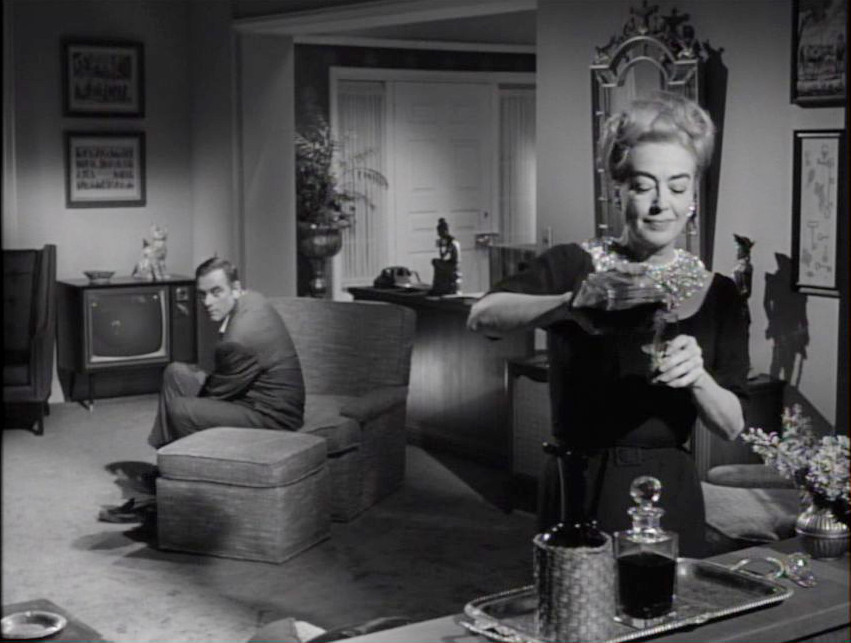
Murder's nothing a nice little drinkie won't solve!

Sunday, May 7, 2023

Cozy Sundays: "Fee Fie Ho Hum!" The Blood of an Englishman (2014), by MC Beaton

At the time of its publication, The Blood of an Englishman (2014) was advertised as something of an "event" in crime writer MC Beaton's long-running Agatha Raisin mystery series, as it was the author's 25th book in the series.  Only five more Raisins from the author's hand (ostensibly) followed it before her death at age 83 on the last day of 2019.  The series has since continued under the hand of R. W. Green (a man, Rod Green), who has been described as a longtime friend of Beaton.

Personally, I suspect Mr. Green, not of having done it with the revolver in the billiard room, but of having helped in the writing of the last of the Beatons ostensibly produced by his benefactor, Beating about the Bush, published the year of her death, because to me it doesn't read quite like Beaton herself and it is a huge improvement on her previous two Raisins, The Witch's Tree (2017) and The Dead Ringer (2018), which are, to be brutally frank, two of the worst mysteries I have ever read.  Sadly, they are practically unreadable, like Agatha Christie's Postern of Fate (1973) without that novel's dotty, meandering charm.  I haven't read the two Raisins which come between Blood and Tree (Dishing the Dirt and Pushing up Daisies), but Blood comes off like a work of sheer genius compared to Tree and Ringer, though in fact Blood is very much adulterated in my view.

When The Blood of an Englishman was published in 2014, the Agatha Raisin series had been in sharp decline for some time, since approximately 2008.  The year before that, in the rather charming (if you like the series) Kissing Christmas Goodbye (2007), the eighteenth Raisin novel, Beaton had introduced Toni Gilmour, a young, beautiful  sidekick for Agatha Raisin, who had graduated from amateur village snoop to licensed private detective in the fifteenth Raisin novel, Agatha Raisin and the Deadly Dance (2004).  The first few PI Raisin books aren't bad, in my opinion, but the wheels start to come off the dead cart with A Spoonful of Poison (2008).  I don't blame Toni for this but rather structural changes that Beaton made in the books at the time.

The books start to rely much more on barking mad murderers, the body counts rise to absurd levels, the plots become disjointed and chaotic, Agatha is put in more perils of her life than Pauline and there's this weird thing where the murderers get revealed early and then the last chunk of the novel concerns the murderer plotting, futilely of course, to kill Agatha, after which there is an epilogue introducing the setup in the next, apparently already written book.  

Beaton's cast of  longtime supporting characters continue to make appearances, but these appearances feel ever more rote.  The charm of life in the Cotswolds village of Carsley, so well-depicted in the debut novel in the series Agatha Raisin and the Quiche of Death (1992) and others which followed it, is lost.

Indeed, after Kissing Christmas Goodbye, the lone bright spot in the series for me has been Something Borrowed, Someone Dead (2013), which immediately preceded The Blood of an Englishman.  Although it shares the same narrative structure of the later Raisins, Borrowed benefits from a better plot and choice of murderer. But let's look in more detail at Blood below, shall we?  Following this list of the Raisin novels, provided so that you can better follow what I have been saying, along with my ratings of them.  (Imagine they are raisins rather than stars.)


Agatha Raisin and the Quiche of Death 1992 ****

Agatha Raisin [hereafter AR] and the Vicious Vet 1993 ***

AR and the Potted Gardener 1994 ***

AR and the Walkers of Dembley 1995 ***

AR and the Murderous Marriage 1996 ***

AR and the Terrible Tourist 1997 ***

AR and the Wellspring of Death 1998 ***

AR and the Wizard of Evesham 1999 ***

AR and the Witch of Wyckhadden 1999 **

AR and the Fairies of Fryfam 2000 ****

AR and the Love from Hell 2001 ****

AR and the Day the Floods Came 2002 ***

AR and the Curious Curate 2003 ****

AR and the Haunted House 2003 ***

AR and the Deadly Dance 2004 ****

AR and the Perfect Paragon 2005 ***

Love, Lies and Liquor 2006 ***

Kissing Christmas Goodbye 2007 ***

A Spoonful of Poison 2008 **

There Goes the Bride 2009 *

The Busy Body 2010 -

As the Pig Turns 2011 *

Hiss and Hers 2012 *

Something Borrowed, Someone Dead 2013 ***

The Blood of an Englishman 2014 **

Dishing the Dirt 2015 -

Pushing up Daisies 2016 -

The Witch's Tree 2017 NONE

The Dead Ringer 2018 NONE

Beating about the Bush 2019 (with R. W. Green?) -

In Blood, Agatha attends a pantomime of Babes in the Wood (mashed up with Mother Goose, Jack and the Beanstalk and other tales) in the nearby village of Winter Parva with her saintly friend and moral mentor (to the extent this is possible with Agatha), Mrs. Bloxley, the wife of the rather less patient and forbearing vicar of Carsley, improbably named (as Agatha herself thinks) Alf.  When the man playing the ogre, bullying baker Bert Simple, is eviscerated by a metal spike when exiting the stage via a trapdoor drop, Agatha is hired by the play producer, Gareth Craven, to find the depraved culprit.  Agatha is not notably successful in this endeavor (to be fair, neither are the police), for it's not long before, after a performance of The Mikado, another actor is decapitated with the (real) sword of the Lord High Executioner.

Why do they call these books cozies again?  These are very unpleasant killings (and there's another one, which I can't divulge, which is even worse).  Even Mrs. Bloxley doesn't mince words (well, not much) in reference to the neutering of Bert Simple, commenting that the villain "plotted not only to kill him but to destroy his manhood in the process."  Nice to know that cozies can encompass emasculation and decapitation and--well, I can't mention the other thing.  With some tonal shifts this book could have been written by Jo Nesbo!

Blood has a lot of the flaws characteristic to the late Raisins, including the sidelining of a great many of the series' longtime supporting cast members and an overemphasis on Agatha's dysfunctional love life, or more accurately lust life.  Anyone reading many of these books must surely start to wonder how much MC Beaton actually liked women. So many of them, including Agatha herself, are messes, hot and cold.

Aside from the fact that Agatha Raisin, in the depiction of whom the author said she drew upon herself, repeatedly denounces feminism for ruining romantic relationships between the sexes, there's the fact that Agatha is such a basket case in her relationships with men.  In Book 5 her marriage ceremony to her handsome neighbor James Lacey, a Jane Austen hero with the stodginess and emotional repression dialed up to 99, is interrupted when her long lost (and conveniently assumed dead) husband Jimmy shows up, then in Book 11, when Agatha and James finally do marry, the union is a train wreck that lasts out only this one novel.  

There are other men whom Agatha gets interested in and even sleeps with over the course of the series, including charming if rakish aristocrat Sir Charles Fraith, but usually they turn out to be utter scoundrels.  Still over and over Agatha falls head over high heels (she hates flats) in love with any handsome man she meets.  No wonder in Blood, her friend with occasional benefits Sir Charles thinks: "It would be hopeless being married to her....He would never be able to trust her.  Agatha would always be one woman looking for an obsession."

"If I were only fifty years younger!"
MC Beaton tweeted this sentiment
 in 2017 concerning this pic of herself
and scrumptious actor Matt McCooey,
who plays cop kindhearted Bill Wong,
Agatha's first friend by her own admission, 
in the Agatha Raisin television series

When I started this series I had a notion that Agatha, she of the breakfasts of back coffee and cigarettes and the perpetual gins and tonics, was some sort of tough feminist icon, but she's really nothing of the sort, even though she's a highly successful, frequently ribald, retired PR executive.  Her neuroses. mostly over men and her appearance but also concerning her lower class social origins, pull her down constantly.  She does have her genuine feminist, girl power moments, like when she storms the woman-averse pub in Fairies of Fryfam, one of the best books in the series, but all is canceled out with her desperate man chasing and pathetic obsession with her looks.  

I recall there was a woman character in a satirical meta episode of the American sitcom Newhart, the horny middle-aged single woman neighbor, who was introduced as "Man-crazy Smitty."  Well, that's Agatha to a "T."  Despite all her professional successes she just can't get along without a man in her life.  She even goes about with her ambiguously gay "toy boy" pal from the City, Roy Silver,  when no other man is available, pale and weedy and effeminate as Roy is invariably described.

In Blood Agatha gets smitten with handsome men four (!) times, though in the one case the passion is somewhat lukewarm because the man has a weak chin, that bane of Golden Age crime fiction, at least as far as men were concerned.  (Conversely with women strong chins were problems.)  

just your typical gay shindig

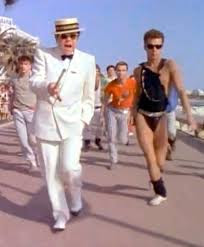
In another case, the man sadly turns out to be gay, a fact to which Agatha tumbles when he invites her to a party he has thrown where the parking attendant is wearing a "hat, black leather thong and nothing else."  I'm guessing Beaton got her notion of this little shindig from watching Elton John's forty year old "I'm Still Standing" video.  

There at least is some relationship to the plot in all but one of these cases, but at this point in the series I just find Agatha's obtuseness in regard to men and her low self-esteem not sympathetic but simply exasperating.  She's like the Bill Murray character in the Nineties romantic comedy Groundhog Day, had he never learned anything whatsoever from repeating the same day over and over again.  

Was the author herself really anything like this?  If so I think I can see how she ended up handing off authorship of the series (and the Hamish Macbeth one too)not to anoither woman writer but to a ruggedly handsome male friend--no toy boy he--named Rod.  She strikes me as rather a man's woman.

Rod Green

The plot in Blood isn't bad, actually.  The climax, which occurs when a fifth of the book yet remains, is actually intriguing, though it's stolen from another, rather famous crime source.  (Let's call it an homage, since the source is actually mentioned in the book.)  

Unfortunately, everything then is dragged out as the murderer pursues Agatha, even abducting her a second time and trying to kill her by throwing her in a river while confined in a barrel.  (It really is very Perils of Pauline.)  By my count this is only a 60,000 word novel, but at least 10,000 words could have been profitably cut from it.  

Agatha's great days in book form were the fifteen years between 1992 and 2007, when you could still hold out hope that Agatha might come to her senses about men.  Really, she and Charles, who latterly carried the series on his nattily-clad, aristocratic shoulders (Mrs. Bloxby and Roy help), should have married after Love, Lies and Liquor, by which time any fan of the series should have wanted to see James Lacey get his richly deserved comeuppance. 

The popular ongoing television adaptation of the Agatha Raisin novels makes the characters more likeable generally, including Roy Silver, James Lacey and, most crucially, Agatha herself.  The TV series is genuinely warm and cozy, Sex and the City-ish gay sex jokes notwithstanding.  That the Agatha Raisin novels are "cozy" is something I have to question.  The tea has a lot of gin in it, and the saucer is littered with stubbed-out cigarettes.

Thursday, April 27, 2023

There's a Place: A Fatal Inversion (1987), by Barbara Vine (Mysteries You Have to Read)

There is a place

Where I can go

When I feel low

When I feel blue

And it's my mind....

In my mind there's no sorrow

Don't you know that it's so?

There'll be no sad tomorrow

Don't you know that it's so?  

--There's a Place (1963), The Beatles

He didn't want to remember any of this, he wanted to escape out of it to a blank screen.

--A Fatal Inversion (1987), Barbara Vine

In the third edition of his mystery genre study Bloody Murder crime writer and critic Julian Symons had the highest of praise for Barbara Vine (aka the late Ruth Rendell), or at least her first three novels, that stunning succession of A Dark-Adapted Eye (1986), A Fatal Inversion (1987) and The House of Stairs (1988).  The fourth Vine, Gallowglass (1991), Symons pronounced an example of a writer "very much off form," and he had nothing at all to say about King Solomon's Carpet (1991), the fifth Vine, which would have appeared, presumably, when he was writing Bloody Murder, though, like A Fatal Inversion, it won the Crime Writers Association's Gold Dagger for best crime novel of the year. 

Afterward followed vine's Asta's Book (1993), No Night Is Too Long (1994) and The Brimstone Wedding (1995), the first and last of which I think measure up to her first magnificent three.  I'd have to say that those five Vine titles are about as good as anything ever produced in the crime and mystery genre that I have read.

Julian Symons judged A Fatal Inversion the best of the Barbara Vines, and he may well be right.  I may still prefer the Victorian density of Asta's Book, but Inversion is unquestionably terrific.  The novel details events which follow the discovery of the skeletal remains of a young woman and infant child interred in a pet cemetary in the wooded grounds of Wyvis Hall, a Georgian country mansion in Suffolk.  This setting is classical and the opening sentence is a nod to the Golden Age detective novel: 

"The body lay on a small square of carpet in the middle of the gun-room floor.  Alec Chipstead looked round for something to put over it. He unhooked a raincoat from one of the pegs and, covering the body, reflected too late late that he would never wear that again."  

Even the surname Chipstead recalls thriller writer Sydney Horler's gentleman hero "Bunny" Chipstead.  Would Rendell have been familiar with this forgotten crime fiction series (Sapper sapped, as it were), which produced four books between 1927 and 1940?  Probably it's just a coincidence.  

Anyway, with these opening lines Inversion opens like an vintage Alfred Hitchcock movie, but actually the body referenced in them is not a human corpse but rather the body of a euthanized pet, while Chipstead and his wife are the current dutiful, innocent owners of Wyvis Hall.  When they discover human remains in 1986 while burying their dog in the old pet cemetery, they promptly ring up the police--and the hunt is on to identify the remains and to discover just how they came to rest there.

However, Inversion is not a police procedural and legal authority appears in the novel only briefly, in snatches.  The story is told primarily though three characters, Adam, Rufus and Shiva, who were present at Wyvis Hall a decade earlier, when the bodies came to end up in the pet cemetery.  They know what happened, but it never becomes quite clear to the reader until close to the end of the novel.  

The narrative shifts from the present day in 1986 back a decade to 1976 when Adam, a nineteen-year-old college student, unexpectedly inherited Wyvis Hall.  He, his rather swaggering medical student friend Rufus, and Shiva, a desperately assimilationist Indian, along with two young women, a strange, eccentric character named Zosie and a devotee of Eastern spiritualism named Vivien, end up spending the summer of '76, one of the hottest on British record, residing in a sort of commune at Wyvis Hall, which Adam whimsically has renamed Ecalpemos ("SOMEPLACE" spelled backwards).  There they sell off the silver and other contents of the mansion to support themselves in the fine art of lotus eating.  

After the experiment at Ecalpemos abruptly ended, the commune members made a pact never to contact each other again, but the discovery of the human remains has caused Adam, in particular, to rethink this course of action.  A computer designer now married with a young daughter, Adam likens his experience a decade ago at Ecalpemos to a computer file, shut away.  He doesn't want to recall any of it.  Neither do Rufus, now a gynecologist and secret drinker, and Shiva.  But unhappy memories can't remain locked away, safely quarantined, in the face of an active police investigation--a murder investigation....

A novel of some 120,000 words, by my count, Inversion is so skillfully put together that it could be taught in writing courses purely for plot construction.  But it's also a beautifully designed novel, a meditation on crime and guilt and retributive justice, with memorable renditions of character and setting and an omnipresent sense of tragic irony, which surges like a tsunami in the final pages.  

Critics like Symons adored this novel, quite rightly, and as mentioned it won the Gold Dagger from the UK's Crime Writers Association for best crime novel of the year.  (Remarkably, Rendell won a total of four Gold Daggers and a Silver Dagger for individual crime novels, along with three Edgars from the Mystery Writers of America, two of them for short stories and the third for A Dark-Adapted Eye, the first Barbara Vine.)  It's a novel I could write much more about, but I would hate to spoilt it for those who have not read it, it's that artfully constructed.

Adverse criticism of this novel baffles me, but some people have complained that the characters are "unlikeable."  This complaint always amuses me when it's lodged against a crime novel.  Had the characters been likable, jolly people, none of the events in the book would have happened and we the readers would be the losers thereby.  Vine is actually extremely effective at catching the atmosphere of youth's all too brief summer, when life seems joyously free and clear and full of possibility, rather than circumscribed by a thousand demands, duties and impositions.

Others have complained that the novel is too slow-moving, but that is the Vine way.  Her books are often compared to Victorian sensation novels, and that is a valid comparison, but they also remind me of American author Mary Roberts Rinehart's sprawling crime novels from the Twenties into the Fifties.  Vine, I believe, is a superior crime writer to Rinehart, but there is a similarity in technique.  Rinehart is known for her teasing "Had I But Known" style of mystery writing, where the retrospective narrator offers tantalizing hints of what happened, and Vine does the same sort of thing.  It's not Had I But Known, however, but rather, Had I Done This, or Not Done This....

Vine keeps up interest with these teasing suggestions in the first half of the novel and by the second half, when events finally start getting revealed in a gathering, gloomy tide, you will not want to put down the novel, until you know all.  At least I sure didn't!  There's one surprise and then another in the final pages, this last a stunner that Julian Symons called "the most brilliantly ironic ending of any crime story known to me."  I have my differences with old Jules, as we know, but I am in full agreement with him here.  I saw it just a couple of pages ahead of time and was like, oh, shit, really?!

It's a shame that Ruth Rendell used to speak so slightingly of Agatha Christie, for both authors were brilliant plotters and Christie herself had a wicked sense of irony and the macabre.  

In early Christie stories like "Accident," "Philomel Cottage" and "Witness for the Prosecution," brilliant little shards of malevolence, and her late shocking, grim novel Endless Night, you will more than a glimmer of Ruth Rendell.  If you see Mary Roberts Rinehart in Barbara Vine, there is Christie in Rendell.

A Fatal Inversion was adapted as a three part British television series in 1992 with dishy Jeremy Northam, then on the cusp of movie stardom, Douglas Hodge and Saira Todd, but it's crying out for a feature film version (see pic above right).  It's rather like crime fiction's Brideshead Revisited.

A good review of the novel is here and another here.

My review of  Asta's Book (eleven years ago!) is here.

Thursday, April 6, 2023

They're Here! Five New Moray Dalton Titles from Dean Street Press

When my friend Rupert Heath of Dean Street Press died a month ago, he had five Moray Dalton titles in the hopper.  I had worked diligently with him on the introductions (and afterword notes in some cases) throughout December 2022 and had gone over the proofs he sent me a few days after Christmas.  This quintet of books was slated for publication in April of this year, but there had been fear that because of Rupert's tragic death they might not actually be published as planned.  However, the good news is that they have indeed made it into print as scheduled: a fitting tribute to Rupert's fine and important work over the last decade in vintage mystery publishing.  They are also fine mysteries indeed, in my opinion.  

Here follow the covers for these, the final DSP volumes, the last of my work with Rupert, which rewardingly commenced nine years ago in 2014:


The first three are Hugh Collier detective novels, while the last two are non-series mysteries set primarily in Italy.  The Mystery of the Kneeling Woman deals with highly topical Thirties issues of rearmament and the shadow of impending war with Germany and introduces Hugh Collier's love interest, Sandra Fleming, a single mother with a bookish young son named Toby.  This pair also appears in Death in the Dark, with Toby playing a particularly important role.  Death in the Forest has several chapters set in South America before settling down into a classic-style, though also highly unique, village mystery.  

The non-series The Murder of Eve and Death in the Villa are highly original crime novels, with murder mysteries yet also all sorts of exciting, terrible events.  Both would be eminently filmable, particularly Villa, which is set in Italy during the waning days of the Mussolini regime.  The second half of the novel had me desperately turning pages to find out what would happen to the characters I had really gotten attached to over the course of events.  I was rather reminded of the French wartime television series A French Village.   

All in all a terrific set of books by one of the most original and talented English crime writers of the Golden Age of detective fiction.  I had planned with Rupert to reissue another set of five Daltons later this year or early next year, including the last Hugh Colliers, followed by another set of five; but this is not to be now, alas.  I am planning other arrangements.  In the meantime, let me for your convenience list below all the Moray Dalton crime titles, identifying them definitively as series and nonseries and listing the ones which have been reprinted by DSP.  


MORAY DALTON MYSTERIES

Hugh Collier Series

1. One by One They Disappeared 1929 DSP

2. The Night of Fear 1931 DSP

3. The Belfry Murder 1933 DSP

4. The Belgrave Manor Crime 1935 DSP

5. The Strange Case of Harriet Hall 1936 DSP

6. The Mystery of the Kneeling Woman 1936 DSP

7. Death in the Dark 1938 DSP

8. Death in the Forest 1939 DSP

9. The Price of Silence 1939 planned

10. The Art School Murders 1943 DSP

11. The Longbridge Murders 1945 planned

12. The Condamine Case 1947 DSP

13. The Case of the Dark Stranger 1948 planned

14. Inquest on Miriam 1949 planned

15. Death of a Spinster 1951 planned

Non-Series Mysteries

1. The Kingsclere Mystery 1924

2. The Shadow on the Wall 1926

3. The Black Wings 1927

4. The Stretton Darkness Mystery 1927

5. The Body in the Road 1930 DSP

6. Death in the Cup 1932 DSP

7. The Wife of Baal 1932 planned

8. The Harvest of Tares 1933 planned

9. The Black Death 1934 planned

10. The Edge of Doom 1935 planned

11. The Case of Alan Copeland 1936 DSP

12. The Murder of Eve 1945 DSP

14. Death at the Villa 1946 DSP

14. The House of Fear 1951 planned


I wish you happy reading and please give Rupert and Amanda some thoughts when you peruse them.

Friday, March 17, 2023

Classic Fridays--Details and Digressions: PD James' Devices and Desires (1989), Book the First

When as a young teen, around 14 or 15, I decided that I wanted to start reading "Great Literature," I went looking for the longest book I could find, which turned out to be American author Theodore Dreiser's sprawling 1925 sociopolitical tract,  An American Tragedy.  The prose was unmemorable, but the plot itself, about an ambitious young man trying to achieve to American dream who ends up on trial for murder, grips.  (The book was filmed in 1951 as A Place in the Sun, with Montgomery Clift, Elizabeth Taylor and Shelley Winters, all of whom were at their peak beauty at the time.)  I suppose one could almost call An American Tragedy a crime novel.  After all at about 225,000 words it's not all that much longer than some of the later sprawling PD James crime novels, like Devices and Desires.

PD James had been publishing mysteries for eighteen years when she finally hit it really big in 1980 with a non-series crime thriller, Innocent Blood.  Personally this is one of my least favorite James novels, but it struck a chord with the public, especially in the United States, which had proved up till then a bit more resistant to her charms than the UK had.  James did not even succeed at finding an American publisher for her first and second detective novels--Cover Her Face (1962) and A Mind to Murder (1963), until 1966 and 1967, respectively. I have to wonder whether she resolved to write her third detective novel, Unnatural Causes (1967), because she finally was getting published in the States, the holy grail of British crime writers.  Maybe not though--after all she did have a significant day job!

In any event, after the success of Innocent Blood, James, now a bestselling novelist--became afflicted, like her role model Dorothy L. Sayers before her, with novelitis: the urge to write a crime novel that really had Things To Say about society, just like a mainstream novel.  James' next crime novels--The Skull Beneath the Skin (1982), A Taste for Death (1986) and Devices and Desires (1989)--were Really Long Books.  I don't know about Skull, an extravagant, long-winded Gothic pastiche and the second of the two Cordelia Grey mysteries--but Taste and Devices are not all that far off 200,000 words by my count, which at that time were extraordinary lengths for mystery novels.  Both feature James' series sleuth Adam Dalgliesh, who had not headlined one of her novels since 1977; and they still stand, I think, as the best reviewed crime novels of her career, with many critics avowing that James was not only the new "Queen of Crime," but that she had, yes, transcended to crime fiction genre like a levitationist, writing mysteries that that rose above "mere puzzles" and possessed the merits of True Literature.

Personally I never much liked A Taste for Death.  James does have things to say about transcending the lower class strata in Britain, through her character of striving, humbly born--and rather earnest and dull--police sergeant Kate Miskin, along with a quite unlikeable brother and sister who are suspects in a double murder at a church; yet I never felt the book was much as a mystery, nor did I find the characters, with a couple of exceptions, all that compelling.  (I quite liked the churchgoing sixty-something spinster and the lower class street waif boy whom she befriends, to be sure.  This is a poignant story line, but frustrating for me because I think the characters could have used a novel--a non-criminous one--all to themselves.)

"PD James does it again!"
--Larry King

I recall seeing a paperback copy of Devices and Desires way back in 1991 that carried a blurb at the top of the cover from mundane media personality Larry King: "Brilliant...wonderful.  P. D. James does it again!"  Americans of my age doubtlessly recall the late Larry King's long-running CNN television interview show on Saturday nights, along with nighttime radio show and his daily column in the once ubiquitous American "McPaper" USA Today.  In this column Larry would string together, like a string of imitation pearls before swine, various thoughts, like "You know, you just can't beat a good hot dog!" or "There's nothing like a lazy Sunday." or "I think Blondes really do have more fun."  I thought at the time, well it shows how James has made it that she has caught Larry King's eye ("P. D. James has done it again!"), but does this really mean she is writing Great Literature, let alone good mysteries?  

I had started reading mysteries again in 1991, but I was reading my new discovery John Dickson Carr and Christies I had missed and Dorothy L. Sayers and Ngaio Marsh.  I did, however, go back and read the older PD James mysteries from the Sixties and Seventies and I quite liked most of them.  Some I thought were brilliant.  When I did read a new James--Original Sin (1994)--it struck me as well-written but too long and its plot seemed egregiously derivative of a Nicholas Blake detective novel.  (I know of two other bloggers who were struck the same way as I by the Blake connection.)  

Over the years I slogged through the succession of James' bloody murder behemoths--A Certain Justice (1997), Death in Holy Orders (2001), The Murder Room (2003), The Lighthouse (2005)--and found that her crime writing was yielding diminishing returns.  The characters, settings, situations had become formulaic--James formulaic--without offering much real ingenuity in plotting.  "Good prose" could only cover up so much in a mystery, in my view, and some of James' prose was getting rather starchy anyway.  There's lots of plot in her books, yes, but in the later books it's lacking the fleet genius of Christie and her clever company or even that of the earlier James.  Like many other longtime writers James had fallen into repeating herself and lacked the same zest of early invention.  

I still have yet to read The Private Patient (2008), James' final Adam Dalgliesh novel--I have held off for fifteen years now--and I had never gotten around to taking up Devices and Desires--that is, until now.  Martin Edwards says this is the best James crime novel.  Is he right?

Well, I have made it through the first three books (yes, books, I said; D&D is like the Crime Torah or something) amounting to 200 pages, about forty percent of the way.  And, despite all the author's details and digressions--I have been rather enjoying it so far.  I'm trying to give it something of the benefit of the doubt by reminding myself that some of the narrative devices, like the long flashback character sketches and the diatribes about "political correctness," were comparatively new for her at this time.  I shall try to go into more detail next week.  For now, take this thousand word introduction as Book the First, shall we say.  So sayeth the Tramp.

Wednesday, March 8, 2023

Death of a Publisher: Rupert Heath (1968-2023)

My friend, the publisher Rupert Heath of Dean Street Press, has died.  We had worked together on projects on projects for nearly a decade now.  Some background:

Back in September 2014 I was a bit down in the dumps.  My Passing Tramp blog had been up for nearly three full years, since November 2011, and my book Masters of the Humdrums Mystery, which attempted to get discussions of crime fiction beyond the increasingly barren (and false) division between the Crime Queens in England and the hard-boiled boys in the United States, had been published a year later.  I knew there was so much vintage crime fiction, of all stripes, waiting to be rediscovered.  But it was starting to feel like I had been passed by.  I had my blog and my book, published by a minor scholarly press, but no really large-scale publishing forum, like Sarah Weinman, whose anthology of domestic suspense tales by mid-century women writers, Troubled Daughters, Twisted Wives, had been published the year before, or Martin Edwards, who was writing introductions for the British Library's classic crime reissues.  

And then came the Farjeon Affair.  Literally the first post on my blog, on November 22, 2011, was about Golden Age thriller writer Jefferson Farjeon, as my blog was named in honor of his tramp sleuth of sorts, Ben, and the amusing convention in GA mysteries, desperately grasped by country house weekend guests suspected of having bludgeoned their host in his library, that a passing tramp must have done the foul deed.  I posted again about Farjeon and my favorite Farjeon crime novels just four days later, then, one day after Christmas, in a post entitled "A Late Christmas Number," I posted about Jefferson Farjeon's 1937 Christmas thriller Mystery in White.  Little did I know where this would go!  Had I but known....

I remember googling about Farjeon back in those days and there was virtually nothing about him on the internet, certainly nothing about Mystery in White.  I had been collecting his books for over a decade and was a great fan of his, having even travelled to visit the marvelous home of his famous American actor grandfather, Joe Jefferson, in Louisiana.  Sadly I was not invited to have any role when, three years later in September 2014, a major concern published a new edition Mystery in White.  Not only that, but my key, indeed essential, part in having publicized the book in the first place was never, to my knowledge, acknowledged anywhere.  That the book went on to become in the UK a seasonal bestseller over Christmas made the situation even more bittersweet for me--more bitter than sweet, really.  There's only so much satisfaction you can get from being essentially alone in knowing that you were right.

But it was also in September 2014 that I received a message from a man named Rupert Heath, in the form of a comment left on my blog.  (I don't know now on which post the comment appeared.)  I emailed him and this was his reply:

Rupert Heath

From: Rupert Heath

Sent: Wednesday, September 17, 2014 3:17 PM
To: curt evans
Subject: Re: Golden Age Reprints

Thanks for your swift reply Curt.

I was just reading your superb essay on Rupert Croft-Cooke 'The Man Who Was Leo Bruce', which was what prompted me to contact you. As it happens I've just been doing some detective work myself, making contact with RCC's estate (in the form of his secretary and companion Joseph, who is still alive - 90 - and living in India). 

As you know the Leo Bruces have been kept in print by Academy Chicago, who were recently bought by Chicago Review Press. Believe it or not, Academy had lost contact details for the estate years ago and had a rather large check for royalties waiting for him. So I found Joseph for them, and in return I am hoping they will allow me to publish ebooks of the Leo Bruce novels, at least outside North America. I consider him to be in the executive class of the golden age mystery writers and ridiculously underrated today.

I'd be really interested to know who you might recommend we track down for our list, or which estates you might have had communication with. One problem we have is that estates controlled by big agencies (which is not a few of them) are often inaccessible - the big agencies tend to have their own agenda regarding the licensing of their backlist (often partnering with big publishers like Random House) so it's hard to obtain rights on a case by case basis.

Other than Rufus King, I was intrigued by the post-golden age novelist Sylvia Angus who seems to be equally forgotten. I've only read DEAD TO RITES (I believe there are only 3 novels by her) but found it very much in the spirit of Agatha Christie in various ways. She's not one of the greats, but I think her novels would find a readership today.

Best,

Rupert

On Wed, Sep 17, 2014 at 8:57 PM, curt evans wrote:

Dear Rupert Heath,

I am the blogger The Passing Tramp and am responding to the message you left me about reprinting Golden Age works. Let me know how I can help. In some cases I know literary agents and heirs and I certainly know books!

Best,

Curt

It was the beginning of a beautiful working relationship--and a friendship.  It meant so much at that time to have someone to work with, someone who was really at the top of his game and respected me too.  I didn't have any doubt about my knowledge or my writing ability (I'm not modest in that respect), but I just didn't have the connections others had and I was afraid I was going to be doomed to comparative obscurity.  Rupert really helped save me from that.  Since then I have been able to work with other presses, writing introductions (besides Coachwhip, who was my first): Stark House and Moonstone and even HarperCollins for one gig and Mysterious Press for a couple.  And I got a column with Crimereads, wrote for the last issue of Mystery Scene, edited an Edgar-nominated book, Murder in the Closet, and there's even news about a good publisher that wants to publish a new book by me.

But I don't know where it would have gone without Rupert.  All those reprinting projects we had: all the ER Punshons, all the Christopher Bushes, Ianthe Jerrold, Robin Forsythe, that Victorian miss Annie Haynes who proved so unexpectedly popular, Peter Drax, Patricia Wentworth, Harriet Rutland, Molly Thynne, Moray Dalton, Anne Morice, Alice Campbell, Bristow and Manning and their Invisible Host.  And not to hog everything, The Puzzle Doctor's pet Brian Flynn project has been very popular!

It meant a lot knowing how much Rupert respected my work.  This last December and January I was under a great deal of stress as my 92 year old father was in the hospital four times and ambulances were called out to the house three times.  I won't go into it all, but you will have noticed how my blog posting really dipped then.  During that time I managed to get a set of intros written for a new set of DSP Moray Dalton resissues and an intro to the Hake Talbot novels with a good deal of new information on the author.  On the Dalton intros Rupert had this to say:

The intros so far are uniformly excellent, Curt! I think they may be among the very best you've written for us. And they all give fascinating colour and background to the context of MD's writing, the when and the where.

Working on those new intros/afterwords I really appreciated them more and more - you're a fantastic writer!

On the Hake Talbot:

I think this is magnificent!

I was in communication a lot with Rupert through December into January, when I learned of the sudden health problems of his wife Amanda.  I last communicated with Rupert on Jan. 20 when he let me know things were rapidly declining.  Amanda died five days later and I never heard from him again.  I wrote him about ten days ago, but never heard back.  Yesterday, coming home from a doctor's visit with my Dad I learned that Rupert had died from a massive heart attack.  He was only 54.  He leaves two children.

What do you say to all this?  I just don't know.  I do know working with Rupert was a real lifeline for me, one of the most rewarding things in my life.  I feel we were able to take a place of significance in vintage mystery publishing that I hope will last.  At the moment I don't know the status of the Moray Dalton reissues.  They were all ready to go, I think, and I had been paid for the intros.  About the Hake Talbots, or anything else, I don't know (hadn't been paid for that one).  For now please think of Rupert and his family.  

In one of his last emails to me, he sent me a link to a George Harrison song titled "Deep Blue":

My friend David recently sent me a rare George Harrison song, which I hadn't heard before, but now love. You probably know it.

I hadn't heard it before.  I responded:

Liked the Harrison song, made me want to get that edition of the album.  About his mother dying from cancer yet the song sounds not gloomy at all.

He also commented, drolly it seemed at the time, concerning other family health problems (He didn't even know Amanda had cancer yet, but he referred to her having some sort of infection): 

I am presently expecting to drop dead any second.

I was getting so overwhelmed with my Dad's problems and suffering from an extremely painful herniated disc left over from Christmas.  When Rupert emailed me ten days later to let me know Amanda had inoperable cancer, my Dad was on a ventilator in ICU, after reacting poorly to anaesthesia.  Dad made it out, but Amanda died ten days later.  I look back and I wish I had said more to Rupert at the time.  I have an idea what stress can do the heart; my blood pressure has gone up ten points since last year.  I thought I would be working another two decades with Rupert, my health permitting.  I never imagined anything would happen to him.  We are about the same age, but he just looked so healthy.  

From an English garden

I did tell him how much I appreciated the flowers he sent after my mother's death.  I hope that he read it:

I had to take care of my mother when her breast cancer spread again three years ago.  I remember those flowers you sent, that was actually the only time I ever cried, if you can believe it, I thought how much Mom would have liked those lilies. Really, it was one of the nicest things someone ever did for me. 

Rupert was a good publisher and editor and a good friend.  He was kind and generous and did things he did not have to do.  He meant a lot in my life.  I will miss him terribly.

Sunday, March 5, 2023

Cozy Sundays: Death of a Series--MC Beaton's Hamish MacRacket

Novelist MC Beaton, who died on the last day of 2019 at the age of 83, was an extremely prolific writer, and not just of mysteries.  If I counted right, she published, according to Wikipedia, 150 novels, almost half of these belonging to her two most famous mystery series: those about, respectively, Hamish Macbeth (1985-2018, 34 novels) and Agatha Raisin (1992-2019, 30 novels).  

Beaton actually began her fiction writing career (she had been a journalist before that) in the late Seventies, when she was in her early forties, with Regency Romances, having found, by her own declaration, the successors to Georgette Heyer sadly wanting in authenticity.  It takes a certain talent to maintain a successful fiction writing career for over four decades when you are that fecund--about four novels a year over four decades on average.  But this certain talent does not necessarily mean that one has a talent for writing good mysteries.  So the question arises: Was MC Beaton really any good as a mystery writer, whatever her undeniable appeal to many cozy mystery fans?

I recall reading some of Beaton's early Hamish Macbeth mysteries in the 1990s and enjoying them reasonably well. Having perused some of later Hamish Macbeth books more recently, however, I really have to wonder when exactly the series began running out of steam, even on its own humbler level.   

 MC Beaton, of course, is deemed one of the major cozy writers from the last three and a half decades, and that mere word cozy would cause many mystery readers to write her off peremptorily.  While I, like myriad others, don't share this unfair reflexive contempt for the cozy, I do believe that at some point the wheels came off Beaton's crime lorry, as it were, at least as regards the Hamish Macbeth series.  (I haven't yet read any of the later Agatha Raisins.)

The cover painting
by Francis Farmar
is cozier than the book.

I gave decidedly lukewarm reviews to MC Beaton's Hamish Macbeth novels Death of a Travelling Man (1993) and Death of a Bore (2005) here.  What did I think of my two most recent reads by her, of Death of a Valentine (2010) and Death of a Sweep (2011)?  Well, the first one isn't much, really, and the second is, well, simply dire.  It might better have been titled Death of a Series because if the series didn't improve from that point, it bloody well should have been ended.  

Yet Beaton dauntlessly continued writing the damn things for another seven years at a rate of one year--unless it was actually her secretary, R. W. Green, who has been continuing both this and the Agatha Raisin series after Beaton's death, who was composing them in the later years.  But, honestly, these later purported Beatons read like they were written by an aging author who simply was burnt out with the whole thing and was just going through the motions for her large, loyal audience.  

Here ya go!  Here's another one, folks!  Next!

And raking in the dough all the while, I might add.  After all, there may not be variety in the hamburgers served by McDonald's, but those commercial comestibles make the fast food chain a great deal of money.  So did Macbeths for MC Beaton.

I notice on Amazon that the later Beaton book Death of a Sweep, a one-star mystery if there ever were one, gets 4.5 stars based on over a thousand ratings, which tells you all you need to know about what Amazon ratings are worth nowadays.  Either the great majority of Beaton's audience is utterly undiscerning, or the "system" is shamelessly "rigged" with planted reviews, as a certain American reality television star and politician says.

Death of a Valentine is modestly the better of the two books, because it actually tells a coherent story, such as it is.  As any Hamish Macbeth reader will know, the books follow a rigidly set pattern: 

Hamish, a Police Sergeant in the Highlands village of Lochdubh, will have some sort of romantic misadventure and his former girlfriends Elspeth and Priscilla will pop up pointlessly (since the romances never go anywhere).

Hamish will get a constable who will be some manner of a comical fuck-up.

Hamish will take his feral cat Sonsie and his dog Lugs around a few times cause Beaton knew cozy mystery readers like pets in mysteries.

Some ecentirc villagers will put in token appearances.  ("Look the Currie sisters!  Sisters.")

Hamish's corrupt and inept superiors will continue to be corrupt and inept with no real consequences.

Oh, yes, there will be some sort of murder.  Actually, in these later books, a lot of murders!  

However, there won't be much mystery, because plotting a decent mystery apparently required more effort than the busy, aging author wanted to expend.

the American hardcover ed.

In Valentine there is a mystery--who killed the heartless beauty queen with a mail bomb valentine--but the solution is handed to Macbeth on a plate, or rather in a video recorder--surely no one could care one whit about this witless "mystery" peopled by puppets.

Any interest the story possesses comes from the plot about Hamish's increasingly insane constable, Josie McQueen, who it turns out is an obsessed stalker of Hamish, determined to trap him into marrying her.  All of this is weirdly played for laughs even when Josie decides she will drug Hamish with a date rape drug, get him naked and unconscious into bed with her and orgasm ("working herself up," as the author euphemistically puts it) so that "a smell of sex" will be apparent in the morning and Hamish will be honor bound to wed her!

And they call this is a cozy!  It reads more like Glenn Close in Fatal Attraction (without the rabbit), were that film a French sex farce.  But, I have to admit, there was a certain compelling aspect to this crazy story.  At least it had more suspense than the murder mystery.  I wanted to see mad, jilted Josie get her comeuppance.

And here, by the way, is the description murder of the titular valentine:

Now for that parcel.

There was a tab at the side to rip to get the parcel open.  She tore it across.  A terrific explosion tore apart the kitchen.  Ball bearings and nails, the latter viciously sharpened, tore into her face and body as flames engulfed her.  Perhaps it was a mercy that one of the nails pierced her brain, killing her outright, before the flames really took hold.

Well, that sure is cozy!  The only thing making this not actually horrific is the childish, Sally, Dick and Jane cadence of the endless succession of simple declarative sentences Beatons employs.  (Did Beaton dictate this stuff? I would suspect so.)  See Jane.  See the man knock Jane on the head.  See Jane bleed.  Die, Jane, die!

a swoop of sweeps
Far worse, however, is Death of a Sweep, retitled Death of a Chimney Sweep in the US.  Catch the publishers ever trusting their audience to know what a "sweep" is!  There are at least five murders in it (I lost track), so the only reason the poor dead irrelevant sweep was honored with the title, I'm sure, is because the chimney sweeps have cozy connotations.  Look at Dick Van Dyke in Mary Poppins! Chim-chim-cher-rie, everyone!  

The sweep isn't even the one whose body is found stuck up the chimney.  The book could just as easily been called Death of a Maid or Death of a Dustman--oh, wait, Beaton used those titles before--or Death of an Innocent Bystander.

Things start off fairly intriguingly, with a shady character hiding out with his mousy wife in the tiny Scottish village of Drim, but as the murders pile up, for no other reason, really, than to goose the story, the whole thing loses conherency.  As much as it's anything, the book is a thriller, with our old friend, effectively, the criminal gang, at work.  Beaton might be following Raymond Chandler's prescription about throwing in a man with a gun when you are stuck, except in Beaton's case it's another body.  

This is the kind of thing best left, really, to Edgar Wallace.  Beaton just meanders all over the place and there's little of the charm people associate with the series, rightly or not, with all this callous bloodletting going on.  (Two of the murdered women are comic snooper types and it's rather disconcerting to see them dispatched so violently.)  Altogether it's just a right bloody mess, neither fish nor fowl and one of the worst so-called mysteries I have ever read.  

MC Beaton always seems to suck me in again for another try--or maybe it's not her so much but those wonderful cozy covers her books get (some of the English ones have those charming paintings by Francis Farmar--but if I do any additional Beaton reading any time soon, I think, it will be Agatha Raisin.  I actually liked the first book in the Raisin series, Agatha Raisin and the Quiche of Death.  The characters and setting were better detailed and the mystery, while simple, was a thing of genius compared to the Hamish Macbeths I have read lately.  It's too bad, but apparently Beaton's devoted audience of Hamish MacFans came to demand very little from her in later years--and that is just what she gave them.