Showing posts with label Georges Simenon. Show all posts

Friday, April 20, 2012

20,000 Views and Six Dead Men, by Stanislas-André Steeman

First, let me mention that as I type this I've just passed 20,000 views, having entered into my fifth month of blogging.  It's nice to know some people are finding this a place worth stopping by for a time.  I will try to keep it interesting!

Like Georges Simenon, Stanislas-André Steeman (1908-1972) is another Franco-Belgian writer of mysteries; yet Simenon is much better known, certainly in the English-speaking world.  The most detailed information I could find on the subject of Steeman comes from this fascinating entry in Xavier Lechard's blog, At the Villa RoseLost in Translation: Stanislas Andre-Steeeman.

Lechard calls Steeman "arguably one of the greatest mystery writers of all time."  He notes that, in contrast with Simenon, Steeman was fascinated with the detective fiction genre and its conventions, or rules, treating them respectfully in many orthodox works.

Despite the fact that one can find more orthodox Simenon mysteries in some of the Inspector Maigret series, there is no getting away from the fact that on the whole Simenon was one of the major influences in shifting the mystery genre away from formal puzzle plotting toward an emphasis on such things as milieu, character, psychology, etc., that one associates, traditionally at least, with the mainstream novel.  And for many readers Simenon's name is synonymous with French crime genre writing in the twentieth century.

So when presented with the prospect of French language mystery author who emphasized classical detection I had to go a-digging for this gold! Unfortunately merely two of his books were ever translated into English and only one of those two seems at all locatable: Six Dead Men/Six Hommes Morts (1930/31--I have seen both years given for its original publication date).  So I had to make do with this one title, a pleasure and a frustration, because while it's a very good book, it makes one wish for more, which simply isn't there, at least not currently.

So, what is the nitty and the gritty, as an instructor of mine used to say, of Six Dead Men?

First of all, the novel bears a striking resemblance in conception to The Sweepstake Murders, by J. J. Connnington, which was published in 1931.  In Connington's mystery--one of his best--nine individuals form a sweepstakes syndicate, so that if any one of their tickets wins they all will share the winnings equally among themselves.  One of their tickets does win, but there is a legal delay in the awarding of the money.  When one of the syndicate members accidentally dies, the survivors formally agree that only living members of the syndicate will share in the winnings, when they eventually are awarded.  Bad idea! Suddenly other members of the syndicate start to expire--this time from someone's deliberate design.

quite similar in conception to Six Dead Men

Well, now, what mystery fancier wouldn't fancy such a plot as this?  Steeman's plot in Six Dead Men is quite similar  to that in The Sweepstake Murders (before writing his own did Connington, who was fluent in French and regularly read French novels, read Steeman's book, assuming it originally appeared in 1930?).

This time the tale concerns not nine, but, yes, six men, who agree to set out in the world for five years, make their fortunes, return and share those fortunes among themselves.  Well, when the novel opens they have started returning, five with fortunes (an impressive bunch!). And, perhaps not coincidentally, they also have started dying.  One man falls overboard from an ocean liner (or was he pushed?), another is shot, another stabbed.  The police seem helpless is stopping this campaign of slaughter.  Can anyone stop it?

rather like an Edgar Wallace....
One is immediately struck by Steeman's adherence to the classical form in Six Dead Men.  Many Simenon tales from the period, such as, say, The Strange Case of Peter the Lett (Pieter-le-Letton) and The Crossroad Murders (La Nuit du carrefour), feel more like Edgar Wallace thrillers then true detective novels.

In the early 1930s both Simenon and Steeman were dubbed "the French Edgar Wallace," an appellation that seems more suited, both in terms of output and subject matter, to the Simenon novels of this period (the early 1930s) than to the Steemans, judging from what Xavier Lechard has written about Steeman.  Six Dead Men indisputably is a true detective novel.

The ploys of deception in Six Dead Men are truly classical. While they may not fool the experienced reader of Golden Age detective fiction, who likely will have seen variations of the ploys in Sayers or Christie or Crofts, for example, they are delightfully and ingeniously handled by Steeman.  I particularly liked the deductions made about one of the murders, which takes place in an apartment lift (Ngaio Marsh later used this locus with great effect in one of her novels, Surfeit of Lampreys).  And, yes, there's even a floor plan!

there's something eerie
about those old lifts....
There is also a bit of love interest, in the form of the novel's only significant female character, the lovely Spanish woman Carmen, fiancee to one of the six men. Two of the other men fall in love with her over the course of the tale, adding complication.  But is Carmen really what she seems?...

As befits a classical detective novel, the writing and characterization is sparely, but effectively, done. Carmen, the rivals for her love, an investigating magistrate and Steeman's series detective, Wenceslas Vorobeitchik (understandably he goes by "Wens"), all are efficiently and economically characterized.  Suspense is artfully maintained (I was quite on edge during the novel's penultimate climax).  This would be a great novel to read alone in a 1930s apartment building at midnight on a stormy night.  Creaky lift an extra!

Six Dead Men was reprinted in the United States in 1932 as part of the French crime wave that hit Anglo-American shores at that time.  Simenon was at the crest of this wave and today is by far its best-known component.  But on the strength of my reading Six Dead Men, I would conclude that Stansislas-André Steeman deserves to be much better known today than he is.

Note: The American edition of Six Dead Men was published by Farrar & Rinehart in 1932, in an attractive edition with what seems to be a good translation by Rosemary Carr Benet (1898-1962). She was the wife of Stephen Vincent Benet, renowned author of the Pulitzer prize winning narrative poem John Brown's Body (1928) and the much-anthologized short story "The Devil and Daniel Webster" (1937).  On the couple, see Patricia McAndrew, "Stephen and Rosemary: A Love Story," in David Garrett Izzo and Lincoln Konkle, eds., Stephen Vincent Benet: Essays  on His Life and Work (McFarland, 2002). Stephen's brother, William Rose Benet, wrote an early Agatha Christie review raving The Murder of Roger Ackroyd.  The Benets, it seems, had good taste in detective fiction!

Next stop: the Rhineland, with your pleasant guide, John Dickson Carr.  He wants to show us a castle where certain unpleasant events have occurred of late.  Come along now, don't hesitate....

Tuesday, April 17, 2012

"As Flat and Artificial as a Picture Postcard?" Maigret in Holland (1931), by Georges Simenon


Maigret had only a faint idea of what it was all about when he arrived one May afternoon in Delfzijl, a small town squatting on the low coast in the extreme northeast of the Netherlands....

So begins one of my favorite Maigret mysteries by that publishing phenomenon Georges Simenon (1903-1989).

Un Crime en Holland is the eighth of ten (ten!) Maigret crime novels Simenon published in 1931, although it was not published in English until 1940, under the title of, naturally enough, A Crime in Holland, translated by Geoffrey Sainsbury.  Since 1980 it has been published in Britain and the United States under the title Maigret in Holland, evidently in an attempt to distinguish  the novel as one of the Maigret series, rather than one of Simenon's roman durs, or hard ("noir") novels*

*(note: the publishing history detail above is drawn from the fantastic Maigret website).

So, why do I like this novel so much?

Three reasons, I think: first, Simenon's portrayal of the Dutch setting; second, the novel's resemblance to a classical British mystery, which is much more pronounced than what one usually encounters in the Maigret series; and third, though the novel is written in Simenon's rather spare early style (and a new English translation is badly needed), there is in it some interesting character psychology and wit.

Maigret is in Holland semi-officially, to look into the shooting death of a native that has involved a French citizen, Professor Jean Duclos, a distinguished criminologist traveling on a lecture tour through northern Europe.  On page two, we are given a list provided by Duclos to Maigret of the victim, Conrad Popinga, a teacher of cadets on the training ship at Delfzijl, and potential suspects in the killing: Liesbeth Popinga, his wife, daughter of the headmaster of a lycee in Amsterdam; Any van Elst, Liesbeth's younger sister, a would-be professional woman recently awarded a law degree; and Beetje Liewens, a nearby farmer's daughter.

Maigret soon discovers additional suspects, including the father of the fetching Beetje and Cornelius ("Cor"), a cadet on the training ship possibly infatuated with her.  Then there are the actual material clues, the butt of a Manila cigar and a sailor's cap left at the scene of the crime....Could the killer have been someone from Popinga's past life as a captain in the merchant service?

This is one Maigret that actually could have used a house floor plan (plans are referred to in the text, but we never see them).  Popinga was shot outside his house by someone, the police believe, in the house. The logistics of who was where when come under serious scrutiny; and they do matter, though Maigret seems to discount those clues of the cap and the cigar and psychology plays an important role in his deductions.  In the closing chapters Maigret even stage manages a reenactment of the night of the murder.

When writing Maigret in Holland Simenon seems to have been thinking of the more classical style, clue-oriented English detective novel, for in the book he includes satire about the methodical, materialistic, scientific detective, as represented by the criminologist, Professor Duclos. The Great Man condescends to Maigret at every turn. Simenon portrays Duclos as a pompous ass of an intellectual, arrogantly certain that he can reduce crime investigation to an exact scientific formula.  We enjoy seeing him naturally getting his ultimate comeuppance at the hands of Maigret.

Maigret in Holland also is of interest for Simenon's portrayal of the straitlaced, conservative, bourgeois Dutch community in which Maigret uncomfortably finds himself. Fans of classical English detection often maintain that the incongruity of murder in genteel surroundings heightens reader interest in the story, and I think Maigret in Holland supports this contention. Certainly Simenon himself through his character Maigret seems to express such a point of view:

Georges Simenon
Such quiet, such serenity--it was almost too perfect, so perfect that it was difficult for a Frenchman to believe that life here was life at all.  Was it?  Or was it all as flat and artificial as a picture postcard?

Turning his back on that scene to study the town, [Maigret] was faced by well-built, well-painted houses, windows beautifully clean, curtains spotless, cactuses on every windowsill.  But what was behind those windows?

Raymond Chandler thought murder needed to be taken out of the Venetian vase and dropped into the alley, but what happens when murder shatters one of those fine Venetian vases (or perhaps in this case we should say a Delft vase)?  Maigret of course eventually answers the question of what messy things went on behind those pristine Dutch windows--to his own satisfaction, if not that of the local inhabitants:

Early next morning Maigret took the 5:05 from the small station at Delfzijl.  He was alone. Nobody had thanked him. Nobody had come to see him off.


Saturday, April 14, 2012

"It's French this time, but don't let that dismay you": Red Warning (1933), by Virgil Markham

Virgil Markham (1899-1973) spent over half his life in the shadow of his father, the once renowned and much beloved poet and man of letters Edwin Markham (1852-1940), author of "The Man with the Hoe," in the first half or so of the twentieth century one of the most celebrated American poems (it was inspired by the famous Jean-Francois Millet painting).  Actually, I should say more than half his life, because even after his father died, Virgil Markham was the tender of his father's literary reputation, still best known for being the son of Edwin Markham.

Virgil Markham's fourth mystery novel takes place in France
--a good part of the time on a train

Yet Virgil Markham was an interesting person in his own right.  He received a B.A. from Columbia University and an an M.A. from the University of California at Berkeley (his 1923 thesis was titled The Satirical Method of Addison and Steele).  In the 1920s he taught at UC-Berkeley's Cora L. Williams Institute for Creative Education and the University of California Extension Division. Under the auspices of the latter Markham in 1929 launched what was called the first university class on mystery literature, "The Development and Technique of the Mystery Story."

The Markham Home in Staten Island
After traveling in Europe for half of 1925, Markham in 1926 published The Scamp, a picaresque historical novel set in Europe.  He would use European settings as well for six of the eight mystery novels he published between 1928 and 1936.

These are:

Death in the Dusk (1928)
The Black Door (1930) (in England, Shock!)
The Devil Drives (1932) (reprinted by Ramble House)
Red Warning (1933) (in England, Song of Death)
Inspector Rusby's Finale (1933)
The Dead Are Prowling (1934)
The Deadly Jest (1935)
Snatch (1936)

Markham's work often won positive critical notice (his last six novels were published in England by the prestigious Collins Crime Club), but are little remembered today.  I suspect the books may have been victims of their own originality (not to say strangeness).

Virgil Markham obviously was not content to do the same old thing with the mystery story, to steer his narratives over worn-out ruts, but rather was looking for different and exciting ways of working with the form.

Edwin Markham (1852-1940),
famous father of Virgil Markham
He certainly found them!  In a very interesting piece on Markham's first and best-known mystery novel, Death in the Dusk, blogger TomCat asserts that it rivals Joel Townsley Rogers' The Red Right Hand (1945) and Frederic Brown's Night of the Jabberwock "in the race for most outlandish detective story ever contrived."*

*(see"The Grim Fairy-Tale of Parson Lolly")

On the other hand, that great detective fiction traditionalist Jacques Barzun lauded Markham's novel Inspector Rusby's Finale in the highest terms and more reservedly praised another, The Black Door.

So!  What,do I think of the Markham title under review here, Red Warning?

Inscribing a copy of Red Warning to an American friend, Markham humorously warned him, "It's French this time, but don't let that dismay you."

Certainly the novel is unbridled in its modernism, doubtlessly owing something to its French setting (Anglo-American readers seem to have had an easier time accepting that racy things happen in France).

Dust jacket flap
of Snatch
showing a photo of
Virgil Markham
Jack Bishop, the hero of Red Warning, is a former California philosophy professor gone to seed, living his life among cafe inebriates and prostitutes due to a failed love affair with rising American opera star Elsie Ritter.

Jack clearly is not a model mystery genre hero for the day, nor is Elsie a typical heroine, being that rarest  of things among Golden Age putative good girls, a girl who is CNAV (Clearly Not A Virgin). For good measure she also smokes, drinks and swears (how long will she keep her voice?).

During the course of the novel these two--who their despite their falling-out are still madly in love with each other--are thrown back together by criminal circumstance. Someone has been sending Elsie "red warnings"--threats of danger and impending death, all with something red in the design.

There is also the matter of the fantastically valuable emerald necklace given to Elsie by one of her most infatuated admirers, the wheelchair-bound American millionaire Waldo Torrens.

The necklace is the object of desire of the Fox, the greatest jewel thief in Europe.  Rather worrisomely, it appears that the Fox not only has the habit of theft, but also that of strangling his victims, all the while singing operatic totenlieder in the most superb basso profundo.

the suspects, erm, passengers board the death train

Also in the character mix is the enigmatic Baron Gluck, yet another of Elsie's admirers. What is his game, exactly?  And are Torrens' valet and secretary really what they seem to be?  Is Madame Torrens, the millionaire's addled mother, quite all there?  And what about Elsie's doctor and another American who is so obviously American as to seem ersatz? Or the mysterious scientific researcher, M. Roche?

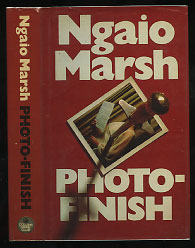
The plot device of the red warnings reminds me a great deal of two detective novels from the 1980s, Photo-Finish (1980) by Ngaio Marsh (threatened opera star again) and The Skull Beneath the Skin (1982) by P. D. James (threatened actress).

However Markham's narrative unfolds much more impressionistically and confusingly, as the scene shifts from Paris then to a night train then to a villa in Avignon.  The reader sometimes may wonder whether everything that is happening is really happening. Red Warning reads less like a classical detective novel and more like an Edgar Wallace mystery thriller, with heavy lashings of Georges Simenon and William Faulkner.

The basic plot of this 1980
Ngaio Marsh detective novel
resembles that of Red Warning--
but oh! what different places they go!
Yet when the explanation is offered at the end, one realizes there were clues embedded in the text.  I think I understood it all by then, though I am not completely sure.

I may have to read The Psychology of Thought, by American psychologist and college professor Harry Levi Hollingsworth (1880-1957), apparently a former teacher of Markham's at Columbia University.  This book gets quite a work-out from the author in the final pages of Red Warning.

Red Warning is quite a sophisticated book for the period--not an easy read, but an interesting one.  I am glad I read it, and I will read more works by this author--no matter the country in which they happen to be set!

Note: The tour of France will continue the upcoming week with reviews of works by Alice Campbell, Georges Simenon and Stanislas-Andre Steeman.  See you soon!--The Passing Tramp.