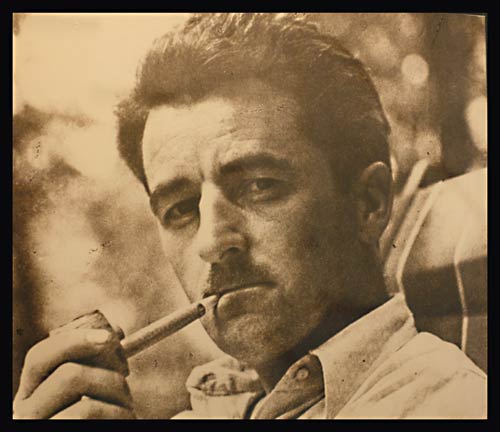
Both John and Clarice found Street a delightful storyteller, with a vast store of colorful and sometimes racy tales of his army days from earlier in the century (among other things Street was an artillery officer in World War One and later served in military intelligence), while John was quite awed and impressed with Street's pronounced ability to hold immense amounts of beer without showing any outward physical effect (John Carr himself was not so blessed in this regard).
If you feel as I do and as Carr and Street did and believe that ingenuity should not be shamefacedly shunted to the narrative periphery but, rather, placed at the very heart of a mystery, seek out some Streets to rub shoulders on your shelves, so to speak, with your Carrs. They would not disgrace Carr's august company (for an interesting recent piece on John Dickson Carr, see Tipping My Fedora).
 |
| John Street's and John Dickson Carr's collaborative novel Fatal Descent, written under their pseudonyms John Rhode and Carter Dickson Note the jacket back flap blurb for the John Rhode novel The Tower of Evil (The Bloody Tower in England) |
At John Street's and Eileen Waller's spacious mock-Tudor residence in Kent, Street and Carr collaborated on the novel Fatal Descent (Drop to His Death in England), Street helping to plot it and Carr writing it. The novel was published in 1939 under the pseudonyms John Rhode (an obvious pun on John Street) and Carter Dickson and it was quite well-received. Huge Walpole memorably declared in a review, for example, that men as clever as the two authors should be "running A.R.P. or settling the Palestine question." Street and Carr planned more such collaborations, but unfortunately World War Two disrupted these plans.
 |
| Yes, there's no arm attached to that gun-wielding glove--queer indeed! |
This interesting if short-lived collaborative effort between two highly regarded Golden Age detective novelists has been discussed by Douglas Greene in his classic biography of Carr, John Dickson Carr: The Man Who Explained Miracles. Doug also explains how Carr based his short story detective from this period, Colonel March (he of The Department of Queen Complaints), on Major Street.
 |
| John Street model for John Carr's Colonel March March is described by Carr as "a large amiable man (weight seventeen stone) with a speckled face, an interested blue eye,and a very short pipe projecting from under a cropped moustache which might be sandy or grey" |
In my own book Masters of the "Humdrum" Mystery: Cecil John Charles Street, Freeman Wills Crofts, Alfred Walter Stewart and the British Detective Novel 1920-1961, I discuss the Street-Carr friendship as well as some additional books by the two men that show hints of mutual influences. Street and Carr both published novels in 1939--the same year their Fatal Descent appeared--that show striking similarities in murder mechanics.
Further, a 1940 Carr novel, the haunted house tale The Man Who Could Not Shudder, besides being highly Street-ish in its murder mechanics, is set in a Tudor mansion probably inspired by Street's house in Kent. Further yet, Street himself in 1943 published his own haunted house tale, Men Die at Cyprus Lodge.
Further, a 1940 Carr novel, the haunted house tale The Man Who Could Not Shudder, besides being highly Street-ish in its murder mechanics, is set in a Tudor mansion probably inspired by Street's house in Kent. Further yet, Street himself in 1943 published his own haunted house tale, Men Die at Cyprus Lodge.
Although today Street is, to be sure, much less read than Carr, the Major shared with his younger friend a positive genius for devising dazzling murder mechanics (however he used the specific locked room plot device only sparingly and was a rather more deliberate writer).
Dazzling murder mechanics were just the sort of thing that Golden Age readers loved, though admittedly today, as P. D. James has written in her short genre history Talking about Detective Fiction, there is in many quarters a preference for what she calls "credibility" over ingenuity. But doesn't it seem odd to so downplay the idea of ingenuity in a detective novel, as James does? Carr, I suspect, would have declared that "credibility" is simply another word for drabness.
Dazzling murder mechanics were just the sort of thing that Golden Age readers loved, though admittedly today, as P. D. James has written in her short genre history Talking about Detective Fiction, there is in many quarters a preference for what she calls "credibility" over ingenuity. But doesn't it seem odd to so downplay the idea of ingenuity in a detective novel, as James does? Carr, I suspect, would have declared that "credibility" is simply another word for drabness.
If you feel as I do and as Carr and Street did and believe that ingenuity should not be shamefacedly shunted to the narrative periphery but, rather, placed at the very heart of a mystery, seek out some Streets to rub shoulders on your shelves, so to speak, with your Carrs. They would not disgrace Carr's august company (for an interesting recent piece on John Dickson Carr, see Tipping My Fedora).
 |
| Was the setting inspired by John Street's home in Kent, where Street and Carr collaborated on the novel Fatal Descent? Certainly the murder means in the novel are quite Street-ish. |
 |
| More Street-ish murder mechanics are found in this Carr novel Note the blurb for Street's and Carr's collaborative novel Drop to his Death (Fatal Descent) on the back flap of the dust jacket |
 |
| as the skull might indicate (dead men do tell tales) this 1943 John Street tale concerns a lethally haunted house |