Monday, March 18, 2013

Backstreets: More John Street Family History

I hope I'm not exhausting interest here (a review of a John Rhode mystery is coming tomorrow), but I've made some more discoveries about the family of Cecil John Charles Street (I do wish all this had made it into Masters of the "Humdrum" Mystery).  In the last John Street post I discussed Street's descent on one side from Major General John Alfred Street (veteran of the Second Opium War!) and on the other from Caroline Bill, daughter of Charles Horsfall Bill, wealthy landowner.

After service in the Royal Artillery John Street became an electrical engineer for about eight years (he was called up again into service in the R.A. when the Great War started).  After the war and a spot of Army Intelligence work in Ireland, Street settled down to a life of writing, publishing his first mystery novel in 1924, when he was forty years old.  Street's detective novels, particularly his Dr. Lancelot Priestley mysteries published under the John Rhode pseudonym, reflect Street's peculiar mechanical genius.  During the Golden Age of the detective novel, he was especially lauded for his ingenious means of murder, which often drew upon principles of science and engineering.

In his mysteries Street also wrote disdainfully of snobbish gentry who looked down their noses at people in business and mechanical trades (see, for example, Mr. Babbacombe Dies--well, if you can ever find a copy!).  Was he writing from personal experience?  Where did John Street get his marked knack for science and technology?

David Hume and Adam Smith--friends of
John Jardine, "a hard-headed, jolly dog,"
according to James Boswell
It now seems there was a family link after all.  Street's paternal grandmother, the mother of his father General Street, was Catherine Jardine, a granddaughter of Reverend John Jardine (1716-1766).  Jardine was a member, with David Hume and Adam Smith and others, of Edinburgh's Select Society, a founder of the Edinburgh Review and a figure in the Scottish Enlightenment.

Writes E. C. Mossner in his The Life of David Hume (Oxford University Press, 1980): "Greatly beloved by David Hume was John Jardine, six feet two of a man with large bones and a huge zest for life" (p. 277).  James Boswell, biographer of Samuel Johnson, described Reverend Jardine in his journal as "a hard-headed, jolly dog."

I was struck by these references, because in great part they could have been made about Jardine's descendant John Street.

As Doug Greene records in his biography of John Dickson Carr, Street was a tall, large man (grown stout in middle age), a zestful imbiber ("I have watched him polish off ten pints of beer before lunch, and more than that after dinner," an admiring Carr once recalled) and a "great storyteller with entertaining accounts of his army experiences" (some of these were retailed by Street in his war memoirs, With the Guns and The Making of a Gunner).

It was Street who, putting his electrical skill to work, wired the eye sockets of Eric the Skull, the Detection Club mascot, to glow red during initiation ceremonies, like the one Carr participated in when he became a member of the Club in 1936.

Catherine Jardine Street's husband died in 1829, when John Street's father was but seven years old.  Six years later Catherine married Sir George Steuart Mackenzie (1780-1848).  Mackenzie was a Scottish baronet, mineralogist and geologist, who co-authored, among other works, Travels in the Island of Iceland, During the Summer of the Year 1810.

plate from Travels in Iceland (1810)

Mackenzie is also known for having conducted experiments, at the age of twenty (four years after his succession to the baronetcy), with his mother's diamonds, in order to establish that diamonds were crystallized carbon.  He succeeded in this endeavor and thereby became at that time the youngest person elected to the Royal Society.

What Sir George's mother thought of the sacrifice of her precious jewels on the altar of science we don't know.

George Steuart and Catherine Jardine Street Mackenzie resided at Coul House, the mansion Sir George had built in 1821.  Catherine had one son with her new husband, who already had fathered ten children by his first wife.  This son of the second marriage, a half-brother of John Street's father and thus a half-uncle to John, was Henry Augustin Ornano Mackenzie (1839-1909).

Coul House in 1888, when Queen Victoria came to visit

Henry Mackenzie was a civil engineer and inventor who was granted several patents, including one to facilitate the opening of wind-chest pallets in organs (see George Ashdown Audsley, The Art of Organ-Building, 1905).

Street never actually killed anyone with an organ in any of his many books (I think the closest we ever got to this was Ngaio Marsh, with a fatal piano--or is someone actually crushed by an organ in Edmund Crispin's Holy Disorders?), but did he ever meet his uncle Henry Augustin Ornano Mackenzie and get inspired thereby with a passion for gadgets and tinkering, which he put to deadly use in his crime books?  Perhaps we will find out someday, as we keep traveling down the backstreets.

Saturday, March 16, 2013

Here Be Villains: Rogue's Gallery (2011), by Robert Barnard

some unsavory characters
Rogue's Gallery, Robert Barnard's third collection of short stores (after Death of a Salesperson and The Habit of Widowhood) is fine contribution the the library of short crime fiction.  Most of the fourteen stories in the book are of twist-in-the-tale variety, rather than essays in detection. With one exception, all were first published in the last dozen years.

The best-known short story from the collection doubtless is the rather brilliantly-titled  "Sins of Scarlet," which won the 2006 Short Story Award from the Crime Writers' Association (beating out over 100 other stories).  The CWA judges, chaired by Peter Lovesey, called "Sins of Scarlet" "the ultimate in locked room murders, set in the Sistine Chapel during an election of a Pope."

In accepting the award, Robert Barnard commented that the story was turned down by "a leading US short story magazine," on the grounds that "it was too offensive to too many people" (it was instead published in a CWA anthology edited by Martin Edwards)  Be that as it may, the situation is a cleverly devised one, with a nice twist explaining precisely how the two deaths that take place in the tale were accomplished.

Obviously Barnard must have been generally inspired in writing this 2006 story by the election of a new Pope in 2005 (though of course there were no murders during that conclave!). Now I review the story the same week another new Pope was elected. Odd coincidence!

Not yet!
In Robert Barnard's "Sins of Scarlet"
there are severe glitches in a papal election

The earlier published title story also involves a wicked pope from a bygone era--or more particularly his painting.  "Rogue's Gallery" actually is more a supernatural tale, and an enjoyable one, somewhat reminiscent of Bram Stoker's "The Judge's House."

The wickedly humorous "Family Values" is one of my favorites from the collection.  Set in 1948, the story takes place at a stiflingly genteel residential hotel in the Peak District.  It's about the mother-and-son--or are they?--who come to stay at the hotel.

The ironically titled "Mother Dear" is a dark tale about a children who begin plotting the murder of their hateful mother.  For me this story had an added frisson from my recollection of an interview where Barnard admitted his own bad relationship with his mother.

"Incompatibles," about a son, a future crime writer, and his ill-matched parents, is another dark tale that seemed like it might possibly be drawing on some personal elements.  The ending is left tantalizingly inconclusive.

The earliest story in the collection, "A Political Necessity," dates from 1991.  It details the plot of a conscienceless politician to get rid of his of his wife, who has became fired with religious enthusiasm--a great deal of it.  Will his plan succeed?

One of the latest stories, "The New Slavery," is original to the book.  This one I would hardly even call a crime or mystery story, but it is a poignant tale, critiquing social conditions in modern England, and parents who palm off the responsibility for raising their children on elderly parents.

Nothing gets past this man!
"Lovely Requiem, Mr. Mozart," is a one more installment of Barnard's alternative history of Wolfgang Amadeus Mozart, in which Mozart lives to become an old man, residing in England and giving musical lessons to Princess Victoria (see two previous novels, published under Barnard's Bernard Bastable pseudonym).

It seems an eccentric, wealthy English gentleman wants to commission Mozart to write a requiem mass for him, but there are some very odd conditions attached....

I liked this one a lot.  It's one of the few lightly humorous tales in the collection.

Some of the tales are less successful.  "The Fall of the House of Oldenborg" and "A Slow Way to Di" seemed to me to wear out their conceits (about Hamlet and Princess Diana, respectively). "The Path to the Shroud" read like a pastiche of Tennessee Williams' The Roman Spring of Mrs. Stone.  "Last Day of the Hols" seemed rather amorphous to me, though there's a great last line about Agatha Christie, where Robert Barnard, unlike some, gives the Crime Queen her due.

Robert Barnard deserves his due too.  He's an accomplished practitioner of the arts of crime and mystery, in both their long and short forms.

Thursday, March 14, 2013

Murder on Tour (1933), by Todd Downing

It's out now!  Todd Downing's first published detective novel, Murder on Tour, which introduced sleuth Hugh Rennert.  The original edition of this book is so rare even I never had a copy of it.  It's a great thrill to be able to make it available again, after eighty years, to fans of classical mystery fiction.

There is also a new introduction by me, never published before, with new information about Todd Downing, courtesy of his sister Ruth's son. It's titled "Day of the Dead: Todd Downing and Murder on Tour."

Without further ado, here is the publisher's blurb to the book:

U. S. Customs Agent John Payne was hot on the trail of the party he suspected of smuggling Mexican antiquities across the Texas border into the United States. Too hot on the trail to be left alive! On October 27, 1933, Payne was found dead, strangled, in his San Antonio hotel room. Three days after the discovery of Payne's savagely slain body, senior Customs Agent Hugh Rennert is in Mexico City to join the thirteen members of the Inter-American Tours party, late of San Antonio. Rennert is hunting for Payne's calculating and callous killer. The party of American tourists seeing the sights around Mexico City initially seems innocuous enough, yet in actuality Murder travels masked among them, patiently waiting, as the macabre Mexican holiday Dia de los Muertos (Day of the Dead) approaches, for the opportunity to strike again. Who will be the next to die by violence, before Hugh Rennert finally cracks the case and corners his quarry? First published in 1933, Murder on Tour is the first in Todd Downing's acclaimed series of seven Hugh Rennert detective novels. Read it and see why the New York Times Book Review proclaimed Murder on Tour a "well fashioned baffler" with "characterization . . . contrived with unusual skill."

It has been about fifteen months since I visited Todd Downing's birthplace of Atoka, Oklahoma, and decided to do my bit to revive his work.  It has taken some time and effort, but I'm glad I did what I did.  Working with Coachwhip, I will continue to do what I can to help get other Golden Age mystery authors back in print.  There is yet another middle American mystery writer coming back soon.  Stay tuned!

Wednesday, March 13, 2013

Street Fanfare: The Eventful Life of Cecil John Charles Street

Cecil John Charles Street
Golden Age Mystery's
Master of Murder Means
I unearthed some interesting new information concerning Eileen Waller, the longtime companion and second wife of Cecil John Charles Street (1884-1964), one of the three primary subjects of my book Masters of the "Humdrum" Mystery (the others two are Freeman Wills Crofts and Alfred Walter Stewart, alias J. J. Connington).

First, however, I had better give some background on John Street, for those of you who have not yet read Masters (all too many I am afraid!).

A founding member of the Detection Club, John Street (like Cecil Day Lewis, he didn't like to be called "Cecil") was one of the most prominent English Golden Age mystery writers and perhaps the most prolific true detective writer of all time.

Between 1924 and 1961, Street, primarily under the pseudonyms John Rhode and Miles Burton, published over 140 mystery novels, almost all of them tales of detection.

Just as John Dickson Carr was the master of the locked room mystery and Agatha Christie was mystery's mistress of misdirection, John Street was the crime genre's master of murder means, celebrated for his superbly ingenious ways of knocking off murder victims.

Currently Street's books are out of print (and extremely collectible), though I'm hoping they might be reprinted, like J. J. Connington's books, by Orion Books' Murder Room imprint (by the way, I have been asked to write an introduction to the Murder Room's Connington reprint series).

It has long been known that John Street had a military background (he rose to the rank of Major and often was known as "Major Street"), but in actuality his period of military service was confined to a relatively short span of years.

To be sure, John Street's father very much was career military.  John Street was the son of Major General John Alfred Street (1822-1889), a veteran of the First Opium War (1839-1842) and the Crimean War (1853-1856).

I'm guessing that Street was the only Golden Age mystery writer who had a father who fought in the First Opium War! 

John Alfred Street was commissioned as Ensign on November 29, 1839, promoted to Lieutenant on October 5, 1841 and to Captain on January 7, 1848.  In 1842 Street was present at the Battle of Chinkiang and at the landing before Nanking.  See Captain H. G. Hart, The New Army List (London: John Murray, 1848), 108.  In the Crimean War, Street was promoted to Major and then Lieutenant-Colonel.  He was present at the battles of Balaclava, Inkerman and Kinburn.  See H. H. Woollright, History of the Fifty-Seventh (West Middlesex) Regiment of Foot 1755-1881 (London: Richard Bentley and Son, 1893), 289.

Battle of Chinkiang

By the 1870s, Street had been promoted to Major General and placed in command over British forces in Ceylon.  Street's first wife had died of dysentery in Ceylon in 1874, but nearing retirement Street in 1881 married Caroline Bill (1846-?), daughter of wealthy landed gentleman Charles Horsfall Bill (1818-1908), owner of the Georgian mansions Storthes Hall (Yorkshire) and The Priory (Gloucestershire), as well as a London townhouse at Great Cumberland Place.

Great Cumberland Place

John Alfred and Caroline Bill Street had one child, a son, Cecil John Charles (named after his father and maternal grandfather), in 1884.  General Street died in 1889 "somewhat suddenly at at his residence" Uplands at Woking, Surrey, when his son, the future author, was but five years old (Charles Horsfall Bill owned yet another house, Firlands, nearby, into which Caroline Bill and her son moved after the General's death).  For further details on all this genealogy see my Masters of the Humdrum Mystery.

Born at Gibraltar, where his father was in service, John Street, the future author, followed in his father's tradition for a time.  He graduated from Wellington College and the Royal Military Academy, Woolwich and was commissioned into the Royal Artillery in 1903.  However, Street transferred from the Regular Army into the Special Reserves but three years later, in 1906.  The same year, he took his first wife, Hyacinth Maud Kirwan (1882-1949), a daughter of a Major in the Royal Artillery.
 
electric street lamp in Lyme Regis, 1909 (lymeregis.org)

Though possessing ample private means, Street, long fascinated with mechanics and applied science, spent the remaining years before the outbreak of World War One as the Chief Engineer of the Lyme Regis Electric Light & Power Company (see Martin Roundell Greene's Electric Lyme).

In World War One Street served as a Captain with the Royal Artillery.  A Forward Observation Officer, Street saw much action and was wounded three times, receiving the Military Cross in recognition of his service.  From 1918 to 1921 he served in British army intelligence (rising to the rank of Major).

John Street, 1920s
Though Street and his wife had one child, a daughter, the couple seems to have become estranged by the time of World War One and I don't believe they ever lived together again after 1914.  By 1936 (probably a good deal earlier), Street was living with another woman, the aforementioned Eileen Waller.

The Streets, as they were known (John and Eileen lived as a married couple, even though they were not in fact married), were great friends of John Dickson Carr, a new Detection Club colleague of John Street's, and Carr's English wife Clarice.

John and Eileen would live together until John's death in 1964 (they officially married after Maud's death in 1949).

Eileen Waller was a daughter of John Edward Hopkins Waller (1856-1930) and Annette Elizabeth Naude, daughter of Adolph Naude (the Naudes were of French Huguenot extraction).

A son of John Francis Waller, an Irish lawyer, poet and songwriter ("The Spinning Wheel"), J. Edward Waller, as he was known, was a very prominent civil engineer.  His firm, Kincaid, Waller, Manville and Dawson was one of the most notable consulting electrical engineering firms in England.  It was involved in such projects as the building of a tramway system of Buenos Aires and the electrification of the London, Brighton and South Coast Railway.

Waller's partner Edward Manville became one of the most noted English industrialists and was later knighted.  Among other things, Manville was one of the most important people in the Daimler Company, serving on the Board of Directors of the British car manufacturer for twenty-eight years.

Trams, Burton upon Trent, 1913 (National Railway Museum)
one of the Kincaid, Waller, Manville and Dawson projects

Having a fuller understanding of the professional background of Eileen Waller's father, I now better comprehend what helped bring John and Eileen together.  The connection between them was, one might say, electric!

Anyone who reads Street's mysteries, particularly the John Rhode books, should notice the author's marked fascination with business and technology.  When you see what Street's professional background was, this is not surprising.

Horace Edmund Waller
But there is yet more connecting John and Eileen.  Eileen Waller had three siblings, one of whom served in the Great War, but, unlike John Street, did not not come out of the conflict alive.  This was Horace Edmund Waller (1891-1915).  Like Street, Waller graduated from Wellington College, as well as Tonbridge School.  After studying engineering at the University of London, he migrated to Canada, where he worked on the hydroelectric installation of the Algoma Central Railway at Steep Hill Falls, Ontario.

At the commencement of the Great War, Waller enlisted in the Canadian Expeditionary Force and reached France in December 1914.  Being fluent in French (presumably a linguistic legacy from his mother), Waller was detailed in France to act as an interpreter and guide.

Frequently in the trenches, Waller soon contracted dysentery.  He entered the hospital on February 4, 1915, dying three days later.

A sergeant in his company wrote Waller's parents that Waller was "one of the best little fellows that ever lived [Waller was 5'6"] and one whom I am very proud to have called friend.  He was the most popular man in the company.

The tragedy of war--another point, a poignant one, connecting John and Eileen, though John Street made it through the fiery furnace of combat and went on to achieve comparative fame and fortune as one of the most accomplished Golden Age English mystery writers.

Horace Edmund Waller's name is listed on the
Memorial at Westgate-on-Sea, Kent
where his family lived

Tuesday, March 12, 2013

My New Book Project: Essays in Honor of Douglas G. Greene


Doug Greene's classic biography of Carr
published eighteen years ago
I can now announce that I am under contract with McFarland Press (publishers of my Masters of the "Humdrum" Mystery) to edit a collection of essays in honor of mystery scholar Doug Greene.  The book should be out next year, before Doug's seventieth birthday.  I am so pleased to have helped bring this project about, because Doug has been such a big influence over my own reading (and ultimately writing)  related to the mystery genre, since the time in Chicago in 1989 when I bought IPL paperback reprint editions of John Dickson Carr's The Judas Window and Hag's Nook, with introductions written by Doug (my introduction to both Carr and Doug).

Of course everyone knows Doug for his great John Dickson Carr biography, The Man Who Explained Miracles (1995), but he also has produced a lot of additional fine mystery scholarship and has done tremendous things in mystery publishing, including founding Crippen & Landru.  I hope this new book will serve as a fitting tribute to one of the really eminent modern figures in mystery genre scholarship and publishing.

Friday, March 8, 2013

"Would You Believe?..." I'll Tell You Everything (1933), by J. B. Priestley and Gerald Bullett

J. B. Priestley (1894-1984) and Gerald Bullett (1893-1958) were respected mainstream writers who occasionally dabbled in the crime fiction genre (the former writer is still relatively well-known today).  In this case of the 1933 thriller novel I'll Tell You Everything, the two men dabbled jointly, to good effect.

I'll Tell You Everything is a joyful send-up of the Golden Age thriller, where the emphasis is on suspense and excitement, not the measured and logical ratiocination of a murder problem.

This type of book once was associated most with such hugely popular authors as the astonishingly prolific Edgar Wallace, the bestselling writer in England in the 1920s; "Sapper," creator of that fearless, jingoistic dunderhead Bulldog Drummond; and Sax Rohmer, father of the fiendish criminal mastermind Dr. Fu Manchu.

However, today the most read Golden Age thrillers probably are those titles, such as The Secret Adversary, The Secret of Chimneys and The Seven Dials Mystery, tossed out occasionally by Agatha Christie as respites from her much more onerously plotted Hercule Poirot detective novels (though Poirot himself got ensnared in one Christie thriller, The Big Four).

Christie's thrillers themselves were pastiches of Wallace, Sapper and Rohmer, which makes their survival when works by the originators have disappeared rather ironic (it should be noted, though, that the the Fu Manchu series is being reprinted).

Be that as it may, the fact that people still enjoy books like The Secret Adversary and The Secret of Chimneys in 2013 should encourage some bright publisher to reprint Priestley's and Bullett's I'll Tell You Everything; for it is quite as enjoyable, I think, as Christie's thrillers, if not more so.

The novel is a highly literate delight, somewhat in the manner of the 1940s/1950s thrillers of Michael Innes, like The Secret Vanguard (1940), From London Far (1946) and Operation Pax (1951)--though not so self-consciously literary.

The great suspense director Alfred Hitchcock is famous for, among many other things of course, popularizing the idea of the MacGuffin in film.  The MacGuffin is the item that the various parties at odds with each other are pursuing.  In Priestley's and Bullett's I'll Tell You Everything, the MacGuffin is a small silver casket, which changes hands a great deal over the course of the novel.

The protagonist in Everything is Simon Heath, "lecturer on Ancient and Earlier European history at the University of Cambridge" (he's "already quite an authority on the Dark Ages").

It all starts, as so many British thrillers do. on a train....

On a train to London to spend his vacation with his jaded journalist cousin Oliver, Simon encounters in his passenger compartment a highly agitated Italian professor, a Dr. Pianella, who, pursued by an obvious ruffian, exhorts Simon to take the casket, which, he avows, hold "the leetle bones and ashes of the Iron Prophet," Yann:

"Of him you have heard in your history, eh?"
Simon rapidly searched his memory.  No, he confessed, he had never heard of the Iron Prophet, the Prophet Yann.  "It's rather out of my place and period," he added, feeling that something of the sort must be said for the honour of Cambridge scholarship.

Priestley in World War One
The ingenuous Simon ("He'd believe anything you told him," says his cousin Oliver of him, "provided it had all happened since the eleventh century") hides the casket in his suitcase and is launched on an adventure involving multiple crooks, a pretty girl (Zoe--perhaps not her real name) and by my count six new, entirely different versions about what precisely the casket does contain, all prefaced with the pregnant words, "I'll tell you everything."

There's amusing satire of naive Cambridge lecturers, facetious, fabricating journalists, detectives who like to don outrageous and unconvincing disguises and the conventions of the thriller genre itself.

Additionally--and at odds with the typical ideological orientation of Golden Age thrillers--British xenophobes and anti-intellectuals are satirized in the form of the patriotic political group known as the Britishers:

In the bar were three gentlemen of a military cut, yapping together like fox terriers.  They were straight, stiff, well-groomed men in their middle forties, and to Oliver's eye they were all exactly alike.  They had little close-clipped moustaches, and a staccato, close-clipped manner of speech, admirable for commanding doomed battalions to attack impregnable salients.

Gerald Bullett
This is a clever, genially satirical book, with lively characters and situations.  J. B. Priestley and Gerald Bullett obviously enjoyed themselves writing I'll Tell You Everything and you should enjoy reading it.

Note: Other genre-related material by J. B Priestley and Gerald Bullett (written separately), include, by Priestley, the novels Benighted (1928) (filmed as the classic horror suspense film The Old Dark House), Blackout in Gretley (1942) (spies) and Salt is Leaving (1961) (murder) and the plays Laburnum Grove (1933) and An Inspector Calls (1945); and, by Bullett, The Jury (1935), The Trouble at Number Seven (1952) and two pseudonymous detective novels, One Man's Poison (1956) and Odd Woman Out (1958) (as Sebastian Fox).

Wednesday, March 6, 2013

Short Form 2: The Casebook of Jonas P. Jonas and Other Mysteries (2012), by Elizabeth Ferrars

Crippen & Landru has published a new collection of short stories by Elizabeth Ferrars (1907-1995), over three decades after her first collection, Designs on Life (1980), was published (in the United States she was known as E. X. Ferrars, which is the name Crippen & Landru uses).  I thought it would be nice to review these two books in succession.  I meant to have this posted Monday, but flu intervened!  Even passing tramps get laid low by sickness occasionally.  Must be the food.

Jonas P. Jonas on the job
The Casebook of Jonas P. Jonas and Other Mysteries includes seventeen Ferrars crime tales, ranging from the near "short shorts" (the six cases of Jonas P. Jonas, "Suicide" and "Look for Trouble") to longer works like The Trap and The Handbag that read more like novelettes.

The shorter shorts are unique in Ferrars' short form output in being pure tales of ratiocination.  The Jonas P. Jonas tales also offer, obviously, a series sleuth: a garrulous retired private detective, who tells of his exploits to his niece in the hope that she will write his memoirs.  All six of these stories originally appeared in the Evening Standard in the second week of December 1958.  Four were reprinted in Ellery Queen's Mystery Magazine.

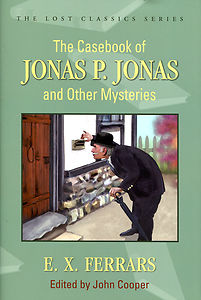
My favorite of these was "The Case of the Blue Bowl," which is illustrated on the cover.  In four pages Jonas P. Jonas tells of the clever little problem of the disappearance of a reputed village miser.  Has her nephew committed foul play?

The key clue is a piece of Chinese porcelain (Philo Vance would be pleased) and there's also a neat bit of social history concerning milk bottle deliveries.  It's an impressive achievement to pack this much incisive plotting into such a short tale.

death in a bowl

"Suicide?" and "Look for Trouble" were originally published in The Saint Mystery Magazine in 1964.  Both offer solid little murder problems.

Ferrars later reworked and slightly expanded "Look for Trouble" as "The Canceling of Mrs. Arbuthnot," her contribution to the eightieth birthday festschrift for Julian Symons in 1992, but I think the original version, involving a murder that implicates the personnel of a hair salon, is superior.  My only complaint is that the shortened title doesn't make much sense (however, the original, longer title, gives away the mystery).

Between the novelettes, I most enjoyed The Handbag, which tells of theft and murder during one of those English stately home tours.   

The Handbag, which originally appeared in 1960 in the magazine supplement to the Toronto Star, has many of the elements found in Ferrars' novels: a murder in genteel surroundings, a nice young woman in peril and a bit of romance.

Six of the other stories in Casebook appeared originally between 1972 and 1992 in Winter's Crimes, the fine English crime story anthology series.  None of these is as good as Scatter His Ashes, Ferrars' Winter's Crime's contribution that was included in Designs in Life, but all are worthwhile.

Three of these Winter's Crimes stories were reprinted in Ellery Queen's Mystery Magazine, though not my two favorites of the bunch, "The Long Way Round" (1972) and "Sequence of Events" (1977).

"The Long Way Round" resembles one of those splendid Roy Vickers inverted murder tales, telling of Leo's plot to murder his wife's uncle in Cyprus.

I don't know why this story was never reprinted in EQMM.  Perhaps there was too much for EQMM about the instability in Cyprus owing to conflicts between Greek and Turk Cypriots (Cyprus had achieved independence from Great Britain in 1960).  I found all this very interesting, however, and it's cleverly worked into the plot.

"Sequence of Events" is an overtly humorous story about a local village feud that starts with stolen carnations and ends with multiple murder (or does it?).  I can imagine Ferrars sharing a laugh with her husband, the prominent plant physiologist Robert Brown (1908-1999), over this winning tale.

Killer Carnations

I should also make note of Instrument of Justice (1981) and Stop Thief (1992).  The former tale concerns a desperate wife who will do about anything to get her hands on some blackmail photos of herself.

The latter tale, Stop Thief, was Ferrars' last original short story, published when she was 85.  This is another pure crime suspense tale, about a husband whose wife, having recently suffered a miscarriage, is engaging in an escalating pattern of shoplifting.  It's set in the village of Lexdale--one of those charming, genteel communities in the English home counties, where, despite the charms, bloody murder runs rife, at least in the fictional work of Elizabeth Ferrars--and is a fitting last testament to Ferrars' work in the short form.