Showing posts sorted by relevance for query E. R. Punshon. Sort by date Show all posts

Wednesday, May 6, 2015

Shady Doings: The Dusky Hour (1937), by E. R. Punshon

It was dusk, the dusky hour that lingers in the English countryside before the closing in of night....

Murder was certainly a dreadful thing, but also, in a way, impersonal.  It was like a war in Spain, a famine in China, a revolution in Mexico or Brazil, tragic, deplorable, but also comfortably remote....[Now] Mr. Moffatt was beginning to feel vaguely uncomfortable. Murder seemed somehow to be creeping near--too near.  No longer was it merely a paragraph in the paper, something fresh to chat about, an occasion for a comfortable shiver over a comfortable glass of wine.


                                                              --The Dusky Hour (1937), by E. R. Punshon


E. R. Punshon's The Dusky Hour was not well-received by that Bible of detective fiction orthodoxy, Jacques Barzun and Wendell Hertig Talyor's A Catalogue of Crime (1971). The COC even condemned the "adolescent name" of Punshon's sleuth, Sergeant Bobby Owen. Apparently, in the view of the COC, sleuths are not to be allowed diminutives (even one that calls to mind actual British slang for a cop).

On the other hand, Punshon was a great favorite of both Dorothy L. Sayers and of Sayers' successor as Sunday Times crime fiction reviewer, her fellow Detection Club member Milward Kennedy. Sayers's rave review of Punshon's debut Bobby Owen mystery in 1933 gave a great lift-off to the Bobby Owen series, while Kennedy declared specifically of The Dusky Hour, "I do not think that Mr. Punshon, another front-rank man, has ever done better work than this."

Concerning this divergence of opinion I side with Sayers and Kennedy.  Whence the divergence between these two pairs of discerning critics?  Likely it arose from their differing aesthetic views. Barzun and Taylor, I suspect, would have preferred a sparer narrative, along the lines of Freeman Wills Crofts or Agatha Christie.  The Dusky Hour is a fairly long book for the period, and Punshon's narrative style is leisurely, his sentences sometimes undisciplined.

Sayers and Kennedy, however, in the 1930s embraced the movement to merge the detective novel with the mainstream, literary novel and they saw Punshon as an important soldier in this movement, one to be celebrated, not castigated, for his narrative style. (Punshon, incidentally, became a Detection Club member in 1933, three years after the formation of the organization; Sayers and Kennedy were founding members.)

Certainly Kennedy commended the novel's plot, which concerns the discovery of a dead body in a car dumped in a Berkshire chalk pit (the novel preceded England's notorious real-life chalk pit murder by nine years) and the net of suspicion that is drawn around the inhabitants of three nearby country homes, including Sevens, the hideous "sham and inappropriate" Victorian Gothic abode of the local squire, Mr, Moffatt, and his young adult children, Ena and Noll. Yet Kennedy also praised the narrative of The Dusky Hour, pronouncing that it was "irreproachable in style" and "spiced by the author's wide reading and acute observation."


Again, I tend to concur with Milward Kennedy. The plot of The Dusky Hour is pleasingly complex, requiring a final chapter of sixteen pages for elucidation.  I greatly enjoyed seeing how Bobby--perhaps I should call him Robert to please the COC--fit all the pieces together. But there also are nicely individuated characters and interesting and unexpected asides that I believe enhance the tale.

For example, Punshon on several occasions amusingly mocks the agrarian conservatism of Mr. Moffatt, as in this passage, which makes mention of a certain English newspaper with a left-leaning, working-class readership:

Mr. Moffatt nodded.  He knew Norris well enough, the constable stationed at the village, a civil, intelligent fellow, though less active against poaching than one could have wished, and reported, though one hoped untruly, to have been seen reading the Daily Herald--a bad sign.


Through Bobby Owen the author also expresses doubt about the efficacy of capital punishment, and indicates that English police actually did need to concern themselves with getting search warrants--surely news to Crofts' Inspector Joseph French, who, with his array of bent wires and skeleton keys, flouts English law in Crofts' detective novels with cheerful abandon.  In The Dusky Hour I was positively thrilled when a character--a chauffeur no less--evicted the police from his abode after they admitted they didn't have a warrant.

On that I say three cheers for the people!  But three cheers also for Mr. Punshon and his Bobby Owen--a likable, young British cop who manages to crack a most complicated case, adolescent name or not.

The Dusky Hour, the ninth E. R. Punshon Bobby Owen detective novel, will be reprinted by Dean Street Press later this year, in both paperback and eBook versions, along with #'s 6, 7, 8 and 10.  The first five Bobby Owen mysteries will be available, on amazon.com and amazon.co.uk and in both paperback and electronic versions, in June.

Wednesday, November 30, 2016

Exit to Death: So Many Doors (1949), by E. R. Punshon

Crime detection at its exciting best!

This fascinating tapestry of murder and superior detection is a prime example of the classic type of mystery story--a story whose ingenious kinks and turns absorb you, while its intense scrutiny of clues will keep you agog with anticipation.

E. R. PUNSHON was inducted into the London Detection Club by the late G. K. Chesterton, then president.  This club was founded with the idea of bringing together mystery writers who were willing to aim at high literary standards, and who believed that in the mystery novel "the reader must always be given fair play...."

--From the front and back flaps of the American edition of E. R. Punshon's So Many Doors (Macmillan, 1950)


Does "intense scrutiny of clues" keep mystery readers "agog with anticipation" these days?  Did it in 1950?  Apparently someone at Macmillan thought so. Or, possibly, they were making for traditionalists the most that they could of Punshon's perceived strengths as a mystery writer in an era when, to generalize, male readers of crime fiction were turning increasingly to hard-boiled novels and women to so-called domestic suspense.

Yet to no avail: So Many Doors (to be reissued in January by Dean Street Press), would be the last Punshon novel published in the United States during the author's lifetime, though nine more new Punshons would be published in the UK by the author's longtime publisher, Victor Gollancz.

Taking note of the 17th-century stage origin of the title of So Many Doors, Anthony Boucher, then dean of American mystery critics, praised the "Elizabethan, even Jacobean" aspect of the novel in its compulsive chronicling of the "obscure destinies that drive [Punshon's] obsessed and tormented characters, and...the frightful violence that concludes the story." These were qualities that should have appealed to mid-century American readers, yet they may have been obscured by Punshon's deliberate narrative style for most of the novel.

For much of the novel Punshon's charming series sleuth, Bobby Owen--now, in his 26th novel appearance, ranked a Commander in Metropolitan Police (more on this below)--is trying to determine what happened to to Isabel Winlock, a respectable young woman who has run off with Mark Monk, a magnetic male of doubtful character who is suspected of having done in his wife.

Monk has a connection to Bexley House, a great Thameside mansion from "the days when domestic help was cheap and plentiful and and no one dreamed that it would one day very much be the reverse."  The once abandoned house seems to be the locale for gambling and black market activities, and there's evidence that someone--Mark Monk? Isabel Winlock?--was done in there, evidently stabbed, not long before Bobby pays Bexley House a visit.

Eventually Bobby's investigation of this most mysterious matter takes him to scenic Cornwall, specifically the old tin mining district around Redruth. What does he discover there? Read the novel and find out!

remains of tin mine works in Cornwall

Now, about Commanders on the Metropolitan Police.  Some people have commented that Bobby's rise in Scotland Yard seems meteoric.  Bobby was still a sergeant in 1939, when he left the Yard to join the police force in Wychshire, where he spent the war years as an inspector and later deputy chief constable.  Returning to London in Music Tells All and The House of Godwinsson (both 1948), Bobby is made a deputy assistant commissioner, the equivalent of deputy chief constable, but by So Many Doors he has become a Commander, reflecting the recent creation of the rank of commander out of junior DAC's.

For comparison, PD James' Adam Dalgliesh started off as an Inspector in Cover Her Face (1962), but had made it up to Commander by The Black Tower (1975). It took Bobby about fifteen years to make it up to deputy assistant commissioner (if you think this was too fast, blame Wychshire, not the Yard), but then he was a lot younger than Dalgliesh.

Or maybe not.  Bobby starts off the series at about age 23 and ages more or less naturally as the series progresses over the next 23 years, so at the end of his recorded career he's about the same age as Dalgliesh, who starts off in his forties, I believe, but never seems to age over the 46 years of cases chronicled by James. Good thing too, because had he aged naturally Dalgliesh would have been around 90 at the time of his last case!

More on the next Bobby Owen novel in the series, Everybody Always Tells, coming soon. If So Many Doors bears resemblance to Christie, Tells brings in bit of today's birthday boy, John Dickson Carr.

Monday, November 28, 2016

In with the New: Five Years of Blogging and A Plenitude of Punshons, A Lone Lingo and Murder in the Closet

It's been just over five years since my premier blog post on November 22, 2011, on the mystery genre's "passing tramp" and the once out-of-print mystery writer Jefferson Farjeon, creator of the series character Ben the Tramp.  I followed with another post on Farjeon on the 26th and then made this one on December 26, on a certain Farjeon novel called Mystery in White, which you may have heard of since.  There were other posts as well in those first few weeks, and there have been many since.  Indeed, this post will be the 700th post at The Passing Tramp.

Lately I haven't been posting here as much as I would have liked, but I have been busy working on proofs for the essay collection Murder in the Closet, which will be out the last day of this year, a long introduction to Ada E. Lingo's regional detective novel Murder in Texas (1935) and the last ten novels in E. R. Punshon's Bobby Owen mystery series, beginning with So Many Doors, which Dean Street Press will Release on January 2.

opening in January
For this last set of Punshon Bobby Owen mystery reissues there is bonus material: with the first four novels, selections from Punshon's crime fiction reviews; with the next five novels, a Bobby Owen short story apiece (there are five known Bobby Owen short stories); and with the last novel, a Punshon Bobby Owen radio play, rediscovered by the indefatigable Tony Medawar.  This brings to 41 Bobby's total cases.

For this last set of Punshons I wrote a 3300-word introduction, "Detective Stories, the Detection Club and Death: The Final Years of E. R. Punshon" and short pieces on the reviews, short stories and radio play.  There also a note by Tony Medawar on the radio play, "Death on the Up-Lift," giving more detail about Punshon's work in radio.

I've now written over 30,000 words, when all the Dean Street Press Punshon pieces are taken together, about Punshon, making him the seventh the pre-WW2 Detection Club member about whom I have written at such length, after Cecil John Charles Street, Freeman Wills Crofts, JJ Connington--see Masters of the "Humdrum" Mystery-- and Douglas and Margaret Cole and Henry Wade (See The Spectrum of English Murder).  I also got the chance to write about Ianthe Jerrold, another early DC member, for DSP's reissues of her crime novels.

Coming soon, some more on Ada Lingo and her Murder in Texas and on Murder in the Closet, my major book project for 2016, to which a lot of great people have contributed.  There will also be some more news on additional projects and, I hope, just some regular book reviews!  Thanks for sticking with the blog all these years, I appreciate the readership.

Friday, July 10, 2015

Bertie and Punshon: The Code of the Woosters (1938), by P. G. Wodehouse

P. G. Wodehouse is known to have been a great fan of detective fiction, and one can certainly see evidence of of Wodehouse's criminal whimsy in The Code of the Woosters, the author's 1938 novel saga of the further antics of his most renowned series characters, the amiable ass Bertie Wooster and his profoundly capable valet, Jeeves.  Sprinkled throughout the Wodehouse novel are general references to detective and thriller fiction as well as a very specific reference to a 1937 mystery by E. R. Punshon. (The credit for the latter discovery belongs to the late William A. S. Sarjeant, an admirer of both authors.)

The Code of the Woosters, as Bertie informs readers at the outset, tells the tale of "the sinister affair of Gussie Fink-Nottle, Madeline Bassett, old Pop Bassett, Stiffy Byng, the Rev. H. P. ("Stinker") Pinker, the eighteenth-century cow creamer, and the small, brown, leather-covered notebook."  There is, as this suggests, a lot going on in this novel! (Bertie actually left out the part about the policeman's helmet.)

When the novel was adapted for the 1990s Jeeves & Wooster television series, the scriptwriters, apparently finding the multiple plot threads too challenging to untangle simultaneously, actually divided the whole story into two episodes, with the first dealing with the affair of the cow creamer and the second addressing the matters of the small, brown, leather-covered notebook and the policeman's helmet.  Mystery readers who like a twisting plot, The Code of the Woosters is a book for you!

Although of course the book is farcical, there actually is quite a bit of country house criminality going on in it. And throughout the novel knowing allusions are made to detective stories and thrillers.

Extorted by his Aunt Dahlia into snitching from a rival silver collector, Sir Watkyn Bassett, an eighteenth-century cow creamer to which she feels her husband is morally entitled, Bertie makes his way to Bassett's country estate, Totleigh Towers, to commit the criminous deed.

There he encounters in addition to Bassett--who, before he retired as a magistrate, fined Bertie for snatching, while on a drunken lark, a policeman's helmet--one Roderick Spode, leader of a fascist organization known as the Black Shorts. (By the time Spode formed his group, you see, all the black shirts had already been taken by British fascist leader Oswald Mosley, so Spode had to settle for shorts.)

Both men dislike, and are quite suspicious of, Bertie, causing him to reflect doubtfully:

the deus ex moochina
I mean, imagine how some unfortunate Master Criminal would feel, on coming down to do a murder at the old Grange, if he found that not only was Sherlock Holmes putting in the weekend there, but Hercule Poirot, as well.

Soon he finds another party, Stephanie "Stiffy" Byng, Sir Watkyn's niece, extorting him to steal the cow creamer for her! Bertie finds the whole situation is getting dashed confusing, leading to this exchange with Jeeves:

"I think it would help if we did what they do in thrillers.  Do you ever read thrillers?"

"Not very frequently, sir."


"Well, there's always a bit where the detective, in order to clarify his thoughts, writes down a list of suspects, motives, times when, alibis, clues and what not. Let us try this plan. Take pencil and paper, Jeeves, and we will assemble the facts."

This is, indeed, something that is done in several E. R. Punshon detective novels from the period, and it's clear from further references made by Bertie that Wodehouse had read Punshon's Mystery of Mr. Jessop, published the year before in 1937.

At one point in the novel, Bertie curls up with a good mystery:

A cheerful fire was burning in the grate, and to while away the time I pulled the armchair up and got out the mystery story I had brought with me from London.  As my researches in it had already shown me, it was a particularly good one, full of crisp clues and meaty murders, and I was soon absorbed.

This mystery is in fact Mystery of Mr. Jessop. Yet later in the novel, when Bertie is trying to retrieve the small, brown, leather-covered notebook that Siffy has swiped from Gussie Fink-Nottle, he finds inspiration to action in the pages of his mystery:

To give the brain a rest before having another go at the problem, I took up my goose-flesher again. And, by Jove, I hadn't read more than half a page when I uttered a cry.  I had come upon a significant passage.

"Jeeves," I said, addressing him as he entered a moment later, "I have come upon a significant passage."


The "significant passage" concerns a section of the book where a young woman's flat has been ransacked, by a person or persons unknown searching for "missing jewels" (actually a diamond necklace). Bertie quotes a portion of the book where the detective--called Postlethwaite by Wodehouse, but actually Punshon's Superintendent Ulyett--lectures "his pal" (actually his subordinate, Punshon's series sleuth, Detective-Sergeant Bobby Owen) about "the top of the cupboard" being "every woman's favourite hiding-place."  This all comes directly from a passage in Mystery of Mr. Jessop.

To Bertie it suggests an immediate course of action:

I eyed him keenly.

"You see the profound significance of that, Jeeves?"

"If I interpret your meaning aright, air, you are suggesting that Mr. Fink-Nottle's notebook may be concealed at the top of the cupboard in Miss Byng's apartment?


"Not 'may,' Jeeves, 'must.'  I don't see how it can be concealed anywhere else but.  That detective is no fool.  If he says a thing is so, it is so.  I have the utmost confidence in the fellow, and am prepared to follow his lead without question."

Of course not all goes as smoothly as Bertie naively expects, and he finds detective novels are not always quite the same as real life.


It's not up here!

Another interesting similarity between the two novels has to do with the references to British politician Oswald Mosley's fascist Blackshirts, who in the mid-Thirties were involved during political demonstrations in violent street brawls with communists. Wodehouse's Roderick Spode and his Black Shorts clearly spoof Mosley and his gang.

a frightful ass in footer bags
Roderick Spode
"The trouble with you, Spode," Bertie lectures (once he has been supplied by Jeeves with a dirty secret on Spode that he can use to keep the obnoxious man in check):

is that just because you have succeeded in inducing a handful of half-wits to disfigure the London scene by going about in black shorts, you think you're someone.  You hear them shouting, "Heil, Spode!" and you imagine that it is the Voice of the People.  That is where you make your bloomer. What the Voice of the People is saying is: "Look at that frightful ass Spode swanking about in footer bags!  Did you ever in your puff see such a perfect perisher?"

In Mystery of Mr. Jessop E. R. Punshon satirically references the London brawls between fascists and communists, indicating that he holds totalitarian ideology in disdain.  He would have more to say on this subject the next year in his detective novel Dictator's Way, which appeared the same year as The Code of the Woosters.

Note: Both the Punshon novels mentioned above, as well as three others--Death Comes to Cambers, The Bath Mysteries and The Dusky Hour--will soon be reissued from Dean Street Press.  They will have introductions by me in which I further ruminate on the mystery writing of Mr. Punshon. As for Mr. Wodehouse, you should be reading him already!

Thursday, November 19, 2015

Patrick Quentin Puzzles and E. R. Punshon Enigmas

I haven't been blogging too much this month because I have been busy with more book introductions (and an afterword in one case), specifically to Dean Street Press's new round of E. R. Punshon reprints and a collection of the short crime fiction by Patrick Quentin, issued by Crippen & Landru.

The Patrick Quentin collection, The Puzzles of Peter Duluth, gathers all the short crime fiction about Patrick Quentin's lead series character. Peter Duluth, who appeared in nine Patrick Quentin novels published between 1936 and 1954.  About twenty years ago I bought my first Crippen & Landru book, an edition of John Dickson Carr's radio play Speak of the Devil, and it is a great honor to get to write an introduction to a Crippen & Landru volume today, especially concerning an crime writer I so admire.  I hope to have some more posted on Patrick Quentin tomorrow (have been under the weather).

Crippen & Landru, you probably know, is owned by Douglas G. Greene, biographer of John Dickson Carr, to whom Mysteries Unlocked, a collection of essays I edited, is dedicated.  More on this book soon!

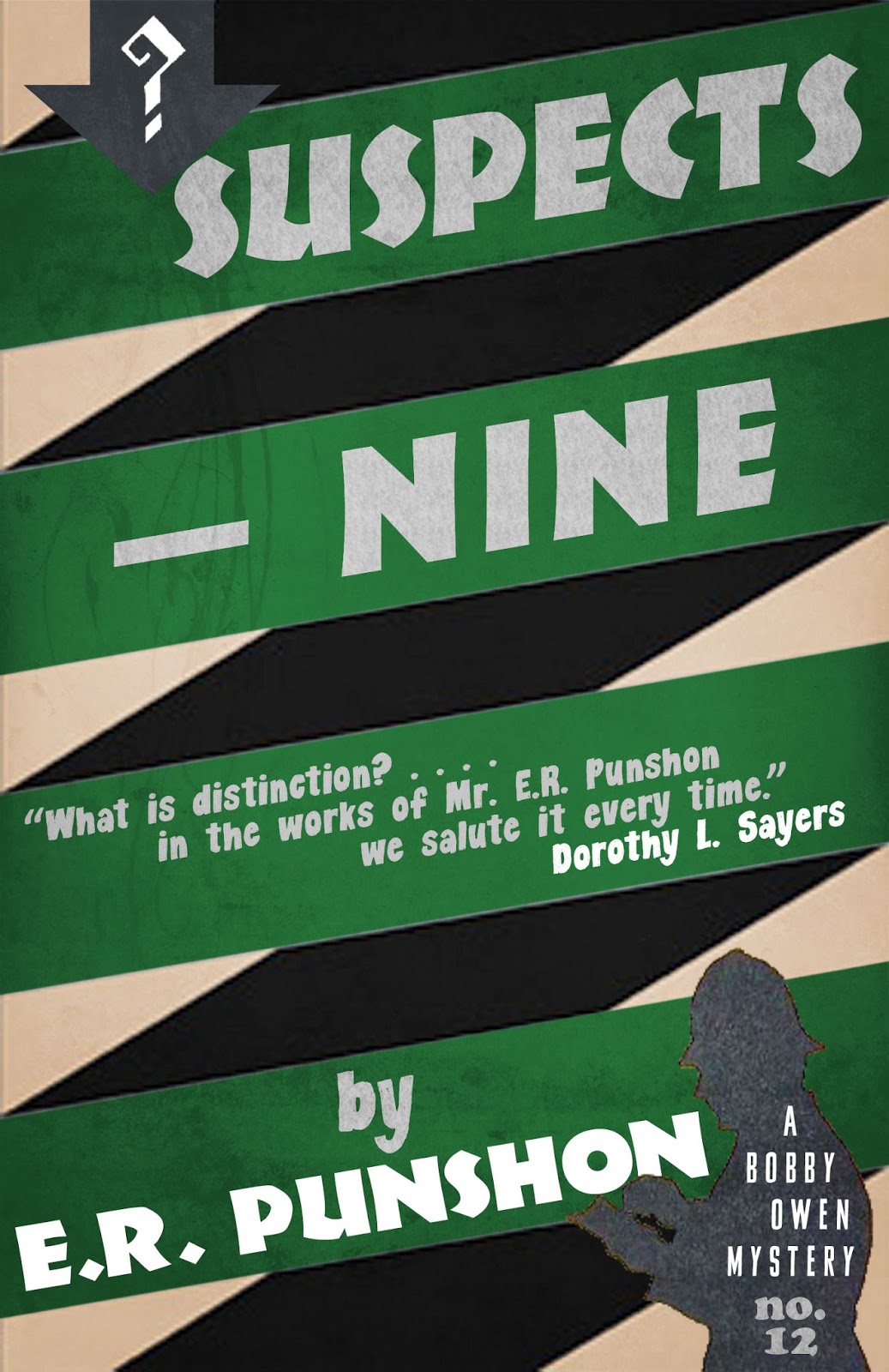
I'm also very excited about the new series of Punshon reissues, the author's 11th through 15th Bobby Owen mysteries: Comes a Stranger (1938), Suspects-Nine (1939), Murder Abroad (1939), Four Strange Women (1940) and Ten Star Clues (1941).

Collectively these books constitute, in my opinion, the single best group of Punshon mysteries, published when the author was at the apex of his popularity in England.

Dean Street Press has introduced a snazzy new design for this group of reissues, which also represent some of the rarest books in the Punshon canon.  Up until now, even most Punshon collectors hadn't been able to read these books (especially the first four), because they simply weren't available on the used book market.  To be able to help bring back worthy, almost impossible-to-find editions like these is a great joy for me.

Comes a Stranger is a bibliophile mystery, with a body in the library (or maybe not); Suspects-Nine is about a murder in fashionable London circles; Murder Abroad, partially based on a real life murder case, details a murder investigation in France; Four Strange Women is a serial killer novel with more than a few hints of horror; and Ten Star Clues is a classic country manor and village case that, like Josephine Tey's celebrated Brat Farrar, draws on the Victorian cause célébré of the Tichborne claimant.  All together a most inspired and entertaining group of Golden Age detective novels.

The Punshons are available for pre-order in in the US and UK and I will let you know when The Puzzles of Peter Duluth is out.  Some good stuff all round!


Friday, June 24, 2016

Plenty of Pleasing Punshons Are Pedaling Your Way!

a palpable sense of the sinister
This month I haven't been able to blog as much as I had hoped because of various writing jobs, including the latest batch of introductions for Dean Street Press' ongoing series of E. R. Punshon mystery reissues.

Coming next month are Punshon's Bobby Owen mysteries from the 1940s, an interesting period for the series, when the UK was bedeviled by war and postwar austerity. (And people think times are bad now!)

This was also a period when a major American publisher, Macmillan, picked up Punshon, producing much more attractive editions than what Punshon's longtime and steadfast English publisher, Gollancz, was putting out at the time.

Among book collectors Gollancz's so-called "Yellow Peril" dust jackets has an infamous reputation.  Noted publisher Victor Gollancz was not a believer in using attractive jacket art--or any art to speak of, really--to sell books.

Gollancz did believe in blurbs, however, and typically the Punshon novels published by the firm would bear Dorothy L. Sayers' famous "What is distinction?" blurb, drawn from a 1933 rave review of Punshon's first Bobby Owen novel, Information Received. Sometimes other blurbists of eminence were used by Gollancz, such as John Betjeman (see below), who later became Poet Laureate.

Nice Blurbs!

Macmillan, on the other hand, offered pleasing cover designs by prominent jacket artists of the time. Their books were also much better made.  On account of paper shortages, Gollancz editions at this time used tissue thin, acidic paper and microscopic print.

Reading Forties Gollancz books is not the aesthetic pleasure a devoted reader would like, their merit notwithstanding; but happily these new Punshon editions, which will be available both in paper and digital versions, will offer a great improvement on that score!

classy cover art

Additional discussion of these matters, and more, will be found in the introductions to the new Punshon reissues by Dean Street Press.

Sunday, April 26, 2015

Pick a Peck of Penguin Punshons

In a writing career lasting over half a century, English mystery writer E. R. Punshon (1872-1956), published over fifty mainstream and mystery novels, but he became best known for his 35 Bobby Owen detective novels, which appeared between 1933 and 1956, the year of Punshon's death. Although they had a spottier publication record in the US, the Bobby Owen series was quite popular in the UK, having been well-launched by a series of laudatory reviews from Dorothy L. Sayers in the Sunday Times.  Like Sayers, Punshon also was an early, and active, member of the Detection Club. (He is one the most featured members in my CADS booklet "Was Corinne's Murder Clued? The Detection Club and Fair Play.")


Five of Punshon's Bobby Owen mysteries were reprinted as Penguin paperbacks, between 1948 and 1955.  After Punshon's death in 1956, however, his books, with the exception of a couple of English library market editions, fell entirely out-of-print until 2009, a year that saw the reappearance of Diabolic Candelabra, a Punshon novel I had included on an internet list of 150 personal favorites by Golden Age authors and which since has been reviewed very favorably on several blogs.  Dean Street Press now plans to reprint the Bobby Owen series, beginning with the first five books in the series, the same five Penguin reprinted sixty and more years ago.


I'll be having more to say about Punshon in the weeks to come, as well as other vintage mystery writers, of course.  I have just about finished the index to my book on the detective fiction of Henry Wade and GDH and Margaret Cole, which along with the introductions, has been taking time away from the blog.  But I expect to be back to it more regularly by next week.

Sunday, June 30, 2019

Drawn and Quartered: The Case of the Fourth Detective (1951), by Christopher Bush


“People will do all sorts of things for money.  It’s still the best motive for murder.”
--Christopher Bush, The Case of the Fourth Detective (1951)


          During the nineteenth century canny newspaperman William Henry Smith and his equally canny son, likewise named William Henry Smith, established a remarkable newsstand and bookstall empire--named, appropriately enough, WH Smith & Son--at railway stations across the United Kingdom.  Train commuters avidly devouring detective fiction and thrillers in the form of Hodder & Stoughton yellow jackets and green and white Penguin paperbacks during the twentieth century heyday of classic crime fiction in the Thirties, Forties and Fifties often had purchased their prose treasures at WH Smith & Son bookstalls.  The company remained privately held until 1948, when, upon the death of the third Viscount Hambleden (the original William Henry Smith’s great-great grandson), shares had to be sold publicly in order to cover the costs of the ravaging inheritance tax (aka “death duties”) that had laid waste to the company’s once burgeoning coffers.  This event--much noted at the time, when the tax policies of Britain’s lately-installed Labour government were the subject of contentious debate--inspired Christopher Bush’s 39th Ludovic Travers detective novel, The Case of the Fourth Detective (1951). 
          In previous detective novels that Christopher Bush had published since the Labour Party took power in 1945, the author through his genteel sleuth Ludovic Travers had taken potshots at Labour’s confiscatory tax policies, making withering asides about the depredations of “Comrade” Hugh Dalton and Stafford Cripps, successive Chancellors of the Exchequer in the Labour government during the years 1945-50.  However, in The Case of the Fourth Detective, Bush, like contemporary crime writer and Detection Club member Henry Wade in his detective novel Diplomat’s Folly, likewise published in 1951, put Labour tax policy front and center in his book.  Some writers of classic British crime fiction felt so strongly about the estate tax issue that they continued to elaborate upon the dread theme even after Winston Churchill and the Tories were restored to power in 1951, the modern British welfare state having proved a hungry creature indeed—see, for example, Henry Wade (yet again) in Too Soon to Die, 1953, and Margery Allingham in The Estate of the Beckoning Lady, 1955, whose titles suggest their author’s agendas (as does “Taxman,” the title of a 1966 Beatles song about the 95% supertax introduced by the government of Prime Minister Harold Wilson, Labour having finally ousted the Conservatives from power again two years earlier).  However, in The Case of the Fourth Detective tax policy feels like more like a key plot point than an occasion for a jeremiad. 
          In the novel Ludovic Travers--now the owner, since the sudden demise from a heart attack of Bill Ellice, of the Broad Street Detective Agency--finds his firm called in by Owen Ramplock, who has succeeded to the chairmanship of Ramplocks, the chain of thirty-four provision shops he has inherited from his late magnate father, old Sam Ramplock.  By the time Ludo arrives at Warbeck Grove, the block of palatial flats where Owen Ramplock resides when in the City, however, Ramplock lease on life has expired.  Ludo finds him on the floor of Flat 5 “as dead as they make them: deader than last year’s hit-song.  At the side of the skull was a bloody gap where the bullet had done its work.  Messy work, but only too efficient.”     Ramplock’s call was taken by the Agency’s manager--Jack Norris, formerly a Chief Inspector at Scotland Yard—and he reports that Ramplock’s last words on the phone were Prince!...What the devil are you doing here!  So now Travers, rather than taking on a juicy job with posh Owen Ramplock, is tasked with trying to find Ramplock’s killer, by helping his old friend Superintendent George Wharton and young Sergeant Matthews of Scotland Yard to discover the identity and whereabouts of the mysterious man named Mr. Prince, who left behind him at the scene of the crime a cryptic calling card.  In bold letters on the back of the card is a terse message warning You’ll be Sorry.  
          Certainly there were plenty of people whom Owen Ramplock--a former playboy turned POW in Italy who until recently had never faced up to real work in his civilian life--had antagonized.  There are, for example, his wife Jane, from whom he was estranged (it appears Ramplock may have had a mistress) but with whom he had recently tried to effect a reconciliation, and Jane Ramplock’s uncle, lately returned from Canada, a character with a large stock of (tall?) stories by the name of Solverson.  Then there are various officers and staff at Ramplocks: Henry Dale, managing director; Richard Winter, head of sales; Charles Downe, chief accountant; and Miss Haregood, Ramplock’s highly efficient secretary.  “A schoolmarm to the life was what I thought her,” dismissively comments Ludo of Miss Haregood.  He is rather more taken with company typist Daisy Purkes, whom he deems “cute as a kitten with a black nose,” and he finds opportunity over the course of the case to interview Miss Purkes more than once on the premises of Ramplocks.  It seems that the company’s directors were trying to determine just how to deal with the crushing death duties imposed on the business after the demise of old Sam Ramplock.  Before his untimely demise was Owen Ramplock trying to cut a deal for survival with Herringswoods, a mammoth concern with over one hundred shops in London and the Home Counties?
          Kevin Burton Smith of the Thrilling Detective website, a devotee of the American school of tough crime fiction, has asserted that while Travers’ murder cases “may lean towards ‘hard-boiled’ they don’t lean far enough.”  For murder fiction fans happily steeped in the more genteel traditions of Anglo-American detective fiction of the between-the-wars period, however, Bush may have timed things just right.  Certainly in The Case of the Fourth Detective Ludo seems to have developed something of the more casual attitude about sex which is associated with American hard-boiled detective fiction.  “Ramplock’s morals didn’t interest me beyond their possible connection with his death,” Ludo confides at one point.  “I’ve skidded about a bit myself in my time and in my furtive moments I’ve thought monogamy a harshly Christian virtue.”  Recalling Ludo’s romantic revelations in The Case of the Magic Mirror (1943) and Christopher Bush’s own amorous flings (at least before he settled down with his longtime partner Marjorie Barclay), this seems an honest enough assessment.  Perhaps now we know why Ludo’s wife Bernice appears to spend so much of her married life away visiting friends.
          By this time, indeed, Ludo seems in many ways to have merged with his creator.  In The Case of the Purloined Picture (1949), for example, we are reminded that Ludo’s native ground is found in East Anglia, just like the author’s, and it is claimed that Ludo is “middle class,” putting him closer in social origin to Bush, who was descended from generations of humble Norfolk farming stock (though the claim that Ludo is of middle class origins is belied by earlier novels).  On American book jackets in the 1950s, underneath photos of the author, readers were informed that Bush was, like Ludo, a Cambridge man, though in fact this claim was untrue.  Bush himself admitted in his memoirs that he had missed his chance to go to Cambridge; evidently that lost opportunity long rankled. 
          In having to forego his chance at obtaining an elite English education, Christopher Bush resembled another prolific mystery writer and Detection Club member who created a popular genteel surrogate detective and has been reprinted by Dean Street Press: E. R. Punshon.  With his Newcastle sugar broker father having gone bankrupt and apparently left his family, Punshon at the age of sixteen was forced, he recalled in mid-life, “to work in the accounts office of a railroad….After a year or two my office superiors told me gently that they thought I was not without intelligence but that my intelligence and my work did not seem somehow to coincide. So I thanked them for the hint, gracefully accepted it, and departed to Canada…”  During the waning years of the reign of Queen Victoria, Punshon had a great many larger-than-life adventures in Canada and the American West—including, he claimed, an escape from a ravening pack of wolves—before he returned to England and settled down to a writing career of over a half-century’s duration.  As any good novelist would, Punshon drew on these New World experiences in one of his early novels, Constance West (1905).
          In his later years, ill with a wasting terminal disease, the now elderly Punshon spent some time, in the fall of 1949, recuperating from an operation at Little Horspen, the charming East Sussex Tudor home of Christopher Bush and Marjorie Barclay.  (Later that year Bush succeeded ER Punshon as the Detection Club’s treasurer.)  The next year, when Bush was writing The Case of the Fourth Detective, he amusingly included, in the person of Jane Ramplock’s uncle Matthew Solverson, a character that may well have been partly modeled on Ernest Robertson Punshon:

          “He’s a delightful person but you may find him…well, just a bit original….He was a natural born wanderer.  He tells the most marvelous stories of all the things he did in Canada and the States.”
          “I know,” I said.  “Bar-keep, prospector, hobo, farm-hand—everything.”
          “But how did you know?”
          “I didn’t,” I said.  “But they always do, at least in books.”

 
        As for the matter of identity of the titular fourth detective, there are Ludo, Wharton, Matthews and….Well, why don't you see for yourself.  The novel has been reprinted by Dean Street Press, along with numbers 31 to 40 in the Christopher Bush series.

Friday, May 1, 2015

Shady Doings: The Dusky Hour (1938), by E. R. Punshon

"Do you think young [Oliver] Moffatt left the lipstick behind as well?"
"Couldn't say, sir, if that's likely," answered Bobby.  "I've never seen him.  It might be true of some at the Cut and Come again [an arty, and disreputable, London nightclub]."
"Well, he's not that sort, anyhow, that's definite," declared the colonel.

                                                                 --The Dusky Hour (1937), by E. R. Punshon

The lipstick in the case lay next to the murdered man, who was found shot dead in his car.  Is the above an unexpected transvestism reference?  Either way, this is an interesting novel that, although disliked by Jacques Barzun, was highly praised by Milward Kennedy, a member of the Detection Club and successor to Dorothy L. Sayers as Sunday Times crime fiction critic.  Sayers too was a great Punshon fan.  More on the novel, which is to be reprinted this year, on Saturday.

Tuesday, July 12, 2016

Golden Age and Modern Age: Cops in Crime Fiction

One of the great misconceptions you run into about classical, puzzle-oriented detective fiction from the Golden Age (c. 1920-1940, but arguably longer than that) is the idea that the detectives from that era were almost invariably amateur or private sleuths, often gentlemanly "glamour boys" (as author Jonanna Cannan derisively termed them) like Peter Wimsey and Albert Campion--whom some readers, and perhaps the authors themselves, fell in love with--but also less romantically-inclined eccentrics of varying stripes, like Philo Vance, Ellery Queen, Nero Wolfe, Hercule Poirot, Lancelot Priestley and Reggie Fortune, and inquisitive older women, such as Miss Marple, Miss Silver and Mrs. Bradley. 

The game is afoot, what?

It's no wonder these brilliant, larger than life figures grabbed so much attention from readers (often aided by radio and film adaptations), but in fact a terrific number of the series sleuths in the Golden Age, both in the US and the UK, were policemen.  Even among the "Crime Queens" Agatha Christie's Superintendent Battle headlined a few of the author's novels and Ngaio March and Josephine Tey had policeman sleuths (admittedly highly sensitive ones).  And you don't have to look far to find additional examples.

recently finished my 25th introduction in E. R. Punshon's Bobby Owen detective series and was thinking about the depiction of policemen in crime fiction then and now.  Henry Wade was one of the British authors from the period who actually broached the idea of police corruption in his work, but British crime writers from the period tended to shy, I would say, from "making the police look bad" (as people put it), at least intentionally.  The view generally seemed to be that venality and "third degree" interrogation methods were things which happened across the pond, in America naturally, but not at home in the mother country, where people (and the institutions which they staffed) had standards.

Inspector French on the case
Sometimes British authors inadvertently made police detectives look not quite so admirable in many modern eyes, however, as when Freeman Wills Crofts has his ostensibly squeaky clean Inspector French--who of course would never get drunk (let alone get high), take a bribe or bed a woman besides his wife--making illegal searches, lying to and threatening witnesses to get information and, with a great show of post-WW1 xenophobia, nastily bullying a "German Jew" he deems insufficiently forthcoming.

The author himself, a highly religious man, likely thought that such behavior was justified in the good cause of fighting "evildoers" (to use his term); and possibly many British crime writers, not to mention much of the British public, agreed with him at the time.

In his books E. R. Punshon, a member of the UK's Liberal Party, makes a point of having Bobby Owen behave with greater scruples concerning citizen's rights and he also indicates that the police, Bobby naturally excepted, often do not, in fact, treat every citizen the same, having a tendency to be overawed by socially eminent people in positions of power.  These observations are part of what makes Punshon's writing interesting to me.

Of course anyone following news from the US is aware of how questions concerning the relations of police and civilians in this country currently are undergoing great discussion and debate (probably there's more debate than discussion).  That's a matter I choose not to get into here, but I thought I would look at some modern police fiction in which some of these issues are raised.

In particular I will be writing about an interesting new police series by Canadian author John McFetridge and a much-admired, long-running one by British-Canadian author Peter Robinson.  I have a high opinion of the work of both of these writers and I look forward to making some comparisons between their writing and that found in the Golden Age, as I did over four years ago in a piece about Freeman Wills Crofts and Ian Rankin.  Please stay tuned!

Tuesday, July 26, 2016

Secrets Can't Be Kept: The New Pack of Punshons is Here

The new set of E. R. Punshon "Bobby Owen" detective novel reissues are available now in eBook form (paper coming soon) from Dean Street Press at AmazonAmazon.co.uk and other Amazon sites.  These are:

The Dark Garden (1941)
Diabolic Candelabra (1942)
The Conqueror Inn (1943)
Night's Cloak (1944)
Secrets Can't Be Kept (1944)
There's a Reason for Everything (1945)
It Might Lead Anywhere (1946)
Helen Passes By (1947)
Music Tells All (1948)
The House of Godwinsson (1948)

As with the first fifteen Bobby Owen reissues by Dean Street Press, I wrote separate introductions of roughly 1000 words apiece for each of these latest reissues, a not inconsiderable though an enjoyable task.

In the introductions I look at E. R. Punshon's life, the books themselves of course and the literary, social and political context of the times, as Britain passed from the crisis of world war to a challenging postwar environment.

Punshon was quite aware of and engaged with his times, and numerous elements of life as he and other Britons then lived it appear in these novels, making them not only interesting mysteries but engrossing social history.  If you look at the books on Amazon, you can read the introductions by clicking "look inside."  Give 'em a look if you'd like.


Friday, May 15, 2015

The Boost of the Blurb: Death of a Beauty Queen (1935), by E. R. Punshon

The first five titles in Dean Street Press' reprint series of E. R. Punshon's Bobby Owen mysteries are now available in paperback, with the electronic versions on the way on June 1. (Dean Street Press has previously published vintage detective novels by George Sanders and Ianthe Jerrold.)

I've been writing introductions for each volume in the series, so I don't want to write too much here about this one title, Death of a Beauty Queen [DBQ] (See Amazon for my full introduction.)

I'll just say that it's an interesting puzzler about the slaying of a beauty contestant and that it incorporates into the plot some unexpectedly serious material about religion.  I strongly recommend it, as did, in her day, Dorothy L. Sayers.  Already by 1935, when DBQ was published, the opinions of Sayers--not only a popular mystery writer but the mystery fiction reviewer for the Sunday Times--had become desirable as book blurbs, as is demonstrated on the dust jacket of Gollancz's "cheap edition" of DBQ.  

Gollancz was famous--or infamous, depending on your view--for its so-called "yellow peril" dust jackets, which eschewed illustrative art.  But Gollancz did trumpet prominent endorsements:

"It is very fine," says Dorothy L. Sayers.

However, don't just take my word for it, or even Dorothy L.'s--get it for yourself and see what you think. And don't forget there are four earlier titles in the series available, with five later titles, including The Dusky Hour on the way soon.  All the titles will be available in paper and electronic formats.

Friday, June 26, 2015

The Spectrum of English Murder (2015), by Curtis Evans; Plus, the Punshon Project

The Spectrum of English Murder, my study of the detective fiction of the Golden Age English mystery writers Henry Lancelot Aubrey-Fletcher and GDH and Margaret Cole, originally published last month, now is available on Amazon. Aubrey-Fletcher, a baronet who published detective fiction under the pseudonym Henry Wade, and the Coles, a prominent socialist intellectual couple, illustrate the diversity of thought that can be found, contrary to much modern-day belief, in Golden Age British detective fiction.

Although Aubrey-Fletcher was a Tory and a member of the country's traditional landed elite, his detective fiction offers searching and sometimes searing criticism of myriad aspects of British society.  A pioneer of both the police procedural and the crime novel (though no mean puzzler when he chose to be), Aubrey-Fletcher was an important figure in the movement to transform the classical tale of detection.

As a sideline from their serious writing on politics and economics, the Coles produced a significant body of detective fiction, much of it mocking conservative British values. Although less formally innovative in their mystery writing than Aubrey-Fletcher, the husband and wife were exceptional within the genre at this time for their employment of leftist-tinged satire and farce.

Following the path laid in 2012 with my book Masters of the "Humdrum" Mystery, which studies the so-called "Humdrum" detective fiction--so styled because of its narrative focus on carefully structured puzzle plots--of Cecil John Charles Street (John Rhode/Miles Burton), Freeman Wills Crofts and Alfred Walter Stewart (JJ Connington), The Spectrum of English Murder analyzes the work of three additional important British Golden Age mystery writers. All six authors, incidentally, were original members of the Detection Club and some of their work gets notice in Martin Edwards' recently published book on the Detection Club between the two world wars, The Golden Age of Murder.

Additionally, I am near completion of my latest round of introductions to reprints of the Bobby Owen detective novels of another Golden Age English mystery writer and Detection Club member, E. R. Punshon.  These reprint editions are published by Dean Street Press, who earlier this year reprinted the two Golden Age John Christmas mysteries of original Detection Club member Ianthe Jerrold, for which I also wrote introductions.

When the Punshon project is completed, I likely will have written about him some 35,000 words, as each individual introduction in the series is about 1000 words and there are 35 Bobby Owen detective novels. This 35,000 words will be about the same length of my individual chapters on Crofts, Stewart, Aubrey-Fletcher and the Coles.  I am pleased that the Punshon project not only makes a notable and accomplished Golden Age mystery writer more accessible to classic mystery fans, but that it has allowed me a platform on which to discuss the fascinating mysteries of Golden Age murder fiction.

Friday, December 18, 2015

Coming Attractions! More Ianthe Jerrold Mysteries: Let Him Lie (1940) and There May Be Danger (1948)

I would be remiss not to mention that the fabulously well-read Michael Dirda, in "Beyond the Bestsellers," his Washington Post review column from last week, included my new book The Spectrum of English Murder (2015) on his list of a dozen recommended books for the holidays, along with such diverse selections as The Big Book of Sherlock Holmes Stories and The Poems of T. S. Eliot. (Of course readers of this blog will know that Eliot was a great fan of detective fiction.) This was so nice to see--especially as Spectrum was published by a small (though excellent) press and is not exactly what one could call a massively publicized tome!

Spectrum, about the Golden Age crime fiction of Henry Lancelot Aubrey-Fletcher (Henry Wade) and GDH and Margaret Cole, is a companion volume of sorts to my 2012 book Masters of the "Humdrum" Mystery, about the austerely puzzle-oriented mystery writers Cecil John Charles Street (John Rhode, Miles Burton), Freeman Wills Crofts and Alfred Walter Stewart (J. J. Connington).  The six authors were all founding members of Britain's Detection Club, a social organization of many of the era's finest mystery writers. (Martin Edwards has written about the Detection Club during the Thirties in his recent popular history The Golden Age of Murder.)

Michael Dirda also mentioned my work with Dean Street Press, who has followed the British Library in reissuing quality editions of vintage English mysteries.  As readers of this blog will know, I have written introductions for DSP's reissues of detective novels by Ianthe Jerrold, another charter Detection Club member, E. R. Punshon, an early Detection Club member, and Annie Haynes and Harriet Rutland, two quite different, but both very interesting, Golden Age crime writers who book-ended the era.

With my introductions for DSP reissues of these authors' works, I've enjoyed expanding what is known about writers like Jerrold and Punshon (with the prolific Punshon I've written introductions to fifteen of his novels so far, totaling over 15, 000 words) and, in the case of Haynes and Rutland, recovering what essentially were forgotten lives.  I'm doing this all again with seven DSP reissues in January, two of them Ianthe Jerrold's forgotten mysteries written under the pseudonym "Geraldine Bridgman" (Let Him Lie and There Might Be Danger) and five of them detective novels by another almost entirely forgotten mystery writer (more on him coming soon).

In the two newly reissued Ianthe Jerrold novels, the author abandons her brilliant amateur detective, John Christmas, who appeared in her earlier books The Studio Crime and Dead Man's Quarry, in favor of intrepid women sleuths who are drawn into crime investigation out of their sense of empathy for the plights of others, especially children.

These two fine mystery novels, which reflect events from Ianthe Jerrold's own life in the 1940s (more on this later), look ahead to the modern crime novels of authors like Ann Cleeves, I would argue; and I'm very happy to see them back in print after, respectively, 75 and 67 years!

Saturday, December 31, 2016

Out with the Old, In with the...Old: 2016 at The Passing Tramp

My blog activity in 2016, the fifth year anniversary at the blog, was mostly devoted to discussing writing projects of mine: the original essay collection I edited called Murder in the Closet (more on this soon) and introductions to vintage mystery issues by Crippen & Landru (Patrick Quentin's The Puzzles of Peter Duluth), Coachwhip (Clifford Orr's The Dartmouth Murders, 1929, and The Wailing Rock Murders, 1932, Louis F. Booth's The Bank Vault Mystery, 1933, and Brokers' End, 1935, Katherine Woods' Murder in a Walled Town, 1934, Anita Boutell's Death Brings a Storke, 1938, and Cradled in Fear, 1941, and Ada Lingo's Murder in Texas, 1935) and Dean Street Press (20 E. R. Punshon titles, 6 reissues by Molly Thynne, and over 30 of Patricia Wentworth's mysteries--the ones without Miss Silver). That's 1 book for Crippen & Landru, 8 books for Coachwhip and nearly 60 for Dean Street Press, for a total of nearly 70 books (though "only" 22 individual introductions, I believe).

The Punshon project was the most involved, extending back two years now and seeing the reissuing of Punshon's entire oeuvre of Bobby Owen mysteries (35 novels, 5 short stories and 1 radio play).  In total I wrote around 30,000 words in introductions for the series, making them collectively rather like an additional chapter to my two books on British mystery writers, Masters of the Humdrum Mystery (John Street, Freeman Wills Crofts, J.J. Connington) and The Spectrum of English Murder (Henry Wade, G.D.H. and Margaret Cole).

But I enjoyed as well writing about Patrick Quentin (about whom there is yet more in Murder in the Closet), and Molly Thynne, Clifford Orr, Louis F. Booth, Katherine Woods, Anita Boutell and Ada Lingo. More is on the way this coming year, 2017.  I have already written an introduction for Eleanore Kelly Sellars' Murder a la Mode (1941), which will be out in January, and introductions for Elizabeth Gill's three "Benvenuto Brown" detective novels--Strange Holiday (1929), What Dread Hand? (1932) and Crime De Luxe (1933)--which will be out in February.  And there is much more to come!

On the blog I had lengthy pieces on the lives of crime fiction writers Kurt Steel, Amen Dell and Gordon Meyrick (all of whom are coming back in print in the coming year), Phoebe Atwood Taylor and the mother and daughters Helen Reilly, Mary McMullen and Ursula Curtiss, as well as crime fiction illustrator GP Micklewright; a long discussion about controversy surrounding Miles Burton's The Chinese Puzzle (1957); and reviews of Margaret Maron's Christmas Mourning (2010), Mary Roberts Rinehart's The Yellow Room (1945), Jonathan Stagge's The Three Fears (1949), Phoebe Atwood Taylor's The Annulet of Gilt (1938), Victor Gunn's Three Dates with Death (1947), George Bellairs' The Dead Shall Be Raised (1942) and Death on the Last Train (1948), W. Bolingbroke Johnson's The Widening Stain (1942), M. C. Beaton's Death of a Travelling Man (1993) and Death of a Bore (2003), Helen Reilly's Name Your Poison (1942), Mary McMullen's Strangle Hold (1951), Ursula Curtiss' The Noonday Devil (1951), HRF Keating's Inspector Ghote's Good Crusade (1966), Gordon Meyrick's The Body on the Pavement (1941), Colin Dexter's Service of All the Dead (1979), Douglas Clark's The Longest Pleausre (1981), Helen McCloy's She Walks Alone (1948) and Gladys Mitchell's Groaning Spinney (1950).

Of these 20 latter books, I would say the best was The Widening Stain, a classic American mystery in an an academic setting. Rue Morgue Press did reissue this one, but it has since gone out of print. Hope someone brings it back!

I wish my blog readers a happy new year and I promise to try to do more reviews while I keep my off-blog writing activities going.  The coming year holds promise of many interesting things, and not just in the world of vintage mystery.