Showing posts sorted by relevance for query rufus king. Sort by date Show all posts

Sunday, August 26, 2012

John Dillinger, Cole Porter and Rufus King Walk Into a Bar....

What connects John Dillinger, renowned gangster, and Cole Porter, renowned songwriter, to Rufus King, once highly esteemed but now mostly forgotten mystery writer?  The Cole Porter connection is not altogether startling (Mike Grost also mentions this on  his website). However, the John Dillinger connection was totally unexpected.

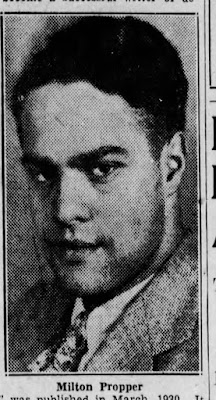
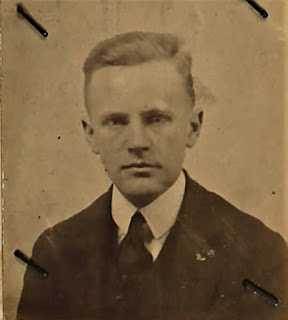
Both Cole Porter, born on June 9, 1891 and Rufus King, born on January 3, 1893, were only children of wealthy parents and attended Yale University in overlapping years.  The families of both men intended that their Yalies become respectable lawyers, but it didn't quite pan out that way.

Both Porter and King took to the musical in a big way while at Yale and they became key members--and in their respective senior years, presidents--of the Yale Dramatic Association (King also was a member of the Elizabethan Club, dedicated to conversation, tea and literature, and the Pundits, the senior prank society).

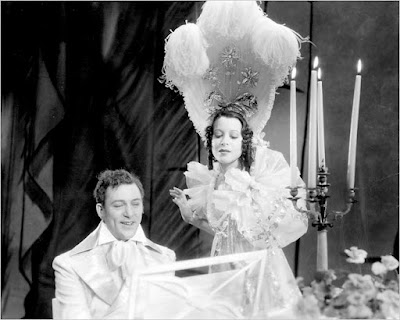
When King came to Yale the precocious Porter already was writing musical plays for the YDA.  "Rufe" King, who was adept among the all-male membership at playing women's parts, became one of the YDA's star attractions (about King, another member of the YDA, Arnold Whitridge, wrote the following--no doubt envious!--couplet: "Little Rufe King couldn't teach me a thing/I'm the Queen of the Yale Dramat").

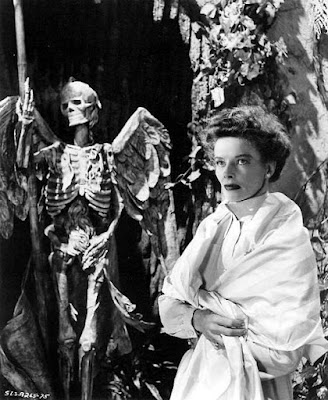
Perhaps the best known Porter play in which King starred was And Still the Villain Pursued Her (1912), a send-up of Uncle Tom's Cabin and nineteenth-century melodramas.  King's friend, the future Oscar-nominated actor Monty Woolley played the villain, while King, age nineteen, took the heroine's part.
 
Here's an except from Porter's song (sung by King) "The Lovely Heroine":

Oh gee! It's heaven to be the lovely heroine.
All the men woo me
And try to undo me
But that's not my line.
I live so far from New York
I faint dead away at the smell of a cork.
Why! I'm such a child I believe in the stork!
For I'm the heroine.

Wooley's lyric from "I'm the Villain" naturally was a mite more pugnacious:


Cole Porter at Yale
Oh, I'm the villain,
The dirty little villain;
I leave a pool of blood where e'er I tread,
I take delight 
In looking for a fight
And pressing little babies on the head
Till they're dead.

(see The Complete Lyrics of Cole Porter, p. 13-14).

Little Rufe King was much in demand for women's parts.  In other Porter musicals King sang the numbers "Oh What a Lovely Princess" (Years have I waited for someone adorable/So far my luck is deplorable) and "The Prep School Widow" (I find that school boys offer more/than many a college sophomore).

In 1914, King was planning to enroll in Columbia Law School (surely a loss to musical comedy), but instead he steered another, more unexpected, course.

Rufus King, author
King spent a couple years at sea as a shipboard wireless operator, enjoying a "romantic life of rolling ships and strange ports" (and obviously picking up a lot of maritime knowledge that would figure in many of his later novels).  He also worked a year in a Paterson, New Jersey silk mill, before serving as an artillery lieutenant in World War One.

After the war King was employed for a time in the maritime division of the New York police, before achieving success in late thirties as a mystery novelist.  All in all, surely one of your most interesting mystery author backgrounds!

Now what, oh what, does John Dillinger have to do with any of this (admittedly it's a little hard to see the notorious public enemy performing star turns in musical comedy)?

Well, in April 1934, Dillinger and his gang were holed-up at the Little Bohemia Lodge in the upstate Wisconsin village of Manitowish Waters.  The lodge owner's wife managed to get a letter to the FBI, which launched a badly botched assault on the building, in the process killing a bystanding Civilian Conservation Corps worker, but failing to capture or kill Dillinger or any members of the gang.

Little Bohemia Lodge, site of a 1934 FBI-Dillinger altercation

Evidently a good businessman, the owner of the lodge, Emil Wanatka, sought to get as much publicity out of the bloody shoot 'em up as he could.

Besides selling his story to Startling Detective Adventures ("I Was Held Captive by Dillinger and Saw Him Blast His Way to Freedom"), Wanatka proudly pointed out to visitors the bullet holes in the walls and windows of his lodge and displayed Dillinger possessions that he said he had found in the small cottage adjacent to the lodge where Dillinger had stayed during his brief but memorable visit (Wanatka also faked a photo of him and Dillinger together; see below).

Proud members of the Rufus King fan club?
These Dillinger possessions included, besides the odd gun or two, two books: John Fox. Jr.'s The Little Shepherd of Kingdom Come (originally published in 1903), a popular Civil War novel, and, yes--you've surely guessed it by now--a Rufus King mystery, Murder on the Yacht (1932).

So was our man Dillinger a fan of Rufus King, an author who "to millions of people" had made-- according to the enthusiastic publicity people at King's publisher Doubleday, Doran--his detective "Lieutenant Valcour a symbol of danger and excitement" (obviously Dillinger didn't get enough danger and excitement in his life already)?

It may well be so--though surely a true crime fiction addict would have dashed back to that cottage and grabbed the book before eluding the clutches of the FBI. Surely one just can't go and leave a Rufus King novel unfinished!

Dillinger must have finished reading Murder on the Yacht before the boys from the bureau started shooting.  Or maybe he waited to make his escape until he finished the last page ("Just one more page, Floyd!").

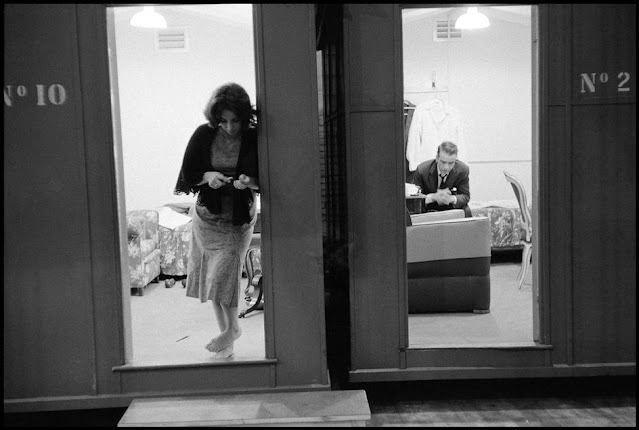
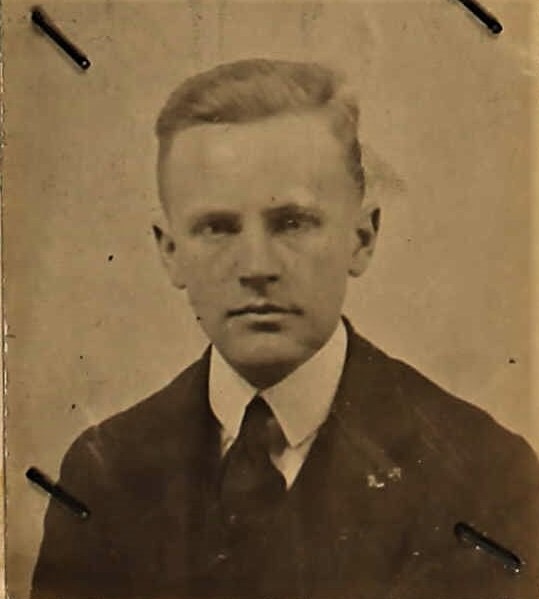
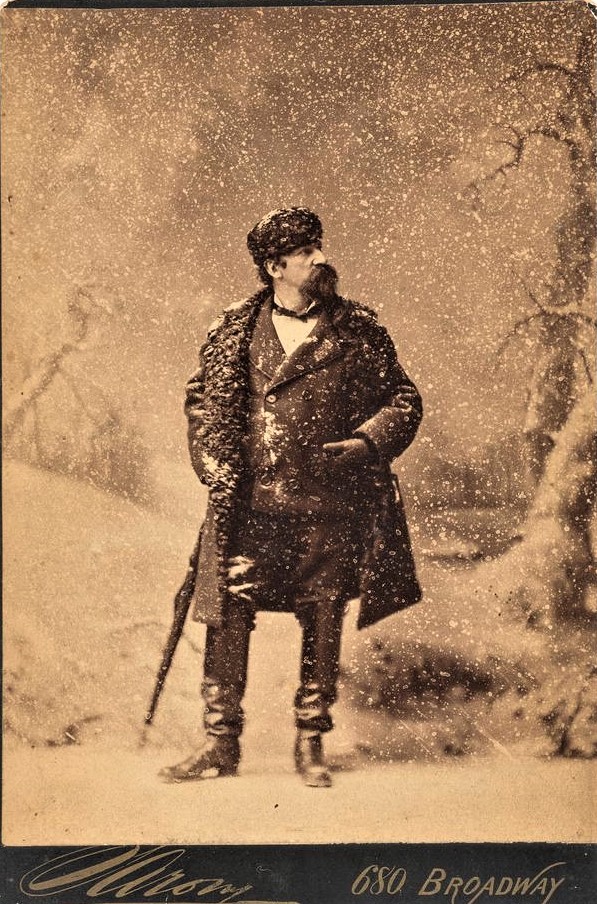
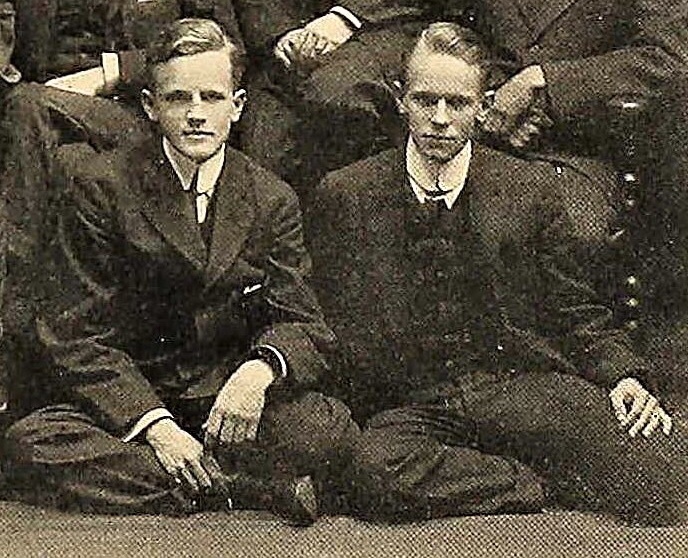
Note: Pictures One and Four are courtesy of Bill Pronzini.  Dillinger and his gang also attacked a state police arsenal in Peru, Indiana, birthplace and boyhood home of Cole Porter, oddly enough.  Did Rufus King ever visit Peru, Indiana?  I'm on the case!

Meanwhile, see my recent review of King's classic Murder by Latitude (1930) here.  A review of King's Murder on the Yacht is coming, along with reviews of Ellery Queen, Rex Stout and Max Alan Collins. TPT

Friday, August 24, 2012

Maneaters: Murder by Latitude (1930), by Rufus King

Valcour sat beside Captain Sohme at the forward end of the small lounge.  The leaden sky and air made of it a cubicle of murk which the ceiling lights, that had been turned on, scarcely affected at all, and the sea was a woman's glass with the ship a tense, unhappy atom creeping, turn by turn, along its flat insensate floor.... (Murder by Latitude, 1930)

For a short period in the early to mid 1930s there were, in the eyes of a number of mystery critics and readers of the time, two reigning monarchs of American classical detective fiction, Ellery Queen and Rufus King.  If Ellery Queen's reputation has faded (most unjustly) among the mystery masses, Rufus King's has vanished into air. I have only read a few novels by Rufus King, but in my view on the strength of his fifth mystery novel, Murder by Latitude, his name should be not merely recollected but lauded.

Certainly Murder by Latitude at least should be in print!  It's one of the major American works within the detective fiction genre from the period between the two World Wars.

a novel as stylish as its dust jacket

Murder by Latitude is one of those novels with a plot so suspenseful that one really must be careful in the name of aesthetic justice of writing too much about it.  Broadly speaking, Murder by Latitude, as the title indicates, is an ocean liner mystery, one of early vintage.  There is a very early yacht mystery, The After House (1914), by Mary Roberts Rinehart and I know Carolyn Wells did one typically mediocre effort in the 1920s called The Bronze Hand that takes place on an ocean liner. There also are a number of later examples, including several others by King himself.  One of the best known of these is John Dickson Carr's The Blind Barber (1934).  However, King's maiden effort in this sub-genre made a great splash at the time--and deservedly so.

On the ship in Murder by Latitude is a remarkably ruthless murderer.  He--or she?--has killed once already and kills again on board the liner Eastern Bay as it makes its tortured way from Bermuda to Halifax.  Indeed, the novel opens in quite an attention grabbing manner with a description of the strangling of the ship's wireless man.  This savage slaying has the effect of preventing the ship from getting messages from the New York police, who now have a description of the murderer for Lieutenant Valcour, King's series detective, who is also on board the ship, trying to catch the culprit.  Now Valcour is left groping in the dark, and the murderer has not yet completed his (her?) work....

the English edition of King's novel

Murder by Latitude is something one doesn't come across every day: a real page turner.  I read over 200 pages in one sitting, something I very rarely do these days.  It's superbly suspenseful (why are those objects disappearing?), evocatively written (you really get the sense of a ship at sea), modern in tone and well-characterized (more below) and, best of all for a 'tec fiction fiend, it boasts a really clever solution, masterfully twisted by the hand of a storytelling virtuoso. 

in the book it's the stiff that's deshabille
--though the dame indeed is a blonde
Mike Grost, who has written rather extensively on the internet about Rufus King (Grost and other bloggers who have written about King are linked below), argues that Latitude is also notable for its "gay sensibility."  I have to say I agree with Grost's assessment.

For example, the middle-aged, much married Mrs. Poole is a maneater who harpoons (Valcour's word) much younger men as husbands.  She is on board with husband number five, Ted Poole, who is constantly portrayed in an objectified manner by the author. "It was a pity he had his clothes on," thinks Mrs. Poole, as she looks over at her much younger husband "wriggling" on a deck chair.

There is also a movingly portrayed relationship between two crewmen on the ship that is, as Mike Grost has written, rather Melvilleian in tone.  Then there's that queer Frenchman, Mr. Dumarque, a remarkable epigram-tossing aesthete.  Latitude is not a "gay mystery," but it does seem as though it might have been written by a gay man.

Currently very little is known about Rufus King, even though he was a popular and prolific writer within the mystery genre for many years, publishing twenty-three mystery novels and short story collections between 1927 and 1951 and three more genre books between 1958 and 1964.  He died two years late in 1966, at the age of 73.
 
King graduated from Yale in 1914, then spent a few years at sea, enjoying "a romantic life of rolling ships and strange ports."  He also spent some time as a workman in a Paterson, New Jersey silk mill.  When the United States entered the Great War he served in it as an artillery lieutenant. King's first mystery novel did not appear until ten years later, when King was 34, but he quickly made a name for himself in the field.  His breakthrough detective novel, Murder by the Clock (1929), was adapted into a well-regarded film in 1931 (the other best-known Rufus King film is the Fritz Lang directed The Secret Beyond the Door, 1947).

the derelict Delaware and Hudson Railway Station at Rouse's Point, New York
where Rufus King regularly would have stopped off


During his life King annually resided part of the year at Rouse's Point, New York, located on Lake Champlain a mile south of the United States-Canada border.  He was a good friend of the Oscar-nominated gay actor Monty Wooley, a fellow New Yorker and Yalie.  I believe both his life and his books are worth exploring.

Links to other bloggers on Rufus King:

Mike Grost (detail on plots)

John Norris (Murder by the Clock)

TomCat (The Case of the Constant God)

Pietro De Palma (Murder by Latitude--SPOILERS!!) Pietro calls it a "masterpiece" and I agree!

Sunday, April 5, 2015

Murder Farce: The Deadly Dove (1945), by Rufus King

"I will tell you more," Joe said, "about the Dove.  He is a gentlemanly, mild-mannered old guy, and for looks you would think that a sneeze would blow him away. With him you never have to worry. Just give him a  job and you can forget about it."

--The Deadly Dove (1945), Rufus King

In The Deadly Dove, Rufus King's assassin, the mild-mannered murderer known as the Dove, is, course, ironically named.  Rather than a man of peace he is a professional hit man, one highly-regarded within the slay racket.  His professional services are called upon in The Deadly Dove.

In New York actor Alan Admont has married the widow Christine Belder. Christine is wealthy and imperious while Alan is handsome and impecunious. Also, Christine is sixty and Alan is twenty-five.

Alan owes a very substantial sum of money to gangster Joe Inbrun, who concludes that the best way for Alan to be in a position to pay him back would be if Alan were to inherit a chunk of change from a rich, dead wife.  Joe tells Alan he has hired the Dove to eliminate Christine at her crumbling Gothic pile of a mansion in the Catskills, where the couple is staying, surrounded by a very odd coterie of retainers.  However, the best-laid plans....

Christine returns from a trip to New York having been persuaded by her conservative, perpetually suspicious attorney, Stuyvesant Swain (a loyal friend of her dead first husband and bemused observer of her own affairs), to create an immediate lifetime annuity. This means that upon Christine's demise gold-digging Alan will get nothing but her jewels, which are enough to cover his debt to Indrun and Indrun's debt to the Dove, with precisely nothing left over for him.  Suddenly Alan has every reason to keep his wife alive. But the deadly Dove already has set flight for the Catskills! What to do now....


The Deadly Dove is a short, farcical murder novel that, as others have commented before me, reads very much like a novel adapted from a play. Like The Case of the Dowager's Etchings and Museum Piece No. 13, both reviewed on this blog, it was originally lucratively serialized in a "slick"; however, I have seen no evidence that it actually was a play, although Rufus King in the 1930s enjoyed some success with play writing, as John Norris has documented.

The Dove is very much the sort of villain one might have expected to see on stage, during the between-the-wars years, in an Edgar Wallace crime thriller; yet in his novel King plays the criminous situation more for laughs than for thrills. I enjoyed the proceedings, but then I enjoy murder farces.

another Belarski pb cover,
clearly adapted from the pulps
(this scene doesn't actually quite
happen in the novel--the Dove
is not so crude a killer)
Rufus King's wealthy father, who died when Rufus was 35, appointed the King family lawyer as Rufus's trustee; and the relationship between headstrong Christine Belder and cautious Stuyvesant Swain may bear some resemblance to that between Rufus and his trustee (a family friend wryly commented on John Norris's blog, "Rufus needed his money looked after").

A relationship between an older wealthy women and a younger attractive man is a familiar motif in King's writing and I think one that reflects the likelihood that King was almost certainly gay. That King's fiction has certain gay aspects to it seems obvious to me, as well as John Norris and Mike Grost; yet this is something that had never been alluded to within the mystery community, as far as I know, before we three began blogging about his books.

King portrays Christine Belder as an eccentric, no question; but ultimately he seems impressed with her determination to live life as she pleases, with little concern for conventional opinion of the day. Can Christine be seen as a female "gay icon" archetype? I think so.

Tuesday, March 31, 2015

The Case of the Dowager's Etchings (1944), aka Never Walk Alone (1951), by Rufus King

Mrs. Carter Giles, for decades the dowager of Bridgehaven, decided that her contribution to the war effort would be opening her house to the war workers who were overcrowding her little city.  She expected to be able to pick her lodgers with the discrimination for which she herself had always been noted.  But Fate and the lodgers decreed otherwise, and a few hours after the invasion of her motley crew, Mrs. Giles found a body under the bushes next to the house....

--from the front jacket flap of The Case of The Dowager's Etchings (Doubleday Doran, 1944)

River Rest was a JUNGLE--And he would be king of this jungle.  He moved down the carpeted hall, his animal senses alert and quivering....Only an old woman stood between him and his dream of wealth....Without realizing it, Carrie Giles had become a stranger in her own home.  Four roomers had moved in.  Three were cold-eyed men.  The fourth was a predatory female whose every word and gesture was a wanton invitation.  All four were interested in Carrie's etchings.  But she never knew why--until a silent killer walked into her room!--from the back cover of Never Walk Alone (formerly The Case of the Dowager's Etchings) (Popular Library, 1951)

Going stag: the hardcover edition
Surely nothing in crime fiction illustrates the calculatedly salacious marketing of fiction in the early years of the paperback revolution than the startling transformation of Rufus King's The Case of the Dowager's Etchings (a 1944 hardcover) to Never Walk Alone (a 1951 paperback).

This remarkable publishing alchemy is a process that academia now metaphorically designates "pulping," i.e., making books more available to readers as cheap paperbacks with vivid, sexualized covers--often adapted by artists from original pulps art--guaranteed to catch the eye, titillating many, while outraging others (in the 1950s Congressional pressure would encourage publishers to tone down the covers).

In 1944, The Case of the Dowager's Etchings was published by that great warhorse of American crime fiction publishing, Doubleday Doran's Crime Club. By this time the Crime Club had a visual categorization system with an array of symbols meant to immediately signify to Crime Club members and potential buyers what kind of mystery they were getting with each title.  The Case of the Dowager's Etchings was denoted with a clutching hand, signifying "character and atmosphere."

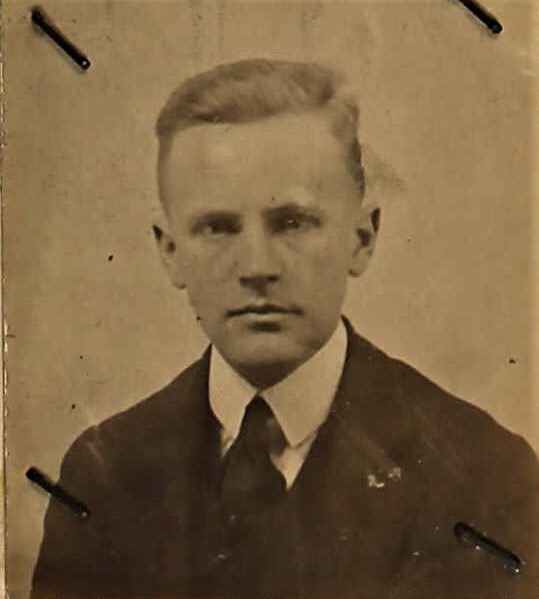
Rufus King in the 1930s
This is a fair classification.  Although in the 1930s Rufus King, like John Dickson Carr, opted in his mysteries for fleeter, more thrilling fictional narratives than those of the so-called "Humdrum" school of Freeman Wills Crofts, John Street and others, he nevertheless fashioned these narratives in the form of classical detective fiction. By the 1940s, however, King was moving away from the traditional detective fiction form to something more on the order of the suspense thriller. Perhaps the best known of this group of King crime novels is Museum Piece No. 13, a modern Bluebeard fable that was filmed, with significant differences from the novel, as The Secret Beyond the Door (1947) (see my review of the novel here).

The Case of the Dowager's Etchings is a fine example of suspense fiction, but where Museum Piece No. 13 is predominantly Gothic and gloomy, Etchings conforms much more to the novel of manners style most associated today with the British Crime Queens Dorothy L. Sayers, Margery Allingham and Ngaio Marsh, with some good character studies, witty writing and minute social observation.

The protagonist of Etchings, the blue-blooded Carrie Giles (Mrs. Carter Giles), is a skillfully-delineated character, one of a long line of memorable wealthy matrons in Rufus King's fiction. King, who grew up in New York City in privileged circumstances--prep school and Yale; summers in Rouses Point, a town at the northern tip of Lake Champlain just below Canada; winters in Florida) no doubt knew such people well (I suspect he drew partly on his own mother).

Although it is unquestionably a slighter novel, Etchings reminds me to some degree of Elisabeth Sanxay Holding's brilliant crime novel The Blank Wall, which it preceded by three years. Holding's novel, also set during the Second World war, offers a fascinating look at social changes wrought by the conflict, particularly in the roles of women, including, in the case of the protagonist of that novel, wealthy, sheltered white matrons.

King skillfully navigates this same process of personal growth with Carrie Giles, who feels, in an increasingly democratic age, obsolete and resented by the local hoi polloi, some of whom make their feelings vocal when they see her being driven about town, to their disgust, in a Victorian carriage, pulled by a "roached black mare" (Mrs. Giles brought out the carriage again because of wartime gasoline rationing).

Rooms to let: all just as Papa left it
Her dashing grandson is a war hero, but Mrs. Giles wants to do more personally for the patriotic cause; so she decides to open her mansion to take in a quartet of war factory workers, having learned that housing for these people is inadequate and overcrowded. Regrettably for Mrs. Giles, trouble soon flows from this noble resolution.  As the hardcover edition explains, not long after she takes in her new boarders, she finds a dead body in the bushes. Soon Mrs. Giles is tangling with mysterious forces that seem to have criminal designs centering on her house.  Who can she trust?  And will the killer feel compelled to kill again?

Mrs. Giles does some investigating in her own right and King offers readers one splendid clue, so there is genuine detective interest in Etchings, but I think readers may enjoy the novel most, like I did, for its "manners."

One of my favorite aspects of the novel is how King has Mrs. Giles, a woman in her seventies, constantly reflecting on the things her Papa did or said. It seems like practically everything in the mansion, River Rest, was purchased by Papa or chosen by Papa.  It's a wonderful portrait of a masterful Victorian father, sublimely confident even when utterly mistaken and though long dead still a great influence on his daughter (however there are signs his grip finally may be slackening).

In its blurb the hardcover edition of Etchings doesn't mention, oddly, the Victorian-era etching, a pastoral scene with stag done by Mrs. Giles, that figures significantly in the plot, though it is depicted in the somewhat stodgy front cover illustration.  On the whole, however, the plot description details the novel's doings dutifully, if a bit dully.

Cinematic: ready for their closeups
With the 1951 Popular Library paperback edition, The Dowager's Etchings got  a major makeover. On the cover we have quite a dramatic moment, courtesy of Rudolph Belarski (one of his best pieces of work I think). A character in the book explicitly is compared to Humphrey Bogart, and certainly that man on the cover bears resemblance to the actor.

In the novel there also is a sexy, brassy woman factory worker (Rosie the Ravisher one might say, or, as the back cover blurb rather overheatedly puts it, "the predatory female whose every word and gesture was a wanton invitation").  I assume this is meant to be the woman on the cover who resembles Rita Hayworth (it's certainly not Mrs. Giles).

The problem is this scene never quite occurs in the book! Nor does the new title seem very particular to the novel. Perhaps it's meant to reflect how Mrs. Giles has to rely, amid great danger, on her own devices in the crisis she faces, with her beloved grandson frequently sidelined? Was the publisher drawing on "You'll Never Walk Alone," the Rodgers and Hammerstein hit from Carousel (1945)? (The song is vastly more familiar to my British readers, I suspect, in this version by Gerry and the Pacemakers.)

Don't let any misleading cover art or blurbs spoil your enjoyment of the actual text of the book.  The Case of the Dowager's Etchings is another great novel from an American Golden Age Crime King, whatever one puts on its covers.

Other Rufus King novels reviewed at The Passing Tramp:

Maneaters: Murder by Latitude (1930)
Tempests: Murder on the Yacht (1932)
Reefs: The Lesser Antilles Case (1934)

Good news too for fans: All the Rufus king novels are being reprinted, by Wildside Press. I wish I could say I has something to do with it (I had been trying for years), but at least it's finally happening.

Monday, September 3, 2012

Reefs: The Lesser Antilles Case (1934), by Rufus King

I've been enjoying reading Rufus King very much, so expect to see more of his stuff here the rest of the year.  But, bear with me, I won't turn this into the Rufus King blog.  After this one will come books by Ian Rankin and George Bellairs (both police procedurals, I would say, no matter how much the term "Tartan Noir" is thrown out concerning Rankin).

However, back to the matter at hand, Mr. King!


The Lesser Antilles Case is the third of three maritime mysteries starring King's series detective Lieutenant Valcour that appeared between 1930 to 1934 (Valcour also solved two non-maritime mysteries in this period).   

Chart your course for death!
 Antilles has a different structure from the earlier two, Murder by Latitude (1930) and Murder on the Yacht (1932).  Instead of starting with Valcour joining the passengers on a maritime craft to try to catch a murderer on board, Antilles begins with survivors of a maritime disaster--the foundering of a yacht, Helsinor, on a reef in the Lesser Antilles--returning to New York unhappily to face the bright, invasive flashes of press cameras.

We learn that while on a lifeboat the survivors may have been drugged with chloral and two of their number--the New York millionaire and owner of the yacht, Lawrence Thacker, and yacht third mate Leighton Klein--pitched by some malign individual off the boat into the shark-infested sea.  A publicity-seeking numerologist, Lillian Ash, is doing all she can to trumpet the word "murder" to the press and Valcour is asking questions of the survivors informally.

Curses! The old hydrocyanic acid
in the highball trick!
For a (non-lethal!)
whiskey highball recipe
see the great cocktails website
 When one of the heirs to the Thacker millions himself dies unnaturally (hydrocyanic acid in his highball), Valcour's investigation becomes official.  This being a Rufus King novel, the only thing to do is to gather Valcour and the survivors of the disaster on board another yacht, Helsinor II, to go back to the scene of the disaster.  Valcour plans to stage a diving expedition to recover clues from the sunken Helsinor.

This part of the book recovers some of the high tension of the earlier pair of maritime mysteries, particularly during the nail-biting diving expedition.  However, the first half of the book is compelling as well, a fast-paced, smoothly-written investigation in New York City locales both high and low of events in the near past.

There are several interesting women characters in the novel, particularly the aforementioned Lillian Ash (though she rather resembles Carlotta Balfe from Murder on the Yacht); Erika Land, the young heiress; and Land's society matron aunt, Helen Whitestone.  Often an exaggerated target of lampoonists, the 1930s society matron in Rufus King's hands becomes a character of surprising depth.

beautiful but deadly
King also does the "lower orders" (the servants and the sailors) well, never stooping to attempts to extract cheap laughs from the reader at their expense.  All in all, King's facility with characterization, I think, matches that of the British Crime Queens.

Neither Antilles nor Murder on the Yacht really has what Mike Grost and I both found in Murder by Latitude to be notable gay subtext.

However, King does include this circumspect though suggestive exchange between Valcour and Mr. Pritchett, butler to the poisoned Edmund Gateshead:

"I wonder whether I'm right about Mr. Gateshead."
"In what way, sir?"
"In seeing him as a man who possessed an intense desire for beauty, a man of strong, few, and perhaps curious friendships.  His life with women confined itself almost exclusively to those of an age with or older than himself."
Pritchett said carefully: "That is about correct, sir."

King has a nice way with words all round.

With that almost terrifying facility of the very rich, to think, with Miss Whitestone, was to act....

She did not think, and never had thought, that sunken bathtubs (possibly from some early Roman connotation) were quite nice.

The word murderer hit her with a sickening physical blow.  It was useless to argue with herself that well-bred people didn't do such things.  She thought irrelevantly that Cain must have been, for his time, well bred.

She did something strange with her lips, under the curious delusion that she was managing a smile.

And to top the whole thing off, the plot is classical, clever and fair play!  What more can a mystery fan ask for, really?

Thursday, June 22, 2017

Just Some Gigolos? Profile of a Murder (1935), by Rufus King

Why, wondered Miss Marshall, were the nicest-looking and strongest men, the most physically attractive men, always found in those impossible positions in life where a marriage with them became almost insurmountably difficult?"

....Alfred's legs...were beautifully shaped, like a runner's, but just below the knew she did feel that they could do with a bit of toughening.  His scant bathing trunks were dazzlingly white against his brown skin, a tan that had been acquired with the slothful poise of a salamander during hours and hours of immobile lying in the sun, and his stunning arms moved just enough to keep the canoe in gentle motion across the lake's surface,

His throat looked like smooth brown velvet out of denim and she felt congealed and rigid with a frozen smile solidly stupid on her face.

"I do forty tricks, all with cards."
"And-coins?"
"I shall show you how I make them jump with my muscles."


                                                                     --Profile of a Murder (1935), by Rufus King

My generation in the United States most likely associates the song "Just a Gigolo" with the much-mugged mashup version (with "I Ain't Got Nobody") by David Lee Roth, an Eighties MTV video fixture. Roth's raucous version of the song  itself was based on the upbeat version popularized by Louis Prima in 1956. (Perhaps inevitably, the Village People did a disco version too, rather dreadfully.)

But the original American version of Just a Gigolo (1929) was based on the Austrian "Schoner Gigolo, armer Gigolo," a song composed in Vienna in 1928 as a melancholy reflection on the social collapse that occurred in Austria after the First World War.  The singer is meant to represent the viewpoint of a former Hussar recalling his once proudly parading in uniform in the martial past, in contrast with his sordid peacetime present as a hired dancer. Rupert Croft-Cooke (who wrote crime fiction as Leo Bruce) visited Vienna in the years after the war and wrote of how the city was rife with destitute male prostitutes, hungrily prowling for customers.

I think the image of the gigolo in between-the-wars detective fiction was decidedly, as least in the UK, that of the continental: if not an Austrian, an ersatz Russian prince perhaps, or maybe some silky and smooth-mannered Frenchman or Italian, the latter regrettably apt to be termed, by some stolid, outraged English male, "that damn dago." The image of American film heartthrob Rudolph Valentino comes to mind, an example of what a character in a Mignon Eberhart mystery from the period, notes Rick Cypert in his essay on Eberhart in Murder in the Closet, suspiciously termed men who were "a little too handsome."  But there were native English gigolos as well.

To readers of classic crime fiction Dorothy L. Sayers' Have His Carcase (1932) is a familiar depiction of what we might term the gigolo culture of the between-the-war years, but I doubt you will ever find a greater crowd of gigolos than those appearing in the works of Rufus King, one of the premier crime writers in the US during the Golden Age of detective fiction.  Or, if not gigolos per se, certainly all-American male gold diggers who with amiable avarice attach themselves to wealthy society women of a certain age.

Perhaps the best example of this phenomenon is found in what is arguably King's best crime novel, Murder by Latitude, but it's also a notable feature of King's Profile of a Murder (1935), which despite its title is less a police procedural than an early example of what is now generally termed domestic suspense crime fiction.

In Profile King on page 109 dispenses with the formal whodunit aspect of the novel, informing readers outright who committed the murder.  King's series police sleuth, Lieutenant Valcour, had very shortly into the investigation deduced the identity of the killer, but he feels he does not have the proof to secure a conviction.

Convinced the murderer will strike again against a specific person, however, Valcour plays a nail-biting waiting game, in order to catch a killer in the act. So you can see how this book is essentially a suspense novel, making it perhaps a little disappointing to me, because all the ingredients for a classic GA detective novel are assuredly present.  But for what it is, it's done well.

Profile of a Murder, which might better have been titled Profile of a Murderer, tells the story of the strangulation slaying of the middle-aged heiress Beatrice Mundy in the master bedroom at her exquisite country home in the village of Peglertown, located on Alden Lake in upstate New York, and its aftermath. There is a quartet of suspects in the dastardly crime:

Rufus King's colonial ancestral home,
located at Rouse's Point, New York,
a few miles from Canada on Lake Champlain
Alfred Mundy, her much younger, oh-so-handsome husband ("He had, from the age of sixteen on, continued to be a pretty perfect example of the physically attractive male")

Emily Haldane, Beatrice's pretty, on-the-make nurse ("She took excellent care of her body, neither ate too much nor drank liquor to any excess, and her not infrequent excursions into the carnal were directed with a scientific lack of nonsense that always resulted in some sound financial gain")

Hilda Mundy, Alfred's kid sister ("the girl had developed a confusedly fumbling infatuation for Beatrice's gardener, a young French Canadian, Segret Gambais")

Segret Gambais, the aforementioned French Canadian gardener ("an agreeable youngster, certainly, of twenty-two, with the slopes of as young bullock")

One of these four people cruelly slew Beatrice, of that you should have no doubt.

Much of this novel seems clearly based on King's own life and personal sensibility, which I have detailed in previous blog posts here and in a "A Bad, Bad Past," an essay in Murder in the Closet. King had a very close relationship with his own wealthy and charming mother, who seems to have been the model for many of the stylish society matrons depicted in his fiction.  For much of his adult life, until he moved to Florida after his mother's death, King divided his time between an apartment in New York City and his ancestral home in a small town on Lake Champlain, close to the border with Canada.

Readers also might sense the gay sensibility in the physical descriptions of Alfred and Segret (see above).  It seems clear that King drew upon his own sexual feelings when depicting those of his female characters, leading to an unusual forthrightness for the period on this subject.

It's a forthrightness that King shared, however, with some other gay male Golden Age crime writers of the period, particularly Richard Wilson Webb and Hugh Callingham Wheeler, a pair of sophisticated Americanized Englishmen who wrote as Patrick Quentin, Q. Patrick and Jonathan Stagge.

Like Webb and Wheeler, as well as a number of female mystery writers of the period, King was a pioneer not only of the domestic suspense novel popularized in the mid-century US (see Sarah Weinman's recent work), but the manners mystery associated with the British Crime Queens. King's work is filled with incisive social observation and a certain ironic detachment, often amusing and sometimes piercing.

Only once during [Alfred and Beatrice's] married life had he ever made up his mind about anything and that had been during their honeymoon on the way to Hawaii when he had wanted to view Los Angeles from a blimp.

Snow fell more thickly.  [Segret] thinks, [Beatrice] decided, that I'm crazy.  Then she wondered whether she wasn't, whether money and the ability to do things with it, wasn't just a sesame to the abnormal.  Certainly it must seem so in the eyes of the anchored poor.
The eyes of the anchored poor.  No, King's not Dashiell Hammett nor Raymond Chandler, but for his part he offers something more penetrating than critics of the social mores of classic crime fiction from the Golden Age often seem willing to allow.

Tuesday, August 28, 2012

Tempests: Murder on the Yacht (1932), by Rufus King

As I write this post Hurricane Isaac is making landfall in Louisiana as a minimal (75 mph) hurricane.  It's much a much weaker storm than Hurricane Katrina, but let us hope the rains it brings don't produce anything close to a repetition of Katrina's flooding in New Orleans.  I lived in Baton Rouge for some years and my thoughts are with you, Louisiana.

stormy weather
The second of Rufus King's trio of Lieutenant Valcour maritime mysteries--Murder by Latitude (1930), Murder on the Yacht (1932) and The Lesser Antilles Case (1934)--involves a hurricane.  Adding a natural disaster to a mystery seems an obvious way of increasing the suspense quotient, but Murder on the Yacht is the first case I am aware of where a mystery author does this.

The next year Ellery Queen produced in The Siamese Twin Mystery a tale of people trapped in a house on a mountain gradually being engulfed in a forest fire who just happen to have on their hands a murder case as well; while in 1934 and 1935, respectively, Todd Downing (whose favorite mystery writer was Rufus King) and Newton Gayle (an American-English duo) produced mysteries, Murder on the Tropic and Murder at 28:10, in which hurricanes played major roles in the story lines.  Since then, I suppose the device has been using many times, but these are some of the most important early instances.

Will Crusader make its destination?
In some ways, Murder on the Yacht is imitative of Murder by Latitude.  Valcour thinks a murderer is on board the yacht Crusader and he joins its voyage to try to spot the killer.  This time a smaller craft is involved, but still there is clear similarity between the two books.  Yet King succeeds in creating another fantastic mystery, full of suspense and genuine detection.  

Crusader is owned by New York millionaire Anthony Bettle.  He is on an unspecified mission to the Ragged Island of Jumento Cays, "a forgotten group of islands rimming the southern edge of the 330-mile-long great Bahama bank in a hundred mile arc."  Only Ragged Island is inhabited (by fewer than 100 people).  What is Bettle up to?  Valcour doesn't know.

Also on the ship are Bettle's wife Helen (a society matron type who married Bettle in the classic exhange of position for money); their son John; Helen's dilettantish brother Wharton Luke; Horatio Barlowe and his lovely red-haired daughter Freda; Freda's companion Miss Singlestar; Peter Moore, nephew of Bettle's attorney Waverly Hedglin; and Carlotta Balfe, famous medium and spiritual guru of sorts to Anthony Bettle.  There's also a complement of crew, several of whom are quite nicely sketched in as individuals and not the usual comic "servant" throwaways that you find all too often in Golden Age mysteries.

Waverly Hedglin was on the yacht but apparently disembarked and has since disappeared.  Valcour thinks Hedglin was murdered on the yacht.  Is he right?

many dangers fill the deep
Two-thirds of Murder on the Yacht passes before an "on-stage" murder takes place (although Hedglin's body briefly appears on a deck chair--or does it?), but this murder, of one of the passengers listed above, is a real doozy, occurring in a chapter that would have graced a first-class horror tale.

From this point on, this narrative never lets up and the suspense is something extra.  Soon the hurricane strikes and Valcour is left giving the traditional drawing room exposition in truly unique circumstances.

Characterization again is excellent, with each named person distinctive, and some quite memorable.  Dialogue is sparkling, descriptive writing evocative.

There's an interesting theme too about the hubris of the American moneyed class in the 1930s.  Rufus King himself came of money, of parents who lived in a posh Manhattan townhouse and wintered in Florida and could send him to a fine prep school and to Yale (where King most distinguished himself playing women's parts in Yale Dramat. musicals.); but in this novel, published in the early throes of the Great Depression, King takes a dim view of the mental effect that masses and masses of money can have on people:

Porpoises looped slickly at the bows, looping, looping, strange projectiles hurtling, all with incredible swiftness and grace, an amusing circus with the Gulf Stream for their rings.  But Valcour was not amused.  Sunlight sank richly with its glow and heat, jading blue water and adding soft glitter to creaming crests, but he saw no beauty in it and felt no warmth.

He thought: Just as love makes you blind so does wealth, and of the two blindnesses wealth is the worse because of the incalculable harm it is able to do to people other than yourself.  Bettle was wealth.  And Bettle was stone blind.

This is mystery genre writing of unusual sophistication, either in the Golden Age or today or any other age, in my view.  Why on earth (or sea) have Rufus King's books dropped out of the canon?

Sunday, December 30, 2012

The Countdown Concludes

2012 has been a big year for this blog (the blog only existed in 2011 for five weeks).  I reviewed 75 works of fiction (counting one more I plan to squeeze in), 70 of them novels, half of those from the 1930s.  They spanned the years 1885 (Benjamin Farjeon's Great Porter Square) to 2007 (Ruth Rendell's Not in the Flesh). 

I hope to review at least that many in 2013, with at least some more recent books!  But, as stayed before, I'm a historian of the genre and plan to keep the focus on the past.  After all, the past keeps expanding, and there's a lot of ground to cover already.  So! On to....

The 2012 Best Blogged Books on The Passing Tramp.  So far we have:

#20 The Victorian Album (1973), by Evelyn Berckman
#19 The Confession (1917), by Mary Roberts Rinehart
#18 Maigret and the Spinster (1942), by Georges Simenon
#17 Death and Dear Clara (1937), by Q. Patrick
#16 Invitation to Kill (1937), by Gardner Low
#15 Murder in Stained Glass (1939), by Margaret Armstrong
#14 The Thirteenth Floor (1931), by J. F. W. Hannay
#13 The Third Eye (1937), by Ethel Lina White
#12 The Black Tower (1975), by P. D. James
#11 The Blackheath Poisonings (1978), by Julian Symons
#10 The Lesser Antilles Case (1934), by Rufus King
  #9 The Bloody Tower (1938), by John Rhode
  #8 The Scarlet Circle (1943), by Jonathan Stagge
  #7 The Ferguson Affair (1960), by Ross Macdonald
  #6 The Warrielaw Jewel (1933), by Winifred Peck

Now to the Top Five:

#5 Murder of a Matriarch (1936), by Hugh Austin (reviewed December 7 )

Hugh Austin's short-lived 1930s series of Peter D. Quint mysteries was highly regarded by detection aficionados.  In the 1960s Anthony Boucher still remembered the PDQ books fondly and called for them to be reprinted (no one listened).

The third volume in this five-book series, Murder of a Matriarch concerns the killing of one of the most repellent murderees in GA mystery fiction, one of those tyrannical wealthy old people we often see in this genre who seem to make it their mission in life to thwart their families in the cruelest ways.

It takes a long time for Hortense Farcourt to be sent to her reward, but this part of the novel is still quite engrossing, because of the strength of Austin's satirical writing.  The situation is amusingly presented, but there's pathos behind it all too.

After Hortense is murdered, the novel moves into high gear, and a very clever plot unfolds.  The author dares the reader to get the solution right.  Most people who read the book won't (of course, unless the book is reprinted someday, most people will never get the chance to read it, because it's extremely rare).

#4 Murder on the Yacht (1932), by Rufus King (reviewed  August 28 )


The second installment in Rufus King's Lieutenant Valcour maritime trilogy, Murder on the Yacht has the distinction of perhaps having been read by John Dillinger shortly before a famous shoot-out with the feds (really).  It's also the great Golden Age hurricane mystery and a viscerally thrilling read (maybe even Dillinger thought so).

Have Poirot's endless drawing rumor lectures before the assembled suspects in the David Suchet Agatha Christie productions become staid and boring to you?  Well, you won't be bored with the Valcour's here, I can assure you!  It's something truly unique in genre history....

#3 Murder by Latitude (1930), by Rufus King (reviewed August 24 )


The first in the maritime trilogy and one of the genre's great ocean liner mysteries.  A seemingly unstoppable fiend is committing a series of murders on a ship as it makes its tortured, desperate way from Bermuda to Halifax. There's terrific suspense, some fascinating characters, beautiful writing and a diabolical twist.  Now, what more could you ask for than this?

#2 Vultures in the Sky (1935), by Todd Downing (reviewed June 15 )

A Crime Club Selection
The Oklahoma Choctaw mystery writer Todd Downing considered Rufus King the greatest mystery writer of the 1930s, better even than Dashiell Hammett, Ellery Queen, John Dickson Carr, Dorothy L. Sayers and Agatha Christie.  He particularly liked the two Rufus King novels listed above.  Their influence can be seen in the use of an isolated setting (a train traveling from Laredo to Mexico City), the interesting character studies and the extreme state of tension achieved by the author.

Another influence Golden Age mystery fans will discern is Agatha Christie's Murder on the Orient Express (1934), which Downing considered an exemplary piece of detective fiction.

Admittedly, Downing's book lacks the strikingly original solution of Christie's classic tale, but, on the other hand, it's a much more exciting read.  And it is a fairly clued, genuine detective novel.

Finally, Vultures in the Sky offers a fascinating exploration of Mexican culture, by one who knew the country and its people well.  Downing, who taught Spanish at the University of Oklahoma for ten years, also authored a highly-praised non-fictional 1940 study of the country, called The Mexican Earth.

Happily, Vultures in the Sky has been reprinted in an affordable, quality paperback edition, along with most of Todd Downing's other detective novels.

#1 Asta's Book (1993), by Barbara Vine (Ruth Rendell) (reviewed April 6 )

In my view this Ruth Rendell novel, published under Rendell's Barbara Vine pseudonym, is a great tour de force of mystery fiction.  I generally feel a great deal of crime fiction of the last two decades has been too lengthy (more actually can be less sometimes, I think), but in this case the high page count is amply justified.

In Asta's Book, Ruth Rendell tells a complex tale of deceit, disappearance and death that spans decades, interweaving multiple story lines and mysteries with consummate artistry.  There are wonderful character studies, compelling period evocations and thoughtful insights into problems of marriage, domesticity and family relationships.

And, it must be emphasized, a fascinating puzzle plot.  Will you be able to untangle this great Crime Queen's fiendish web of mysteries?  Try and see.  Reading Asta's Book is a tremendously rewarding experience.

I do hope mystery fiction fans so inclined can track down some of these books (as well as others blogged here)!

Five of the Top 20 are currently in print, though of these only the Downing is a Golden Age work (the others in print are from the last half-century or so: the James, the Symons, the Macdonald and the Vine).  Let's hope publishers make a New Year's resolution to get some of the other books back in print in 2013!  TPT

Sunday, December 23, 2012

2012: The Blog Year in Review

I'm hoping to get in my Christmas mystery review and two other books this coming week, but in the meantime I thought I would review my first full year on the blog.

The biggest news was the appearance in June of my book, ten years in the making, Masters of the "Humdrum" Mystery: Cecil John Charles Street, Freeman Wills Crofts, Alfred Walter Stewart and the British Detective Novel, 1920 to 1961. With it, I hope to persuade modern mystery critics and fans that the Golden Age of the detective novel (roughly 1920 to 1940) was a more diverse period, ideologically and aesthetically, than is admitted and also that these specific authors had their merits (some critics and fans know this already, of course, but many don't).

The book has received some excellent notices, such as Jon L. Breen's in Mystery Scene, J. Kingston Pierce's at Kirkus Reviews and Geoff Bradley's in CADS.  Also a great piece by Patrick Ohl on his blog, At the Scene of the Crime.

I also contributed introductions to Coachwhip's new editions of titles by J. J. Connington and Todd Downing.  My own book on Todd Downing will be out, after a delay, in January (you'll be hearing more about this one).

All these books are available from Amazon.  Additionally, titles by Connington are being reissued in Ebook format by Orion's Murder Room.  I hope they can follow suit with John Street and Freeman Wills Crofts.  Those who control Street's literary estate have not been notably helpful to date.

Now to the books discussed this year on the blog!

Herewith is the list of the them, by year of publication:

Great Porter Square (1885), by Benjamin Farjeon

The Confession (1917), Mary Roberts Rinehart

Carteret's Cure (1926), Richard Keverne

The Copper Bottle (1929), E. J. Millward

Murder by Latitude (1930), Rufus King

Castle Skull (1931), John Dickson Carr
The Floating Admiral (1931), Various Authors
Maigret in Holland (1931), Georges Simenon
The Matilda Hunter Murder (1931), Harry Stephen Keeler
Six Dead Men (1931), Stanislas-Andree Steeman 
The Thirteenth Floor (1931), J. F. W. Hannay

Murder on the Yacht (1932), Rufus King

Red Warning (1933), Virgil Markham
The Warrielaw Jewel (1933), Winifred Peck

Cartwright is Dead, Sir! (1934), Hugh Baker
Death of a Banker (1934), Anthony Wynne 
A Girl Died Laughing (1934), Viola Paradise
Desire to Kill (1934), Alice Campbell
Give Me Death (1934), Isabel Briggs Myers
Insoluble (1934), Francis Everton
The Lesser Antilles Case (1934), Rufus King
Still Dead (1934), Ronald Knox

Crime in Corn Weather (1935), Mary Meigs Atwater
The First Time He Died (1935), Ethel Lina White
Halfway House (1935), Ellery Queen
How Strange a Thing (1935), Dorothy Bennett
Murder with Pictures (1935), George Harmon Coxe
Smoke Screen (1935), Christopher Hale
Vultures in the Sky (1935), Todd Downing

A Frame for Murder, Kirke Mechem (1936) 
Murder of a Matriarch (1936), Hugh Austin

Death for Dear Clara (1937), Q. Patrick
Invitation to Kill (1937), Gardner Low
Murder a la Richelieu (1937), Anita Blackmon
The Third Eye (1937), Ethel Lina White
Todmanhawe Grange (1937), J. S. Fletcher

Banbury Bog (1938), Phoebe Atwood Taylor
The Bloody Tower (1938), John Rhode
Double Death (1939), Various Authors

Murder in Stained Glass (1939), Margaret Armstrong

The Affair in Death Valley (1940), Clifford Knight

Maigret and the Spinster (1942), Georges Simenon

The Scarlet Circle (1943), Jonathan Stagge

Absent in the Spring (1944), Agatha Christie (as Mary Westmacott)

The Vultures Gather (1945), Anne Hocking
Death in the Night Watches (1945), George Bellairs

Museum Piece No. 13 (1946), Rufus King
Death Before Wicket (1946), Nancy Spain 

Poison for Teacher (1949), Nancy Spain
Knight's Gambit (1949), William Faulkner

The Arm of Mrs Egan (1952), William Fryer Harvey
Death in the Fifth Position (1952), Gore Vidal (as Edgar Box)
Venom House (1952), Arthur Upfield

Death Before Bedtime (1953), Gore Vidal (as Edgar Box)

Death Likes It Hot (1954), Gore Vidal (as Edgar Box)
Man Missing (1954), Mignon Eberhart

The Barbarous Coast (1956), Ross Macdonald

Licensed for Murder (1957), John Rhode

The Ferguson Affair (1960), Ross Macdonald

The Turret Room (1965), Charlotte Armstrong

The Protege (1970), Charlotte Armstrong

The Victorian Album (1973), Evelyn Berckman

The Black Tower (1975), P. D. James

The Blackheath Poisonings (1978), Julian Symons
Waxwork (1978), by Peter Lovesey

Nightshades (1984), Bill Pronzini

The Wench is Dead (1989), Colin Dexter

Going Wrong (1990), Ruth Rendell

Asta's Book (1993), Ruth Rendell (as Barbara Vine)

Dover: The Collected Short Stories (1995), Joyce Porter

More Things Impossible (2006), Edward D. Hoch
A Mammoth Murder (2006), Bill Crider

Not in the Flesh (2007), Ruth Rendell

73 books!  This is not counting four capsule John Dickson Carr reviews I reprinted here.

Will Ruth Rendell seize the crown next year?
Only four volumes of short stories, by William Faulkner, William Fryer Harvey, Joyce Porter and Edward D. Hoch, but I also did a piece on Edith Wharton's superb "A Bottle of Perrier" and one comparing the short stories of Bill Pronzini and Dashiell Hammett.  There is also an oddity, a lyrical murder mystery poem by Dorothy Bennett.

Most reviewed author: Rufus King, who died forty-six years ago.  Runner-up: Ruth Rendell, very much with us still.

So that's 68 novels, 35 of them from the 1930s.  I guess it won't surprise you to learn that I think the formal detective novel achieved a state of perfection in the thirties that has never since  been bettered.

I did mean to review more recent books, and will try to do better next year.  But there are so many blogs devoted to the newer stuff already.  I think interesting things are being done today, to be sure, but my focus will continue to remain on older works.

I also reviewed an interesting book on Ellery Queen, Joseph Goodrich's Blood Relations: The Selected Letters of Ellery Queen, 1947-1950, Michael Dirda's winsome and Edgar-winning On Conan Doyle: Or, The Whole Art of Storytelling and Jon L. Breen's fine collection of genre essays, A Shot Rang Out.

Lately I admittedly have been reviewing a preponderance of novels by American authors, but I have become fascinated with the sheer volume of classical detection produced by Americans.

The notion that the genre in the United States was dominated during the Golden Age by hard-boiled writers could not be more wrong, it seems to me.  Aside from the so-called HIBK school of Mary Roberts Rinehart and Mignon Eberhart and other women writers (which is getting a little attention from academics now), there were numerous male writers in the classical tradition, like S. S. Van Dine, Ellery Queen, Rex Stout and Rufus King.

As critic Jon L. Breen has pointed out, Queen gets shockingly little attention today (the same is true of Stout, which is especially strange when one considers that the Nero Wolfe novels have remained in print--there is really no excuse for the critical neglect here).

Anyway, with 66 novels blogged in 2012, I think I will do a top ten (or or twenty) for New Year's.  What will the Best Blogged Books of 2012 be???  Your Passing Tramp will have to do some heavy cogitation....

Wednesday, September 12, 2012

Murder Rooms: Museum Piece No. 13 (1946), by Rufus King

First off, another piece on a "forgotten book"--Q. Patrick's Death and Dear Clara (1937)--should be posted on Saturday.

Now, just a few notes about my newest books.

Masters of the "Humdrum" Mystery is now available at Amazon on Kindle for $17.99.  If you have Kindle and have been thinking you might want to read Masters, it's never going to get cheaper than this!

The paper version is now in thirty-nine university libraries (the book has been out now for three months).  I'll post a list of them later this week. There might be one near you!

I am also very pleased to note that the eminent Allen J. Hubin--who succeeded Anthony Boucher as the New York Times Book Review mystery fiction reviewer, founded and edited Armchair Detective (I fondly remember reading all the issues at Louisiana State University in the 1990s), and is the man behind the massive bibliography Crime Fiction--posted on Amazon of Masters that it "is a marvelous work, thorough, well balanced, free of the clutter of academese.  Edgar Committee, Mystery Writers of America, take note!"  That made my day, I can tell you.

Also, my book on Todd Downing, the 1930s Native American detective novelist and critic, is almost completed and will be published this year, along with reprints of six of his novels.  I'll be writing more about the Todd Downing book soon.

Now back to the books by other people!

Marry in haste, repent at leisure.

The idea behind this old adage supplied the plot for countless novels of what used to be known as the "woman's suspense" mystery subgenre (and their numerous film adaptations).  Of course, come to think of it, in the suspense novel the woman who marries in haste doesn't really have that much time to repent at leisure.  Usually she realizes that there is Something Wrong, that the bloom is seriously off the rose, well less than a year into the marriage.  Sure, the little things mean a lot, but it's also important to be absolutely certain that your new husband isn't really that brides-in-the-bath murderer everyone was talking about a couple years ago....

Usually suspense novels of this sort are associated with women writers, but some of the men tried their hands at these too, including Rufus King, much blogged about here lately.

In 1942, Rufus King, reflecting the tenor of the times, turned away from straight detection (his series detective Lieutenant Valcour made his last appearance in 1939) and began writing what are more properly seen as hybrid detective-suspense novels.

 Museum Piece No. 13 is perhaps the best known of this series of later Rufus King novels, because it was filmed in 1947 by the well-regarded director Fritz Lang as The Secret Beyond the Door (to be precise the film seems to have been based on the serialized version of the novel in Redbook, which carried the same title as the film).  My review of the film will be posted on Steve Lewis' Mystery*File website (I will post a link when it is posted there).

As far as the book is concerned, it is rather good, I think.  To be sure, one has to get over the conceptual hurdle that the rich, pliant New York City widow Lily Constable would marry handsome newspaper owner Earl Rumney, himself recently widowed, when she hardly knows him and that she would hand over a quarter of her fortune over to him to plow into his failing newspaper business.  King portrays Lily no so much as stupid, but as so essentially good-natured and accommodating that she lets strong personalities run right over her.

When she gets to Earl's classical mansion Blaze Creek (located, nebulously, in the town of Lebanon Falls), Lily (now Lily Rumney) finds herself in a full-fledged Gothic pickle.

Husband Earl's menage, which includes his sister and her husband, his secretary, his son from his first marriage and an absolutely horrid leftist woman celebrity newspaper columnist (she's one of those very political people who doesn't talk to you but rather orates at you), are uniformly hostile to, and contemptuous of, Lily.

And then there's Earl's little hobby, which no one in the town but Lily seems to find really rather disconcertingly odd (I found this odd).  It seems Earl Rumney "collects" rooms where murders have taken place.  He's just installed room number thirteen, but he won't allow anyone, including Lily, to see it.

Just what lies beyond the door?

The idea of a collection of murder rooms is ingenious and some of the descriptions of them and the people that they represent are truly creepy (and rather modern in their unpleasantness).

Here's a bit of a discussion between Lily and Earl's strange secretary, Miss McQuillan, that takes place as the secretary takes Lily on an impromptu tour of the museum wing of the house.  One of the exhibits is the childhood bedroom of Race Blandrick.

"What"--Lily couldn't help it--"had the child done, Miss McQuillan?"
"Well, his crime career started at the age of thirteen, when he had a habit of tying up and torturing children in the suburbs of Boston.  It reached its climax toward the close of the last century, when he mutilated and killed a boy of four and a girl of nine."
Lily said almost desperately: "It's late.  I think no more today."

Soon Lily is on the phone consulting with a New York psychiatrist she met recently at a dinner party.  She thinks Earl may have a little problem, that he's perhaps a trifle morbid. Fortunately for Lily, the psychiatrist is fine with diagnosing the case over the phone.  He suggests that Lily make a wax impression of the key to Room 13....

This is the sort of book one doesn't want to say too much about, for fear of spoilers, so I just will add that, in spite of occasional over-writing, a fine narrative tension is maintained and the ending is unexpected.  Museum Piece No. 13 is an excellent example of the postwar suspense novel that lives on today as the"psychological thriller" in the hands of such accomplished modern writers as Ruth Rendell and Minette Walters.

Note: Here's a review of the book by Diane Plumley.  She liked it too!

Wednesday, February 25, 2015

Guest Post from The Strolling Player: Twelve Favorite Film Adaptations of Golden Age Detective Novels

The Passing Tramp is proud to introduce to you Scott Ratner, known here as The Strolling Player, author of the Agatha Christie-inspired play Kill a Better Mousetrap (click the link to see the impressive celebrity endorsements from Golden Age Hollywood), with an interesting piece on his dozen favorite film adaptations of Golden Age detective novels. I have blogged every so often about crime and mystery films (including films mentioned below), but I most definitely bow to our Strolling Player's knowledge of Golden Age crime cinema. And now over to Scott Ratner and his list, with some illustrations and captions by me, followed by some comments from me. Scott and I would love to hear the opinions from readers of this blog as well. What do you think?

1) AND THEN THERE WERE NONE (1945--based on the novel by Agatha Christie)

Yes, it's a total Hollywoodization, but a brilliantly executed one, vastly entertaining, and with a great deal of intelligence employed in its elements of plot deception. So until a truly faithful (and still entertaining) version comes along--and no, the Russian version doesn't really qualify on either of those counts.…


2) GREEN FOR DANGER (1946--based on the novel by Christianna Brand)

In many respects this film is superior to the very fine source novel (though it does leave out a few of my favorite clues). Make sure to see the Criterion version--it makes all the difference. Incidentally, a quickie adaptation of Christiana Brand's first novel Death in High Heels was released the following year (and can be found on video), but it's not very good.


3) THE KENNEL MURDER CASE (1933--based on the novel by S. S. Van Dine)

This one is all it's cracked up to be, in my opinion. Michael Curtiz perfectly captures the brisk world of the American Golden Age Detective novel. William Powell may not be as smug and insufferable as the Philo Vance of the novels--but he's so damn cool to watch!


4) DEATH ON THE NILE (1978--based on the novel by Agatha Christie)

My favorite of the more recent big screen Christie adaptations (well, 37 years ago now). I think Anthony Shaffer did a brilliant job of simplifying Christie's complex plot, keeping the core stuff, and jettisoning the least necessary. Peter Ustinov is not Dame Agatha's Poirot, but he's an amusing presence, and I much prefer his portrayal to Albert Finney's weird, stiff disguise work (see the film Murder on the Orient Express, 1974).


5) THE VERDICT (1946--based on Israel Zangwill's The Big Bow Mystery)

Yes, I'm stretching the chronological boundaries of the Golden Age, but Israel Zangwill's novel was undoubtedly a key template for many subsequent Golden Age puzzle plots (it's arguably the first to employ its particular impossible crime solution). Don Seigel, in his feature directorial debut, actually improves upon Zangwill's plot (with the help of his screenwriters, of course). And the starring duo of Sydney Greenstreet and Peter Lorre is, as always, wonderful to watch.


6) LOVE LETTERS OF A STAR (1936--based on Rufus King's The Case of the Constant God) 

A very difficult film to find, unfortunately--I was lucky enough to see it at last year's Cinecon. A faithful and exciting adaptation of Rufus King's novel. There was an actual gasp from the crowd at the sudden revelation of the culprit--followed by a brief, welcome explanation of the detective's deductive process.

still from Love Letters of a Star

7) THE NIGHT CLUB LADY (1932--based on Anthony Abbot's About the Murder of the Night Club Lady)


An excellent adaptation of Abbott's novel, capturing its very Philo Vance-ish metropolitan atmosphere, featuring a fine performance by Adolphe Menjou as sleuth Thatcher Colt, and also one of the truly great, "I did it and I'm glad! Glad! Glad!!!" speeches of cinema history.


8) THE DARK HOUR (1936--based on Sinclair Gluck's "The Last Trap")


It's poverty row stuff--Chesterfield Pictures--and hardly dynamic filmmaking, but this is an extremely faithful adaptation of its source novel, with a terrific last five minutes of multiple false solutions.


9) THE NURSEMAID WHO DISAPPEARED (1939--based on the novel by Philip MacDonald)


An very exciting adaptation of Philip McDonald's novel, very reminiscent of Alfred Hitchcock's late '30s British work. Unfortunately, this is another film that is hard to track down (I saw a copy at the British film Institute). Much more faithful--and interesting--than the 1956 American remake, 23 Paces to Baker Street, which is nonetheless a good film.

a gripping film

10) THE CASE OF THE CURIOUS BRIDE (1935 based on the novel by Erle Stanley Gardner) 

More dynamic filmmaking from Michael Curtiz.  Erle Stanley Gardner apparently wasn't all that crazy about it, but his plot is left fairly intact, and the Warners stock company gives it more verve and excitement than was ever found in the 1950's Perry Mason series.

Okay, not the bride, but it is Errol Flynn, and from the film!

11) THE NINTH GUEST (1934--based on the novel "The Invisible Host" by Bruce Manning and Gwen Bristow, and its stage adaptation by Owen Davis)

An atmospheric precursor to Christie's And Then There Were None, admittedly lacking Christie's plausibility and ingenuity, but excitingly directed by Roy William Neill, who would later direct the Universal Sherlock Holmes series. Lots of fun.

seven guests

12) MENACE (1934 - based on Philip MacDonald's R.I.P.)The screenwriter changed the identity of the culprit; but then, in this case, the identity of the culprit in the novel wasn't all that satisfying anyway! Actually, neither the novel nor the film has a solution that lives up to the its opening premise--how to identify the revenge-seeking brother of a dead man, whom  no one has ever seen before--but the premise is pretty great, keeping the viewer (reader) wondering all along. One of three films on this list to feature Paul Cavanagh, and he also showed up in several other interesting whodunits--the man certainly left his mark on the genre.

Menace--the film

Unfortunately, several of my favorite whodunit films (Affairs of a GentlemanThe Last of SheilaThe Phantom of CrestwoodCrime on the Hill) don't qualify, because they weren't made based on novels.

Menace--the novel

Thanks Scott!

I've seen the first five of the twelve films our Strolling Player lists, including The Verdict, and, I agree, they are all quite good.  Death on the Nile I recall seeing at the movie theater when I was, I think, twelve years old.

It's not the last of this mousetrap!
I wasn't aware of most of the other films that Scott lists, but they are a fascinating group to me, including two films based on fine novels by Philip MacDonald, one of the most cinematic of crime writers, who left England to work in Hollywood; a Perry Mason before Raymond Burr; another two films based on novels by today insufficiently acknowledged Golden Age American crime writers, Anthony Abbot and Rufus King (there's been quite a bit posted about King on this blog); one film based on the controversial And Then There Were None precursor, The Invisible Host, hilariously mocked by Bill Pronzini in his classic Gun in Cheek but also defended by others over the years; and, lastly, a film based on a novel by Sinclair Gluck,an author forgotten by just about everyone, I suspect, but about whom I shall have more to say this week.  I happen to have a number of novels by Mr. Gluck, including The Last Trap.