Showing posts with label Sherlock Holmes. Show all posts

Sunday, February 10, 2013

Look Out, Look Out, the Pannyman: The Bughouse Affair (2013), by Marcia Muller and Bill Pronzini

Well, here I am reviewing a new book!  That doesn't happen too much on this blog.  Still, The Bughouse Affair is a historical mystery, and it's by veterans Marcia Muller and Bill Pronzini, editors of 1001 Midnights, that classic comprehensive compendium of criminally good crime fiction from over the many decades (people who enjoyed Book to Die For and aren't familiar with 1001 Midnights should track it down); so it's appropriate enough for The Passing Tramp.

Set in 1890s San Francisco, The Bughouse Affair commences a new series of novels about a private investigator duo, Sabina Carpenter and John Quincannon.

This is not a super-serious crime novel, but rather a lightly entertaining one in the mode, I think, of some of John Dickson Carr's wonderful historical mysteries.  Criminy, there's even a locked room problem!

The novel is interestingly constructed around two separate investigations of two separate problems conducted by Sabina and Quincannon (this is how the authors refer to them)--which of course we know will ultimately connect!

Sabina is trying to catch a pickpocket, Quincannon a housebreaker (or pannyman, to use the criminal lingo of the book).  Chapters are alternately headed Sabina and Quincannon, and we get a good sense of the two authors' distinct writing sensibilities in the chapters on "their" respective detectives.

Sabina is more empathetic and level-headed and less self-centered than Quincannon, who, nevertheless, I found to be a lot of fun (his immodest credo is that he will die in bed at the age of ninety--and not alone).

Once the first murder is discovered about a-third of the way into the novel, the pace picks up and we get an intriguing, fair play puzzle.  The second murder offers no less than a locked room problem, which is always great to see (and unexpected) in a modern crime novel.

Who is this madman?!
Something else I enjoyed in this book (I'm not giving anything here, since it's discussed on the flap) is the presence of a man claiming to be Sherlock Holmes. Quincannon thinks the man is crazy, "bughouse," since everyone knows Sherlock Holmes died at Reichenbach Falls!

The presence of this bughouse Sherlock has been criticized by a few people on Goodreads, I noticed, who have deemed him irritating.  The real Sherlock Holmes was never irritating, they cry!  Personally I was much amused with the demystifying approach to the Great Detective (a parody) that is taken in The Bughouse Affair.

Quincannon finds the bughouse Sherlock especially exasperating, because Quincannon himself likes to be the star of the show and his rival really is rather an insufferable know-all.  Not everyone is as self-effacing as Watson!

The resolution of the novel cleverly finds each detective--Quincannon, bughouse Sherlock and Sabina--making an important contribution in untangling the web of mysteries.

two authors plot a bughouse affair
Finally, I should note that I loved some of the passages in the Quincannon chapters, because they so reminded me of a certain detective who shall not be named (let's say he shall be left Nameless):

Quincannon muttered five short, colorful words, none of them remotely of a deductive nature.

[Luther Duff] was short, round, balding, fiftyish, and about as appetizing as a tainted oyster.

Quincannon grinned and added sagely, "The best-laid plans aren't always the best-planned lays."
 
I also enjoyed Quincannon's visit--for investigative purposes only--to the "parlor house" Fiddle Dee Dee, and I was deeply intrigued by the reference to the Hotel Nymphomania.  Maybe we will see something of the latter in the next book!

Of course, there's a will they or won't they? aspect to the relationship between Carpenter and Quincannon left unresolved at the end of The Bughouse Affair.  For the answer to that question and what will assuredly be another good mystery, I await the next novel in the series!

Thursday, January 19, 2012

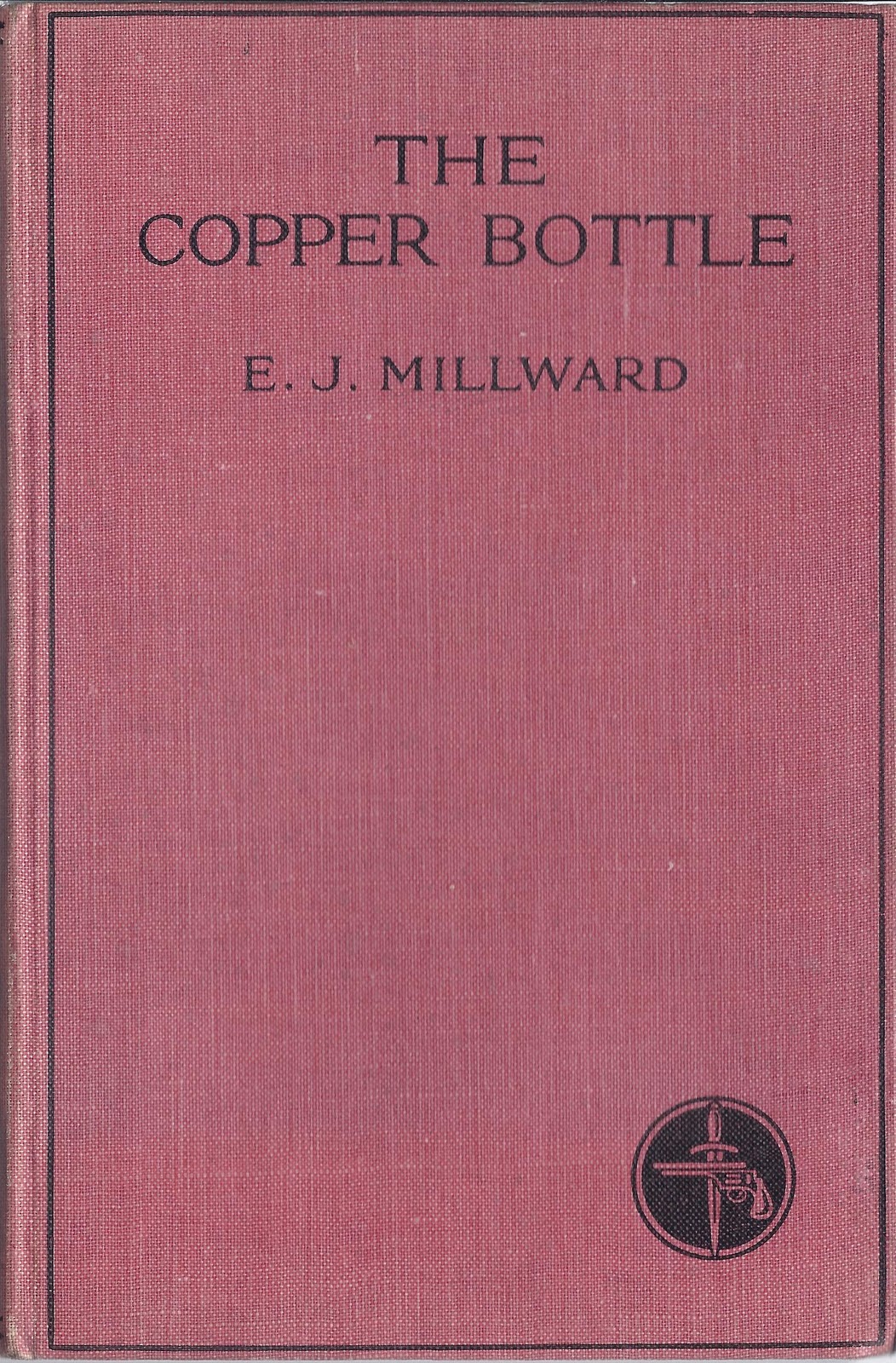
Forgotten Books by Forgotten Authors: The Copper Bottle (1929), by E. J. Millward

Recently I mentioned The Copper Bottle, by one Edward J. Millward, in my post "Forty from the Twenties," wherein I recommended a list of thirty-six British detective novels and four mystery short story collections from the 1920s (see Forty from the Twenties ).  Today I look more closely at this novel, which I believe has much to recommend it.--The Passing Tramp


Published in 1929 as part of Methuen's "Clue Stories" series (it was also published in the United States),  The Copper Bottle is a strong example of a Golden Age British rural detective novel.  Unusually, it takes place in Wales, as the stunning endpaper maps indicates:


If you need more confirmation that this novel is set in Wales, let me add that one of the characters is a Constable Evans (perhaps a grandfather of Rhys Bowen's Constable Evans?).  Of course you can't have a Welsh mystery without a character named Evans!

The narrative structure of the tale is rather different from the norm.  It opens with a cyclist on a dark, snowy winter evening stopping at the Castle Vale Hotel.  The guests at the hotel learn that the newcomer is Erle Stallard, local poet, and that he has the latest news of the investigation into the recent murder at "The Copper Bottle," near the town of Five Wells.  At the urging of the guests, Stallard unfolds the story....


From this point on the narrative continues in Stallard's voice.  He tells of visiting his old Great War comrade, Police Inspector Greer, and Greer's friend, Sammy Fork, a detective, and during his visit learning that George Smith has been found dead of a rifle wound at "The Copper Bottle," a former inn now converted into a private residence (the map above includes an inset floor plan of the building--note the image of the genie's/demon's head carved above the doorway).


Erle Stallard soon emerges as our Watson, with Fork as a Holmesian Great Detective and Greer as the more bumbling Lestrade figure.  Stallard soon finds that he is personally impacted by the murder, the dead man turning out to be rather closely connected to Stallard's own family (Stallard is a grandson of the recently deceased Sir Reginald Griffith of Castell Griffith, a picturesque ruin evocatively described by the author).


An interesting plot unfolds, as a number of suspects in the George Smith killing emerge, including George Smith's friend, Hector Smythe; a Japanese manservant (problematically named "Jap," though we are spared pidgin English); Erle Stallard's cousin, Frank; a neighbor couple, a Mr. and Mrs. Derney; and a private detective nosing about the vicinity.  In a touch of Moonstone, there is even a cursed gong from the East that sounds seemingly of its own accord.  There is a rumor that angry priests are out to recover the gong and avenge its theft....

Did the gong do it?

The strongly conveyed setting is a great plus, and the whole story is original in several ways (besides the narrative structure, there is also the fact that the tale ends with a poem).  The tale was well-reviewed in its day, but for some reason there was a six-year lag before another Millward mystery, The House of Wraith (1935), appeared. It was followed by The Body Lies (1936) and The Aero Clubs Mystery (1939).  And that was that for Mr. Edward J. Millward.

According to William Rubinstein, Millward was a direct descendant of John Bunyan, was born in South Africa and educated at Leeds Training School for Teachers, and was a farmer and a newsagent.  This is absolutely all I know about the man currently, but further reviews of his books will be forthcoming.

Monday, January 9, 2012

The Sheer Joy of Genre Reading: On Conan Doyle, or, The Whole Art of Storytelling (2011), by Michael Dirda


The great majority of fictional detectives come, strut for a time upon the bloody stage of crime, and then depart, as popular fancy alights on the doings of others.  How many people today have read a tale of an exploit of Lieutenant Valcour or Ludovic Travers?

the imperishable detective duo
Yet Sherlock Holmes remains imperishable.  Just in the last month or so we have had the appearance of a big-grossing Sherlock Holmes film sequel starring Robert Downey, Jr. and Jude Law as the Great Man and his perpetually perplexed sidekick, Dr. John Watson; the second season of a highly praised British television series about a present day Holmes and Watson starring a pair of rapidly ascending British actors, Benedict Cumberbatch and Martin Freeman; a much publicized authorized Sherlock Holmes novel, The House of Silk; and the subject of this review, the ingratiating small volume produced by the distinguished author and book critic Michael Dirda (for more on Dirda, see http://www.locusmag.com/Perspectives/2009/12/michael-dirda-dashing-international-man.html

Michael Dirda

Dirda's attractive little book (published by Princeton University Press) manages to range far beyond Sherlock Holmes or even Conan Doyle.  Essentially the book is a paean to imaginative literature and the profound impact it has over the span of readers' lives, from childhood into older age.  Dirda himself concisely explains what he's doing in his preface:

"On Conan Doyle, or, The Whole Art of Storytelling is a book about the pleasures of reading, a celebration of plot and atmosphere, adventure and romance, and an invitation to go beyond the Sherlock Holmes stories to explore a remarkable body of writing."

My favorite part of On Conan Doyle is Dirda's recollection of his discovery of mystery fiction as a child.  Though I'm a generation younger than Dirda, this section of the book carried me back to my own adolescent encounters with genre literature in the 1970s.  The appeal of such graceful and evocative nostalgic prose as Dirda's surely is, like much of Conan Doyle's own writing, timeless.

I sometimes surprise people when I tell them my first experience with reading mystery tales took place at the age of eight during  a summer in the seventies spent in Mexico City with my parents and teenage sister.  At a Mexico City Sanborns department store my mother bought three Agatha Christie paperbacks (at eight pesos apiece I believe): And Then There Were None, Easy to Kill (Murder Is Easy) and Funerals Are Fatal (After the Funeral).

One of the three Christie paperbacks
from Sanborns, Mexico City
Curled up on the sofa in our apartment, by a big window overlooking a busy city street from high above, I read them all, along with some Alfred Hitchcock Mystery Magazines (I particularly remember a story in one of those magazines called "The Machete Murderer" that was illustrated with cartoonish severed limbs--it rather amazes me that only a couple years earlier I was reading the adventures of Sally, Dick and Jane.  "Run, Sally, Run!" takes on a whole new meaning after one has read "The Machete Murderer").

I was immediately hooked by Agatha Christie, and I read her to this day.  Back then, I watched the 1974 film version of Murder on the Orient Express on the big screen, was saddened when Agatha Christie died in 1976 and read Curtain and Sleeping Murder, the "final cases" of Hercule Poirot and Miss Marple, when they came out in paperback in 1976 and 1977 respectively.

It was only in that latter year, 1977, that I discovered Sherlock Holmes, when at Christmas I received a slipcase set of all the Sherlock Homes novels and stories (I think it was published by Bantam).  They were rapidly and joyfully devoured!  Besides The Hound of the Baskervilles I especially remember reading for the first time, over that Christmas vacation, "The Five Orange Pips," "Silver Blaze," "The Six Napoleons," "The Red-Headed League," and, of course, "The Speckled Band."

Given these strong and to me very pleasant memories of youthful reading, I was fascinated by Dirda's account of his own experiences with fiction, which date back to the 1950s, the great era of pulp paperbacks and E.C. Comics.  Dirda's seminal childhood reading material was somewhat loftier than, say, Vault of Horror, but he still got from it that same delicious frisson of fright:

no one forgets the first encounter with the hound

"The Hound of the Baskervilles...was the first 'grown-up' book I ever read--and it changed my life...Romantic poets regularly sigh over their childhood memories of splendor in the grass, of glory in the flower.  But what are daisies and rainbows compared to...sleek and shiny paperbacks?...With a dollar clutched in my fist, I pedaled my red Roadmaster bike to Whalen's drugstor, where I quickly picked out two or three candy bars, a box of Cracker Jack, and a cold bottle of Orange Crush.  After my family had driven off in our new 1958 Ford, I dragged a blanket from my bed, spread it on the reclining chair next to the living room's brass floor lamp, carefully arranged my provisions near to hand, and crawled expectantly under the covers with my paperback of The Hound--just as the heavens began to boom with thunder and the rain to thump against the curtained windows....The Hound of the Baskervilles left its teeth marks in me and seriously aroused my then still slumbering passion for reading.  I was no longer the same ten-year-old when I reached its final pages."

Did it change your life?

Dirda goes on to discuss other amazing genre discoveries he made, after Sherlock Holmes and Conan Doyle showed him the way:

G. K Chesterton's clerical Father Brown ("each story chronicled a crime utterly beyond human ken")

Sax Rohmer's diabolical Dr. Fu Manchu (Dirda writes that he dare not go back and reread the Fu Manchu tales, "lest I be seriously appalled by my youthful taste")

Howard Haycraft's Boys' Book of Great Detective Stories (where Dirda "first read the stunning Thinking Machine classic, 'The Problem of Cell 13' ")

Ernest Bramah's blind detective, Max Carrados (see http://thepassingtramp.blogspot.com/2012/01/all-hail-max-12-cases-for-max-carrados.html 

"The highly scientific Dr. Thorndyke of R. Austin Freeman"

If you're a longtime fan of this amazingly rich period of mystery genre fiction, from the 1890s to World War One and beyond, to the "Golden Age" of the 1920s and 1930s, Dirda's book makes entrancing reading.

But there is more.  Throughout his book Dirda has scattered fascinating observations on the Holmes saga and on Conan Doyle as a man and a writer.  The splendid variety of the author's output, from his detective stories to his supernatural tales to his historical fiction and more, is done justice.  There's also a long section on the Baker Street Irregulars and Dirda's involvement with them that perhaps I'm just not a big enough Holmes fan (fanatic?) to sufficiently appreciate.  But I recommend the book wholeheartedly to all lovers of the great genre literature of yore.