Showing posts with label Golden Age detective fiction. Show all posts

Sunday, March 4, 2012

Alfred Walter Stewart, alias J. J. Connington


Three of the seventeen Sir Clinton Driffield detective novels by Golden Age British great J. J. Connington (the pseudonym of the distinguished Scottish chemistry professor Alfred Walter Stewart) have been reprinted by Coachwhip Publications, a quality print-on-demand publisher (for my review of Coachwhip's edition of Max Carrados stories by Ernest Bramah, see here).  The three reprinted titles (each with a ten-page introduction by me on the author and his books) are Murder in the Maze (1927), The Castleford Conundrum (1932) and The Tau Cross Mystery (In England, In Whose Dim Shadow) (1935).

Murder in the Maze (1927), the third Connington mystery novel and Sir Clinton Driffield's debut, was Stewart's breakthrough in the mystery field. It has received praise over the years from many discerning individuals, including T. S. Eliot, Jacques Barzun and John Dickson Carr.  When Eliot reviewed the novel back in 1927 he proclaimed that it instantly put J. J. Connington in the front of the crime writing pack.

Fans of the novel typically have noted, among other the things, the novel's bravura murder setting, a deadly double-centered hedge maze (see left).  Maze is meticulously clued and investigated and has an excellent narrative pace.  It is one of the best 1920s English country house mysteries.
Maze has everything people have come to expect from Golden Age English detective novels: an outwardly peaceful but inwardly fractious country house filled with suspicious denizens; fiendish murders (better yet it's poisoning with our old friend curare); a brilliant detective and his Watson-like sidekick (Sir Clinton Driffield, Chief Constable of the country, and his friend Squire Wendover); discreet love interest; and clues aplenty.

What more could the mystery fiend ask for than the above catalogue?  Yet the novel has its original touches, mostly stemming from the bracing ruthlessness of Clinton Driffield, a unique investigator in the field whom you won't soon forget. Country houses may well be cozy in theory, but this tale is no cozy.

The eighth Clinton Driffield detective novel, The Castleford Conundrum (1932), is another classic country house detective tale.  If you thought "Whistlefield" in Murder in the Maze was a fractious house, wait until you visit Castleford's "Carron Hill," home of the odious yet immensely wealthy Winifred Castleford, her husband and stepdaughter, and sundry designing--and mutually despising--relations.

Alfred Walter Stewart suffered gladly neither fools nor knaves--and there are fools and knaves aplenty in The Castleford Conundrum, giving rise to some of Connington's best writing, in his most scathing vein.  Winifred Castleford certainly is not one of humanity's great prizes, but then neither is most of her family!
When "Winnie" is found shot dead by a rook rifle, the field of suspects is large.  A not necessarily exhaustive list at first blush includes the second husband, the stepdaughter, the two brothers-in-law from the first marriage, the half-sister, the nephew and even a neighbor.

Clinton Driffield arrives--with Wendover in tow--later in the novel, when the investigation is flagging, and his investigation is brilliant, a delight to all lovers of classical English detection.  In The Castleford Condundrum, the author is writing at the height of his powers, both in terms of plotting and pure writing.  E. C. Bentley, author of Trent's Last Case, specifically praised Connington's character-drawing in the novel.


Connington's tenth Sir Clinton Driffield detective novel, The Tau Cross Mystery/In whose Dim Shadow (1935), moves away from the country house milieu so strongly associated with Golden Age English mystery. In truth many 1930s English mysteries do not take place in imposing country houses or Edwardian villages, despite the fact that it is these settings that have so powerfully captured the modern view of classical English mystery.

Much suburban housing expansion occurred in 1930s England, with bungalows and mock Tudor dwellings springing up all over once pristine countryside.  The Tau Cross Mystery takes place in precisely such a development, one convincingly conveyed by the author.
There is even a frontispiece map of the neighborhood where the murder takes place (every true classic mystery fan loves a map and/or houseplan). Yet more than the setting is of interest--Connington's cast of characters is strong as well. The ambitious police constable, the pushy journalist, the callow evangelist, the careworn Frenchwoman, the introverted clerk and others are compellingly portrayed.

Critics again praised both Connington's clueing and his character drawing.  "These are not the detective's stock figures," wrote one, "but fully realised human beings." Similarly, another reviewer, the American writer Will Cuppy, was dazzled by the novel's "abundance of clews and many other aids to armchair sleuthing."


It would be wonderful to see other Clinton Driffield detective novels appear back in print, such as Tragedy at Ravensthorpe (1927), The  Case with Nine Solutions (1928), The Boathouse Riddle (1931), The Sweepstake Murders (1931), The Ha-Ha Case (1934) and A Minor Operation (1937), but future publication depends on how these three editions sell.  If there is sufficient interest we may see more.  Having devoted a heavily researched and lengthy chapter of my forthcoming book with McFarland to Alfred Walter Stewart and his J. J. Connington mysteries, I believe that the man's fictional work deserves at least a modest revival.

Thursday, January 19, 2012

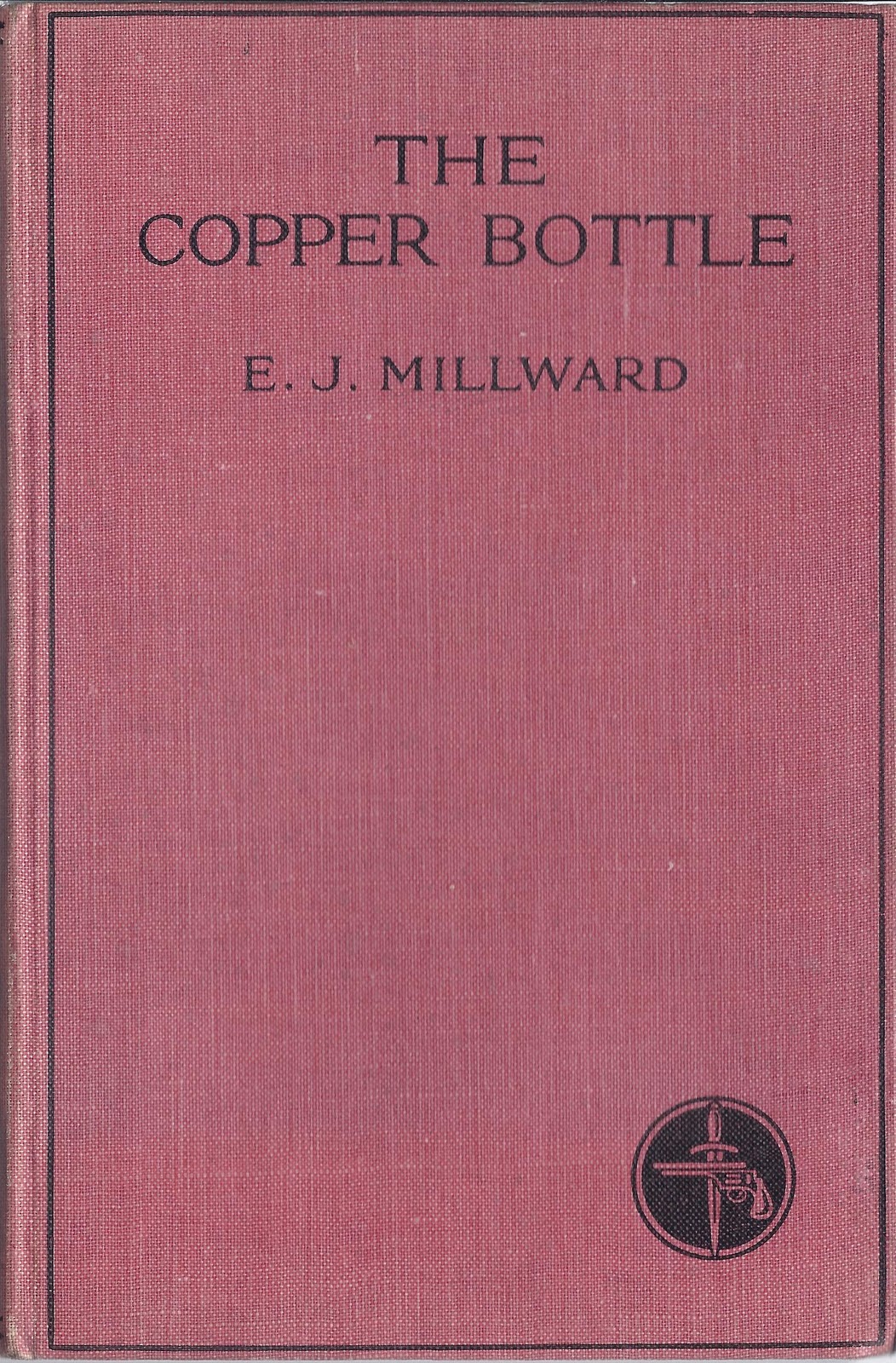
Forgotten Books by Forgotten Authors: The Copper Bottle (1929), by E. J. Millward

Recently I mentioned The Copper Bottle, by one Edward J. Millward, in my post "Forty from the Twenties," wherein I recommended a list of thirty-six British detective novels and four mystery short story collections from the 1920s (see Forty from the Twenties ).  Today I look more closely at this novel, which I believe has much to recommend it.--The Passing Tramp


Published in 1929 as part of Methuen's "Clue Stories" series (it was also published in the United States),  The Copper Bottle is a strong example of a Golden Age British rural detective novel.  Unusually, it takes place in Wales, as the stunning endpaper maps indicates:


If you need more confirmation that this novel is set in Wales, let me add that one of the characters is a Constable Evans (perhaps a grandfather of Rhys Bowen's Constable Evans?).  Of course you can't have a Welsh mystery without a character named Evans!

The narrative structure of the tale is rather different from the norm.  It opens with a cyclist on a dark, snowy winter evening stopping at the Castle Vale Hotel.  The guests at the hotel learn that the newcomer is Erle Stallard, local poet, and that he has the latest news of the investigation into the recent murder at "The Copper Bottle," near the town of Five Wells.  At the urging of the guests, Stallard unfolds the story....


From this point on the narrative continues in Stallard's voice.  He tells of visiting his old Great War comrade, Police Inspector Greer, and Greer's friend, Sammy Fork, a detective, and during his visit learning that George Smith has been found dead of a rifle wound at "The Copper Bottle," a former inn now converted into a private residence (the map above includes an inset floor plan of the building--note the image of the genie's/demon's head carved above the doorway).


Erle Stallard soon emerges as our Watson, with Fork as a Holmesian Great Detective and Greer as the more bumbling Lestrade figure.  Stallard soon finds that he is personally impacted by the murder, the dead man turning out to be rather closely connected to Stallard's own family (Stallard is a grandson of the recently deceased Sir Reginald Griffith of Castell Griffith, a picturesque ruin evocatively described by the author).


An interesting plot unfolds, as a number of suspects in the George Smith killing emerge, including George Smith's friend, Hector Smythe; a Japanese manservant (problematically named "Jap," though we are spared pidgin English); Erle Stallard's cousin, Frank; a neighbor couple, a Mr. and Mrs. Derney; and a private detective nosing about the vicinity.  In a touch of Moonstone, there is even a cursed gong from the East that sounds seemingly of its own accord.  There is a rumor that angry priests are out to recover the gong and avenge its theft....

Did the gong do it?

The strongly conveyed setting is a great plus, and the whole story is original in several ways (besides the narrative structure, there is also the fact that the tale ends with a poem).  The tale was well-reviewed in its day, but for some reason there was a six-year lag before another Millward mystery, The House of Wraith (1935), appeared. It was followed by The Body Lies (1936) and The Aero Clubs Mystery (1939).  And that was that for Mr. Edward J. Millward.

According to William Rubinstein, Millward was a direct descendant of John Bunyan, was born in South Africa and educated at Leeds Training School for Teachers, and was a farmer and a newsagent.  This is absolutely all I know about the man currently, but further reviews of his books will be forthcoming.

Saturday, January 14, 2012

Murder in the Family: Ronald Knox and Winifred Peck

Many classical mystery fans have at least heard of the English detective novelist Ronald Knox; few, however, know of Knox's novelist sister, Winifred Peck, who also contributed to the field of crime fiction.  In this two part article I will discuss genre works by this pair of sibling crime writers.  First up: Ronald Knox and his novel Still Dead.--The Passing Tramp


P. D. James contends that it was
Dorothy L. Sayers who made the
Golden Age detective novel
intellectually respectable

Although in her recent short genre survey, Talking About Detective Fiction (2009), mystery doyenne P. D. James asserts that it was Dorothy L. Sayers in the middle 1930s who made detective fiction intellectually respectable (with such “manners” crime novels as The Nine Tailors and Gaudy Night), in fact many intellectuals were attracted, both as readers and writers, to detective tales at the very beginning of the Golden Age (roughly 1920), because of those tales’ ratiocinative appeal as puzzles.

For these individuals, the intellectual appeal of detective novels lay in the quality of their puzzles, not in any attempts on the part of their authors to ape the mainstream “straight” novel with portrayals of social manners or emotional/psychological conflicts. Indeed, during the Golden Age too much emphasis on purely literary elements often was seen by common readers and more lofty genre theorists alike as detrimental in detective novels, because it distracted readers’ minds from what was deemed the proper business in such fiction: the cold analyses of clues.

An undeniably intellectual mystery fan and mystery writer, Ronald Arbuthnott Knox, held this obsolescent view of the proper nature of detective fiction.

Ronald Knox
an intellectual who respected puzzles

Knox, a son of the Bishop of Manchester and an Eton and Oxford educated classical scholar who converted to Catholicism in 1917 (soon becoming a priest and one of England’s most prominent and articulate Anglo-Catholics), published his first detective novel, The Viaduct Murder in 1925.  Two more detective novels appeared in the 1920s (The Three Taps, 1927, and The Footsteps at the Lock, 1928), as well as Knox’s famous Detective Fiction Decalogue, wherein he laid down rules for the writing of detective fiction (all of which emphasized the puzzle aspect, or “fair play”--see http://thepassingtramp.blogspot.com/2011/12/ronald-knox-his-detective-fiction.html ).


On the strength of these accomplishments, Father Knox was invited in 1930 to become a founding member of the Detection Club. Three more detective novels would follow — The Body in the Silo (1933), Still Dead (1934) and Double Cross Purposes (1937) — before Knox gave himself completely over to his religious scholarship.

Less donnishly facetious than the 1920s tales, The Body in the Silo and Still Dead are commonly considered to be Father Know’s best detective novels, though oddly and frustratingly, they are two of the most difficult to find.  Both novels are well worth reading for fans of the pure puzzle sort of detective novel, as they have rigorous fair play problems and even include footnotes listing the pages where clues were earlier given.


Still Dead concerns the death of Colin Reiver, the thoroughly undesirable heir to the Dorn estate in Scotland. Colin’s dead body was glimpsed by one of the estate’s employees, but had disappeared by the time he had left for help and returned to the spot with others.

Two days later, however, the body reappears at the same spot (and still dead, hence the title). Colin is pronounced to have expired from exposure, but is that really true and, either way, why were morbid shenanigans played with the corpse?

If Colin was murdered, there is no shortage of suspects. There is another employee, a gardener, whose child was run down by a drunken Colin (the latter was exonerated in court on the strength of false testimony from an Oxford friend, once again proving the value in Golden Age mystery of old school ties). There also are several family members, including Colin’s own father, Donald, as well as Colin’s sister, brother-in-law and cousin (truly, nobody liked Colin). Then there's a family physician and also a leader of the odd religious sect to which Donald Reiver adheres.

The police write off the case (all to the good, since Father Knox apparently knew nothing and cared less about police procedure), but insurance investigator Miles Bredon--Knox’s series detective in five novels and a single, classic, short story, “Solved by Inspection”--is called in, because the question of when Colin actually died bears directly on a crucial insurance settlement (the dissolute Colin was heavily insured in his father’s favor and the Dorn estate is sadly diminished).

There are strange goings-on indeed
at the Dorn estate in Scotland
Still Dead reveals both Father Knox’s strengths and weaknesses as a detective novelist. Positively, the fair play cluing is exemplary and reading the solution is quite enjoyable. Negatively, human interest is minimal and the narrative moves slowly.

Aside from a gentrified old lady at a hotel, Colin Reiver’s military martinet-ish cousin and a eugenics-professing doctor, none of the characters has more than a bare semblance of interest. Even these three aforementioned characters do not come to life as they might have, given the basic material.

To be sure, Knox provides some lightly humorous verbal byplay, courtesy of Miles Bredon’s wife, Angela (she always seems to accompany him on his investigations, despite having a child — or children, Knox is inconsistent on this point — at home). Yet Miles and Angela are no Lord Peter and Harriet, despite having preceded them into print as a mystery genre male-female duo by three years.

I found Still Dead more slow-moving than novels by Freeman Wills Crofts or John Rhode from this period, because Bredon’s sleuthing is peripatetic. Knox’s fictional works lack the relentless investigative drive we see in mystery tales by those other, “humdrum”, authors, who focus so resolutely on the problem. Nor is Knox’s problem itself, though very well-clued, as interesting as the alibi and murder means conundra presented by Crofts and Rhode, respectively.

In the blurb for Still Dead, Father Knox’s English publisher, Hodder and Stoughton, called Knox “a master of the English language.” To be sure, Knox is a very good writer indeed; yet in my opinion his strength as a writer is that of an essayist, not a novelist. Scattered throughout Still Dead are fine scenic descriptions, pithy observations on religion and interesting digressions on the fate of England’s aristocracy, the nature of English gardens, chess, books, caves, hotels, etc.; yet while they are quite interesting in themselves, by themselves they do not sustain the dramatic situation desirable in a crime novel.

Of course Knox would counter that he was merely trying to provide readers with a good puzzle, and this is a perfectly reasonable point. Still Dead is a good puzzle. Yet the basic material here — a dissolute gentry heir having killed a young child while driving inebriated — is interesting enough to have deserved a more serious treatment.  Knox’s handling of the material is on the dry side, even in the final chapter when the philosophical implications of the problem are discussed by the characters (though this is a good discussion).

Just a few years later Nicholas Blake (the pen name of poet Cecil Day-Lewis) would take a rather similar plot and inject it with real human pain and suffering, in The Beast Must Die (1938), a novel much better-remembered today than Still Dead.  In Knox's case, however, there seems to have been a reluctance to grapple with deeper, darker emotions in his detective novels. (One sees this quirk as well in the half-dozen mild mystery tales by a Knox contemporary, Anglican minister Victor Whitechurch.)

Blake's mystery novel
has greater emotional heft
than Knox's Still Dead

Despite these reservations on my part, Still Dead is well worth reading for admirers of classical British mystery. If you can find the Hodder & Stoughton hardcover edition, you also will find a beautiful endpaper drawing of the Dorn estate and a dramatic frontispiece of stark Dorn House, both by Bip Pares, as well as that footnoted clue page guide.  The Pan paperback edition of from 1952 lacks these graces, so charmingly redolent of the Golden Age detective novel, when many writers in their mystery tales unashamedly emphasized puzzles.


See Part Two for Winifred Peck.  Special Note: The mystery/crime fiction world suffered a great loss with the recent death of Reginald Hill, one of the towering figures in the genre.  I plan to devote  a piece to him in the upcoming week.--The Passing Tramp

Saturday, December 24, 2011

Lord Ernest William Hamilton (1858-1939), Mystery Writer

Lord Ernest William Hamilton (1858-1939) certainly came from one of the more elite backgrounds among British mystery writers.  His father was James Hamilton, first Duke of Abercorn (earlier he had been merely Marquess of Abercorn--and before that there had been nine Earls of Abercorn, going back to 1606).  During the reign of Queen Victoria, the Duke served in the Privy Council and was twice Lord-Lieutenant of Ireland.
James Hamilton,
1st Duke of Abercorn, Lord-Lieutenant of Ireland,
and, last but surely not least, father of a mystery writer
Ernest Hamilton was the youngest of fourteen children of the Duke of Abercorn and his wife, Louisa, daughter of John Russell, the sixth Duke of Bedford.  Like four of his brothers, he served for a time as a Conservative member of parliament, but he was also known in his day as an accomplished man of letters, publishing several volumes of memoirs, as well as theological studies and novels.
John Russell,
6th Duke of Bedford,
Lord Ernest Hamilton's maternal grandfather
Among Lord Ernest's novels, which include several works of historical fiction (such as The Outlaws of the March, 1897 and The Mawkin of the Flow, 1898) are at least two books that clearly fall with the mystery genre: a thriller, The Perils of Josephine (1899), and a much later detective novel, published when Lord Ernest was seventy years old, The Four Tragedies of Memworth (1928).

Both Perils of Josephine and Tragedies of Memworth (particularly the former tale) bear resemblance to the Victorian triple-decker sensation novel associated with Wilkie Collins and Mary Elizabeth Braddon, among others.  A contemporary review of Perils of Josephine, in which rather bored reference is made to Lord Ernest leading the title character, Josephine ("that unhappy young person"), "through a series of experiences with bolting horses, sliding panels, crazed cousins, wicked priests, and burning houses," gives some idea of the style in which it was written (yes, it even draws on traditional English anti-Catholicism).
Mary Elizabeth Braddon
Queen of the Victorian Sensation Novel

Wilkie Collins
King of the Victorian Sensation Novel
The admittedly jaded reviewer went on to dismiss, in rather amusing fashion, the whole sensation or Gothic fiction genre as hopelessly outmoded and old-fashioned at the dawning of a new century (the twentieth):

"A strong impression remains with the [modern] readers that 'these things are not done.'  In our well-policed days, the most malevolent of wicked uncles whom our father's will is keeping out of his rights is hardly the cloaked and sinister figure that he was.  Our rival in love is not so likely to drop poison into our tea as to pity us for our unfortunate taste in collars.  Our athletic young women, with their inches and their biceps, cannot be counted upon to swoon when the panel slides back, but would probably make things unpleasant for the slider."
The athletic, bicycling young women of the 1890s
could not be expected to swoon at the sight of a sliding panel
When, nearly three decades later, Lord Ernest published The Four Tragedies of Memworth, it was at the height of the Golden Age of detective fiction, with its rules (one of the most famous sets propounded by Ronald Knox) designed to mark a clear aesthetic boundary between the detective novel and the thriller (or shocker, as it was sometimes called).  The novel was grabbed by the up and coming firm of Victor Gollancz, who also would publish such prominent Golden Age names in the English mystery writing field as Dorothy L. Sayers, E. R. Punshon and J. J. Connington.
Gollancz was one of the prestige publishers of Golden Age English detective fiction
For his part, Lord Ernest dutifully attempted in Tragedies of Memworth to move away from the tad lurid style of Perils of Josephine toward the more purely cerebral pleasures of the modern, 1920s detective novel; yet some affinity with the sensation style clearly remains.  As I indicated in Part One of this review essay, there is in the novel, for example, the lurking presence of a certain Asian gentleman with a vengeful agenda.  Yet Ronald Knox proclaimed Memworth an honorable exception to his anti-Chinaman, anti-thriller rule for the writing of detective fiction.  In Part Three of this review essay, I will assess just how successful a detective novel The Four Tragedies of Memworth really is.
Though it may have fallen out of critical fashion after 1900,
Victorian melodrama lived on in England--
in the 1930s, for example, in the films of Tod Slaughter--
and full scale critical revival lurked just around the (dark) corner!
Note: I do not have a photo of the actual Lord Ernest Hamilton.  If anyone finds or has one I would love to add it to the blog.  And for more on Lord Ernest Hamilton, see
http://thepassingtramp.blogspot.com/2011/12/ronald-knox-his-detective-fiction.html