Showing posts with label P. D. James. Show all posts

Wednesday, May 16, 2012

The Country House Murders of "Edgar Box": Death Before Bedtime (1953)

In part one of the piece on Gore Vidal's Edgar Box mysteries, originally published in the 1950s, I wrote about their origin as the joint brainchild of Gore Vidal and Victor Weybright (publisher of Signet paperbacks) and then went into some detail on the first one, Death in the Fifth Position, which is the most pronounced of the three in what might be termed outre subject matter (especially in the 1950s).  Although the last two Boxes, Death Before Bedtime (1953) and Death Likes It Hot (1954), both include coital couplings between Vidal's amateur detective, Peter Cutler Sargeant II, and lady friends of the moment, on the whole the sex element (certainly the gay sex element) is toned down somewhat and there is a more concentrated focus on detection.  While neither novel, particularly Bedtime,  has as memorable characters as those in Fifth Position's ballet company (who tend to dance away with the tale), both books are more successful than Fifth Position as true detective novels.  And both books admirably display the wickedly satirical writing that graced the first. Both are herewith recommended.  Bedtime is reviewed here, Hot in the last installment.

Death in the Fifth Position belongs to what surely is a tiny subgenre, the ballet mystery/thriller (as additional examples there's the three novels published from 1937-1940 by Caryl Brahms and S. J. Simon and Lucy Cores' Corpse de Ballet, 1944, available from Rue Morgue Press).  Death Before Bedtime and Death Likes it Hot, on the other hand, essentially are country house mysteries of the sort most commonly associated today with Agatha Christie, with a slightly hard-boiled twist.

Although it is the fashion today in many circles to disparage Agatha Christie and her novels, Vidal, like John Updike (see this earlier piece by me) admires Christie as a writer.  During an interview last year conducted between Gore Vidal and Stephen Heyman of the New York Times ("Gore Vidal, P. I."), the following exchange took place:

England's Queen of Crime
influenced "Edgar Box"
Heyman: Agatha Christie is a particularly strong influence in these books.
Vidal: In everybody's books.  Don't single me out.

Heyman: And there's also one passing reference to Holmes...
Vidal: I like Christie because I thought she was a great naturalist--those are real villages she writes about--and it's fascinating.  I used to like to read not for the mysteries but I read her for the characters.  They are of no use to an American writer, but anyway they are very nice to read.

Heyman: Edmund Wilson called detective stories a vice that "ranks somewhere between smoking and crossword puzzles."
Vidal: I don't think mystery stories are any lower than stories of how George and Emily failed to get status at the university or to English department politics.  That to me is about as tedious as it can get in print.  

P. D. James, for example, has credited Dorothy L. Sayers with effectively portraying an English village in her 1930s detective novel The Nine Tailors, but contrarily she often has scoffed at the notion that anyone could find much to praise in the writing of Agatha Christie; so it was quite pleasing to me, as an admirer of such English village mystery tales by Christie as The Murder of Roger Ackroyd (1926), The Murder at the Vicarage (1930) and A Murder Is Announced (1950), to see a literary titan like Gore Vidal come to Christie's defense (the last of these Christie novels, incidentally, even includes a quite effective portrayal of a lesbian couple).

Christie "cozy" mysteries
often are quite satirical
And Vidal says he read Christie "not for the mysteries," but "for the characters"!  Himself a brilliant satirist, Vidal appreciates that there in fact is fine satire in Christie's village mysteries.  What would journalists who have written so condescendingly of Christie's novels--such as Rachel Cooke ("hack-work") and Lindsay Duguid ("One can hardly bear to read on")--say of Gore on this score?  That this "upstart" doesn't know good writing when he sees it?

Christie's influence can be seen in both the Edgar Box books under review here (there is also a healthy splash of Christie's purported antithesis, Raymond Chandler).  Basically these two Box novels are 1950s American versions of the stylized closed-circle English house-party mysteries of the Golden Age of detective fiction (roughly 1920 to 1940), of which Christie today is the most renowned exemplar.

Death Before Bedtime takes place in the Washington, D.C. mansion of an unscrupulous, ultra-conservative Midwestern senator with presidential aspirations, Death Likes It Hot in the Hamptons "beach house" of a socially ambitious matron.  In both cases Vidal's amateur detective, publicist Peter Sargeant, is hired by the mansion owner to do a publicity job and thus is conveniently on hand when murder inevitably strikes (under the circumstances it's surprising the police don't come to suspect that Sargeant is a serial murderer).

Senator Thomas Pryor Gore (1870-1949)
Gore Vidal's maternal grandfather
Gore Vidal's maternal grandfather, Thomas Pryor Gore (1870-1949), was a prominent United States senator from Oklahoma.  T. P. Gore began his political career as a Populist Democrat but later became an isolationist in foreign affairs, opposing America's entry into World War One under Woodrow Wilson,  and in the 1930s criticizing much of Franklin Roosevelt's New Deal (FDR engineered Senator Gore's defeat in 1936, when Gore Vidal was eleven years old).

Vidal himself today sounds rather like his famous grandfather on foreign affairs, though less like him on other matters.  He also appears to have idolized his grandfather.  In contrast, Vidal despised his egocentric, tipply and flighty (as he portrays her) mother, Nina Gore Vidal, who divorced his father and later, through her second marriage, ultimately became inter-connected with the Kennedy family (see Vidal's 1995 memoir).

This material is brought into Bedtime in rather an interesting way by Gore Vidal.  Leander Rhodes, the villainous Midwestern senator who is murdered in the novel (by explosives planted in his fireplace) would not appear really to be a portrait of Thomas P. Gore, but it sure seems to me that Senator Rhodes' dissipated daughter Ellen was inspired by Vidal's mother Nina.

Gore Vidal
Bedtime opens memorably with Ellen Rhodes and the always ready and willing Peter Sargent about to commence copulation on a D.C.-bound train:

"You know, I've never gone to bed with man on a train before," she said, taking off her blouse.
"Neither have I," I said, and I made sure that the door to the compartment was securely locked.
"What innocents we are," she sighed, then: "I wish I had a drink."

This gives you a pretty good idea of Ellen.

On the whole, it must be admitted, the characters in Bedtime are less interesting than those in Fifth Position, despite Vidal's own fascinating background among the country's political elite; yet Ellen Rhodes makes up for any deficiencies in this regard.

After Senator Rhodes is messily blown up in his own study, the guests in his home act as all guests should in a proper country house mystery, where death essentially is a game.

In short they're blase.  Explains Peter Sargeant:

I was surprised at how calmly the guests took the sudden, extraordinary turn in their affairs...especially Ellen, who was the coolest of the lot.
"Do fix me a Scotch," she said....I sat beside Ellen on an uncomfortable love seat....
"This is awful," I said inadequately, conventionally.
"I should hope to hell it is," said Ellen, guzzling Scotch like a baby at its mother's breast.

Ellen quickly loses interest in Peter and begins pursuing another eligible young male, a virginal writer for an advanced leftist intellectual magazine that was doing an expose on Senator Rhodes when the Senator suddenly and violently expired.  Here is more frank repartee between Peter and the not-so-blushing Ellen:

"By the way, have you gotten into the Langdon boy yet?"
"What an ugly question!" she beamed; then she shook her head.  "I haven't had time.  Last night would have been unseemly...I mean after the murder.  This afternoon I was interrupted."
"I think he's much too innocent for the likes of you."
"Stop it...you don't know about these things.  He's rather tense, I'll admit, but they're much the best fun...the tense ones."
"What a bore I must have been."

grandfather and grandson
Not for nothing is the cover of the Black Lizard edition of Bedtime illustrated by a woman's eyes looking out of a brandy snifter!  The fantastically uninhibited Ellen is something of a female version of Louis from Death in the Fifth Position.  Still, there is barbed humor directed at other subjects besides (I think) Vidal's mother.  Note this bit:

I found [Camilla] off by herself in a corner of the drawing room, studying the latest issue of Harper's Bazaar.  She was reading the thin ribbon of text which accompanies the advertisements; this thin ribbon was, I could see, the work of the latest young novelist: it concerned a young boy in Montgomery, Alabama, who killed nine flies in as many minutes on the eve of the Fourth of July...I had read it earlier, being of a literary turn (though I belong to the older literary generation of Carson McCullers and have never quite absorbed the newcomers even though they take mighty nice photographs).

Truman Capote
Gore Vidal was not his number one fan
Perhaps needless to say, another one of Gore Vidal's great dislikes (besides his mother), extending back over half a century now, is In Cold Blood author Truman Capote (1924-1984).

It looks like in Bedtime Vidal handed "Edgar Box" a stiletto to deftly stick between Capote's ribs!

But what of the mystery, you may well be asking, at this late point in the review?  I found the detection in Bedtime superior to that offered in Fifth Position. Though the later section again is too huddled, here Vidal makes more serious stabs at clueing.  There certainly are plenty of suspects as well, including, in classic fashion, a butler and a private secretary (John Dickson Carr warned readers to watch out for those private secretaries).

I thought the ending was a surprise, though in retrospect I should have seen it, which is always a nice feeling with a detective novel. And Vidal does provide some real--and rather subtle--clues.

In Death Before Bedtime Vidal shows he was learning the game--and playing it. In my view, he went on to produce the best of the Edgar Box bunch with his last mystery, Death Likes It Hot. See my next blog post for more!

Saturday, April 14, 2012

"It's French this time, but don't let that dismay you": Red Warning (1933), by Virgil Markham

Virgil Markham (1899-1973) spent over half his life in the shadow of his father, the once renowned and much beloved poet and man of letters Edwin Markham (1852-1940), author of "The Man with the Hoe," in the first half or so of the twentieth century one of the most celebrated American poems (it was inspired by the famous Jean-Francois Millet painting).  Actually, I should say more than half his life, because even after his father died, Virgil Markham was the tender of his father's literary reputation, still best known for being the son of Edwin Markham.

Virgil Markham's fourth mystery novel takes place in France
--a good part of the time on a train

Yet Virgil Markham was an interesting person in his own right.  He received a B.A. from Columbia University and an an M.A. from the University of California at Berkeley (his 1923 thesis was titled The Satirical Method of Addison and Steele).  In the 1920s he taught at UC-Berkeley's Cora L. Williams Institute for Creative Education and the University of California Extension Division. Under the auspices of the latter Markham in 1929 launched what was called the first university class on mystery literature, "The Development and Technique of the Mystery Story."

The Markham Home in Staten Island
After traveling in Europe for half of 1925, Markham in 1926 published The Scamp, a picaresque historical novel set in Europe.  He would use European settings as well for six of the eight mystery novels he published between 1928 and 1936.

These are:

Death in the Dusk (1928)
The Black Door (1930) (in England, Shock!)
The Devil Drives (1932) (reprinted by Ramble House)
Red Warning (1933) (in England, Song of Death)
Inspector Rusby's Finale (1933)
The Dead Are Prowling (1934)
The Deadly Jest (1935)
Snatch (1936)

Markham's work often won positive critical notice (his last six novels were published in England by the prestigious Collins Crime Club), but are little remembered today.  I suspect the books may have been victims of their own originality (not to say strangeness).

Virgil Markham obviously was not content to do the same old thing with the mystery story, to steer his narratives over worn-out ruts, but rather was looking for different and exciting ways of working with the form.

Edwin Markham (1852-1940),
famous father of Virgil Markham
He certainly found them!  In a very interesting piece on Markham's first and best-known mystery novel, Death in the Dusk, blogger TomCat asserts that it rivals Joel Townsley Rogers' The Red Right Hand (1945) and Frederic Brown's Night of the Jabberwock "in the race for most outlandish detective story ever contrived."*

*(see"The Grim Fairy-Tale of Parson Lolly")

On the other hand, that great detective fiction traditionalist Jacques Barzun lauded Markham's novel Inspector Rusby's Finale in the highest terms and more reservedly praised another, The Black Door.

So!  What,do I think of the Markham title under review here, Red Warning?

Inscribing a copy of Red Warning to an American friend, Markham humorously warned him, "It's French this time, but don't let that dismay you."

Certainly the novel is unbridled in its modernism, doubtlessly owing something to its French setting (Anglo-American readers seem to have had an easier time accepting that racy things happen in France).

Dust jacket flap
of Snatch
showing a photo of
Virgil Markham
Jack Bishop, the hero of Red Warning, is a former California philosophy professor gone to seed, living his life among cafe inebriates and prostitutes due to a failed love affair with rising American opera star Elsie Ritter.

Jack clearly is not a model mystery genre hero for the day, nor is Elsie a typical heroine, being that rarest  of things among Golden Age putative good girls, a girl who is CNAV (Clearly Not A Virgin). For good measure she also smokes, drinks and swears (how long will she keep her voice?).

During the course of the novel these two--who their despite their falling-out are still madly in love with each other--are thrown back together by criminal circumstance. Someone has been sending Elsie "red warnings"--threats of danger and impending death, all with something red in the design.

There is also the matter of the fantastically valuable emerald necklace given to Elsie by one of her most infatuated admirers, the wheelchair-bound American millionaire Waldo Torrens.

The necklace is the object of desire of the Fox, the greatest jewel thief in Europe.  Rather worrisomely, it appears that the Fox not only has the habit of theft, but also that of strangling his victims, all the while singing operatic totenlieder in the most superb basso profundo.

the suspects, erm, passengers board the death train

Also in the character mix is the enigmatic Baron Gluck, yet another of Elsie's admirers. What is his game, exactly?  And are Torrens' valet and secretary really what they seem to be?  Is Madame Torrens, the millionaire's addled mother, quite all there?  And what about Elsie's doctor and another American who is so obviously American as to seem ersatz? Or the mysterious scientific researcher, M. Roche?

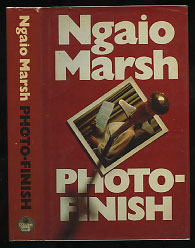
The plot device of the red warnings reminds me a great deal of two detective novels from the 1980s, Photo-Finish (1980) by Ngaio Marsh (threatened opera star again) and The Skull Beneath the Skin (1982) by P. D. James (threatened actress).

However Markham's narrative unfolds much more impressionistically and confusingly, as the scene shifts from Paris then to a night train then to a villa in Avignon.  The reader sometimes may wonder whether everything that is happening is really happening. Red Warning reads less like a classical detective novel and more like an Edgar Wallace mystery thriller, with heavy lashings of Georges Simenon and William Faulkner.

The basic plot of this 1980
Ngaio Marsh detective novel
resembles that of Red Warning--
but oh! what different places they go!
Yet when the explanation is offered at the end, one realizes there were clues embedded in the text.  I think I understood it all by then, though I am not completely sure.

I may have to read The Psychology of Thought, by American psychologist and college professor Harry Levi Hollingsworth (1880-1957), apparently a former teacher of Markham's at Columbia University.  This book gets quite a work-out from the author in the final pages of Red Warning.

Red Warning is quite a sophisticated book for the period--not an easy read, but an interesting one.  I am glad I read it, and I will read more works by this author--no matter the country in which they happen to be set!

Note: The tour of France will continue the upcoming week with reviews of works by Alice Campbell, Georges Simenon and Stanislas-Andre Steeman.  See you soon!--The Passing Tramp.


Wednesday, March 7, 2012

John Updike on Mystery Fiction

Perusing Due Considerations (2007), the recent essay collection by the late, great American writer John Updike (1932-2009), I spotted a few nuggets on the mystery/detective novel/thriller that I hope are of interest to mystery fans (they were to me!).


In a piece on his childhood reading that he wrote for the New York Times in 1965, Updike reflected on what he calls his "inability to read bravely as a boy":

My reading as a child was lazy and cowardly, as it is yet.  I was afraid of encountering, in any book, something I didn't want to know....O. Henry was the only recommended author unreal enough for me to read with pleasure.  Having deduced that "good books" depict a world in which horror may intrude, I read all through my adolescence for escape.  From the age of twelve I had my own user's card to the Reading (Pennsylvania) Public Library, a beautiful, palatial haven....I read all the books the library had by Erle Stanley Gardner, Ellery Queen, Agatha Christie, and John Dickson Carr, in that order....Also humorists....Fifty books by P. G. Wodehouse I must have consumed....Science fiction just barely escaped being too alarming; I read of it copiously until its implications--of time and space so vast that the individual life is as nothing--began to sink in.

John Updike

Reading Public Library: "a beautiful, palatial haven"

The young Updike saw the mystery genre as the great genre of escape and thus he embraced it wholeheartedly.  "With such books," he writes, "I dissipated my youth, while my contemporaries were feasting on classics."  Updike recalls at age fifteen experiencing his "last vivid boyhood fright from books" when he visited his uncle and aunt in Greenwich, Connecticut and discovered their copy of James Joyce's Ulysses:

The whiff of death, God's death, that came off those remorseless, closely written pages overwhelmed me.

So back the young Updike went to "soluble mysteries, as in mystery novels...."

the "whiff of death, God's death" in the
"remorseless" pages of James Joyce's Ulysses 
gave the young Updike a genuine "fright"

John Updike

In a review forty years later of a spy thriller, Robert Littell's Legends (2005), Updike recalled being

a fourteen year old boy lying on a red caneback sofa in Pennsylvania eating peanut-butter-and-raisin sandwiches (a site-specific ethnic treat) and reading one mystery novel after another.  Not just mysteries--Ellery Queen, Agatha Christie, John Dickson Carr, Ngaio Marsh, Erle Stanley Gardner--but an occasional international thriller, like Eric Ambler's A Coffin for Demetrios and Graham Greene's The Third Man.  The idea of reading a non-genre novel, with its stodgy domestic realism and sissy fuss over female heartbreak, repelled me then, but I could lose myself all morning and afternoon in narratives of skullduggery, detection and eventual triumphant justice.  And, so, to judge from the best-seller lists, can millions still.  Thrillers, as we shall call them, offer the reader a firm contract...The reader's essential safety, as he reclines on his red sofa, will not be breached.

Gardner evidently goes down great with
 peanut-butter-and-raisin sandwiches

Updike goes on to note that modern crime writers  like P. D. James "give signs of wanting to be 'real' novelists, free to follow character where it takes them and to display their knowledge of the world without the obligation to provide what William Dean Howells disapprovingly called 'a complicated plot, spiced with perils, surprises and suspenses'."

American realist author William Dean Howells
wrote disapprovingly of complicated plots
"spiced with perils, surprises and suspenses"

So, is Updike condemning his childhood mystery reading as the dissipated escapism of youth?  As a great literary eminence, did Updike feel contempt for the classical mystery genre?  Not so, I would argue.  He seems finally to have regarded the books with genuine warmth and affection.

Updike admired Christie's
"brilliantly compact, stylized and efficient mysteries"

Considering Agatha Christie specifically, Updike writes of the Crime Queen's "brilliantly compact, stylized and efficient mysteries."  He adds that "the genre in its lean classic English form fit [Christie] like a cat burglar's thin black glove."

credibility over ingenuity?

Updike sounds much more respectful of Agatha Christie than many modern journalists and crime writers!  Judging from the above I am not altogether certain Updike believed that P. D. James necessarily got the better of Christie when in her mysteries she traded ingenuity for credibility (as James herself has put it). Updike seems to recognize that there is a respectable place in the world of literature for the classical detective novel of the sort associated with Christie, Carr, Queen, Gardner, Marsh and others.

I suspect those of us who devoured classical mystery at a young age, like John Updike and Michael Dirda, never forget the youthful pleasure of it, even if we "outgrow" it.  And, for better or worse (personally, I'm in the better camp), many of us, like the great intellectual Jacques Barzun (age 104), never outgrow it.

Jacques Barzun
mystery reader of nine decades standing

Addendum: Here's a great 2004 interview with Updike where he refers to his childhood love of classical detection--The Passing Tramp

http://www.achievement.org/autodoc/page/upd0int-1

I loved Agatha Christie, of course. And also, an American team called Ellery Queen. I read a lot of Ellery Queen. Erle Stanley Gardner. I must have read 40 books by Erle Stanley Gardner before I was 15 or so. 

Saturday, January 14, 2012

Murder in the Family: Ronald Knox and Winifred Peck

Many classical mystery fans have at least heard of the English detective novelist Ronald Knox; few, however, know of Knox's novelist sister, Winifred Peck, who also contributed to the field of crime fiction.  In this two part article I will discuss genre works by this pair of sibling crime writers.  First up: Ronald Knox and his novel Still Dead.--The Passing Tramp


P. D. James contends that it was
Dorothy L. Sayers who made the
Golden Age detective novel
intellectually respectable

Although in her recent short genre survey, Talking About Detective Fiction (2009), mystery doyenne P. D. James asserts that it was Dorothy L. Sayers in the middle 1930s who made detective fiction intellectually respectable (with such “manners” crime novels as The Nine Tailors and Gaudy Night), in fact many intellectuals were attracted, both as readers and writers, to detective tales at the very beginning of the Golden Age (roughly 1920), because of those tales’ ratiocinative appeal as puzzles.

For these individuals, the intellectual appeal of detective novels lay in the quality of their puzzles, not in any attempts on the part of their authors to ape the mainstream “straight” novel with portrayals of social manners or emotional/psychological conflicts. Indeed, during the Golden Age too much emphasis on purely literary elements often was seen by common readers and more lofty genre theorists alike as detrimental in detective novels, because it distracted readers’ minds from what was deemed the proper business in such fiction: the cold analyses of clues.

An undeniably intellectual mystery fan and mystery writer, Ronald Arbuthnott Knox, held this obsolescent view of the proper nature of detective fiction.

Ronald Knox
an intellectual who respected puzzles

Knox, a son of the Bishop of Manchester and an Eton and Oxford educated classical scholar who converted to Catholicism in 1917 (soon becoming a priest and one of England’s most prominent and articulate Anglo-Catholics), published his first detective novel, The Viaduct Murder in 1925.  Two more detective novels appeared in the 1920s (The Three Taps, 1927, and The Footsteps at the Lock, 1928), as well as Knox’s famous Detective Fiction Decalogue, wherein he laid down rules for the writing of detective fiction (all of which emphasized the puzzle aspect, or “fair play”--see http://thepassingtramp.blogspot.com/2011/12/ronald-knox-his-detective-fiction.html ).


On the strength of these accomplishments, Father Knox was invited in 1930 to become a founding member of the Detection Club. Three more detective novels would follow — The Body in the Silo (1933), Still Dead (1934) and Double Cross Purposes (1937) — before Knox gave himself completely over to his religious scholarship.

Less donnishly facetious than the 1920s tales, The Body in the Silo and Still Dead are commonly considered to be Father Know’s best detective novels, though oddly and frustratingly, they are two of the most difficult to find.  Both novels are well worth reading for fans of the pure puzzle sort of detective novel, as they have rigorous fair play problems and even include footnotes listing the pages where clues were earlier given.


Still Dead concerns the death of Colin Reiver, the thoroughly undesirable heir to the Dorn estate in Scotland. Colin’s dead body was glimpsed by one of the estate’s employees, but had disappeared by the time he had left for help and returned to the spot with others.

Two days later, however, the body reappears at the same spot (and still dead, hence the title). Colin is pronounced to have expired from exposure, but is that really true and, either way, why were morbid shenanigans played with the corpse?

If Colin was murdered, there is no shortage of suspects. There is another employee, a gardener, whose child was run down by a drunken Colin (the latter was exonerated in court on the strength of false testimony from an Oxford friend, once again proving the value in Golden Age mystery of old school ties). There also are several family members, including Colin’s own father, Donald, as well as Colin’s sister, brother-in-law and cousin (truly, nobody liked Colin). Then there's a family physician and also a leader of the odd religious sect to which Donald Reiver adheres.

The police write off the case (all to the good, since Father Knox apparently knew nothing and cared less about police procedure), but insurance investigator Miles Bredon--Knox’s series detective in five novels and a single, classic, short story, “Solved by Inspection”--is called in, because the question of when Colin actually died bears directly on a crucial insurance settlement (the dissolute Colin was heavily insured in his father’s favor and the Dorn estate is sadly diminished).

There are strange goings-on indeed
at the Dorn estate in Scotland
Still Dead reveals both Father Knox’s strengths and weaknesses as a detective novelist. Positively, the fair play cluing is exemplary and reading the solution is quite enjoyable. Negatively, human interest is minimal and the narrative moves slowly.

Aside from a gentrified old lady at a hotel, Colin Reiver’s military martinet-ish cousin and a eugenics-professing doctor, none of the characters has more than a bare semblance of interest. Even these three aforementioned characters do not come to life as they might have, given the basic material.

To be sure, Knox provides some lightly humorous verbal byplay, courtesy of Miles Bredon’s wife, Angela (she always seems to accompany him on his investigations, despite having a child — or children, Knox is inconsistent on this point — at home). Yet Miles and Angela are no Lord Peter and Harriet, despite having preceded them into print as a mystery genre male-female duo by three years.

I found Still Dead more slow-moving than novels by Freeman Wills Crofts or John Rhode from this period, because Bredon’s sleuthing is peripatetic. Knox’s fictional works lack the relentless investigative drive we see in mystery tales by those other, “humdrum”, authors, who focus so resolutely on the problem. Nor is Knox’s problem itself, though very well-clued, as interesting as the alibi and murder means conundra presented by Crofts and Rhode, respectively.

In the blurb for Still Dead, Father Knox’s English publisher, Hodder and Stoughton, called Knox “a master of the English language.” To be sure, Knox is a very good writer indeed; yet in my opinion his strength as a writer is that of an essayist, not a novelist. Scattered throughout Still Dead are fine scenic descriptions, pithy observations on religion and interesting digressions on the fate of England’s aristocracy, the nature of English gardens, chess, books, caves, hotels, etc.; yet while they are quite interesting in themselves, by themselves they do not sustain the dramatic situation desirable in a crime novel.

Of course Knox would counter that he was merely trying to provide readers with a good puzzle, and this is a perfectly reasonable point. Still Dead is a good puzzle. Yet the basic material here — a dissolute gentry heir having killed a young child while driving inebriated — is interesting enough to have deserved a more serious treatment.  Knox’s handling of the material is on the dry side, even in the final chapter when the philosophical implications of the problem are discussed by the characters (though this is a good discussion).

Just a few years later Nicholas Blake (the pen name of poet Cecil Day-Lewis) would take a rather similar plot and inject it with real human pain and suffering, in The Beast Must Die (1938), a novel much better-remembered today than Still Dead.  In Knox's case, however, there seems to have been a reluctance to grapple with deeper, darker emotions in his detective novels. (One sees this quirk as well in the half-dozen mild mystery tales by a Knox contemporary, Anglican minister Victor Whitechurch.)

Blake's mystery novel
has greater emotional heft
than Knox's Still Dead

Despite these reservations on my part, Still Dead is well worth reading for admirers of classical British mystery. If you can find the Hodder & Stoughton hardcover edition, you also will find a beautiful endpaper drawing of the Dorn estate and a dramatic frontispiece of stark Dorn House, both by Bip Pares, as well as that footnoted clue page guide.  The Pan paperback edition of from 1952 lacks these graces, so charmingly redolent of the Golden Age detective novel, when many writers in their mystery tales unashamedly emphasized puzzles.


See Part Two for Winifred Peck.  Special Note: The mystery/crime fiction world suffered a great loss with the recent death of Reginald Hill, one of the towering figures in the genre.  I plan to devote  a piece to him in the upcoming week.--The Passing Tramp

Sunday, December 11, 2011

What "Killed" Crispin? The Creative Life and Death of Bruce Montgomery/Edmund Crispin, Part Five

"Worth waiting for!" the publisher Gollancz assured Edmund Crispin's fans when The Glimpses of the Moon finally appeared in 1977, twenty-six years after the last Crispin detective novel, The Long Divorce (1951).

Bruce and Ann, husband and wife, 1976
Bruce Montgomery had started the novel as far back as 1965 or 1966, but had been able finally to complete it only after his marriage to his secretary Ann Clements in 1976.  Clements was able to manage her alcoholic husband, difficult as he could be at times. "In many ways," notes Montgomery's biographer, David Whittle, "Ann became Montgomery's nurse, but she was an exceptional woman."  She needed to be in dealing with Montgomery:
"In the 1970s, [Kingsley] Amis recalls  receiving telephone calls from Ann introducing Montgomery who, when prompted by Amis, would reply with no words, just vague noises.  He was probably so drunk that he could not speak.  Amis would keep on trying to get a word out of him, with little or no success.  Montgomery's sister, Shelia Rossiter, recalled visiting Ann to have coffee one morning and arriving slightly early.  Montgomery was still in his dressing gown, drunk and abusive, and demanding to know what she was doing there.  Rossiter could not tell whether this was the effect of the previous night's drinking or because he had made an early start.  From time to time Ann would pack him off to Moorhaven for another course of treatment.  Against Ann's wishes Rossiter visited him, and on one occasion found him more or less crawling up the walls.  Although he had nothing in his hand, he was flicking the ash of an imaginary cigarette and stubbing it out."
Incredibly, Montgomery's so-called "friend" Kingsley Amis (Amis comes out of the Whittle biography as a jealous backbiter in my view) declared himself baffled by what Montgomery saw in Ann, in one letter making what Whittle calls, justly, a "typically ungenerous comment."  Amis, writes Whittle, "thought that someone who had known plenty of attractive film starlets should have had higher standards":
"I say, why's he going to marry that woman with all the teeth, eh?" (this in a letter to poet Philip Larkin, another Montgomery friend).
Kingsley Amis: with friends like these....

Fortunately "the woman with all the teeth" shepherded the rapidly declining Montgomery into finally completing The Glimpses of the Moon.  Was it worth waiting a quarter century for?  Personally, I find it a weak book, a succession of sometimes forced comic vignettes strung together by a frayed murder mystery plot; yet it is nice to see Gervase Fen back in a novel again for one last time, in a bucolic setting and confronting some whimsically oddball characters and situations.

All the emphasis in Glimpses on misplaced body parts in rural surroundings suggests that Montgomery had been reacquainting himself with the works of a fellow Detection Club member he had enjoyed as a student back in the 1940s, Gladys Mitchell (then approaching eighty), particularly her joyously macabre second tale, The Mystery of a Butcher's Shop (1929).  Gladys Mitchell also was a favorite, incidentally, of Philip Larkin.

The murder victim rests in pieces.
Montgomery bemoans modernization throughout the novel, condemning both the invasion of the countryside by the "South Western Electricity Board [SWEB]" (particularity as manifested in the form of a huge menacingly vibrating pylon--see the dust jacket--known locally, even to little old genteel ladies of the neighborhood, as "The Pisser") and omnipresent television jingles, which evidently have taken over the brain of the seemingly rather simple-minded local Major, who incessantly repeats them.

Something like "The Pisser"?
Whatever one thinks of The Glimpses of the Moon, Montgomery had other creative accomplishments in his generally unaccomplished later years (those past the age of forty).  He edited notable anthologies of both detective and science fiction, contributing as well significant prefaces.  Whittle's Appendix One, "Montgomery and Detective Fiction," profitably examines Montgomery's views of crime fiction.

Although in his own genre writing Montgomery's comic exuberance could overwhelm his commitment to fair play detection (who really cares about the formal puzzle plot in The Moving Toyshop?), as a critic of the genre, "Edmund Crispin" was a passionate and articulate defender of the traditional fair play form, often taking issue with his friend, the crime novelist and critic Julian Symons, who advocated the superiority of the literary "crime novel" over the puzzle-oriented "detective story."

"I'm also faintly discouraged because the 'better' reviewers over here all seem to be highly contemptuous of orthodox detective fiction nowadays," Montgomery wrote the great American crime fiction critic Anthony Boucher in 1960.  "None the less, I'm convinced that there's still a large public for that kind of thing, as opposed to sub-Chandler thrillers, realistic stodge about police routine, or spineless pseudo-profound guesses at criminal psychology; so I shall push on regardless."

Anthony Boucher
In his capacity as a Sunday Times crime fiction reviewer, "Edmund Crispin" proved particularly astute in noting the promise of modern day British Crime Queens P. D. James and Ruth Rendell.  Both women, Whittle notes, wrote him appreciative thank you letters for his critical support:
"There is no one whose encouragement and criticism has meant more to me than yours (the more so because of my great respect for you as a writer)....You have been kind to me from the beginning and it was your generous review of 'Shroud for a Nightingale' which gave me the breakthrough I needed and which seemed so long in coming" (P. D. James, 1977)
P. D. James
"[Y]our two reviews, so generous and enthusiastic, have made me really happy and give me a confidence I sometimes lack." (Ruth Rendell, 1970)
Ruth Rendell
Montgomery was generous to and supportive of other writers (he was also very supportive of Julian Symons' seminal genre study Bloody Murder, even though he disagreed with much of it), yet he bemoaned the path British mystery fiction was taking in moving away from the the detective story and toward the crime novel.  The original idea of the Detection Club, he noted in 1976, had been to get mystery writers "to stop propounding imbecile plots in appalling English" in the manner of the Edgar Wallace/Sapper school of crime fiction; now, rather mortifyingly, the body in his view had become "to all intents and purposes, a thriller-writers' Club."  Despite his concerns about the direction it was talking, however, Montgomery never resigned from the Detection Club, though he did just that--resign--when the Crime Writers' Association in 1976 awarded its coveted Gold Dagger to Nicholas Meyer's The Seven Percent Solution, a book he deemed "a preposterous and inept pastiche."

Worth quitting the CWA over?

It was at a Detection Club dinner in 1977 that Montgomery's mystery writing friends saw a "clearly very ill and...much reduced figure" of a man.  "His neck was so thin that it was not touching the collar of his shirt, and his voice was so weak that only those close to him could hear what he said," writes Whittle, paraphrasing a 1992 letter form Julian Symons.  At the time, crime writer Josephine Bell (an octogenarian who had begun writing detective fiction back in the 1930s), wrote Ann Montgomery worriedly that at the dinner she had found Bruce "woefully changed."  Bell was right to worry.  Within a year Bruce Montgomery was dead (not from liver failure as many suspected, but from heart failure, the latter organ being unable to withstand the stress of needed surgery on his body).

Certainly the later years of Bruce Montgomery tell a sad tale, but they were not years entirely bereft of accomplishment.  Nor can anything detract from the glittering successes that Montgomery enjoyed in the 1940s and the 1950s with his detective novels and films scores.  Concerning the detective novel, "Edmund Crispin" wrote several delightful and enduring genre classics that will continue to be remembered in the decades to come.  As should be David Whittle's biography, a fine tribute to an accomplished and interesting man.

Dirge for a detective novelist....