
 |
| Virgil Markham's fourth mystery novel takes place in France --a good part of the time on a train |
Yet Virgil Markham was an interesting person in his own right. He received a B.A. from Columbia University and an an M.A. from the University of California at Berkeley (his 1923 thesis was titled The Satirical Method of Addison and Steele). In the 1920s he taught at UC-Berkeley's Cora L. Williams Institute for Creative Education and the University of California Extension Division. Under the auspices of the latter Markham in 1929 launched what was called the first university class on mystery literature, "The Development and Technique of the Mystery Story."
 |
| The Markham Home in Staten Island |
These are:
Death in the Dusk (1928)
The Black Door (1930) (in England, Shock!)
The Devil Drives (1932) (reprinted by Ramble House)
Red Warning (1933) (in England, Song of Death)
Inspector Rusby's Finale (1933)
The Dead Are Prowling (1934)
The Deadly Jest (1935)
Snatch (1936)
Markham's work often won positive critical notice (his last six novels were published in England by the prestigious Collins Crime Club), but are little remembered today. I suspect the books may have been victims of their own originality (not to say strangeness).
Virgil Markham obviously was not content to do the same old thing with the mystery story, to steer his narratives over worn-out ruts, but rather was looking for different and exciting ways of working with the form.
 |
| Edwin Markham (1852-1940), famous father of Virgil Markham |
*(see"The Grim Fairy-Tale of Parson Lolly")
On the other hand, that great detective fiction traditionalist Jacques Barzun lauded Markham's novel Inspector Rusby's Finale in the highest terms and more reservedly praised another, The Black Door.
So! What,do I think of the Markham title under review here, Red Warning?
Inscribing a copy of Red Warning to an American friend, Markham humorously warned him, "It's French this time, but don't let that dismay you."
Certainly the novel is unbridled in its modernism, doubtlessly owing something to its French setting (Anglo-American readers seem to have had an easier time accepting that racy things happen in France).
 |
| Dust jacket flap of Snatch showing a photo of Virgil Markham |
Jack clearly is not a model mystery genre hero for the day, nor is Elsie a typical heroine, being that rarest of things among Golden Age putative good girls, a girl who is CNAV (Clearly Not A Virgin). For good measure she also smokes, drinks and swears (how long will she keep her voice?).
During the course of the novel these two--who their despite their falling-out are still madly in love with each other--are thrown back together by criminal circumstance. Someone has been sending Elsie "red warnings"--threats of danger and impending death, all with something red in the design.
There is also the matter of the fantastically valuable emerald necklace given to Elsie by one of her most infatuated admirers, the wheelchair-bound American millionaire Waldo Torrens.
The necklace is the object of desire of the Fox, the greatest jewel thief in Europe. Rather worrisomely, it appears that the Fox not only has the habit of theft, but also that of strangling his victims, all the while singing operatic totenlieder in the most superb basso profundo.
 |
| the suspects, erm, passengers board the death train |
However Markham's narrative unfolds much more impressionistically and confusingly, as the scene shifts from Paris then to a night train then to a villa in Avignon. The reader sometimes may wonder whether everything that is happening is really happening. Red Warning reads less like a classical detective novel and more like an Edgar Wallace mystery thriller, with heavy lashings of Georges Simenon and William Faulkner.
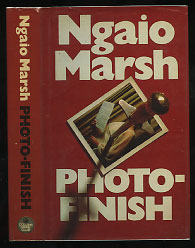 |
| The basic plot of this 1980 Ngaio Marsh detective novel resembles that of Red Warning-- but oh! what different places they go! |
I may have to read The Psychology of Thought, by American psychologist and college professor Harry Levi Hollingsworth (1880-1957), apparently a former teacher of Markham's at Columbia University. This book gets quite a work-out from the author in the final pages of Red Warning.
Red Warning is quite a sophisticated book for the period--not an easy read, but an interesting one. I am glad I read it, and I will read more works by this author--no matter the country in which they happen to be set!
Note: The tour of France will continue the upcoming week with reviews of works by Alice Campbell, Georges Simenon and Stanislas-Andre Steeman. See you soon!--The Passing Tramp.
