Some auctions by me in which you might be interested. Check out the listings, vintage mystery fans.

The Passing Tramp: Wandering through the mystery genre, book by book.
Wednesday, August 16, 2023

Wednesday, July 26, 2023
Back to Eden: Will the Crime Fiction of Eden Phillpotts Ever Really Be Revived?
 |
| When he was forty-six years old Eden Phillpotts advised his nineteen-year-old Torquay neighbor Agatha Miller to stick with the writing thing and she would achieve success. And so she did--as Agatha Christie. |
During the Golden Age of detective fiction, Eden Phillpotts (1862-1960) was deemed one of the major contributors to the mystery genre, yet today he seems barely remembered at all. Had Dover not reprinted his novel The Red Redmaynes (1922) four decades ago and Martin Edwards more recently mentioned the book in his own work, it seems likely almost no one would today would know anything of him the author.
I blogged about Phillpotts' crime writing and his unexpectedly controversial life back in 2013 and 2014 respectively, but those pieces, posted here at The Passing Tramp, seem to have made little dent in public consciousness. Yet if you go back and look at the period, Phillpotts, an incredibly prolific "serious" writer who produced works in a multiplicity of genres, was considered rather a significant figure in detective fiction.
Phillpotts, who was born not long after the Battle of Antietam in the American Civil War and died at the venerable age of 98 around the time the Beatles were playing in Hamburg, in the seven decades between 1888 and 1958 is said to have published some 250 books, nearly 120 of which were, by my count, novels.
Although he was best known for his mainstream novels, particularly those which constituted his acclaimed Dartmoor Cycle" of tales, about one-third of his novels by my estimation were crime, mystery and adventure fiction.
Yet Phillpotts did not become a regular producer of crime fiction unto 1921, when, a few months after his former near neighbor, Agatha Christie, published The Mysterious Affair at Styles (1920), he published the quasi-supernatural "room that kills" mystery The Grey Room, a book which critics of the day immediately hailed as a classic of the genre.
.jpg) |
| Kerswell House, Broadclyst, Devon the Victorian Gothic house where Eden Phillpotts resided between 1929 and 1960 |
"At last we have come upon a horror story which horrifies, a mystery story which mystifies," cheered journalist Heywood Broun in his Books column in the New York Herald Tribune.
"Eden Phillpotts has given us a tale that will chill the very marrow in the reader's bones," pronounced the LA Times. "[A] worthy addition to the few splendid mystery stories of the last ten years," concurred the Oakland Tribune.
I think the Twenties Phillpotts mysteries went over even bigger in the U. S.--where they were raving as well over the mysteries of Phillpotts' Yorkshire mainstream writer contemporary JS Fletcher--than in the UK, but across the pond The Guardian declared approvingly of The Grey Room that Phillpotts "essays the mystery story, and brings it off with considerable success and the right amount of thrill."
.jpg) |
| On this Seventies Pocket edition of Peril at End House, which Agatha Christie dedicated to her brief mentor Eden Phillpotts, the house which artist Tom Adams drew rather resembles Phillpotts' own Devon home, Kerswell House. The novel is set at a fictionalized Torquay, where Christie and Phillpotts had been near neighbors in the 1890s and the early decades of the twentieth century. |
Between 1921 and 1927, Phillpotts published a total of nine highly praised detective novels, four of them under an alliterative pseudonym Harrington Hext. He then halted for four years, a period during which his first wife died from cancer and he remarried and relocated to another home in Devon, his place of residence for seventy years. He published another mystery novel in 1931, the same year in which Agatha Christie published Peril at End House, a book which saw the return of Hercule Poirot to print after a hiatus of three years.
Christie admiringly dedicated Peril to Phillpotts, who as a close neighbor of hers in the Devon seaside resort town of Torquay had encouraged her to continue with her writing way back in 1909.
Between 1931 and 1944 Phillpotts would publish a total of 18 mystery novels, followed by a final one, George and Georgina, in 1952, when he was ninety years old. His crime writing would continue to receive predominantly strong notices from reviewers, although by this time some American critics, the most notable of them being Anthony Boucher, began criticizing his writing as old-fashioned, even ponderous and dull.
However, even in this period he produced some fine works, in my estimation. I'll be discussing some of his work this week. There is also a 11,500 word piece by me coming over at Crimereads on the author's crime writing and life.
Wednesday, July 5, 2023
Bringing Coles to New Readers: Shedunnit and Me and Douglas and Margaret Cole
.jpg)
I was pleased to participate in a Shedunnit podcast this month on the spousal mystery writing team of GDH (Douglas) and Margaret Cole, who were active in the English mystery world from 1923 into the mid-1940s, publishing twenty-eight detective novels and four books of short fiction, plus some odds and ends here and there, a few additional, uncollected short stories and a novella.
During the Golden Age of detective fiction the Coles--prominent left-wing intellectuals who wrote crime fiction for kicks and a modest competence--were well-known in the mystery field, with most of their books published in the US as well as the UK.
Although the authors when murderously moonlighting were dismissed as "unserious" about life by that ever-reliable Silver Age mystery writer, critic and occasional obtuse chowderhead Julian Symons, the Coles' mystery fiction did in fact include leftist political and social commentary that was uncommon in detective fiction at the time time.
One of their books (the highly satirical The Affair at Aliquid) even earned them a testy scolding in print in the Sunday Times from Dorothy L. Sayers for over harshly mocking Britain's clergy and aristocracy. She Who Must Be Obeyed was Decidedly Not Amused.
Although the Coles signed both their names to most of their detective fiction, in fact the books were written primarily by one or the other, Margaret writing ten of them and Douglas writing eighteen. (However, the non-writing spouse for any given volume would read over the completed manuscript and make suggestions.)
.jpg)
.jpg)
The spouses similarly divided authorship of their sizeable body of short crime fiction, which includes, to my knowledge, nearly forty short stories and a novella. Their two most notable series characters are Superintendent Henry Wilson, a Scotland Yard detective in the mold of Freeman Wills Crofts' Inspector French (though he actually preceded French into fiction by a year) and Everard Blatchington, an insouciant amateur sleuth, like Sayers' Lord Peter Wimsey.
Douglas Cole wrote the first Cole mystery, The Brooklyn Murders (1923), on a dare from his wife while convalescing from illness. It shows hugely the influence of Freeman Crofts, with a policeman sleuth and ample alibi busting.
Next, also from Douglas' hand, came the altogether more original The Death of a Millionaire (1925), a murder mystery that is also a biting satire of English Jazz Age political corruption, complete with a unrequited same-sex love story. (Cole himself was bisexually--arguably more homosexually--inclined, though he fathered three children with Margaret before he lost interest in sex altogether.) The next year came the very amusing country house mystery The Blatchington Tangle, which decidedly resembles Agatha Christie's The Secret of Chimneys, published the previous year.
.jpg)
.jpg)
After that Margaret got in the game, with the non-series The Murder at Crome House (1927), which Jacques Barzun and Wendell Hertig Taylor in A Catalogue of Crime proclaimed "the Coles' masterpiece...terse, witty, and to the point." Four of her ten novel-length mysteries would feature Everard Blatchington, introduced in Douglas' Blatchington Tangle. Her best mysteries, in my view, aside from Crome House, are Burglars in Bucks (1930), a witty epistolary crime novel like Dorothy L. Sayers' The Documents in the Case from the same year, Death of a Star (1932), a proto police procedural, Death in the Quarry (1934), Scandal at School (1935) and Counterpoint Murder (1940). All but Crome and Counterpoint feature Everard Blatchington. Counterpoint is arguable Superintendent Wilson's greatest case.
.jpg)
Margaret also wrote the five short works that comprise the interesting book Mrs. Warrender's Profession (1938), which chronicles the cases of a Miss Marple/Miss Silver like elderly gentlewoman sleuth. Mrs. Warrender appears in a single Margaret Cole novel, her last, Knife in the Dark (1941).
.jpg)
Douglas' best novels, in my view, are the aforementioned Death of a Millionaire and Blatchington Tangle, as well as The Man from the River (1928), Corpse in Canonicals (1930), which introduces Supt. Wilson's friends Hubert and Emily Welsh, The Brothers Sackville (1936), Disgrace to the College (1937), another Everard Blatchington mystery, and Double Blackmail (1939).
Of the roughly forty Coles short crime stories, I think the Coles split those about evenly, with Margaret authoring the classic satire "A Lesson in Crime" and the very darkly shaded "Glass" and probably the excellent late novella Death of a Bride (1945).
Douglas wrote some classics like "Supt. Wilson's Holiday," the ultimate "footprints" mystery and the racism-skewering "The Oxford Mystery," as well as "In a Telephone Cabinet" and "Birthday Gifts," a neat pair of gadgety mysteries reminiscent of John Rhode.
All in all, an ample and impressive crime fiction legacy that merits dignified repriting.
For more on the Coles's mystery writing see my book The Spectrum of English Murder, available for purchase here. It's loaded with spoiler warnings, no fear!
Sunday, June 25, 2023
From Stage to Page: Milton Herbert Gropper's and Edna Sherry's Inspector Kennedy/Homicide and Is No One Innocent? (with a tease on Edna Sherry's Sudden Fear)
.jpg) |
| The Bijou Theater, where Inspector Kennedy played, adjacent to the Morosco, where the Bat started it all |
In December 1929, Inspector Kennedy, a mystery play co-scripted by Milton Herbert Gropper and Edna Sherry, premiered at New York's Bijou Theatre. The decade of the Twenties had commenced with a roar on Broadway with the staging of the hugely popular mystery thriller The Bat, adapted by Avery Hopwood and Mary Roberts Rinehart from Rinehart's 1908 landmark mystery novel The Circular Staircase. Although no Mousetrap (though it shares many points of similarity with Agatha Christie's mighty hit), The Bat was hugely influential in American theater, launching the so-called "old dark house" sub-genre of neo-Gothic mystery in stage and film.
The Bat, which ran for two years and 867 performances, inspired many a playwright to take a stab at a crime thriller, particularly of the old dark house type like The Bat, loaded with clutching hands, sliding panels, masked murdering fiends and terrified, wilting, imperiled heroines. Just from 1922 there came The Cat and the Canary (the best known of these plays after The Bat), Whispering Wires, The Monster and The Last Warning, none of which, it must be allowed, enjoyed the success of The Bat, though they performed decently to quite well, Cat and Canary leading the way (101 to 349 performances).
Soon the old dark house thriller and its cinematic incarnations (all of these plays were adapted as films in the Twenties and Thirties) became utterly clichéd in the eyes of the critics (and audiences too, at least in New York), who resultantly became jaded rather than thrilled with the shocks they had to offer. Later plays like The Gorilla (1925) and Sh! The Octopus (1928) bombed on Broadway, The Gorilla managing to stay open for just 15 performances and Sh! The Octopus for 47.
There were as well numerous mysteries staged in the 1920s that dispensed with the gothic trappings of The Bat and its fearsome progeny in presenting less spooky murders, more akin to those found in classic detective novels of the 1920s. (In England thriller writer Edgar Wallace made a cottage industry out of both types of crime plays, with The Terror, 1927, being his most notable contribution to the old dark house mystery.) Milton Gropper's and Enda Sherry's Inspector Kennedy is one of these. Though it takes place entirely within the walls of a wealthy New Yorker's brownstone house and the lights do go out a couple of times, its thrills are not really of the Gothic order, but rather the modern Twenties murder mystery (including a couple of locked room situations).

In 1929, when Inspector Kennedy premiered on Broadway at the Bijou Theater, Edna Sherry was a comparative neophyte in the world of stage. Six years earlier in 1923 when she sold the stage rights to her play Guilty? to theater impresario Albert Herman Woods (formerly Aladore Herman), she was nearly forty years old and the married mother of two children. Woods tried the play out in Baltimore on March 5 in a production starring lovely silent film actress Hazel Dawn and dashing English actor Henry Daniell, the latter of whom went on to a distinguished film career of over thirty years' duration, which for mystery fans included a definitive turn as Sherlock Holmes' nemesis Professor Moriarty in the Basil Rathbone-Nigel Bruce film The Woman in Green (1945).
A review of Guilty? in the Baltimore Sun deemed the play's dialogue "stilted and unconvincing" but pronounced the plot "remarkably good" and and concluded that the play held promise if considerable revisions were made. (The critic also panned Hazel Dawn, but singled out Daniell for praise for acting his part of the "neurotic artist" with "grace and finesse" despite "being killed three times during the performance.")
 |
| "rough sketch" of the first floor of wealthy dead man Dwight Mortover's brownstone |
Sadly for Sherry, however, the production's electrician turned the play into an unintended farce by repeatedly turning on the lights while the hands were still on stage shifting scenes, inducing in the audience "roars of laughter" as startled men rushed "for elusive exits." The play died a quick death in Baltimore and has never been heard from again.
When Sherry and Milton Gropper together wrote Inspector Kennedy six years later, Sherry drew on elements of the plot of Guilty? for her new play. The contribution of Gropper--a handsome playwright and screenwriter of Rumanian Jewish origin who, though a decade younger than Sherry, had already had a half-dozen plays performed on Broadway, including the provocatively titled hit Ladies of the Evening, adapted in 1930 by Frank Capra as the hit film Ladies of Leisure, starring a youthful Barbara Stanwyck--seems to have been with the dialogue.
The same year Gropper and Sherry had collaborated on a Hollywood courtroom mystery film (another popular stage mystery subgenre in the Twenties), Through Different Eyes, which innovatively was told in a series of flashbacks from three different perspectives, recalling the classic Japanese film Rashomon (1951). The New York Times deemed the film an "ingeniously conceived murder trial story."
.jpg) |
| William Hodge and Margaret Mullen in Inspector Kennedy/Homicide |
Unfortunately, Inspector Kennedy fared less well with New York critics and died a fairly quick death there, running for only forty-three performances over December 1929 and January 1930, despite starring, in the title role, popular actor William Hodge, who also directed the play. However, later that year Hodge took the play, retitled Homicide, on the road, performing in Chicago, Detroit, Pittsburgh, Wilmington, Boston and Windsor, Ontario, among other locales, to much greater praise and success.
The same year Gropper and Sherry published a novelized version of Inspector Kennedy/Homicide, retitled Is No One Innocent?
The novel adapted the plot of the play, concerning the murder of a despised rich man by the name of Mordaunt in a locked room (the living room in this case), actually changing the identity of the murderer. "Rough sketches" of the first and second floors of the house are provided, along with a raft of suspects, all of whom, with one exception (and he ends up as the second murder victim) confess to the crime!
Let's see, there's the pretty secretary, the business partner and his son, the glamorous movie star, the professor and Mary Ann...Wait a minute, let me start over!
The pretty secretary, the business partner and his son, the lawyer nephew, the housekeeper, a drug-addicted girl, and the visiting telephone repairman....There's also a Chinese butler named Wong, but he gets dispatched before he ever gets to utter more than a few lines. He never had a real chance to confess to the crime had he been so inclined! He's killed in the locked living room too, under similar circumstances to the first murder, right under Inspector Kennedy's eyes, though in the dark.
 |
| Goo Chong on stage |
Aside from William Hodge, the play's cast included in the role of the secretary one Margaret Mullen (Margaret Mullen Root), a tall, pretty brunette then only nineteen years old, who later became a fixture at the Bucks County Playhouse in New Hope, Pennsylvania, which Philadelphia mystery writer Milton Propper fictionalized in his detective novel The Station Wagon Murder (1940), reviewed by me here. There's a nice interview with the actress, who died in 2003, here,
The chinese butler Wong was play by Goo Chong, or Peter Chong, a pioneering American Asian stage and film actor, though his film roles mostly went uncredited. (He was credited, however, as Ingrid Bergman's cook in The Inn of Sixth Happiness and Fred Astaire's valet in Easter Parade.)
 |
| Peter Chong as Fred Astaire's manservant in Easter Parade |
Gropper's and Sherry's collaborative work ended after this and Edna Sherry faded from the world of the New York stage, never having made, truth be told, a lasting impression. Her early stage writing did serve her well, however, when, eighteen years later at the age of sixty-three, she published her second novel and most famous work, the suspense thriller Sudden Fear (1948). This classic, filmed in 1952 as a highly-regarded Joan Crawford vehicle, will soon be back in print, courtesy of Stark House. More on this soon!
.JPG)
Saturday, June 3, 2023
Children's Hour--Lady Bountiful in a Red Roadster: The Hidden Staircase (1930) and The Secret of Red Gate Farm (1931), by "Carolyn Keene"
My sister's bedroom in our ranch house in Northport, Alabama back in the 1970s was decorated in colors of pale yellow and blue. In the corner, by the only window in the room, which looked down the sloping lawn, was a metal bookcase, painted yellow, where she kept her books. Being extremely bookish from a young age, I naturally took peeks at them now and again. She had some books my Grandmother Ada from California had bought her, like The Borrowers, Mr. Mysterious and Company, the first two of Frank Baum's Oz novels and a number of Nancy Drew mysteries, the yellowbacks with the pictures directly on the front covers (no dust jackets). I can still remember the ones she had from looking up the covers on the internet: The Secret of the Old Clock, The Hidden Staircase, The Mystery at Lilac Inn, The Secret at Red Gate Farm, The Clue in the Diary, The Sign of the Twisted Candles, The Secret in the Old Attic, The Clue in the Old Album. (I don't recognize any others.)
.jpg)
.jpg)
I don't know that my sister was too devoted to Nancy Drew; she wasn't a big reader in general. I remember being intrigued by that Hidden Staircase cover with Nancy, looking rather school librarian-ish in her sensible blue blouse, skirt and shoes, intrepidly traversing that old stone staircase, that beaming flashlight in her hand. I never read any of them, however, at least that I can recall.
By 1974 I had started reading Agatha Christie mysteries, starting with four Pocket paperbacks that my Mom bought when we lived in Mexico City (Easy to Kill as it was called, Ten Little Indians, as it was called, Funerals Are Fatal as it was called, and The ABC Murders). Before Agatha my favorite book compulsion was L. Frank Baum's Oz series of fantasy children's books. (I was the only kid in my set who knew there was more than one.) Nancy had to wait. As for the Hardy Boys, I had one my Mom got me, when I was in the fourth grade I think, called The Scarlet Claw. I don't believe I ever even cracked the covers. Oddly enough I did read a Bobbsey Twins book that had mysterious elements, but I forget the title.
When the 1990s rolled around and I was in graduate school studying history (and a great mystery reader), I bought some of the facsimile eds. of Nancy Drew and Hardy Boys mysteries reissued by the publisher Applewood. The fact that these were replicas of the actual stories from the 1920s and 1930s interested me. Beginning in 1959, the year my sister was born, the older Nancy Drew and Hardy Boys were heavily edited and updated, in some cases essentially rewritten. I had no interest in any of that. A love of history and "Golden Age," between-the-wars mystery, I wanted to read those books, if I ever got around to reading them, as they originally appeared, within the true context of their times.
.jpg)
Finally I've gotten around to reading a couple of Nancy Drews: The Hidden Staircase (Yes!) and The Secret of Red Gate Farm, the second and sixth books in the series, originally published in 1930 and 1931 respectively, in the heart of the Golden Age of detective fiction.
Many of you will be very familiar indeed with the plots of these beloved children's mystery novels. Hidden Staircase may be the single most famous Nancy Drew title. It opens when privileged, blonde, sixteen-year-old teenage do-gooder Nancy, all alone at the Drew home in River Heights (her father, big shot attorney Carson Drew, has been called out of town on a case, and the housekeeper, Hannah Gruen, has her day off), gets a visit from a repulsive, rude stranger from nearby Cliffwood, Nathan Gombet, who to Nancy accuses her father of having cheated him in a land deal. Nathan, you see, is a miser and frankly rather off his rocker.
After Nancy gets rid of this objectionable person, the book rather hangs fire for a bit. The teen gets a visit from Allie Horner, one of the many people, it seems, who has benefitted from Nancy's crusading goodness. Allie and her sister Grace had lived on a farm, where they "were undernourished and beset with financial worries," but, all due to the efforts of Nancy, "the girls had come into an inheritance and their troubles had vanished." (All this is detailed in the debut mystery in the series, The Secret of the Old Clock.) They discuss Nathan Gombet a bit and Allie confirms he is bad news. Then Carson Drew gets home and they discuss Nathan some more.
A few days late Nancy visits the cottage of Abigail Rowen, another beneficiary of Nancy's decsive intervention in the Old Clock case: "Nancy had found in her deplorable condition. There was little food, or money with which to buy it, and Abigail had firmly refused medical attention because she could not pay for it. It was through Nancy's instigation that she had received her inheritance from the Crowley estate...."
.jpg) |
| Ronen Mansion, Stone City, Iowa |
Abigail introduces Nancy to her friend Rosemary Turnbull, "an elderly maiden lady" (she's actually no more than forty-five by my calculation) who resides in Cliffwood with her twin sister Floretta at an old stone mansion, naturally called The Mansion. It seems that, like all the other maiden ladies mentioned above, the Turnbull sisters have a problem for Nancy Drew to solve: their house is infested with poltergeists!
Noises all over the house, shadows on the walls and objects disappearing, even when all the doors and windows are locked. Yes, technically this is a locked room mystery, though you will have about as much trouble answering that riddle as you would in a Carolyn Wells detective novel.
Finally, after forty pages and five chapters, Nancy gets to The Mansion, where she finds Floretta all aflutter! She wants to move out of the house immediately! Hey--could this be someone's clever plot to drive the Turnbull sisters out of their ancestral home, built before the Civil War? I'll bet you a bag of Scooby snacks it could!
Nancy quickly decides that the Turnbulls are worthy objects of her benevolence and gets to work trying to find the true guise of the poltergeist. Gazing at the family portraits that adorn The Mansion, she realizes "that once the Turnbulls had been the leading family in Cliffwood." Although Rosemary and Floretta, the last of the local Turnbull line, are decayed gentlewomen with "an income only sufficient for their needs," they are, Nancy appreciates, "welcome in the best of society." (Okay, this is apparently Iowa, so let's not get too carried away with pretensions.)
As Nancy tells her father, "They come from an excellent family. I believe The Mansion has belonged to the Turnbulls ever since it was built....It would be a tragedy if they had to sell the place now...I want so badly to help them."
Carson Drew has to go on a business trip to Chicago, but he hands daughter Nancy a revolver and tells her you go, girl, basically. Which she does. The gun doesn't play any real role in the novel, however, it's mostly just Nancy snooping around at the Turnbull place and later at another stone house that looks a lot like theirs. It turns out that the pair of houses were built by two Turnbull brothers who were once close but then became enemies during the Civil War....And that wicked Nathan Gombet lives in the other house....And that he has been pressuring Rosemary and Floretta to sell their house to him cheap....
Solved the mystery yet? Could a hidden staircase be involved somehow? One thing you can say, at least this story has truth in advertising.
Truth is, Nancy is no great detective here, just very determined. But it's an enjoyable story nevertheless. If there's one thing kids love, it's mysterious, secret passages in old houses and you sure get them in this novel.
A few books later Nancy is at it again, trying to discover The Secret of Red Gate Farm. This time she has two pals, cousins George and Bess, whom she meant in the previous books when she was deciphering The Secret of Shadow Ranch. George is a tomboy type and Bess is girly type of girl, with Nancy naturally being the golden (literally) mean. (Wait for the modern adaptation where George is a lesbian of color.) I think these two were added to the series because Nancy seemed a little lonely in Hidden Staircase. (In that book her only friend, as opposed to charity case, who appears is Helen Corning, whom Nancy deems too gossipy to bring into the case.) Never fear, though, George and Bess take orders from Nancy, who is very much the "Head Girl" type.
Red Gate Farm opens with Nancy and Bess and George finishing a shopping trip in a nearby city. They find a "quaint Oriental shop" on their way to the train station and stop in the place. There they encounter an unpleasant Eurasian shopgirl, Yvonne Wong, and request to purchase from her a certain "Oriental scent" which pervades the shop; but the shopgirl does not want to sell it to them. Finally, after being repeatedly badgered by the girls, she offers it to them for three dollars (about $53 today), and the girls chip in to buy it. Of course this perfume will figure significantly into the story....
The girls head for the train station, grousing all the while complaining about the Eurasian shopkeeper. "Snippy," pronounces George. "I didn't like her looks. She was too flashy or something." On the train, however, they encounter an altogether nicer girl, Millie Burd, who will become the latest object of Nancy's benevolence. They learn that Millie is seeking a job in the city because she and her grandmother, who live at Red Gate Farm, have to pay off the farm's mortgage and don't have the money. Nancy accompanies Millie to her job interview and becomes suspicious that her would-be employer is a nogoodnik. (He has "harsh features," saucy manners and wears a "bold" suit and "gaudy" necktie.) Millie, who is rather a noodge really, doesn't get the job, and Nancy decides that she, along with Bess and George, will spend part of their summer vacation at Red Gate Farm as boarders to help out the Burds financially.
 |
| not quite the nature cult the author had in mind |
So off they all go to Red Gate Farm, where they are soon plunged in another mystery! It seems that Grandma Burd has let part of her land (including a cave) to a weird nature cult of some sort, the Black Snake Colony, who dress up in white robes that make them resemble Ku Klux Klan members and dance about in the moonlight. Well, of course Nancy has to get to the bottom of this! And she does, but not until she and her chums face grave peril.
Red Gate Farm is an enjoyable story, more eventful, than Hidden Staircase, but the whole edifice is built upon a succession of coincidences: Nancy and her chums just happen to go into the Oriental shop and buy the bottle of perfume, which they they just happen, when a certain nogoodnik is present, to break on the train, where they just happen to encounter Millie Burd, who just happens to apply for a job at a place connected with the Black Snake Colony, which just happens to rent some land at Red Gate Farm, where Nancy and her chums just happen to board out for the summer. Wow! The gods surely know Nancy loves solving mysteries and are doing everything they can to help her along. Fortune's child, that girl!
From the perspective of a Golden Age mystery fan, it's interesting to see a spurious religious cult popping up in Red Gate Farm, for these insidious organizations often are up to no good in adult mysteries of that time. And of course there's the crooked Eurasian, with no "good" minority character to balance her. In Hidden Staircase wicked Nathan Gombet--whom some have argued is Jewish, although I don't believe Gombet is a specifically Jewish surname--has a wicked black housekeeper accomplice, who is only ever described as "the colored woman" and has a hosts of negative descriptions: "fat," "slovenly," "surly-looking," "positively vicious," "looks as though she were an ogre."
All the characters whom Nancy helps was well-born (by American standards), "nice" WASPish women, down on their luck. The only minorities depicted in the book are villainous. The other villains are obvious gangster types and are all marked by cruel faces and colorful dress. One woman in Red Gate Farm declares that you can't tell who the criminals are these days, but I would say that so far in the Nancy Drew tales that is precisely wrong. Villainy is openly revealed to Nancy, at least, in countenance and costume.
Thankfully Nancy is more than capable of combating it. Does Nancy ever actually attend high school, I had to wonder, when reading these books. She seems to have ever so much free time. My thought after reading these novels was Nancy is a Lady Bountiful type and sure enough when I searched those terms I came up with "American Sweethearts" Teenage Girls in Twentieth-Century Popular Culture, an academic monograph by Ilana Nash. She notes that Harriet Stratemeyer Adams--who for over half a century ran the Stratemeyer Syndicate, which published the Nancy Drew books, and wrote the original outlines for most of the Nancy Drew novels (many of which actually were then written by Mildred Wirt Benson)--very much believed in the Lady Bountiful ideal.
.jpg)
A Wellesley College graduate and high society matron, Harriet Adams, according to Nash, adhered to a "model of female citizenship predicated on noblesse oblige, in which women influence the public sphere by uplifting the less fortunate and performing acts of philanthropy. Adams frequently told interviewers that she used the Wellesley College motto to inform the character of Nancy Drew: "Non ministrari, sed ministrare ('Not to be ministered unto, but to minister')."
Nash describes all this as a "vision of the ideal woman as a sort of Lady Bountiful," informed with "the ideas of first wave feminists of the turn of the century, whose vision of proper womanhood remained conservatively focused on the white privileged classes...."
I really sensed this myself reading these two Nancy Drew books and it put me off Nancy a bit, even though I enjoyed the books. Nancy just seems so perfect and remote, almost like a Greek goddess or Amazonian princess. She doesn't even seem ever to attend school and of course does not hold a professional job, instead devoting herself, in the classic manner, to amateur sleuthing, in order to charitably help those less fortunate than herself, these being, so far, entirely white women of good stock who through ill fortune and a certain lack of pluck have fallen on hard times.
Famously the Stratemeyer Syndicate in 1959 began revising the earlier Nancy Drew titles, a task not completed until 1975, when all the novels published between 1930 and 1956 were revised. Certainly a character like the "colored woman" from Hidden Staircase could never have survived to the present day. That she even made it up to 1959 is striking. Harriet Adams herself carried out the revisions of that novel.
I'll keep looking at the Nancy Drew books, however (along with those from the rival Judy Bolton series). These books will always take me back to my youth and my sister's little Nancy Drew collection. Later on she began reading Seventeen, Madeisemiselle and Cosmopolitan and Seventies potboilers like Harold Robbins' The Betsy and John Jakes' The Bastard. (I looked at those too.) Nancy Drew and her more innocent mysteries of life had been left far behind, with George and Bess and her shiny red roadster.
Sunday, May 28, 2023
Prince Albert in a Can: Out of the Dark/Child's Play (1964), by Ursula Curtiss and its film adaptation I Saw What You Did (1965)
To a great extent, children were neither seen nor heard in Golden Age detective fiction, though they certainly pop up in Dorothy L. Sayers' humorous short story Talboys, say, Margaret Cole's novel Scandal at School (1935), where the murderee is a blackmailing teenage girl, and Agatha Christie's Crooked House, where--well, I'd better not say more about that one!
.jpg)
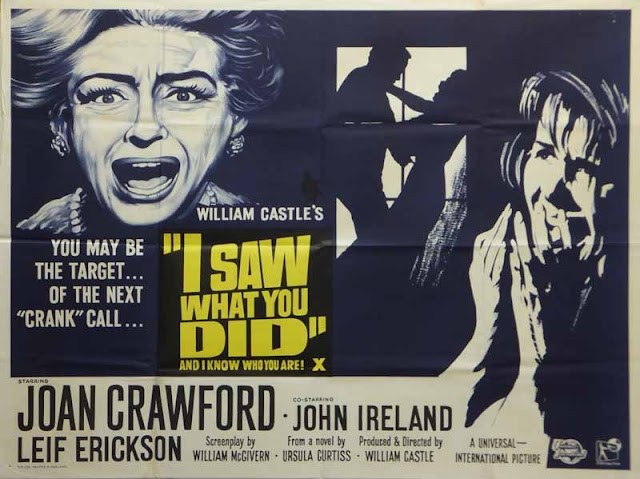
I have the impression that the depiction of children in crime fiction owes rather more to the Americans than the Brits, Americans like like Craig Rice with her classic Home Sweet Homicide and the various mid-century mistresses of domestic suspense, like Ursula Curtiss. Indeed, Curtiss, the mother of five children, went so far as to base her 1964 crime novel Out of the Dark (Child's Play in England), on her own family.
.jpg)
The book reads something like Shirley Jackson's popular domestic child-raising comedies, Life among the Savages and Raising Demons, crossed with a tale about a psychotic killer. It's a rather weird combination, to my mind inadvertently making the case for keeping kids out of crime stories, unless they are themselves killers like the sociopathic tot in William March's The Bad Seed--tales of morbid psychology, in other words, where anything narsty goes.
Tales about the mirthful doings of wacky kids, on the other hand, don't really mix well with murder, in my view. But that is rather what we got here!
The basic scenario in Child's Play--the title I'm used to, and the better one I think--is clever, and it's not surprising the novel was adapted as a film by that great American impresario of horror schlock, William Castle. In the novel a pair bored girls, "home alone" as it were, decide to make a series of prank phone calls to unsuspecting victims, and soon get in over their heads.
It's the old "Prince Albert in a can" ruse, I suppose you know that one? It's where kids call a store asking if they have "Prince Albert in a can?," referring, don't you know, to the Prince Albert brand of tobacco. If the victim unsuspectingly answers, "yes, we do" then the kids scream: "Let him out!" Hilarity ensues. I did this one myself, but disappointingly the person on the other end of the line anticipated me by saying, "No, we let him out." Stephen King used this bit in his horror novel It and it appeared as well in the television adaptation. It's referenced in the Curtiss novel as well.
.jpg) |
| Let him out! |
In the Curtiss novel, which is set in Albuquerque, New Mexico, the author's place of residence from 1960, the teen girl pranksters are Libby Mannering and her visiting friend from Chicago Kit Travers. In the book Kit--a sort of urban sophisticate who seems older than her fourteen years (Libby is fourteen as well)--is the instigator of the phone calls, uttering to her victims, all for fun, the threatening line: "I know who you really are, and I saw what you did...."
This lands the girls in trouble when they utter the line on the phone to a man who years ago got away with a terrible murder....
As I mentioned above, this is a classic suspense scenario and kudos to Curtiss for being the first, apparently, to use it.
Unfortunately, however, from my perspective, Libby happens to have four younger siblings, three brothers and a baby sister, and their antics, lovingly dwelt upon by the author, undermine the suspense. It seems that Curtiss, herself the mother of five children, based the kids in the book on her own. She told the Albuquerque Journal that the novel "was written around the five Curtiss children, Katy, 15, John, Paul, Kieran and Mary, 8." Based on the antics in this book I would say that the Curtiss children must have been quite the hellions! More than a match for any mere murderer, indeed.
But the book is not a murder comedy either. To me it's schizophrenic. Early on there's a rather frightening depiction of the original murder that makes clear the killer is a very bad dude, a sociopathic type, and it should make us fear powerfully for the safety of the kids, but it really doesn't. I could never really make myself believe Curtiss' brat pack was in true danger, despite the atmospherics. (The somewhat feckless Mannering parents are spending the night in Santa Fe and had gotten the kids an adult babysitter, who never shows.)
Perhaps had Curtiss confined the cast of kiddie characters to just the two teenage girls, it might have worked better. If three's a crowd, five is a calamity, at least as far as suspense is concerned. The author's slightly earlier suspense novel, Hours to Kill, a superb study in terrifying isolation, is much stronger as pure suspense, I believe.
*******

Some reviewers voiced similar complaints about the book as mine, but on the whole the novel received boffo reviews (specially in England) and it became one of only two Curtis novels to be filmed. The 1965 film version of Out of the Dark, entitled I Saw What You Did, is an interesting movie to thriller fans, though ultimately I think it is deeply flawed.
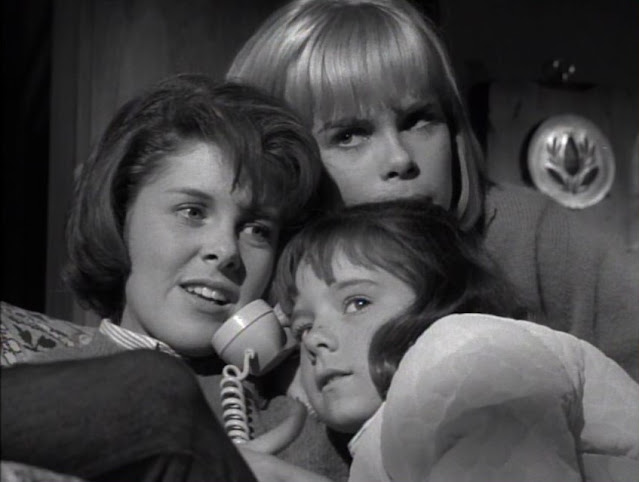
It was directed by William Castle, the last film by him, I believe, that anyone ever talks about, though he would direct five more. Its main stars were two teenage unknowns, Andi Garrett and Sara Lane, as Libby and Kit respectively. (Lane was fifteen at filming; I'm not actually certain how old Garrett was.)
 |
| Girls Night In |
However, the main adult co-stars in the film were big movie stars then in their fifties: Joan Crawford, 58, and John Ireland, 50. Both stars had drinking problems and if anything looked older than their ages. It's stated a couple of times that John Ireland's character is, or looks like, around forty old, which is laughable, while Crawford, saddled with a horrendous beehive hairdo and some sort of costume jewelry collar contraption that looks like it was lifted from the Temple of Doom, is positively matronly. (Originally Barbara Stanwyck was supposed to play the role, which would have been more plausible, though Stanwyck was only a year younger than Crawford.) However, Joan and John still lend an air of needed seriousness to the film.
 |
| John Ireland can't figure it out either. |
Fifty-three year old actor Leif Erickson is in the film too, in the throwaway part of Libby's father, like Crawford and Ireland looking old for his age. The only other sizeable part belongs to nine-year-old Sharyl Locke, as Tess Mannering, Libby's baby sister. Libby's three brothers from the book, all have been expunged, surely a necessary move for cohrency's sake. However, little Sharyl does enough mugging for all of them.
 |
| more glamorous days Joan Crawford and John Ireland in the melodrama Queen Bee, from 1955 |
For the film, it must be noted, is as schizophrenic as the book, if not more so. The teenage actresses have been much criticized as terrible, but I don't know that this is such a fair charge. Basically they are tasked with playing a pair of silly teenage girls and at that job I think they succeeded well enough. (Andi Garrett gets a bit goofy at times though.)
The biggest problem I had with the film is the godawful silly sitcom music on the soundtrack, which made the film seem like more like a wacky episode of the contemporary "identical cousins" sitcom, The Patty Duke Show. The lightness of the portions with the kids doesn't blend well with the murderous goins-on among the adults, which, come to think of it, is a pretty fair translation of the book, only more so!
In particular, the first murder--a blatant rip-off of Alfred Hitchcock's infamous shower scene from Psycho--is quite violently presented and rather off kilter with much of the rest of the film. So, what's the first murder, you ask (if you haven't seen the film already)? Well, John Ireland, playing Steve Marak (Leonard Whelk in the book), knocks off his pretty young wife Judith (Joyce Meadows) in a rage because she is leaving him. When he gets a call from Libby, in the sexy guise of Suzette, telling him, "I saw what you did....and I know who you are!," he goes bananas of course.

Joan Crawford, who starred in William Castle's 1964 horror film Strait-Jacket (a much better flick), has been shoehorned into this film in the part of Amy Nelson, a seriously overdressed neighbor who has the hots for Steve and is always spying on him from her window. Amy comes up with the brilliant idea of blackmailing Steve, with her knowledge of the murder, into marrying her, which predictably only succeeds in prompting Steve to slay Amy too. Before Amy--okay, let's just say Joan, cause this is who Joan really is playing here--kicks the bucket, however, she has a great scene confronting Libby, who has come to get a gander at Steve (she thinks he sounds sexy on the phone), scolding and shoving her and denouncing her as a tramp. Why, if they had gotten Joan's daughter Christina to play Libby, Joan wouldn't have had to do any acting at all!
 |
| "Get outa here, you tramp!" the scariest thing in the film |
Apparently in real life, however, Joan got along with the teenagers just fine. It was the adult and sexy Joyce Meadows whom she felt threatened by and banned from the set. (Joan and John Ireland had had a fling during the filming of Queen Bee a decade earlier.)
"Amy" really wasn't much of a part for Joan, in truth, but after I Saw What You Did all she would have left to do on film was two indifferent English horror flicks, Berserk (1967) and Trog (1970). The Oscar-nominated Whatever Happened to Baby Jane? in the end proved no career-saver for Joan. Soon we may take a look at the late career of Joan's arch-nemesis from Baby Jane (and real life), Bette Davis, and she how she fared!
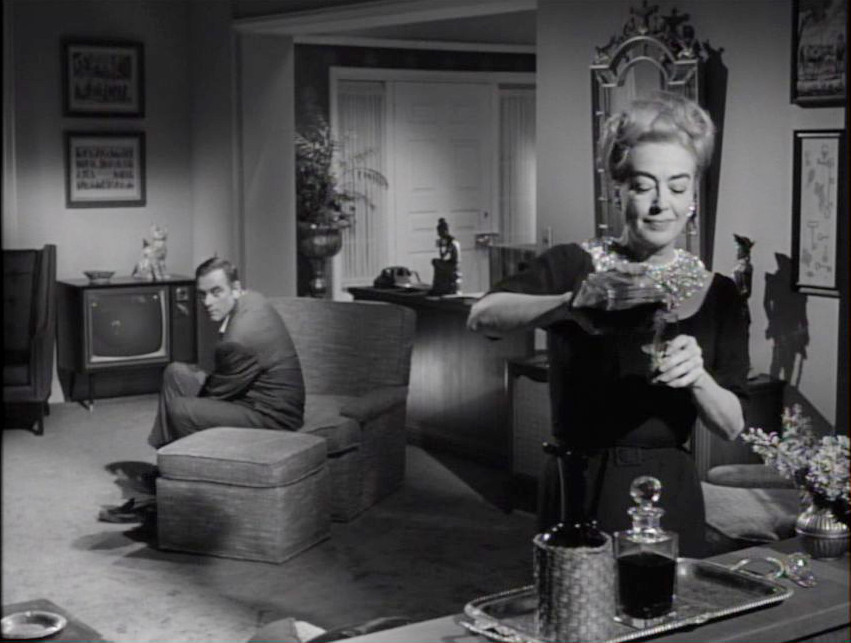 |
| Murder's nothing a nice little drinkie won't solve! |
Sunday, May 7, 2023
Cozy Sundays: "Fee Fie Ho Hum!" The Blood of an Englishman (2014), by MC Beaton
At the time of its publication, The Blood of an Englishman (2014) was advertised as something of an "event" in crime writer MC Beaton's long-running Agatha Raisin mystery series, as it was the author's 25th book in the series. Only five more Raisins from the author's hand (ostensibly) followed it before her death at age 83 on the last day of 2019. The series has since continued under the hand of R. W. Green (a man, Rod Green), who has been described as a longtime friend of Beaton.
Personally, I suspect Mr. Green, not of having done it with the revolver in the billiard room, but of having helped in the writing of the last of the Beatons ostensibly produced by his benefactor, Beating about the Bush, published the year of her death, because to me it doesn't read quite like Beaton herself and it is a huge improvement on her previous two Raisins, The Witch's Tree (2017) and The Dead Ringer (2018), which are, to be brutally frank, two of the worst mysteries I have ever read. Sadly, they are practically unreadable, like Agatha Christie's Postern of Fate (1973) without that novel's dotty, meandering charm. I haven't read the two Raisins which come between Blood and Tree (Dishing the Dirt and Pushing up Daisies), but Blood comes off like a work of sheer genius compared to Tree and Ringer, though in fact Blood is very much adulterated in my view.
.jpg)
When The Blood of an Englishman was published in 2014, the Agatha Raisin series had been in sharp decline for some time, since approximately 2008. The year before that, in the rather charming (if you like the series) Kissing Christmas Goodbye (2007), the eighteenth Raisin novel, Beaton had introduced Toni Gilmour, a young, beautiful sidekick for Agatha Raisin, who had graduated from amateur village snoop to licensed private detective in the fifteenth Raisin novel, Agatha Raisin and the Deadly Dance (2004). The first few PI Raisin books aren't bad, in my opinion, but the wheels start to come off the dead cart with A Spoonful of Poison (2008). I don't blame Toni for this but rather structural changes that Beaton made in the books at the time.
The books start to rely much more on barking mad murderers, the body counts rise to absurd levels, the plots become disjointed and chaotic, Agatha is put in more perils of her life than Pauline and there's this weird thing where the murderers get revealed early and then the last chunk of the novel concerns the murderer plotting, futilely of course, to kill Agatha, after which there is an epilogue introducing the setup in the next, apparently already written book.
Beaton's cast of longtime supporting characters continue to make appearances, but these appearances feel ever more rote. The charm of life in the Cotswolds village of Carsley, so well-depicted in the debut novel in the series Agatha Raisin and the Quiche of Death (1992) and others which followed it, is lost.
Indeed, after Kissing Christmas Goodbye, the lone bright spot in the series for me has been Something Borrowed, Someone Dead (2013), which immediately preceded The Blood of an Englishman. Although it shares the same narrative structure of the later Raisins, Borrowed benefits from a better plot and choice of murderer. But let's look in more detail at Blood below, shall we? Following this list of the Raisin novels, provided so that you can better follow what I have been saying, along with my ratings of them. (Imagine they are raisins rather than stars.)
Agatha Raisin and the Quiche of Death 1992 ****
Agatha Raisin [hereafter AR] and the Vicious Vet 1993 ***
AR and the Potted Gardener 1994 ***
AR and the Walkers of Dembley 1995 ***
AR and the Murderous Marriage 1996 ***
AR and the Terrible Tourist 1997 ***
AR and the Wellspring of Death 1998 ***
AR and the Wizard of Evesham 1999 ***
AR and the Witch of Wyckhadden 1999 **
AR and the Fairies of Fryfam 2000 ****
AR and the Love from Hell 2001 ****
AR and the Day the Floods Came 2002 ***
AR and the Curious Curate 2003 ****
AR and the Haunted House 2003 ***
AR and the Deadly Dance 2004 ****
AR and the Perfect Paragon 2005 ***
Love, Lies and Liquor 2006 ***
Kissing Christmas Goodbye 2007 ***
A Spoonful of Poison 2008 **
There Goes the Bride 2009 *
The Busy Body 2010 -
As the Pig Turns 2011 *
Hiss and Hers 2012 *
Something Borrowed, Someone Dead 2013 ***
The Blood of an Englishman 2014 **
Dishing the Dirt 2015 -
Pushing up Daisies 2016 -
The Witch's Tree 2017 NONE
The Dead Ringer 2018 NONE
Beating about the Bush 2019 (with R. W. Green?) -

In Blood, Agatha attends a pantomime of Babes in the Wood (mashed up with Mother Goose, Jack and the Beanstalk and other tales) in the nearby village of Winter Parva with her saintly friend and moral mentor (to the extent this is possible with Agatha), Mrs. Bloxley, the wife of the rather less patient and forbearing vicar of Carsley, improbably named (as Agatha herself thinks) Alf. When the man playing the ogre, bullying baker Bert Simple, is eviscerated by a metal spike when exiting the stage via a trapdoor drop, Agatha is hired by the play producer, Gareth Craven, to find the depraved culprit. Agatha is not notably successful in this endeavor (to be fair, neither are the police), for it's not long before, after a performance of The Mikado, another actor is decapitated with the (real) sword of the Lord High Executioner.
Why do they call these books cozies again? These are very unpleasant killings (and there's another one, which I can't divulge, which is even worse). Even Mrs. Bloxley doesn't mince words (well, not much) in reference to the neutering of Bert Simple, commenting that the villain "plotted not only to kill him but to destroy his manhood in the process." Nice to know that cozies can encompass emasculation and decapitation and--well, I can't mention the other thing. With some tonal shifts this book could have been written by Jo Nesbo!
Blood has a lot of the flaws characteristic to the late Raisins, including the sidelining of a great many of the series' longtime supporting cast members and an overemphasis on Agatha's dysfunctional love life, or more accurately lust life. Anyone reading many of these books must surely start to wonder how much MC Beaton actually liked women. So many of them, including Agatha herself, are messes, hot and cold.
Aside from the fact that Agatha Raisin, in the depiction of whom the author said she drew upon herself, repeatedly denounces feminism for ruining romantic relationships between the sexes, there's the fact that Agatha is such a basket case in her relationships with men. In Book 5 her marriage ceremony to her handsome neighbor James Lacey, a Jane Austen hero with the stodginess and emotional repression dialed up to 99, is interrupted when her long lost (and conveniently assumed dead) husband Jimmy shows up, then in Book 11, when Agatha and James finally do marry, the union is a train wreck that lasts out only this one novel.
There are other men whom Agatha gets interested in and even sleeps with over the course of the series, including charming if rakish aristocrat Sir Charles Fraith, but usually they turn out to be utter scoundrels. Still over and over Agatha falls head over high heels (she hates flats) in love with any handsome man she meets. No wonder in Blood, her friend with occasional benefits Sir Charles thinks: "It would be hopeless being married to her....He would never be able to trust her. Agatha would always be one woman looking for an obsession."
.jpg) |
| "If I were only fifty years younger!" MC Beaton tweeted this sentiment in 2017 concerning this pic of herself and scrumptious actor Matt McCooey, who plays cop kindhearted Bill Wong, Agatha's first friend by her own admission, in the Agatha Raisin television series |
When I started this series I had a notion that Agatha, she of the breakfasts of back coffee and cigarettes and the perpetual gins and tonics, was some sort of tough feminist icon, but she's really nothing of the sort, even though she's a highly successful, frequently ribald, retired PR executive. Her neuroses. mostly over men and her appearance but also concerning her lower class social origins, pull her down constantly. She does have her genuine feminist, girl power moments, like when she storms the woman-averse pub in Fairies of Fryfam, one of the best books in the series, but all is canceled out with her desperate man chasing and pathetic obsession with her looks.
I recall there was a woman character in a satirical meta episode of the American sitcom Newhart, the horny middle-aged single woman neighbor, who was introduced as "Man-crazy Smitty." Well, that's Agatha to a "T." Despite all her professional successes she just can't get along without a man in her life. She even goes about with her ambiguously gay "toy boy" pal from the City, Roy Silver, when no other man is available, pale and weedy and effeminate as Roy is invariably described.
In Blood Agatha gets smitten with handsome men four (!) times, though in the one case the passion is somewhat lukewarm because the man has a weak chin, that bane of Golden Age crime fiction, at least as far as men were concerned. (Conversely with women strong chins were problems.)
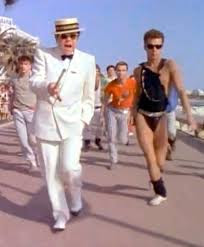 |
| just your typical gay shindig |
In another case, the man sadly turns out to be gay, a fact to which Agatha tumbles when he invites her to a party he has thrown where the parking attendant is wearing a "hat, black leather thong and nothing else." I'm guessing Beaton got her notion of this little shindig from watching Elton John's forty year old "I'm Still Standing" video.
There at least is some relationship to the plot in all but one of these cases, but at this point in the series I just find Agatha's obtuseness in regard to men and her low self-esteem not sympathetic but simply exasperating. She's like the Bill Murray character in the Nineties romantic comedy Groundhog Day, had he never learned anything whatsoever from repeating the same day over and over again.
Was the author herself really anything like this? If so I think I can see how she ended up handing off authorship of the series (and the Hamish Macbeth one too)not to anoither woman writer but to a ruggedly handsome male friend--no toy boy he--named Rod. She strikes me as rather a man's woman.
 |
| Rod Green |
The plot in Blood isn't bad, actually. The climax, which occurs when a fifth of the book yet remains, is actually intriguing, though it's stolen from another, rather famous crime source. (Let's call it an homage, since the source is actually mentioned in the book.)
Unfortunately, everything then is dragged out as the murderer pursues Agatha, even abducting her a second time and trying to kill her by throwing her in a river while confined in a barrel. (It really is very Perils of Pauline.) By my count this is only a 60,000 word novel, but at least 10,000 words could have been profitably cut from it.
Agatha's great days in book form were the fifteen years between 1992 and 2007, when you could still hold out hope that Agatha might come to her senses about men. Really, she and Charles, who latterly carried the series on his nattily-clad, aristocratic shoulders (Mrs. Bloxby and Roy help), should have married after Love, Lies and Liquor, by which time any fan of the series should have wanted to see James Lacey get his richly deserved comeuppance.
The popular ongoing television adaptation of the Agatha Raisin novels makes the characters more likeable generally, including Roy Silver, James Lacey and, most crucially, Agatha herself. The TV series is genuinely warm and cozy, Sex and the City-ish gay sex jokes notwithstanding. That the Agatha Raisin novels are "cozy" is something I have to question. The tea has a lot of gin in it, and the saucer is littered with stubbed-out cigarettes.
Subscribe to:
Posts (Atom)