Showing posts with label Carolyn Wells. Show all posts

Friday, June 14, 2013

Axing Questions: Studies in Murder (1924), by Edmund Lester Pearson Part One

Lizzie Borden (1860-1927)
On this day in June 120 years ago, the people of the United States were in thrall to the murder sensation of 1892-93 (and one of the great such sensations of all time), the Lizzie Borden murder case.
 
The trial of Lizzie Borden (1860-1927) for the horrific ax slayings of her wealthy father, Andrew, and her stepmother, Abby, at their home in Fall River, Massachusetts had commenced on June 5, 1893 and culminated a couple weeks later on June 20 with a finding by the jury of not guilty.

To the jubilation of her supporters, Lizzie was free.  She would live in Fall River for the rest of her life (though not at the house of the murders, which, I understand, is now, rather creepily, a bed and breakfast).  No one else was ever tried for the crimes.

Popular opinion has tended to register another verdict from that of Lizzie's jury, however, as embodied in the famous rhyme:

Lizzie Borden took an axe
And gave her Mother forty whacks;
When she saw what she had done,
She gave her Father forty-one!

Actually, Andrew got ten whacks and Jennie nineteen, but that amount was more than sufficient to do the jobs.

By the way, the mystery writer Carolyn Wells recalled that when she once was discussing limericks with Theodore Roosevelt (only clean ones I'm sure!),  Roosevelt recalled the Lizzie Borden rhyme as the most memorable piece of "doggerel verse" that he had ever heard.

The man from whom I learned that piece of information, Edmund Lester Pearson (1880-1937), was the great American chronicler of true crime during the Golden Age of detective fiction (roughly 1920-1940).  He made the Lizzie Borden murder case the centerpiece of his pioneering 1924 true crime book, Studies in Murder.

Just as people around the globe during the 1920s and 1930s found detective fiction fascinating, they thought true crime terrible interesting as well; and Pearson made quite a splash with this book.

A man of his time, Pearson was a witty and entertaining writer who tended to view his true crime cases more as deductive puzzles than psychological studies.  Yet he also had a strong belief in the moral imperative of meting justice to murderers, which lends a serious tone to his essays as well.

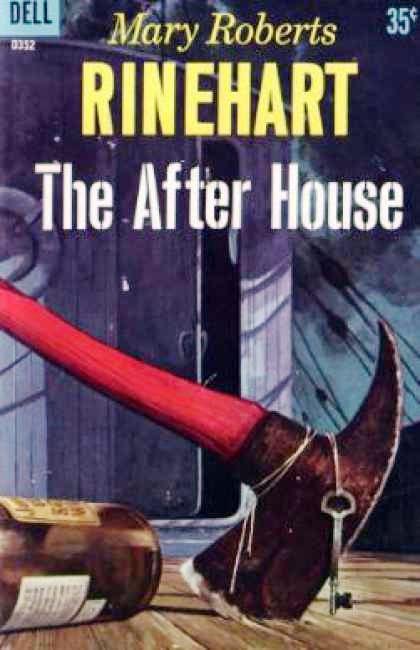
Mary Roberts Rinehart'scrime novel
was inspired by a true crime case,
the Mate Bram murders
In his study of the Borden case, it's clear that, though he does not come right out and say so, Pearson thinks Lizzie, who was still quite alive when the book was published, had to be guilty, and he is scathing to the press and other institutions that he believes recklessly proclaimed Lizzie's innocence right from the start, in the process heedlessly defaming the police and the prosecutorial authorities who brought her to book.

I will have more on this later in Part 2, where I discuss Pearson's handling of the Borden case.  This case is, I think, the most interesting one that Pearson covers in his Studies in Murder, although I will talk about another one Pearson deals with as well, the Mate Bram murders.  This was another 1890s American ax slayings case, one that took place on the high sea and inspired Mary Roberts Rinehart's 1914 mystery, The After House.

See what Pearson thought of these cases, both classics of American murder.  And if you have any thoughts about it all, please comment!

Friday, August 24, 2012

Maneaters: Murder by Latitude (1930), by Rufus King

Valcour sat beside Captain Sohme at the forward end of the small lounge.  The leaden sky and air made of it a cubicle of murk which the ceiling lights, that had been turned on, scarcely affected at all, and the sea was a woman's glass with the ship a tense, unhappy atom creeping, turn by turn, along its flat insensate floor.... (Murder by Latitude, 1930)

For a short period in the early to mid 1930s there were, in the eyes of a number of mystery critics and readers of the time, two reigning monarchs of American classical detective fiction, Ellery Queen and Rufus King.  If Ellery Queen's reputation has faded (most unjustly) among the mystery masses, Rufus King's has vanished into air. I have only read a few novels by Rufus King, but in my view on the strength of his fifth mystery novel, Murder by Latitude, his name should be not merely recollected but lauded.

Certainly Murder by Latitude at least should be in print!  It's one of the major American works within the detective fiction genre from the period between the two World Wars.

a novel as stylish as its dust jacket

Murder by Latitude is one of those novels with a plot so suspenseful that one really must be careful in the name of aesthetic justice of writing too much about it.  Broadly speaking, Murder by Latitude, as the title indicates, is an ocean liner mystery, one of early vintage.  There is a very early yacht mystery, The After House (1914), by Mary Roberts Rinehart and I know Carolyn Wells did one typically mediocre effort in the 1920s called The Bronze Hand that takes place on an ocean liner. There also are a number of later examples, including several others by King himself.  One of the best known of these is John Dickson Carr's The Blind Barber (1934).  However, King's maiden effort in this sub-genre made a great splash at the time--and deservedly so.

On the ship in Murder by Latitude is a remarkably ruthless murderer.  He--or she?--has killed once already and kills again on board the liner Eastern Bay as it makes its tortured way from Bermuda to Halifax.  Indeed, the novel opens in quite an attention grabbing manner with a description of the strangling of the ship's wireless man.  This savage slaying has the effect of preventing the ship from getting messages from the New York police, who now have a description of the murderer for Lieutenant Valcour, King's series detective, who is also on board the ship, trying to catch the culprit.  Now Valcour is left groping in the dark, and the murderer has not yet completed his (her?) work....

the English edition of King's novel

Murder by Latitude is something one doesn't come across every day: a real page turner.  I read over 200 pages in one sitting, something I very rarely do these days.  It's superbly suspenseful (why are those objects disappearing?), evocatively written (you really get the sense of a ship at sea), modern in tone and well-characterized (more below) and, best of all for a 'tec fiction fiend, it boasts a really clever solution, masterfully twisted by the hand of a storytelling virtuoso. 

in the book it's the stiff that's deshabille
--though the dame indeed is a blonde
Mike Grost, who has written rather extensively on the internet about Rufus King (Grost and other bloggers who have written about King are linked below), argues that Latitude is also notable for its "gay sensibility."  I have to say I agree with Grost's assessment.

For example, the middle-aged, much married Mrs. Poole is a maneater who harpoons (Valcour's word) much younger men as husbands.  She is on board with husband number five, Ted Poole, who is constantly portrayed in an objectified manner by the author. "It was a pity he had his clothes on," thinks Mrs. Poole, as she looks over at her much younger husband "wriggling" on a deck chair.

There is also a movingly portrayed relationship between two crewmen on the ship that is, as Mike Grost has written, rather Melvilleian in tone.  Then there's that queer Frenchman, Mr. Dumarque, a remarkable epigram-tossing aesthete.  Latitude is not a "gay mystery," but it does seem as though it might have been written by a gay man.

Currently very little is known about Rufus King, even though he was a popular and prolific writer within the mystery genre for many years, publishing twenty-three mystery novels and short story collections between 1927 and 1951 and three more genre books between 1958 and 1964.  He died two years late in 1966, at the age of 73.
 
King graduated from Yale in 1914, then spent a few years at sea, enjoying "a romantic life of rolling ships and strange ports."  He also spent some time as a workman in a Paterson, New Jersey silk mill.  When the United States entered the Great War he served in it as an artillery lieutenant. King's first mystery novel did not appear until ten years later, when King was 34, but he quickly made a name for himself in the field.  His breakthrough detective novel, Murder by the Clock (1929), was adapted into a well-regarded film in 1931 (the other best-known Rufus King film is the Fritz Lang directed The Secret Beyond the Door, 1947).

the derelict Delaware and Hudson Railway Station at Rouse's Point, New York
where Rufus King regularly would have stopped off


During his life King annually resided part of the year at Rouse's Point, New York, located on Lake Champlain a mile south of the United States-Canada border.  He was a good friend of the Oscar-nominated gay actor Monty Wooley, a fellow New Yorker and Yalie.  I believe both his life and his books are worth exploring.

Links to other bloggers on Rufus King:

Mike Grost (detail on plots)

John Norris (Murder by the Clock)

TomCat (The Case of the Constant God)

Pietro De Palma (Murder by Latitude--SPOILERS!!) Pietro calls it a "masterpiece" and I agree!

Tuesday, April 10, 2012

"Bosh!": The Marvelous Marginalia of Lieutenant-General Coote Synge-Hutchinson (1832-1902), Part 2


Note: For Part One of Bosh! see here.

In his personal copy of Great Porter Square: A Mystery (1885), Benjamin Farjeon's first sensation novel, Coote Synge-Hutchinson writes words in the margins of sixty-nine out of 372 pages, nearly a fifth of them.  Additionally, there are copious lines, question marks and squiggles.  If the marks are included, scarcely a page is left unscathed.

Coote Synge-Hutchinson found this novel
something less than sensational
Some modern readers have declared over the years that they find the sentimentality and plot contrivances of some Victorian sensation novels unbearable.

Coote Synge-Hutchinson (let's call him CSH from here on out), though a Victorian himself, in this respect appears to belong in the company of the scoffing moderns.

CSH initially contented himself with making question marks challenging the author on a number of points concerning simple logic or matters of politics.

In regard to the latter, CSH questioned, for example, aspersions cast by the author on the police.  When Farjeon writes that

It is a peculiarity of policemen in private clothes that they are always ready to suspect, and that in their eyes every poor-looking person with whose face they are not familiar is a disreputable character.

This earns a ? from CSH in the margin of page 35.

It is not until page fifty, however, that CSH apparently felt compelled to put words to paper to protest the course of the events in the tale.

As represented by Farjeon, the character Antony Cowlrick has been released by the court on the grounds of the prosecution's not being able to present any evidence against him on the charge of murder.

Cowlrick attempts to evade the mob outside the court and is pursued by it, its bloodlust having been stirred. After the chase has gone on a bit, Cowlrick's attorney, Mr. Goldberry, and the novel's heroic reporter character (called our Reporter) step up and defuse the situation.  "How," demands CSH

did Mr. Goldberry and the Reporter manage to be here considering that AC has been represented as running though several streets?

Once he started in this vein, CSH evidently found it hard to stop.  When Farjeon tells of a lady who "was young, and an orphan" and "whose relatives were far away in the country" so that "she was alone in London," CSH responds:

a curious position for a young lady to be in?

Much of Farjeon's novel is told in the form of ostensible newsppaer accounts from our Reporter.  Often CSH doubted the plausibility of these accounts, such as this one:

Amused, and, as he declared to her, charmed out of himself, our Reporter said, somewhat jocosely:
"Why, what would you have done if you had been born a man instead of a woman?"
"I am afraid," she said, in a half-whisper, and with her finger on her lips, as though enjoining him not to betray her, "I am afraid I should have been a dreadful rake."

To this CSH dryly declared:

curious conversation to put into a newspaper

Sometimes CSH's protests involve not logical points but philosophical or political ones. When Cowlrick tells Mr. Goldberry that he is not grateful to him for his legal service, because God would not have allowed an innocent man like himself to be convicted of the murder and God does not need the assistance of lawyers, CSH points outs, in a challenge to this piece of high-flown oratory:

Yet he [God] has ordered us to use human means.

When a character pronounces, with fine democratic idealism, that a certain woman is a "daughter of Eve, and therefore the equal of a queen," CSH is disgusted:

What utter rot: I suppose the author goes in for manhood suffrage!

When a character approvingly refers to the United States as "the wonderful country which one day is to rule the world," CSH patriotically is having none of that, vehemently scribbling:

Bah! Stuff! Nonsense!

Unlike Farjeon, CSH seems to hold the press in contempt.  When our Reporter assures Cowlrick that the press will keep covering his story, because newspaper readers are eager for details about anyone "connected with an atrocious crime," CSH disapprovingly queries:

Is not that pandering to a morbid sentiment?

When Farjeon writes "Such is the power of the newspaper.  To convey to remote distances, into village and city, to the firesides of the poor and rich, the records of ennobling deeds," CSH again is having none of it:

Papers, I should say, have been a far greater curse than a blessing.

Farjeon gives us Fanny, the plucky little match girl,
though Coote Synge-Hutchinson disputes
 the contention that more happiness
 is to be found among the poor than the rich
Our Reporter offers what the great anti-Victorian mystery writer John Dickson Carr no doubt would have called a pious hymn, to the effect that "more happiness is to be found among the poor than among the rich" (this in the section where the author introduces to us a sweet-natured street waif named Fanny, who is, I kid you not, a little match girl).  To this CSH scoffs:

Oh really!

After the first 100 pages, CSH was no longer able to restrain himself at what he saw as the novel's illogic and sentimentalism and began openly denouncing various characters as asolute idiots, often adding his seemingly favorite exclamations, "Bosh!" "Rot!" and "Stuff!"  

When CSH finds that the young orphan lady's bonds, her sole source of income, are forgeries and that her prospective banker, Mr. Holdfast, generously declares he will cover her loss, CSH is thunderstruck:

What an idiot he must have been!

When the young lady lightly confesses to Mr. Holdfast that the purse of money he gave her was snatched from her in the streets of London and that she spent her absolutely last coins buying cakes for two poor children, Mr. Holdfast is "almost overcome with delight...at her childish innocence, simplicity, and kindness."  Not CSH, who sneers:

Oh crikey, what an idiot.

When one character reflects that a young man's fondness for a young woman is nothing to worry about, because "He is but a boy," CSH counters:

What an idiot!

CSH frequently was unmoved and unpersuaded by the author's depiction of events.  When the little match-girl Fanny and her protector Becky happen in the streets of London to stumble into each other after some time has passed, CSH is not touched but disgusted:

How is it all these convenient things happen in novels?

In the early 20th century Carolyn Wells
declared that gravity clues were overdone
Coote Synge-Hutchinson would have agreed!
Similarly, when a woman drops a ring and earring at the crime scene and cannot find them (mystery writer and critic Carolyn Wells called these oh-so convenient droppings "gravity clues"), CSH declares:

Bosh.  Why should she not find them.  All these things so conveniently happen in novels.

It is the ingenuous character of Frederick Holdfast (son of Mr. Holdfast) who most gets CSH's goat, however.

Frederick Holdfast informs us that a male character set up a female character, a lady thrown on hard times, in a house in the suburbs, but that the relationship was completely platonic:

"[T]he intimacy between the two was perfectly innocent...Sydney treated and regarded Grace with such love and respect as he would have bestowed upon a beloved sister.  It was not as a sister he loved her, but there was no guilt in their association."

"To believe this of most men would have been difficult," concedes Frederick Holdfast, to which CSH responds knowingly:

I should say so, indeed.

When Frederick explains that Sydney was able to cajole London society into treating Grace respectfully, CSH demurs:

Utter bosh.  London society, however bad it may be, cannot be cajoled.

When Frederick finds the woman his father loves is a ruthless schemer, he holds his tongue, provoking CSH to comment:

What utter stuff.  He must have been a queer son never to have said anything to his father.

When Fredrick like an absolute ninny continues to allow himself to be bamboozled by this adventuress, on account of her womanly pleading, CSH writes disgustedly:

The author appears to have collected about the greatest lot of idiots I ever came across.

A few pages later he simply writes Bah!

When Frederick gets a condemnatory letter ostensibly from his father, CSH sensibly asks:

Was it in his father's handwriting?

Sure enough, it wasn't, but Frederick, like all the nice people in Farjeon's novel, naively steps into the bad people's snare.

"Oh indeed," reiterates a triumphant CSH, "does he not know, as a son, his father's handwriting?"

As perhaps is clear by now, I enjoyed the marginalia of Coote Synge-Hutchinson more than the novel itself.  For me his acerbic commentary made an excessively sentimental tale much more bearable.  But about these matters perhaps I am as cynical as the Lieutenant-General appears to have been.