Showing posts with label Oklahoma. Show all posts

Monday, June 10, 2013

Teddy, Todd and Sam

In my book Clues and Corpses: The Detective Fiction and Mystery Criticism of Todd Downing, I write about Todd Downing's Choctaw Indian background, which was very important him, and about the role of his father, Sam, in local Choctaw affairs in the small city of Atoka, Oklahoma, where the Downing family lived for many decades.

Todd Downing
Golden Age Choctaw mystery writer
In a 1926 essay, "A Choctaw's Autobiography," Todd Downing (1902-1974) refers to Sam Downing as someone who "has always been a power among the Choctaws."

Downing also mentions how his father served in the Spanish-American War with Theodore Roosevelt's Rough Riders, as an interpreter for the Indian Territory Cavalry. 

I recently came across some material that certainly supports Todd Downing claims about his father being a "power" among the Choctaws.

In 1906 Sam Downing traveled to Washington, D. C., for a meeting with Roosevelt, who now, of course, was serving as President of the United States.

The elder Downing hoped to persuade his former Rough Rider commander to disapprove an "act of the Choctaw legislature that authorized the employment by the principal chief of the Choctaw nation [Greenwood "Green" McCurtain] of the firm of Mansfield, McMurray & Cornish" [it seems it was felt the monetary compensation allowed the firm was too great]. 

Theodore Roosevelt
whether or not he said "Bully!" he did
what Sam Downing requested

Accompanied by two prominent territorial politicians, Downing met with Roosevelt.

This is the how the meeting is retrospectively portrayed in The Daily Ardmoreite (June 27, 1910, 5):

"What can I do for you fellows, Sam?" the president asked of his former comrade.

"Mr. President, we want that McMurray contract disappoved," replied Downing.

"Put your request in writing," said the president, and turning to Secretary Loeb he instructed him to tell the secretary of the interior that the contract would not be approved.

Downing, who was also a member of the Republican territorial executive committee, "got the presidential ear," declares The Daily Ardmoreite on January 28, 1907 in the article "Republicans Want Indian Vote," "and told the president in so many words that that with a little encouragement the Indians of the Indian Territory, although now for the most part Democrats, could be converted to the Republican fold if the administration went about the thing in the right manner."

"Mr. Downing," the article concluded, recalling language Todd Downing used two decades later, "is said to be a power among Indians."

If only Theodore Roosevelt had lived to read Todd Downing detective fiction in the 1930s!

Wednesday, December 7, 2011

Todd Downing: Murders in Mexico


Todd Downing was born in Atoka, Oklahoma in 1902.  Downing was a quarter Choctaw, the Popular Library informed readers in its paperback edition of Downing's best-known detective novel, The Cat Screams, and his paternal grandmother was a survivor of the Trail of Tears.

Atoka in 1900, two years before Todd Downing's birth
Downing attended the University of Oklahoma, where he received bachelor's and master's degrees.  He taught as an instructor at the university and during summers lived in Mexico and conducted guided tours there.

Todd Downing in the 1930s
Not only was Downing fascinated with Mexican history and culture, however; he also was a voracious reader of detective fiction.  In 1933, he wrote Murder on Tour, his first of a series of detective novels mostly set in Mexico.


Published in the United States by Putnam's, Murder on Tour enjoyed only modest success, but his second Mexican mystery novel, The Cat Screams, won him greater attention.  It was published in the United States by Doubleday, Doran's prestigious Crime Club, which would produce the rest of his novels in the United States as well.

The Crime Club was quite emphatic that it saw The Cat Screams as something of an event:

"Only in exceptional instances is the first book of  a new writer on the Crime Club list made a Crime Club Book of the Month.  Here is the exception.  The author, as a creator of atmosphere, suspense, and horror, is reminiscent of Mignon G. Eberhart.  His plot, though exotic, is plausible and logical and, stylistically, he is far superior to the average mystery writer."
The bookplate (designed by Juanita Gould in 1933) featured below is found in a copy of The Cat Screams.


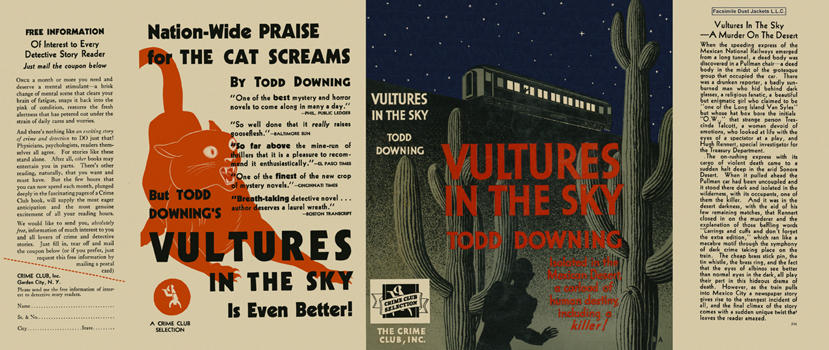
Downing's next mystery, Vultures in the Sky, set on an eerie train traveling from Texas to Mexico City (think Murder on the Orient Express with less plot and more tension) was also a Crime Club selection.

The Crime Club noted how The Cat Screams had "won high praise from the critics" and declared that its author was "rapidly making his way to the foremost rank of American mystery fiction writing."


Downing went on to publish six more detective novels, including the excellent The Last Trumpet (1937) and Night Over Mexico (1938).  Most of these novels featured as investigator the intrepid U. S. Customs Agent Hugh Rennert.

Yet Downing's last novel appeared in 1941, before he had even reached the age of forty.  Downing, who had once seemed headed to a cosmopolitan literary life in New York City, instead retired not only from that life, but from teaching at the University of Oklahoma.

Downing returned to the small town of Atoka, where he taught high school and later the Choctaw language at Southeastern Oklahoma State University.  He resided in the old family home with his mother, staying on in the house after her death in the 1960s. 

While being treated at the local hospital in early 1974, he died suddenly of a heart attack, at the age of 71.

Todd Downing in the 1960s


Here is the rest of the series of Crime Club dust jackets for the Todd Downing detective novels.  I particularly like that bull on The Last Trumpet (about the death of a bullfighter) and the surrealistic quality of The Lazy Lawrence Murders.  But all are splendid.


Todd Downing also attained some popularity in Great Britain, where, for example, the esteemed crime fiction critic Torquemada proclaimed Downing "a born detective writer."

Overall, Downing probably is most important in the history of the crime fiction genre for being a notable American "local color" mystery writer of the 1930s.  An admirer of Agatha Christie and John Dickson Carr, Downing attempted to put both atmosphere and narrative dash in his books, along with the Mexican "exoticism" for which he was most celebrated.

The Todd Downing Detective Novels:

Murder on Tour (1933)
The Cat Screams (1934)
Vultures in the Sky (1935)
Murder on the Tropic (1935)
The Case of the Unconquered Sisters (1936)
The Last Trumpet (1937)
Night Over Mexico (1938)
Death Under the Moonflower (1939)
The Lazy Lawrence Murders (1941)

Tuesday, December 6, 2011

Authors Encountered on the Passing Tramp's Recent Trip

The Tramp recently passed through three interesting places on a research trip for his newest book project, a broad study of the transition of the mystery tale from detective story to crime novel (yes, Julian Symons has done this already, but my take on the subject is rather different).

Among the authors I researched are:

Arguably Oklahoma's greatest mystery writer (yes, there are several).


 Highly prolific English writer, active in the mystery field from the 1930s through the 1970s.


More famous for genre writing in another field, she is the subject of a recent biography.

 Do you know recognize these people?  More on them--and Part Five of the Edmund Crispin article--coming soon!