Showing posts sorted by relevance for query marsh. Sort by date Show all posts

Sunday, April 1, 2018

Out of Africa I : Black as He's Painted (1974), by Ngaio Marsh, Part 1

A better post for dealing with death and resurrection is coming on Tuesday, but for now I hope you enjoy this one, the first of a Passing Tramp series. (I hope.)

Detective novelist and theater director Edith Ngaio Marsh (1895-1982) left her native country of New Zealand for the first time at the age of 33, when in 1928 she traveled to England at the invitation of the Rhodes, a family of superior social station in Marsh's home city of Christchurch, from where they had recently departed.  (The Rhodes, on whom Marsh would base the title family in Surfeit of Lampreys, had returned to England, where they settled for a time at a Georgian manor house in Buckinghamshire, giving Marsh a taste, much relished by her, of English country house society.)  Until near the end of her life the nearly indefatigable author would travel back and forth between her mother country, with which she was much enamored, and her home in New Zealand, making her last trip to England in 1974-75, when she was nearly 80 years old.

On a 1961-62 trip to England, during which Marsh wrote her detective novel Hand in Glove, the author stayed at a "rented house in Montpelier Walk, in Knightsbridge, her favorite part of London," notes biographer Margaret Lewis.  Lodging with Marsh was one of her young actor proteges, a student at the London Academy of Music and Dramatic Art, a 23-year-old fellow Christchurchian who was 43 years her junior.  (Though Marsh removed five years from her declared age, what she actually admitted to still made a great gap in years between the two.) 

Knightsbridge street, I believe, where Ngaio Marsh resided in 1961-62

To preserve the proprieties, as she imagined them, over the eighteen months during which the pair cohabited, Marsh called him her godson and he called her "Godma," a term of endearment used by a character in a late Marsh detective novel, Grave Mistake (1978).  The two got along smashingly, Marsh coaching her "godson" "to get rid of the last vestiges of his New England accent" (a lifetime bugbear for the Anglophile Ngaio) and he acting as her "squire," dining with her in the evenings and escorting her to the theater. And then there were those stay-at-home Sundays:

He could have been posing for Agatha Troy:
New Zealand professional wrestling legend
Steve Harper (1929-2015), mainstay of
the New Zealand wrestling program
"On the Mat" (1975-1984)
Not quite Shakespeare, but it'd do.
"On Sunday afternoons when they were both at home [we learn from biographer Joanna Drayton], they would watch television together.  Ngaio's favorite recreational viewing was on-the-mat wrestling.  They sat on sofas eating pieces of fruitcake topped with slices of cheese, and Ngaio would become engrossed in the action, leaning forward, leaping up and occasionally shouting directions at the screen."  Probably not your usual image of Ngaio!

Marsh adored the rented house and its quaint neighborhood, with its "street musicians and the daily cries of a knife-grinder, a flower-seller with a horse-drawn cart, and an 'any-old-rags-bones-or-bot-oools' man.  There were centuries-old echoes that reminded her of a street scene from Henry V."

In this colorful remnant of traditional England, Marsh, a cat person as you might expect, adopted a stray feline, whom she named Lucy Lockett after a character in John Gay's The Beggar's Opera and an English nursery rhyme:

Lucy Lockett lost her pocket
Kitty Fisher found it
Not a penny was there in it
Only ribbon round it


This modern-day feline Lucy, who had been given Marsh by her housekeeper, a member of the Cats Protection League, had a habit, familiar to her kind, of bringing in to her home captured trophies from the outside.  On one occasion the object was a small wooden fish.

Marsh returned to reside in the neighborhood, this time in a three-room basement flat, a decade later, when she was making another visit to England in 1971.  She reported that she loved "walking down the darling little streets to my old shops," like Capri, an Italian grocery, and a "wine shop whose family greeted me as if I'd only been away for the weekend."  She was unhappy, however, with the exchange rate and the high cost of living in 70s England relative to New Zealand: "[E]verything has spiralled like crazy," she lamented.

Knightsbridge street, I believe, where Ngaio Marsh resided in 1971

Marsh would draw on these memories (well, not the whole high cost of living thing) a couple of years later in New Zealand, when she was writing her book Black as He's Painted, her 28th Roderick Alleyn detective novel, which was published in 1974, when the author was nearly 80 years old.

Elderly Golden Age mystery writers--the few of them, like Marsh, Agatha Christie and Christopher Bush, who survived and wrote into the late Sixties and the Seventies, that is--are not noted for their enlightened tolerance of the era of hippies, highs, free love and flower power, and Ngaio Marsh, a woman who very much knew what she liked and even more what she didn't, was no exception in this regard.  Happily, young people (anyone under 40, say) barely exist in Black as He's Painted

Marsh, however, does tackle, rather boldly in the circumstances, the subject of race, in the form of an African despot--or, erm, president-for-life--who just happens once to have been a great public school pal of Chief Superintendent Roderick Alleyn, still the handsomest and downright poshest man in Scotland Yard, though he must be pushing 75 by now. (Press accounts refer to him as "Handsome Super.")

I think Marsh handles the racial aspect of the novel fairly well, despite the manifest snares it offers.  As we shall see, what real problems we find in Black as He's Painted stem more from other of the author's rather finical prejudices--of which, I've come to conclude, there was no lacking.  These prejudices do not ruin the book for me, but sadly they do undermine it.

Black as He's Painted is rather an odd sort of "detective novel," in that if I can make sense of it at all, it is a combination of cat mystery and political thriller.  There is also a fair play murder problem embedded in the story, but it is somewhat unsatisfactory, although it serves the theme of the novel, because the victim barely has any presence in, or real significance to, the story.  So there is not much of an emotional investment here.  But let's get into it, shall we?

Lucy Lockett may have lost her pocket, but she finds a fish.
The first section of the novel is a charming love story between an elderly man, Samuel Whipplestone, lately retired from the foreign service, and a delightful stray cat named, as mentioned above, Lucy Lockett. 

At loose ends in retirement, Mr. Whipplestone has left his depressing flat for new lodgings in a charming house in a charming neighborhood, the Capricorns, prompting Marsh tetchily to pronounce:

In London there are still, however precarious their state, many little streets of the character of the Capricorns.  They are upper-middle-class streets and therefore, Mr. Whipplestone had been given to understand, despicable.

This is a defensive refrain British (and white Commonwealth) Golden Age crime writers had played since the end of the Second World War, when the Labor party came to power and began enacting, to the ire of a great many of these writers, an ambitious agenda of government prompted economic redistribution. 

Soon Mr. Whipplestone is snugly ensconced in the Capricorns with his beloved Agatha Troy landscape over the mantel, a sure indicator of his refined good taste; the winsome stray cat, now named Lucy Lockett, that he rescued from young cocky Cockey vulgarians ("'One of 'er nine lives gawn for a burton,' said the youth.  He and his friends guffawed themselves into the garage."); and his most gratifyingly deferential servants, the Chubbs.  ("You won't find anything scamped or overlooked, sir....We give satisfaction, sir, in all quarters, really we do.")

Here let me digress a bit, concerning this Chubbish matter.  Despite the fact that it's ostensibly around 1973, no one in the book refers to Mr. Chubb as, well, "Mr." despite the fact that they do call Mrs. Chubb "Mrs."  Not only does Mr. Whipplestone (who is always called "Mr."--even I'm doing it) omit the "Mr."when referring to Chubb, so does Chief Superintendent Roderick Alleyn, during the course of his murder investigation, not to mention the author herself.  (There he is, in the cast of characters: "Chubb.") 

And Chubb himself refers to Alleyn as "sir," even though he does not even work for Alleyn.  This does not seem like 70s egalitarianism to me, certainly not the 70s I knew in the US, but the fact that the Chubbs seem such throwbacks to Downton Abbey days no doubt is why Mr. Whipplestone deems them such rare and precious treasures; and he always refers to them, rather patronizingly, as "my Chubbs" and "my poor Chubbs," when the servant couple is drawn into the murderous affair detailed in the novel.

Now for a longer digression.  (I promise next post we will get into the heart of the novel!) 

Mr. Whipplestone so adores his new neighborhood, where time evidently has mostly stood still, that he is truly mortified to learn that he has for neighbors a brother and sister of appearances that are quite distasteful to him.  Of the brother and sister, Kenneth and Xenoclea Sanskrit, Marsh writes:

....he saw they were truly awful.

It wasn't that they were lard-fat, both of them, so fat that they might have sat to each other as models for their wares [they make pottery pigs], or that they were outrageously got up.  No clothes, it might be argued in these permissive days, could achieve outrageousness.  It wasn't that the man wore a bracelet and an anklet and a necklace and earrings or that what hair he had fell like pond-weed from an embroidered head-band.  It wasn't even that she (fifty if a day, thought Mr. Whipplestone) wore vast black leather hotpants, a black fringed tunic and black boots.  Monstrous though these grotesqueries undoubtedly were, they were as nothing compared with the eyes and mouths of the Sankrits which were, Mr. Whipplestone now saw with something like panic, equally heavily made-up.

"They shouldn't be here," he thought, confusedly protecting the normality of the Capricorns.  "People like that.  They ought to be in Chelsea.  Or somewhere."


This last may be a bit of a joke on Marsh's part, as Roderick Alleyn and his wife, the noted artist Agatha Troy, actually live in Chelsea, traditionally a a home to writers and even a detective novelist or two.  However, by 1974 Chelsea, particularly King's Road, which ran through the neighborhood, had become a Mecca of modish psychedelia, prompted by the opening, in 1966, of the famed prog boutique, Granny Takes a Trip.  Perhaps the Sanskrit's shopped there sometimes, however inadvisably.

Chelsea was also known for being queer-friendly and it was the longtime home of the Gateways Club, a lesbian nightclub that opened in King's Road in 1931, the year Ngaio Marsh wrote her first detective novel in yet another three-room basement flat in London.

At the blue door: entrance to the Gateways Club
Obviously Mr. Whipplestone, bless his heart, would not be in the vanguard either of fashion or transgender rights today.  But the venom of the reaction is striking to me in that it is not really moral (Marsh has always struck me as the least preoccupied of the Crime Queens with moral issues), but rather aesthetic.

Doesn't the reaction seem exaggerated and the language extravagant?  Through Mr. Whipplestone the author expresses her horror simply at how these people look-- culminating in the appalling, unspeakable fact that the man wears makeup! 

Fear of androgyny seems to be a running theme in Marsh's writing.  Yet had Marsh--who spent a substantial part of her life in theater, Shakespeare no less--really never before seen a man in makeup or, heaven forbid, drag? (Apparently Mr. Whipplestone hadn't, at least to his knowledge.) Did she find it so appalling and unspeakable then?

Was the author compensating for the face that she herself was frequently described by friends and contemporaries as "mannish in appearance":

tall, five foot ten inches...flat-chested, rather gawky...dressed usually in beautifully-cut slacks, large feet with shoes like canal boats, a deep voice--yet intensely feminine withal.

See and hear Ngaio Marsh for yourself by following this link.

Ngaio Marsh (second from the upper right) with members of the Rhode and Plunkett families

Alleyn, who shares Mr. Whipplestone's distaste for the awful Sanskrits, sums up Kenneth Sanskrit from a police report as follows, taking time to mention every thing that horrified Mr. Whipplestone:

Height 5 foot 10.  Weight: 16 stone 4.  Very obese.  Blond.  Long hair.  Dress: eccentric: Ultra modern.  Bracelets.  Anklet.  Necklace.  Wears make-up.  Probably homosexual.  One ring through pierced lobe.  Origin: uncertain.  Said to be Dutch. 

Honestly, I was expecting the poor man's origin to be from the very pits of Hell!  And what a remarkably thorough report, it lists the man's every fashion accessory.  (What, no toe ring?)  And you have to love the "Probably homosexual."  Ya think, darling Rory?  Ngaio wasn't exactly being subtle here, but then she never was with her gay characters.  Also, if I am right, Sankrit's weight was about 228 pounds?  If that is Marsh's conception of unspeakably, grotesquely "lard-fat" for a 5'10 man, she had singularly, dare I say appallingly, stringent standards for weight. 

Noted theater director reacting with disdain to strange-looking man in makeup?

But, oh, does Ngaio go on, when writing about this pair, about their weight, as well as other things:

a grotesquely fat man

a baleful fat lady

They were both fat

The man was as outlandish as ever.  Even fatter.  And painted.  And, as Mr. Whipplestone turned quickly away, what had he seen, dangling from that unspeakable neck?

the man's shirt...was unspeakable, being heavily frilled and lacy....He wore many rings on his dimpled fingers.  His fair hair was cut in a fringe and concealed his ears....The sister, vast in green, fringed satin, also wore her hair, which was purple, in a fringe and side-pieces.  These in effect squared her enormous face.  They moved slowly like two huge vessels, shoved from behind by tugs.


presumably gay, but certainly not fat,
even by Marshy standards, one presume
Chelsea Arts New Years Eve Ball, 1947
Round that ghastly fellow Sanskrit's fat neck.

those frankly appalling Sanskrits....

an astonishing deep voice inside Miss Sanskrit [as deep as the author's?--TPT]

her fat, pale hands

her embedded eyes beneath the preposterous beet-root-colored fringe

She's undoubtedly rattled, as far as one can think of blubber rattling

"Sanskirt," Alleyn repeated.  "They are enormously fat."

the elephantine bulk of Sanskrit

the great bladder-like face

walking lightly as fat people so often do

the huge bulk of Sanskrit

rather like a walking tent with his buoyant fat man's stride

a faint high-pitched voice

As the enormous tent figure, grotesque in the uncertain darkness, flounced towards them

this horrid fat man [this one from Handsome Alleyn]

smelling of hot, wet fat

his vast rump

Ngaio Marsh was not a member of any fringe groups
except perhaps the International League of Fat-Shamers
And it gets worse!  When the Sanskirts are killed--the sister symbolically makes pottery pigs and she and her brother have their heads stove in with a large one--the police surgeon snidely asks "if they would provide him with bulldozers" to remove the bodies and later adds, "You'll send these monstrosities along then, Rory?"

I find this fat obsessing and shaming, to use the author's terms, appalling (if not unspeakable).  There are genuinely unspeakable things in this world, like genocide and child abuse, but extreme girth, if extreme girth it even be, is not one of them.

Now it's true that the Sanskrits are supposed to be genuinely horrible people (the brother was a drug dealer apparently and the couple is said to have abused the cat Lucy Lockett), but since Marsh has trouble conveying real moral horror in her books (so vulgar, darling), what we really are left with is that these two "monstrosities" are horrible people because they're fat.  They might as well be Shakespeare's hunchbacked Richard III, doubled.

And, oh yes, she deplorably wears hippy clothes at, shall we say, a certain age and he's an effeminate gay.  A fat effeminate gay.  Indeed, from all this so far one could almost see the novel being titled Fat as He's Painted.  Not that Troy would want to paint a fat person, I assume.

Troy does want to paint the African dictator, however, very much.  Very much indeed.

If you can past all this classism and fat-shaming, there are good points to the novel and I will get to them, I promise, in my next post.  Marsh in my view is far more sympathetic writing about racial minorities than she is the overweight, the queer and the fringed.

Tuesday, April 3, 2018

Tuesday Night Bloggers The Great Detectives 1: Roderick Alleyn Murderset: Off with His Head (1956), by Ngaio Marsh

If we keep adding Great Sleuths
this old tug may capsize--and then
who will solve our murders for us?
Lord Peter Wimsey, Albert Campion, Hercule Poirot, Miss Jane Marple, Inspector Alan Grant: they all appear as entries in a new book edited by Eric Sandberg, 100 Greatest Literary Detectives.  The perennially interesting subject addressed in this book has resulted in the reconvening of the world-renowned Tuesday Night Bloggers, who now ask the question: who else should make the cut as Great (nay, the Greatest) Detectives?

Also included in the Sandberg book are Chief Inspector Wexford, Inspector Morse, Commander Adam Dalgliesh and Detective Superintendent Andrew Dalziel.  From the classic era we further have Nigel Strangeways, Philip Trent, Nero Wolfe, Chief Inspector Maigret, Dame Beatrice Adela Lestrange Bradley, Ellery Queen, Father Brown, Doctor Fell and Gervase Fen.  And, of course, there are icons Sherlock Holmes and C. Auguste Dupin.

Right off I can think of a few obvious omissions here: Charlie Chan, Philo Vance, Perry Mason, Reggie Fortune, Max Carrados, Miss Silver, Carolus Deene, for example, and four British policemen: Michael Innes's Sir John Appleby, Leo Bruce's Sergeant Beef and Chief Superintendents Roderick Alleyn, created by Ngaio Marsh, and Peter Diamond, created by Peter Lovesey.  Some of these I will be talking about this month. 

I start with that handsome posh devil, Roderick Alleyn, whom one mainstream author and mystery fan, Sheila Kaye-Smith, disparagingly termed one of the "glamour boy" detectives.  Opinion has divided about "Handsome Alleyn" for decades, but over those years he has maintained a large following of dedicated admirers.

Alleyn's creator, Ngaio Marsh, usually is included by rote in the Hall of Greatness with her sister Crime Queens Agatha Christie, Dorothy L. Sayers and Margery Allingham.  Yet in the Sandberg book her place, and her detective's, in the Crime Queen pantheon is taken by Josephine Tey and Tey's Alan Grant.  Was Alleyn unjustly exiled?

Marsh in the 1950s, probably
at the height of her critical reputation
Just as Rex Stout is credited with fusing the classical and hard-boiled traditions in the US with the teaming of master armchair brain Nero Wolfe and his wisecracking assistant Archie Godwin, Ngaio Marsh has been credited with melding the gentleman detective and policeman strains in British detective fiction in the attractive form of posher-than-thou Roderick Alleyn.  I have seen Marsh even credited with creating the first important Golden Age policeman detective.

While this latter claim is errant, certainly the first one is true.  If this fact alone does not make Alleyn one of the greatest literary detectives, his tremendous worldwide popularity over many decades should be considered as a major point in his favor.  The simple truth is that since around 1940, Alleyn's name, along with Campion's and Wimsey's, has been synonymous with British Golden Age detection. 

This dazzling trio of polished and sophisticated tecs constituted the Great Trimvirate, if you will, of British romantic gentleman sleuths from the Golden Age and I think all three of them should be considered "Greatest Literary Detectives."

"Romantic" is important here, else we could include a whole slew of additional gents, such as the aforementioned Reggie Fortune, whose greatest passions are cream puffs and his cat.  But no reader, presumably, ever indulged in fond and loving dreams about Reggie Fortune.  (I am always amazed to recall that he has a wife, one who is rather fond of him too.)  By bringing love and romance into the lives of their seluths, Sayers, Allingham and Marsh helped expand the audience for detective fiction, removing it strictly from the dry ratiocinative plain and adding the stormy dramatic emotions associated with the mainstream novel. 

Some liked this, some did not.  Naysayer Raymond Chandler complained that Troy Allen was an utterly "silly" character, apparently because she was a great woman painter.  I think what Chandler may have been getting at is that he felt Troy, like Sayers's Harriet Vane and Nicholas Blake's Georgia Strangeways, whom he specifically referenced as well, was an overliy idealized "Mary Sue" character.  As opposed to Philip Marlowe, of course!

Wimsey, Allingham and Alleyn all fell in love in the course of their mysteries and married clever and accomplished women.  Here Wimsey set the mold, to be sure, but Marsh very much imitated it, and rather ably too.  The first Marsh mysteries remind me very much of Christies, and inferior ones at that.  But with Artists in Crime and Death in a White Tie, Marsh introduced Alleyn's love interest, painter Agatha Troy, and the quality of her books jumped markedly. 

Marsh's greatest skill as a writer lies with her depiction of social manners rather than with her mystery plotting per se.  The latter, while competent, seldom reaches the higher flights of creative imagination.  Her puzzle plots often are more workmanlike than inspired, contrasting with sublime tricksters like Christie and John Dickson Carr.  Not for Marsh the cunningly hidden motive or the baffling impossible crime, such ingenuity demonstrably inspiring neither her nor her detective:

"Don't," said Alleyn wearily, "let us have any nonsense about sealed rooms."                                                                                                                   --"I Can Find My Way Out"

So to writers who prefer extreme puzzlement, Marsh can be a disappointment.  Sayers, whatever you think of Lord Peter, like John Rhode often has some fiendishly clever "howdunit" aspects to her mystery plots.  Similarly Margery Allingham can be immensely fertile in her criminal imagination.  (Further, I would argue, she is the best pure writer of the group.)

However, Marsh did offer fans of miracle problems an "impossible" situation on rare occasions.  One of these, I understand, is in her recently completed (by author Stella Duffy) Money in the Morgue.  Another is found in her 1956 detective novel Off with His Head (Death of a Fool in the US), where a man is decapitated on stage during the performance of an ancient pagan fertility rite, the South Mardian Sword Dance.  How this was done is, well, a mystery!

Handsworth Sword Dancers Sheffield, England
Sure it's a half-century before the book is set, but who would know?

This situation plays to Marsh's proven capacity as an adept director of theatrical productions, particularly Shakespearean plays, which often involved fleet movements of actors wielding swords.  Marsh, in short, had to know first and foremost how to move people around on a stage.  Indeed, her first five detective novels, as I recollect, all include restagings of the murders in various theaters of death (a country house, a stage, a hospital, a church, a stage again), with Alleyn directing his cast of suspects, if you will, hoping to catch one out in crime.  This quickly got rather redundant, and thankfully Marsh stopped doing it so much, but in Off with His Head, there's more sense to it, because the "how" is very much the thing and the setting is, literally, a stage.

Besides its miracle problem, Off with His Head offers fans of  classic English mystery what many of them like best in detective fiction: a very, very "English" setting.  Here we have a snowbound village, a ruined castle, a hideous Victorian country house, a pub and a smithy, which are variously peopled by gentry, rustics, a fetching barmaid, a village "natural," young lovers of different classes (Oh, heavens!), a rector, a doctor and a gas station owner, late of the RAF, named Simon "Simmy-Dick" Begg.  If a character is named "Simmy-Dick," you know it must be a British mystery.

The speech of all the characters, including an intrusive visiting German-born folklorist in her late 50s, one Mrs. Bunz (not Buns please!), is rendered in scrupulously observed dialect.  This is the sort of setting lovers of classic English mystery tend really to love and haters of English mystery tend really to hate.  What seems charmingly "real" olde England to some seems insufferably synthetic to others.

"[F]aked-up English country people," is how scold Edmund Wilson disparagingly referred to Marsh's provincial characters (specifically referencing her village novel Overture to Death).  Even one character in Off with His Head pronounces the whole milieu "Mummerset," employing the facetious term for the heavy imitation West Country accents used in English drama to signify bucolic rusticism.

Behold a pale rider! His steed is "Crack."
From her earliest days as a detective fiction writer, Marsh, a New Zealand native, was fascinated with the traditional English class system.  Even her biographers admit she idealized it, though they argue that over time she came to be more skeptical of it. Her classic English country house and village mysteries, extending over more than four decades, are A Man Lay Dead, *Overture to Death, *Death at the Bar, *Death and the Dancing Footman, *Final Curtain, *Scales of Justice, *Off with His Head, Dead Water, Tied Up in Tinsel and Grave Mistake, which amount to about a-third of her total output (the starred titles major efforts). 

I mentioned in my last post about Marsh, concerning her late mystery Black as He's Painted, that she liked places in England where in her eyes time stood gratifyingly still, in this case a street in London that reminded her of Shakespeare's Henry V.

I think in her own life Marsh was like a lot of Anglophile American mystery lovers who want England to be all tea and crumpets and forever quaint and cozy. I like to read about this land myself sometimes!  Fictional England in this reading becomes a kind of mental refuge from problems of dislocated modern life, a place where we can travel in our minds where everyone has the comfort of having a sure and certain place in society. 

South Mardian in Off with His Head is such a place to a great extent (rather unbelievably one could argue)--but things are changing even there.  The only representatives of the gentry are Dame Alice Mardian, 94-year-old chatelaine of Mardian Castle; her unmarried great-niece, Dulcie Mardian, a victim of too much gentry inbreeding (hey, this is what the characters say) who banged her head after falling off a horse at a hunt and has never been quite right since; her great-nephew by marriage, Reverend Mr. Samuel Stayne; and the reverend's son, Ralph, a lawyer in town. 

Obviously Dulcie is a genetic dead-ender.  (How cruel Marsh could be to "spinsters"--though she was one herself--was this more deflection on her part?)  Thus all hopes for the future rest with Ralph, who has recently thrown over the barmaid at the Green Man, Trixie Plowman, for captivating Camilla Campion, who represents an almost absurdly unlikely example of cross class breeding.

The Village Blacksmith
by Thomas Hoveden
Camilla is the granddaughter of village blacksmith William Andersen (the Guiser), whoo--along with his five strapping sons (including a set of twins and the youngest, Ernie, a "natural"), Ralph Stayne and RAF veteran and service station operator Simon Begg--every year performs the ritual Sword Dance on the grounds of the Mardian's ruined castle. 

William Andersen had one daughter, Bess, who years ago ran off with the baronet Camillo Campion (an authority on Italian primitives, don't you know), after he caught sight of the fair maid while getting his car fixed at the Andersen's smithy. Their daughter, Camilla, now a rather affected but oh! so fetching drama student, has fallen for Ralph Stayne and he for her, but, as in Overture to Death and Death at the Bar, there is grave concern about mixing up the classes. 

Even Camilla, who talks about "her gentry side" and "her rustic side" (which seems ridiculous to me, because she was never even reared in the country, as a rustic or otherwise; but then she is talking about the dubious science of ancestral inheritance and what-not), sees this as an important issue, especially after her grandfather somehow gets decapitated at the Sword Dance, where for decades he has literally played the Fool:

There'll be the most ghastly publicity, won't there? [Camilla is the type of person who uses the word ghastly a lot-TPT.]  What about that?  What sort of fiancee am I going to be to a rising young country solicitor?  Can you see the headlines?  "History Repeats Itself!" "Mother Ran Away from Smithy to Marry Baronet!"  "Grand-daughter of Murdered Blacksmith Weds Peer's Grandson"!  "Fertility Rite Leads to Engagement"! 

Camilla is 18 and it's supposed to be, I surmise, 1955, a year after Kingsley Amis published his iconoclastic novel Lucky Jim.  Modern readers may be disappointed to learn that Camilla is considering abandoning her career so soon--before it has even started--to marry and they may doubt that she really would be so desperately sensitive to what the newspapers might say about her marriage.  But this is the dramatic conflict which Marsh gives us, so you have to take it or leave it as you please.  Personally I concentrated on the milieu and the mystery. I have never been that taken with Marsh's guileless yet so very pleasantly posh young lovers, who appear in book after book after book.  (There is a similar couple who pops up as late as 1978, in Grave Mistake, except there as I recollect the nice boy is the son of a dazzlingly rich Greek, a sign of social progress in Marsh's eyes I gather.) 

In Christie's works there is always a possibility that one of the "nice" young lovers could turn out to be a conniving and rather fiendish murderer indeed, but Marsh is more like Patricia Wentworth in this regard, being a great believer in not only the passion but the purity of young love, at least in her writing (and Shakespeare's). Poor middle-aged and elderly spinsters often get rather a hard time of it in her books, as if they must be mocked for their failure to marry. (Here it's Dulcie Mardian and folklorist Mrs. Bunz--though the latter, actually a widow, makes rather an amusing satirical portrait of academic enthusiasm.)

Whether you see Marsh's milieu in Off with His Head as real or contrived, I think it's artfully done.  The setting is memorable, and the dance stuff intriguing.  Marsh by name credits two books, Douglas Kennesdy's English Dances and Violet Alford's Introduction to English Folklore, for their help, which at least indicates more research on Marsh's part than Sayers's bell-ringing pamphlet, inspiration for the latter's highly-regarded The Nine Tailors.

The problem afforded readers is a fair play one, and on rereading I can see how meticulous Marsh was with her clueing.  For a story depending so much on stage movements, a plan of the stage and the players really should have been provided, however.

As for Roderick Alleyn, Great Detective, he is his usual charming and rather precious and all-too-pleased-with-himself self. 

He still gratingly calls Sergeant Fox, his long-suffering yet fortunately phlegmatic assistant, "Foxkin" (urk!) and, in my favorite Alleynism in the novel, the handsome Super indicates that he is quotingly familiar with that supreme camp anthem, an innuendo-laden hit made famous by the inimitable Beatrice Lillie (or, as Alleyn no doubt would have known her, Lady Peel) during the Golden Age of detective fiction (arguably rather akin to Tiny Tim's Tiptoe Through the Tulips) called There Are Fairies at the Bottom of Our Garden:

"I take it," said Mr. Fox during a pause, "that we don't believe in fairies. He looked mildly around the table.
"Not at the bottom of this garden, anyway," Alleyn muttered.
"My dad did, then," Ernie shouted.
[He's the natural, naturally.]
"Did what?"  Allen asked patiently.
"Believe in fairies."
Fox sighed heavily and made a note.

I don't know about my Foxkin, but at this point I have learned to love Handsome Alleyn's priceless preciosity  and wouldn't have the dear man any other way.  Rory can visit the bottom of my garden any time he wants!  Oh dear, did I just type that?!


"You wouldn't think they'd dare/To come merrymaking there/Well--they doooo!" 

To be sure, there may not be actual fairies in this particular Marsh garden, but Off with His Head still is chock full of queer and colorful characters mysteriously and sometimes murderously gamboling in the wintry gloam.  Whether or not the novel really speaks accurately to evolving social conditions in Fifties Britain, it makes an enjoyable mystery read--and that is enough for most of us, I expect.

Monday, March 11, 2019

"Die" in Amber: Swing, Brother, Swing (1949), Ngaio Marsh

Here lies Lord Berners
One of the learners
His great love of learning
May earn him a burning
But, Praise the Lord!
He seldom was bored.

--epitaph (self-composed) of Gerald Hugh Tyrwhitt-Wilson, 14th Baron Berners (1883-1950)

"I've taken it up seriously, Lord Pastern continued.  "Swing.  Boogie-woogie.  Jive."

--Lord Pastern and Bagott in Swing, Brother, Swing (1949), by Ngaio Marsh

Lord Berners in his thirties
Perhaps in Britain dotty aristocrats are a dime-and-dozen, if you will (inherited money and titled privilege can produce some strange results), but when it came to eccentricity surely English bon vivant Lord Berners was a pearl among potty princes. 

Lord Berners was a dilettante artist, composer and author, a flamboyant aesthete, a practical jokester and cheeky homosexual.  In 1932 he privately published The Girls of Radcliff Hall (a play on the name of the groundbreaking lesbian author), which naughtily portrayed himself and some of his famous friends, including Cecil Beaton and Oliver Messel, as lesbian schoolgirls.  (Cecil Beaton was so appalled by this he tried to buy and destroy every copy of the book.) 

The same year Lord Berners took up residence with his well-born 28-years-younger lover, the so-called "Mad Boy" Robert Vernon Heber-Percy, at Faringdon House, a family home where the couple for the next eighteen years held court for prominent aristocrats and artists, including Nancy and Diana Mitford, Sir John and Lady Penelope Betjeman, Siegfried Sassoon, Harold Acton, Gertrude Stein, Elsa Schiaparelli, Igor Stravinsky, Salvador Dali and H. G. Wells.  Quite a coterie!

Oddball Lord Berners, upon whom Nancy Mitford based the character of Lord Merlin in her lauded 1945 novel The Pursuit of Love, was known for idiosyncratic behavior, like dyeing his pigeons' feathers in pretty pastel colors, decking his dogs in pearl necklaces, having Penelope Betjeman's pale horse over for tea and, as a 1935 birthday tribute to his handsome and virile 24-year-old partner, symbolically constructing a tower, Faringdon Folly, upon which a sign was placed, reading: "Members of the public committing suicide from this tower do so at their own risk."

the menage at Faringdon House
Lord Berners (in skull cap), Rupert (holding baby) and Jennifer (looking on)

During the Forties the Mad Boy, who evidently was bisexual, would unpredictably marry a woman of genteel birth, with whom he fathered a daughter.  The family lived together at Faringdon House for a few short years during the war (when they were photographed in a family group scene by Cecil Beaton), before the wife, Jennifer, decided she couldn't stick it any more and left with her child to go home to her parents at Oare House.

Reading Ngaio Marsh's postwar detective novel Swing, Brother, Swing (in the US A Wreath for Rivera), which is about an eccentric 55-year-old English aristocrat. George Settinger, Marquis of Pastern and Bagott, I couldn't help thinking how rather more interesting the novel would have been had it been directly about the Berners menage.  Marsh's Lord Pastern (I'm going to drop the rest of the handle) seems disappointingly mild by comparison.  But then most people would.

Lord Berners in middle age
Was Lord Berners in fact any sort of inspiration for Lord Pastern?  Here is how Marsh first describes him:

He was short, not more than five foot seven, but so compactly built that he did not give the impression of low stature.  Everything about him was dapper, though not obtrusively so; his clothes, the flower in his coat, his well-brushed hair and moustache.  

Here's a description of Lord Berners, from Sofka Zinovieff's book The Mad Boy:

He was short and solidly built, his hair only barely there, and he sported a well-clipped moustache over a sensualist's lips.  

Harold Acton described Lord Berners as bubbling over "with private jokes and farcical inventions" and "constantly changing his skin, as it were, reveling in mystification.

This all seems to fit Marsh's Lord Pastern to a T. 

I'm betting they ate like horses at tea--
or one of them did, anyway
Where Lord Berners had genuine artistic ability himself and genuinely promoted art amid his toffish silliness, however, Marsh has Lord Pastern uselessly diffusing his undoubted energies in footling (to use a favored word of the author's) activities which Marsh clearly means her readers to mock. Lord Pasten's starchy aristocratic French wife--with whom he had been estranged though they have since (improbably) reconciled--complains bitterly in a letter to Carlisle Wayne, her husband's niece, that after the war she had been forced to share their London townhouse, Duke's Gate, with

"members of an esoteric Central European sect" whose "dogma appeared to prohibit the use of soap and water" and whom in person "resembled the minor and dirtier prophets."  (Oh, those silly, dirty Central Europeans!) 

And her husband's strange enthusiasms--as doubtlessly Marsh and most of her readers saw them-- did not end there:

I found myself confronted in turn by Salvation Army Citadels, by retreats for Indian yogis, by apartments devoted to the study of Voodoo, by a hundred and one ephemeral and ludicrous obsessions.  Your uncle has turned with appalling virtuosity from the tenets of the Christadelphians to the practice of nudism.

Truly, Ngaio Marsh never went in for religious enthusiasm in her books.  (Recall Death in Ecstasy, Spinster in Jeopardy, Last Ditch).  Though again, I couldn't quite divine why Lady Pastern returned to live with a man she clearly can't abide.  However, for the purposes of the novel we have to accept this and move on from there.  So, let's go!

Lord Berners and Gertrude Stein
Also living at Duke's Gate are Lady Pastern's daughter from a prior marriage, Felicite De Suze, who is twenty years old and at the moment madly infatuated with an Argentine piano-accordionist in a dance band, Carlos De Rivera, much to her mother's horror. 

I couldn't help wondering whether Marsh got the inspiration for the "De Suze" surname from Henriette de Coligny de la Suze, a celebrated 17th century French poet from one of the country's most prominent Protestant families.  (Her father Gaspard III de Coligny was a Marshall of France and her great-grandfather Gaspard II a major Huguenot leader who was assassinated in the infamous St. Bartholomew's Day Massacre.

"Suze" reminds me of the Portuguese surname Souza or Sousa, and I thought maybe this was Ngaio's way of suggesting the family has some remote Portuguese background.  I'm sure Lady Pastern would want this hushed up, given her attitude about Carlos Rivera (I think the "De" he uses is bogus.)  She can't even be bothered to get his nationality right, referring to him as a "Mexican bandsman" in the presence of Carlisle (or "Lisle" as everyone calls her).  Ugh, that woman.

Gaspard III de Coligny
On the other hand, "Suze" is a French brand of bitters drunk as an aperitif (did Poirot ever drink it, I'm sure John Curran would know) and Sousa is a river in northern Portugal, so maybe they have absolutely nothing to do with each other!  Sometimes a Suze is a Suze  is a Suze, I'm sure.

To look after these three people, Lord and Lady Pastern and Felicite ("Fee"), there are the servants: butler Mr. Spence, Housekeeper Miss Parker, French maid Hortense, chef Monsieur Dupont, a footman named William (such a popular name for footmen) and two girls, Mary and Mrytle, house maids of some sort, and a bit on the giggly and goggly side. 

They are very Thirties fictional servants, docile and faintly comical, though Alleyn is able to get William, who "with any luck read detective magazines and spent his day-dream sleuthing," to open up a bit during his murder investigation. 

In terms of its social milieu and attitudes, this could be Marsh's Death and the Dancing Footman or Surfeit of Lampreys, published at the start of the Second World War (and set before it), or even Marsh's first detective novel, A Man Lay Dead, published fifteen years earlier--though I think this is the first time Alleyn had deigned to interview servants, because he so intimidates them, don't you know; they much prefer homey chats with homely Inspector Fox in the cozy confines of basement kitchens.

You would almost never guess from Swing, Brother, Swing that the UK was recovering from a calamitous world war, its second in less than a quarter century.  I think in the novel there were three passing references made by the author to "the food shortage" and a blink-and-you'll-miss-it line about bombing damage in London. 

Recently I finished writing introductions to some Christopher Bush mystery reissues from the years 1946-52 and the contrast in the portrayal of social conditions  in England is striking indeed.  But then Bush lived through the war and its aftermath in England, even playing an active role in it; for him England wasn't just a romantic and jolly place to gather writing material.  Marsh's book could easily have been given a prewar setting.

In short Swing, Brother, Swing is rather like a fly in amber--or as a murder mystery a "die" in amber, if you will allow that punning conceit.

a rough show
Unlike most authors of of British detective fiction during the Second World War
Ngaio Marsh had missed out on this sort of thing.

Marsh's two biographers have been harshly dismissive of Swing, Brother, Swing.  Noting that, when Marsh wrote the novel in New Zealand in 1948, she had not been back to England since 1937 (!) and was thus drawing on distant prewar memories of London, Margaret Lewis pronounces:

The plot [of the novel] is weak and trivial, the setting inappropriate, and in comparison to the originality of the New Zealand-based novels, Swing, Brother, Swing, appears a retrograde step....all the characters seem extraordinarily out of touch with the real world. 

As a fairly lightweight society crime story set in the 1930s it would have been acceptable, but set in the grey and dreary London of the Second World War, the plot seems ridiculous and the atmosphere of snobbery and privilege insensitive.  A trip to England was long overdue if [Ngaio] was to continue to set plots there with any kind of conviction.


Similarly, Joanne Drayton complains:

Swing, Brother, Swing was a formulaic book.  Ngaio fell back on what she knew to produce something that bordered on hackneyed....she peopled [it] with tired old aristocratic characters....

Pastern is an anachronistic comic cliche straight out of Ngaio's property box of 1930s stock characters. Before the war there had been nostalgia value and shared humour in this aristocratic type, but the cosy familiarity had disappeared somewhere in the grey daily grind of casualty lists.  There is no place in post-war Britain for Pastern's hedonism....Ngaio was out of date and out of touch....


This is strong criticism, and typical of biographers of Golden Age mystery writers, who often have no interest in mystery plots per se and never seem to ask the question, is it a good whodunit (or howdunit)

Rather they want to look for deeper meanings in the text, as if the GA mystery writers--the good ones, don't you know--were trying to write "Great Literature."  Sorry to tell people, but most all the time they weren't.  And there's absolutely nothing wrong with that.  Writing a well-plotted and even well-written mystery is the most we should ask from a mystery writer, in my opinion.  Their work doesn't need to "transcend the genre" and become "Great Literature."

the American first edition
I agree that Ngaio Marsh was dreadfully out-of-date in Swing, Brother, Swing and that a trip to England, which she finally set out on in 1949, the year of the publication of Swing, was badly indicated--though in fact Lord Pastern, if he was partly based on Lord Berners, was not one of the out-of-date elements, as Lord Berners was alive and kicking all through the Forties.  Lord Pastern, I would say, is, while admittedly outlandish, a perfectly valid character.

By and large contemporary reviewers in the UK and US do not seem to have found fault with Swing, as her biographers did many decades later. Indeed, much to the contrary, the book was highly praised by critics.

Influential American crime fiction reviewer and earnest liberal Anthony Boucher raved Marsh's latest  (with one qualification) in his contemporary review:

John Strachey once rightly described the Nineteen Thirties as the golden age of English detection--a period in which the comedy of manners and the strict puzzle successfully fused to produce a new and suavely literate form of entertainment.  Of those who made made the age golden, some, such as Anthony Berkeley and Dorothy Sayers, have retired from the field and others have fallen off in their work.  But we are still blessed, if far too infrequently, with golden age specimens from a few such writers such as Nicholas Blake, Michael Innes and Ngaio Marsh.  [Note the omissions of Agatha Christie and, more surprisingly, Margery Allingham, who was one of the authors praised originally by Strachey.--TPT]

The latest Marsh stars, of course, Chief Inspector Roderick Alleyn and presents him with the murder of a hot piano accordionist in which several standard gambits and gimmicks are so neatly interwoven with red herrings ("red whales," Allen eventually calls them) that the most habituated reader is lulled into overlooking their obviousness.

This problem is played against a background of London high society, viewed a trifle more critically than has been Miss Marsh's wont.  Even an old square like me might object that her handling of jazz musicians is not nearly so knowledgeable as her earlier treatments of painters and actors.  But this is a slight flaw in a succulent novel.

early Sixties reprint of the classic
British first edition
Boucher's contemporary, the late long-lived puzzle purist Jacques Barzun (1907-2012), who often found himself at odds with Boucher, agreed with him concerning Marsh's Swing, selecting it as one of his and his colleague Wendell Hertig Taylor's 100 Classics of Crime Fiction.  This suggests he found it the most pleasing overall example of detection in Marsh's 32 novel crime fiction oeuvre.

However, another traditionalist who often agreed with Barzun, Edmund Crispin, rendered a dissenting opinion.  In January 1966, a morose time in the slowly dying alcoholic author's life when he was supposed to be writing a mystery after a long divorce from authorship but was getting nowhere, Crispin wrote dispiritedly in a journal that he was reading a mystery by Ngaio Marsh. 

A once active and accomplished music composer himself, Crispin was not impressed with Swing, Brother Swing.  It seems he agreed with Boucher about the novel's shaky grasp on jazz musicians, but he was much more put off by it:

Reading Ngaio Marsh's Swing, Brother, Swing--poor, and if she's going to try and write about jazz bands, why the hell can't she find out something about them.  'Tympanist,' indeed.

In the novel the latest enthusiasm of Lord Pastern is playing drums in a jazz band.  Marsh uses the terms drums and tympani interchangeably, which apparently is what irritated the hell out of Crispin.

The jazz band in question is that of popular London bandleader Breezy Bellairs.  Piano-accordionist Carlos Rivera, with whom Lord Pastern's stepdaughter Felicite ("Fee") is much enamored, is one of Breezy Bellairs' Boys (nice alliteration there).  Yet another is drummer Sid Skelton, whom the vain Lord Pastern wants to replace with himself as drummer-cum-tympanist. 

Skelton, by the way, is an Australian Communist, which means he's doubly damned with chips on his shoulder in the author's eyes.  "He's an odd chap," Alleyn pronounces, "a truculent Communist."  He didn't strike me personally as all that truculent, really, but then Marsh (and Alleyn) never lived to see tweets on Twitter.

However, among the band members, it's the oleaginous Breezy Bellairs (who is so determined to supplicate Lord Pastern's whim's that he imperils his own band's existence) and most of all the utterly awful Carlos Rivera who draw most of the venom from the author's poisoned pen.  (The other band members barely register one way or the other.)

To be sure, as Boucher noted, Marsh does view the aristocrats involved with this jazz band somewhat sardonically, though I recollect that some of that quality was present in her Thirties novel Death in a White Tie as well, the one about the social cruelty of "coming out" balls.  I would go far as to say they are, the whole bunch at Duke's Gate, profoundly unlikable.  Lord Pastern is all raging ego, with little of Lord Berners' reputed charm and actual talent (however whimsically applied), but haughty Lady Pastern and flighty Fee  are not much better, really.

Lisle is more sympathetic, being the standard Ngaio "nice girl" outsider or relation (with an androgynous name like, well, "Ngaio"), who stands somewhat coolly apart from the kooky family and provides a focal point of normality for the reader.  There's also a nice boy, Edward Manx ("Ned"--none of these younger people go by their actual birth names, seemingly), a second cousin of Lord Pastern's; and if you've waded into enough Marshes you may well feel you know where this subplot in going--though in fact Ned is a more suspicious character than the usual Ngaio nice boy. 

Still, both are attractive and seem nice and they appear to care about the world, as Lisle has been doing something vague in Greek famine relief (though no one at Duke's Gate is remotely interested) and Ned's books all seem to come from the Left Book Club (though he's not an actual Communist evidently--maybe he was in remission like George Orwell).

The sounds he made were frankly lewd....
Bandleader Lawrence Welk (1903-1992)
on the piano-accordion--Would
Ngaio have liked his playing?

But what really arouses Marsh's ire far more than her aristocrats are jazz and, worse yet, jazz musicians.  "All swing bandsmen," Lisle thinks while watching a performance of Breezy's Boys, "ought to be Negroes.  There's something wrong about their not being Negroes."  Now, maybe Marsh was in the vanguard of the anti cultural appropriation movement, but I think probably not.  When even the "nice" characters think disapprovingly of the "frankly lewd" jazz and the "lascivious virtuosity" of its players--well, draw your own conclusions. 

Now, I had a great aunt who married a band leader in Amarillo, Texas back in 1936, by the way, and I'll have you know he was personally quite respectable, thank you, even though he played the saxophone and the trombone.  Thankfully no piano-accordion, I guess!

The woman singer with the band (often mocked in the day as a "croonerette") gets a derisive treatment from the author as well during her brief appearance:

She...began to moo very earnestly: "Yeoo knee-oo it was onlee summer lightning."  Carlisle and Edward both detested her.

Yes, she "mooed."  Ngaio went there.  Really, sometimes in her cattiness Ngaio sounds like she was channeling the late Karl Lagerfeld.

Karl Lagerfeld
It is Carlos Rivera whom Marsh most loathes, however.  Over and over people, including Alleyn himself, complaining that he's "all flashing teeth and hair oil."  Of course, as Marsh portrays him, he's a genuinely despicable villain, a drug dealer and blackmailer; but even before we learn the full depths of his villainy, he's damned for comparatively minor things, like the fact that he has decorated his flat in a purple and green color scheme (!!) and he wears black satin pajamas (!!!). To Alleyn this is, only partly tongue in cheek, "damning and conclusive evidence as to character."

Ngaio is really laying it on here, but then she does seem so often to judge books by their outlandish covers.  (See my prior post on her Lagerfeldish portrayal of overweight people in Black as He's Painted). 

Marsh seems as bothered by Carlos's various gaucheries as she is by his genuine moral evil.  With Marsh I do tend to wonder whether vulgarity is not the greatest of all sins: "Thou Shalt Not be Vulgar, Darling," saith the Lord. 

And of course the fact that Carlos is from Argentina doesn't help in this sort of book, as Carlos by several people gets dinged as a "dago" several times over the course of the novel (as well as a swine and a cad, seriously).  It's kind of dispiriting that someone as smart as Ngaio took such a lazy course here, in 1949, when Anglo-American entertainment was belatedly starting to recognize that "ethnic" people merited respectful treatment in film and fiction as real human beings and not just as minor rogues and comic relief for the WASP readership.

Were this book adapted today for television by, say, Sarah Phelps, Phelps would find, I have no doubt, that what Marsh really wanted, but for some reason couldn't do at the time, was to portray Carlos as a heroic, put-upon character and Fee as his true-blue gal, defying her bigoted parents by taking a Latin lover.  Then the murder victim, bloodily beaten to death, would be Lord Pastern, or perhaps Lady Pastern (or more likely both), and Carlos would be unjustly suspected, then probably arrested and hanged and Fee naturally would drink cleaning fluid in despair.  Finis.

Hm, okay, maybe what Ngaio did wasn't so bad after all!  But, no, it still is, really.  Surely there's got to be some middle ground.  It would take Ngaio a while to find it, however.  My dear!  Middle ground is so common!!

Well, this will never play in America!
Desi Arnaz (TV's Ricky Ricardo) and tympani, er, bongo
The man in the novel Ngaio really admires is Roderick Alleyn, of course. 

Her surrogate Lisle  takes time scrutinize the elegant profile of  "Handsome Alleyn" in the early morning hours after the murder and ruminate that if Fee gets a good look at this posh man too, "it'll be all up" for good with all her other boys.  Because every woman, from age 20 to 80, goes all silly-girlish over Alleyn, apparently. 

Even though he will insist on saying things like this:

"Fox, my cabbage, my rare edition, my objet d'art, my own especial bijouterie...."

There are places where you call a guy a cabbage, not to mention a bijouterie, and you get a fast punch across the jaw, I say, but not in the Yard, apparently.  Maybe the guys there are all in love with Handsome Alleyn's precious ways as well.  After all, they were already used to Lord Peter and Albert Campion.

Run for your life!  He's got a trombone!
Yet, through it all, I enjoyed Swing, Brother, Swing, primarily because it's a swinging mystery.  A lot of bloggers of the more puzzle purist sort dismiss Marsh's books, but as I stated before in my piece on the author's Off with His Head, Marsh often had a grand, dare I say theatrical, sense of how to commit a bizarre, yet fairly clued, murder.  As a director of stage plays Marsh knew how to "stage" a murder, as it were.  In some of books, like this one (and Off with His Head), the murder actually takes place on stage, but seemingly it paradoxically could not have happened. 

It's all rather akin to a John Dickson Carr miracle problem, in other words--something you would think would please the Carr crowd in the blogging community.

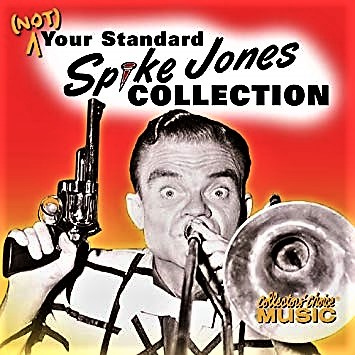
The crime here--the murder of Carlos Rivera during a gimmicky performance of "Hot Guy, Hot Gunner," wherein Lord Pastern is supposed to fire a gun loaded with blanks at Rivera (As Joanne Drayton noted, Marsh seems inspired by the Forties comic antics of outlandish American bandleader Spike Jones here)--is neatly carried out in the Golden Age baroque tradition.  I thought it superior to Ellery Queen's The American Gun Mystery, for what it's worth. 

There's a nicely managed subsidiary mystery as well, though all in all the resolution of the whole thing conforms, I think, to the author's general biases.  Christie, as Robert Barnard has remarked, was trickier in this respect.  He called her the "disappearing author" because she hid her attitudes so much better than other mystery writers.  Or maybe it's the inherent challenge of writing more character-driven mystery, as Golden Age genre theoreticians like Dorothy L. Sayers commented back in the day.  Revealing character in a mystery is like revealing cards in a game of poker.

Still, Swing, Brother, Swing is a peppy number I would recommend, on the whole. Although back in the Forties I would have advised Edmund Wilson and Raymond Chandler, if they didn't want to feel impelled to tear out what remained of their hair, to keep far away from its pages.

Other blog reviews:
http://wordcount-richmonde.blogspot.com/2015/05/ngaio-marshs-swing-brother-swing.html
https://grandestgame.wordpress.com/list-of-authors/ngaio-marsh/swing-brother-swing-ngaio-marsh/
http://clothesinbooks.blogspot.com/2016/05/swing-brother-swing-by-ngaio-marsh.html

Sunday, March 17, 2019

Swan Song: Light Thickens (1982), by Ngaio Marsh, a sequel of sorts to Death at the Dolphin (1966)

Light thickens, and the crow
Makes wing to the rooky wood


--Macbeth, William Shakespeare

Last books by long-lived, prolific mystery writers sometimes can be lamentable performances, like that of an actor of declining powers who vainly deigns to remain strutting upon the stage.  Even their warmest admirers often do not have much to say that is laudatory about Agatha Christie's Postern of Fate (1973) or John Dickson Carr's The Hungry Goblin (1972), both of them written near the end of the author's lives.

Sometimes this failure of powers may be due to disabilities associated with old age. Christie, who was 82 and 83 respectively when her last novels Elephants Can Remember and Postern of Fate was published, was suffering from dementia when she was writing them, according to a researcher, who says of Christie's writing at that time that her use of vocabulary had "completely tanked."  Or sometimes a writer simply may be written out.  Carr was only 65 (a time when many authors remain at their prime) when The Hungry Goblin was published, yet even his admiring biographer Douglas G. Greene considers it too poor a work to merit reprinting.  Yet Carr's work had been declining for some time, arguably for as long as two decades.  The could be said, too, of Christie, or a number of other Golden Age writers.

For many Golden Age writers, the 1950s, when most of them were entering their sixties or seventies after two or three decades (or more) writing, signaled a beginning of a decline in their work, which accelerated in the 1960s.  This doesn't mean they couldn't still produce good books--Christie's 4:50 from Paddington, Cat among the Pigeons and The Pale Horse, written when Christie was around 70, are all well-regarded by fans--yet there often was an overall decline.  In the Thirties, noted Robert Barnard of Christie, for example, one expected masterpiece after masterpiece from the author's pen, while after around 1950 or so one could only hope.

What about New Zealander Ngaio Marsh, who after the death of Dorothy L. Sayers in 1957 and Margery Allingham in 1966, remained, in the eyes of critics and many fans, the main rival to Christie's crown as Queen of Crime until Christie's own death in 1976? 

I think that Marsh, who was five years younger than Christie (and claimed to be nine years younger), produced several books in the Fifties that were comparable with her best work.  However, by the 1960s Marsh's work too was slipping, in my view.  I like the comedy of manners in Hand in Glove (1961) and the original situation in Clutch of Constables (1968)--not to mention the clever alliterative title with its double meaning--as well as the timeliness of Black as He's Painted (1974) and the classic country house set-up in the New Zealnd setting of Photo-Finish (1980), but I'm pretty lukewarm, on the whole, about the rest of her output from her later years.

Often Marsh's Death at the Dolphin (1966) draws high praise, however.  Indeed, in its day influential American reviewer Anthony Boucher raved the novel, placing it on his ten best of the year list, which he had done since 1949 and continued until 1967.  (He died in 1968). 

Over those 18 years, during which Marsh published a total of ten detective novels, Boucher included just two other Marsh mysteries, Opening Night (1951) and Scales of Justice (1955), in his annual top ten lists, giving Marsh the same number of mentions, incidentally, as late Fifties newcomer Patricia Moyes.   So presumably Boucher thought that Marsh's Killer Dolphin, or Death in the Dolphin as it was re-titled in the US, was one of Marsh's very best mysteries. 

Golden Age stalwart Christie, in case you're wondering, made Boucher's lists 9 times (out of 20 novels and 1 short story collection), which is pretty terrific for an author in relative decline as I have contended, though Ross Macdonald edged her with 11 (!) mentions (out of 13 novels and 1 short story collection).  

I agree with Boucher that Opening Night and Scales of Justice are two of Marsh's best mysteries, but, despite the admiration Boucher and other later readers held for it (Crime writer and Sunday Times mystery reviewer Edmund Crispin was another admirer), I simply cannot work up enthusiasm for Death at the Dolphin.  It's one of Marsh's theater mysteries, which the author, who directed stage plays when she wasn't writing mysteries, periodically produced.   In her own home country of New Zealand, we are told, it was her theatrical work which won her the most critical respect.

It seems that the Bard was
the main man in Ngaio Marsh's life
The first chapter of "Killer Dolphin," in which young theatrical director, Peregrine "Perry" Jay (why not Poppin "Poppy" Jay if we're going to be twee?) tours a derelict, bomb-damaged  theater, the Dolphin, and falls under its decrepit yet still potent charm, is appealing. 

On stage Jay falls into a hole filled with slimy cold water, but is rescued by reclusive millionaire Vassily Conducis, who owns the theater and is yet another character from the era modeled on Green tycoon Aristotle Onassis (though Mr. Conducis is part Russian).  He offers to restore the Dolphin and put Jay in charge of producing plays there.  He also shows Jay a glove he owns which supposedly belonged to Shakespeare's son, Hamnet, who died when he was but 11. 

Jay decides that for The Dolphin he will write a play, "The Glove," based on events in Shakespeare's life (with plenty of fictional invention). And why not?  The whole book reads like a fantasy wish fulfillment novel for theatrical directors who are also, like Ngaio Marsh, Shakespeare fiends.  They should love this book, to be sure.  Did I mention Jay finds his beloved future wife in the novel as well?  Of course he does.  And the at the play is a big hit?  Of course it is.

Years later, in Marsh's detective novel Light Thickens, a sequel of sorts to Death at the Dolphin, Perry's wife Emily tells a young boy, now acting at the Dolphin, the story of "how Peregrine, a struggling young author-director, came into the wrecked Dolphin and fell into the bomb hole on the stage and was rescued from it and got the job of restoring the theatre and was made a member of the board."

"Even now, it's a bit fairy-like," she reflects.  And indeed it is.  Killer Dolphin is a fairy tale.

"the master-mistress of my passion"
portrait of the young Earl of Southampton
Was the Earl Shakespeare's "W.H."?
There is, to be sure, one of Ngaio's narsty murders, about 150 pages into this 300 page novel.  The problem for murder fanciers is that it's a very routine murder.  There's also a theft (of the fabled glove), but this is routine as well, outside of the fact that a Shakespearean relic is involved.  The only interesting mystery that actually appears in the novel, I think, is the question of Mr. Conducis' motivations, but even this was slim compensation. 

And please recall that in my last blog post, a review of Marsh's Swing, Brother, Swing, I defended Marsh against criticism that she couldn't plot worth a damn, so I don't feel I'm biased against the author in this respect.  It's simply that I believe what Jacques Barzun has written about Dolphin is true: "the mystery is forced and the outcome dull."

Are there any compensations?  Not for me, really.  I didn't find the characters sufficiently interesting or memorable, nor did Jay's play "The Glove" fascinate me.  Indeed, I couldn't see why it would have been so popular. 

Jay brings into the play the ambiguous "W.H" from the sonnets, along with the Dark Lady, but I thought the whole thing tamely handled.  As usual, Ngaio only mentions homosexuality to make dismissive references about it: Jay and his male friend and roommate Jeremy are most emphatically not gay and in fact spend a number of pages worrying that the whole setup with Mr. Conducis might be some elaborate effort on the magnate's part to bed Jay.  But then we learn that Mr. Conducis is not gay either, so the poor boys were needlessly panicked at the thought of the big bad gay wolf. 

They should have known better, however, for the only people in Ngaio's books who actually ever are portrayed as queer are, as I recall, one lone, suicidal lesbian, in Singing in the Shrouds (1958), and a flock of extremely broadly drawn "flaming queen" stereotypes scattered throughout the author's lengthy crime corpus. 

Lytton Strachey
"Homosexuals seem to live in such a state of hectic misery & to get so little fun out of whatever antics they employ...one wonders they don't give it up as a bad job," Ngaio commented dismissively in a 1978 letter after reading  biography of Lytton Strachey, who died way back in 1932, nearly a half century earlier (and only two years before Marsh published her first mystery).  Which attitude helps explain, I think, her portrayals of LGBTQ people in her books.

As a group gay men in particular just did not interest her, except as stereotyped comic relief, and her one lesbian is simply pathetic and sad, a backward step even from The Well of Loneliness (1928).  It's as if Marsh's views of homosexuality had set in stone around 1930 and she never saw a need to update them.  Marsh's second biographer tries to make the case that Marsh herself was a lesbian, but I've always had trouble accepting this view, given Marsh's writing on the subject.  If she was a lesbian, she must have been deeply closeted, both physically and mentally.

So concerning Death in the Dolphin aka Killer Dolphin I'm afraid that I have to part company with Anthony Boucher, seeing it as I do as a novel with very little to commend it after the first chapter (which I agree is very well written).  Perhaps Ngaio was really a mainstream novelist trying to break out of the mystery "ghetto," if you will, but in Dolphin, as I see it, she regrettably has nothing of interest to say and the mystery element, like the killer whale, blows. 

At best, it seems to me, it's simply a trifling amiable fantasy about nice people putting on a nice show at a nice theater, with a discordantly not-nice murder perfunctorily thrown in so that it can be called a mystery.  Given that I've just admittedly described a lot of modern mysteries, this may actually be the sort of thing a lot of modern mystery readers enjoy.  And certainly there is no crime in that.  We all have different preferences about what sort of fictional worlds we like to escape into, but I like one with a little more spikiness, whether in the puzzle or the milieu (or both).

However, Marsh gamely returned to the Dolphin theater to stage another murder in her final detective novel, Light Thickens, which she wrote at the age of 86, heroically completing it just a few weeks before her death in 1982; and I like the results better.  It is definitely more to my taste.

Although modern critical wisdom about Light Thickens is that it is a weak effort, in my view it is at least an improvement on its predecessor Death at the Dolphin.  Peregrine Jay returns in a major role, now married to Emily and with three boys.  There are a couple of other characters from the Dolphin milieu who return as well.  The play is still the thing, and with all due respect to Ngaio it's a rather better one than The Glove that they're putting on this time: Shakespeare's own Macbeth.

Light Thickens is, I think, unquestionably more thinly, even choppily, written than earlier Marshes, with much of the witty and rich language which characterized her previous novels sadly gone missing.  The decline in the writing quality between this one and even her immediately previous novel, Photo Finish, is evident:

The rest of the evening was unreal.  The visit to the royal box and the royal visit to the cast.  The standing ovation at the end.  Everything to excess.  A multiple Cinderella story.  Sort of. 

This is way off from the usual Marsh standard, though the customary Ngaio wit does glint at points.  "Old Nina's got the bug very badly," Jay says of a superstitious actress in Macbeth fearful of all the dark legends which have built up around the play. "Her dressing-table's like a second-hand charm shop.

There is also a funny little bit when Emily, who is trying to invent an imaginary malady for her husband to assume (read the book), suggests diverticulitis.  Why that one, Jay asks, to which Emily responds:

"I don't know why...but it seems to me it's something American husbands have.  Their wives say mysteriously to one: 'My dear!  He has diverticulitis!  And one nods and looks solemn."

There's an additional amusing twist to this joke, but I'll leave you to read it for yourself.  Of course if you're suffering from diverticulitis, whatever it is exactly, you may not find this passage so mirthful.

What gives considerable boost to Light Thickens in my estimation is its overall conception, which is a grand one.  Marsh had long had the idea for this novel in mind, but only in her final months did she finally attempt to set it to paper. 

Of course murders have taken place during plays before in detective novels (Marsh herself had done one nearly a half century earlier), but Light Thickens fully integrates the murder story with the performance of the play itself, and what a play it is for a murder: "The Scottish Play," Macbeth, superstitiously believed to be cursed, like the Hope Diamond.  It's known as "The Scottish Play," in fact, because it's considered bad luck during a production even actually to speak the title of the play out loud.  It is, verily, the play that dare not speak its name.

Apropos of which, see this old Blackadder sketch:


During the production of the play, pranks are played on the cast members, non of them deadly but all of them nasty and grotesque.  Could there be some sinister purpose behind this seemingly senseless japery? 

The main cast members of the play are characterized economically but sufficiently to advance the mystery along.  There are, first and foremost, Dougal Macdougal, a real Scotsman, in the title role and Simon Morten as his nemesis Macduff, both of whom are enamored with the leading lady, Margaret Mannering, who plays Lady Macbeth. 

Then there is Bruce Barrabell, an actor's equity union representative and all round leftist malcontent (Ngaio's pronounced distaste for Communists has never been clearer than in this, her final novel), who plays Banquo; superstitious Nina Gaythorne as Lady Macduff; Rangi, one of the three Weird Sisters, a Maori actor from New Zealand ("My great-grandfather was a cannibal"), who has his own watches and wards against the supernatural; well-bred, aspiring nine-year-old actor William Smith, as Macduff's son; and arms enthusiast Gaston Sears, as Seyton, attendant to Macbeth.  (He also choreographed the final passage of arms between Macbeth and Macduff.) 

There's even a "stage" Cockney Props, Ernie, who says things like "fink" for "think," so that you will know he is a Cockney.  Marsh's Cockneys had been speaking like that for nearly a half-century; I suppose Ngaio figured, why stop now?  At least she doesn't have a plumber saying "Arr," like she does in Swing, Brother, Swing.

He's gone a little loopy.
Michael Fassbender playing the title role
in the most recent film version of Macbeth (2015)

Jay heroically tries to hold things together, with the help of his wife and sons, but will the play, which promises to be one of the great Macbeths, actually see its opening night?  Of course murder--a horrible, bloody mess of a murder--will take its turn on the stage as well, pretty late into the novel.  The murder is most apt, so apt, indeed, that most people probably will discern the identity of the murderer about as easily Superintendent Alleyn does. There are some clues, but they only point to what should be, I imagine, already sufficiently clear to most readers.  Mystery fiction bloggers who are great devotees of puzzles like TomCat, for example, doubtlessly won't be impressed with the formal puzzle apparatus here.

However, even if I am right in that supposition, I don't see this novel as a failed effort.  The solution is a most fitting one artistically.  I agree to a great extent with Jacques Barzun, who wrote of the novel that the "denouement is predictable, but so brilliantly reached that the fault is overlooked."

It helps if you like Shakespeare, it should go without saying, and know about Macbeth.  Fortunately for me, it was my favorite in school of Shakespeare's major tragedies, for I found King Lear too depressing, Othello too vexing and Hamlet too enervating.  It's also the only one of the bunch I've ever personally seen on performed stage, at the Alabama Shakespeare festival.  (Yes, there is one, near Montgomery, Alabama, and quite nice it is too.)


Perhaps Ngaio might have given us a flawless crime novel had she made Light Thickens an actual crime novel, jettisoning the weak puzzle elements.  As it is, it bears resemblance to a remarkable film about Shakespeare and murder which won an acting Oscar for a veteran British thespian in the 1940s.  (And I'm not taking about Olivier.)  But instead Marsh cast it as her usual detective novel, and as such it makes a charming adieu to her fans and to the Golden Age of mystery.  Of novels written by actual between-the-wars members of the Detection Club, only four by seemingly indefatigable fiction factory Gladys Mitchell, who died in 1983, would follow Light Thickens into publication; three of them were posthumously published, like Ngaio's last Light.

Ngaio Marsh knew that her health was failing when she was writing Light Thickens.  I'm sure she must have suspected it would be her last novel.  With a great effort she made her final public appearance in September 1981, when she appeared at the dedication ceremony of the newly restored Theatre Royal in Christchurch, New Zealand (restored again after the 2011 earthquake, not the last of the city's calamities as we saw this week).  Marsh cut the ribbon across the theater's portal and resoundingly declared, "God bless this ship and all who sail in her."

Housebound thereafter, her own ship taking sail no more, Marsh completed her manuscript and sent it out on January 7, 1982.  Her agents had reservations about the novel, but Little, Brown, her longtime American publisher, accepted it immediately, which Marsh was much pleased to hear two weeks before her death on February 18.  She never did learn that Collins had accepted her final novel.  Collins in fact had contemplated rejecting it and insisted on substantial editing after Marsh's death.  Something they should have done for Christie's last two novels!

Despite publisher concerns, Light Thickens was much praised by critics and lapped up by fans.  Seemingly nothing becomes an author, in the eyes of critics and fans alike, like her recent death.  But today, 37 years after Ngaio Marsh's demise, I think that Light Thickens is still well worth reading.  Perhaps had she written the novel earlier in her life, it might have been one of her masterpieces, but as it stands it makes an affecting swan song from one of the major figures in the mystery genre.

Other reviews of Death at the Dolphin aka Killer Dolphin:
The Puzzle Doctor (This is dull.  Deathly dull.  By the end of the book I just didn't give a flying monkey's whodunit.)
Lucy Fisher (the characters....are so well-drawn--it's a joy to spend time with them, and the banter is really witty....I love the atmosphere....That's how I remember [London].)
Kate Jackson (the end of the book fell flat for me, which is a pity as the beginning of the story is strong and Marsh is expert at recreating the world of the theatre.)
Nick Hay (The actual crime, investigation and solution are all fairly routine, with the question of the theft of the glove itself being rather tedious.)
Moira Redmond (Her good points and her bad points shine out.  She is funny and perceptive, and does excellent dialogue....her division of character into nice and nasty can be excruciating....She is forever...telling us what is good taste and bad....She can be very amusing and clever in her observations, and then plonking and banal in the next paragraph.  Her hero Alleyn is apparently irresistible to all women...which is wince-making.)

Theatre Royal, Christchurch