Tuesday, September 29, 2015

Deathtraps, Dream Bombs, Snow, Flakes, Third Girl: Third Girl (1966), by Agatha Christie (Christie in the Sixties)

Note: For non-American readers of this blog, or American readers under the age of, say, forty-five or so, the post title references the theme song to the That Girl television series (starring Marlo Thomas), which premiered the same year Agatha Christie's Third Girl was published.--TPT

"She's a third girl....It's the way girls like living now.  Better than P. G.'s or a hostel.  The main girl takes a furnished flat, and then shares out the rent.  Second girl is usually a friend.  Then they find a third by advertising, if they don't know one...."
                               --Ariadne Oliver in Third Girl (1966)

Third Girl traditionally has not been much esteemed by critics.  In his book Adventure, Mystery and Romance scholar John G. Cawelti cites Third Girl as an example of one of Christie "artistic failures," and Robert Barnard, in his generally quite favorable Christie monograph A Talent to Deceive, dismisses the novel as "one of Christie's most embarrassing attempts to haul herself abreast of the swinging sixties."  

More recently, however, Laura Thompson in her 2007 biography of Christie praises Third Girl, declaring that the sixties milieu is "utterly convincing." 

Where do I stand on this one?  When I first read Third Girl when I was about twelve or so I must admit I thought it was one of the "boring" Christies. I didn't pay much attention to publishing dates at the time, but I now realize that I thought most of the later Christies, from 1965 (At Bertram's Hotel) onward, were pretty boring.  Rereading some of them now, I am finding them of greater interest.

girls one and two
One thing that appealed to me about Third Girl is how this is a full-bore Poirot mystery, something that was an increasing rarity after the mid-fifties, when Hickory, Dickory Dock and Dead Man's Folly were published. Between 1957 and 1975, a nearly twenty-year period, only six Poirot detective novels appeared: Cat among the Pigeons (1959), The Clocks (1963), Third Girl (1966), Hallowe'en Party (1969), Elephants Can Remember (1972) and Curtain (1975).

Of these novels, the last title was actually written by Christie during the Second World War, and Poirot plays a recessive role in both Cat and Clocks. In both of those latter novels I believe he is mostly is occupied with writing a book on detective fiction, which he has finally finished in Third Girl.

When Hercule Poirot popped up in Third Girl, it was his first fully active performance since Dead Man's Folly was published a decade earlier. Contemporary reviews of the novel, Cawelti and Barnard notwithstanding, were favorable.  

For example, while Anthony Boucher thought the plot "only moderately good Christie," he lavished praise on Poirot and his mystery writer sidekick Ariadne Oliver and the author's "acute sense of the immediate contemporary scene."

the third girl
I think one can appreciate why critics were positive: it's nice to have Poirot back in a truly active capacity, even if he does rely extensively on subordinate investigations by a Mr. Goby, who appears on occasion in Poirot novels. 

The brilliant Belgian sleuth is fully in his environment, with manservant George, the ever-efficient Miss Lemon, endearingly scatty Mrs. Oliver, his magnificent vanity and moral force, his tisane, his sirop de cassis, his chocolate, his mustaches, etc.--it's a warm bath of authentic Christie nostalgia, something I most definitely missed in Sophie Hannah's ballyhooed Poirot continuation novel, The Monogram Murders.

And Christie has worked up a good "situation" for Third Girl. When the distraught young "third girl" of the title, Norma Restarick, barges into Poirot's flat, telling him she thinks she "might have committed a murder" before abruptly departing, declaring that Poirot is just "too old" to be of help to her (the generation gap rearing its head), it's a set-up that immediately entices the reader.

Marlo Thomas, aka "That Girl"
The plot itself employs time-tested Christie devices and deceptions in an enjoyable manner, if not quite as smoothly as in the past. Aspects of the plot, though clever, take a bit of swallowing and the resolution of two of the characters' fates felt rather forced.

While there are not actually all that many scenes devoted to swinging sixties London in Third Girl, I did not find Christie's portrayal of this milieu "ridiculous" like Robert Barnard did. To be sure, Christie does drop drug references with wild abandon: Purple Hearts, Dream Bombs, coke, snow, hash, etc.  It's raining meth, you might say. 

In fact, I thought David Baker, the modster artist character described by Christie as "a young man with lavish chestnut hair curled on his shoulders, wearing a red velvet waistcoast and a very fancy jacket" and nicknamed "the Peacock" by Mrs. Oliver, actually was the most interesting new character in the novel. Over the years he has inspired much of the cover art for Third Girl.

The basic idea of the "third girl" works beautifully, I think, Christie having alertly caught onto and cleverly employed a phenomenon of modern English life. (It's a shame the television adaptation moved the time period back to the Thirties.)  

I was fascinated with Borodene Mansions, the London block of flats where the three girls live, which Christie likens in appearance to the prison Wormwood Scrubs; and I noted the harlequin wallpaper in their flat, captured on the Pocket paperback cover illustrated above. Christie was always fascinated by the Harlequin motif.

All in all, Third Girl is a worthy addition to the Poirot canon. If the novel doesn't make it to home base, it certainly hits a double, or, dare I say...a triple?

not Borodene Mansions

Postscript: In Third Girl there's a marvelous instance of the "odd" English terms to which Christie books used to introduce me, a young American reader.  Mrs. Oliver, in one of the novel's unlikely coincidences, happens upon Norma Restarick and David Baker in a cafe called The Merry Shamrock. The two are eating beans and toast, which always sounded singularly unappealing to me as a lad.  Is it really as simple as canned baked beans on toast with Worcestershire sauce on top?  I'm afraid my reaction, if actually presented with this dish, might be rather like that of these Americans:

Americans try Beans on Toast (Caution: Humor!)

This recipe, now, looks pretty good!

British-style Beans on Toast

The Tuesday Night Bloggers

In a nod to Agatha Christie's classic book of Miss Marple short stories, The  Thirteen Problems (aka The Tuesday Club Murders in the US), in which Miss Marple herself as well as other individuals swap stories about real-life mysteries, some of us in the mystery blogging community have formed

The Tuesday Night Bloggers

a group dedicated to discussing aspects of all things Agatha.

Here are the links to some very original and interesting pieces by our club members (I have one too, on the way):

Bev Hankins, Murder on the Orient Express: Review and Audio-Visual Extravaganza
Brad Friedman, The Bloodstained Pavement, Part I: Agatha Christie and the Serial Killer
Curtis Evans, Deathtraps, Dream Bombs, Snow, Flakes, Third Girl
Helen Szamuely, The Mystery of Raymond West
Jeffrey Marks, He Must be Belgian!
Moira Redmond, An Agatha Christie List
Noah Stewart, Christie's Rarest Paperback Editions

Monday, September 28, 2015

Ray and Jimmy: The Raymond Chandler-James M. Fox Correspondence, Part 2

Sometimes I get distracted with other jobs and don't continue a blog post series in what you might call a timely fashion.  In this case, it's been nearly two years!  Back in December 2013, I started writing about the correspondence between Raymond Chandler and a much lesser-known hard-boiled (sometimes medium-boiled) writer, James M. Fox. (See my admittedly rather tepid review of his novel The Gentle Hangman.)  The correspondence sheds revealing light on attitudes toward the crime fiction craft by two mid-twentieth-century practitioners of it, one of them one of the mystery genre's most important figures.

James M. Fox
When I left off, Fox, in a letter from 3 March 1953, had just informed Chandler that he had, at Chandler's suggestion, started writing a spy novel, nearly completed, which he wanted to dedicate to the older author: The basic format is not unlike that of [Somerset Maugham's] Ashenden, although I can hardly hope even to approximate Maugham's craftsmanship and general excellence.

Chandler replied that "I should be only too flattered at the idea of having one of your books dedicated to me," adding that "I have read quite a few spy stories (I mean recent ones, written since the war) but I can't say that I have read anything that impressed me much."

Although he admired crime writer Dorothy B. Hughes "very much," he wasn't impressed with her recent espionage novel, The Davidian Report.

"It may be that there is something self-defeating in the spy story itself and that intelligence or counter-intelligence work in fiction is ether damned dull stuff  or so oversimplified that it becomes silly," he ruminated.  "The same thing could probably be said about police work, and perhaps this is why so few mysteries of any quality (when I say so few, I can't offhand think of any) are written around actual police detectives, or to be more accurate I should say police detectives who might conceivably actually be policemen."

In his response Fox noted that he was about to publish a new novel, Code Three, the first in a new series, with a police sergeant protagonist. "The publisher likes it, which means very little, of course" he noted bluntly. "It will probably sell all right because of the sex plus violence element in it, and because it contains at least a flavor of actual police work, but the word 'quality' is one I hardly expect to hear mentioned in connection with it."  [In the event critic Anthony Boucher found the material in the novel over-familiar, but declared that "it reads at such a terrific clip, with such economy and vividness, that your reservations come only after you've finished it."]

On 8 January 1954 Fox sent Chandler a copy of his completed spy novel, Dark Crusade, and three weeks later Chandler replied, bestowing considerable praise on the book, though not without some qualification:

I liked the book so much that I wish I had three more just like it to look forward to....I like the cool literate way in which you write.  I think some of your stuff will go over the heads of the lending library creeps, but that can't be helped....What the story lacks is a central drive.  I'm talking, please understand, in terms of popular support....As for comparisons your stuff makes most of the so-called spy novels seem pretty fantastic [i.e., unbelievable].  I'm not thinking of a terrible piece of rubbish like Little Red Monkey (which is practically G. A. Henty) but rather of competent writing jobs such as The Davidian Report or [Julian Symons'] The Broken Penny.  Neither sounds in the least as if the author knew anything about intelligence or C. I. work  Of course there is always a danger in knowing too much.  You forget to simplify.  I don't think you did, not for me anyhow, but I do think the book might have had a possibly better sale if the central story line had been simpler and more emotional.

Chandler's view of Stalin
was rather different from
that advanced in this
propaganda poster
Occasioned by his reading of Dark Crusade, Chandler went on to express his views of the Cold War, as well as, incidentally, the American Civil War, by my reading denouncing the United States for not sufficiently resisting the Soviet Union and avowing support for the Lost Cause:

I don't suppose the people of this country will ever let themselves realise how much harm to themselves and their future their foreign policy has done.  The principle of self-determination seems to work everywhere in other people's colonies, unless of course it is a question of placating some swine like Stalin, when you toss whole nations into the incinerator without a qualm. The only domestic problem of self-determination we have faced was in the War Between the States (in which I should most certainly have fought on the losing side). It was also almost the first demonstration of high-powered propaganda in convincing the world that the war was about slavery, which it was not. The nation, said Lincoln, cannot exist half slave and half free, but apparently we think the world can. So much for that.

Chandler sent a copy of this English edition
to his friend Fox
Chandler also noted that his new Philip Marlowe novel, The Long Goodbye, had sold close to 30, 000 copies in the UK, adding "I only wish American sales could compare. Adjusted for population that would mean a real sale here." He promised he would send Fox a copy of the book, which the next year would win the Edgar for best mystery novel.

In his reply Fox expressed dissatisfaction with Dark Crusade, explaining that he had to draw on pre-1939 memories of Europe and had been allowed only six months to complete the book: "This sort of writing really shouldn't even be attempted without at least 50, 000 words in background notes, made on location within the past year or so."

Fox ruefully admitted to Chandler that

The question of compromise between cool fact and emotion is one that has always bothered me, badly.  I realize full well that the average reader craves emotional experience, yet it is very difficult for me to supply anything of the sort.  My instinctive tendency is to supply only "facts," whether fictitious or not; to place them in studied relationship to each other, preferably ironical relationship; and to demand that the reader understand thoroughly, grasp the meaning, perform the often necessary doubeltake and work up his own emotional reaction.  This procedure is against the rules, I know, and sells no books.

the average American's idea of "Dutch"?
Fox noted that he was planning a trip to Europe and he hoped to write another espionage novel set there. However, he feared that financial considerations would force  him "to stick to routine bread and butter stuff for quite awhile. Right now I'm on one of those three-and-four-letter word, six-word sentence, cops and gangsters stories for which the reprint publishers are yammering."

In the hope of facilitating his book sales Fox was now advising publishers in publicity material "not to emphasize my Dutch origins."  He wryly explained that the "average American reader tends to associate the adjective Dutch only with cheese, wooden shoes and little boys plugging holes in dykes with their thumbs."

Chandler, who now was calling his correspondent simply "Fox" (rather than "Mr. Fox") urged in his next letter, "Cut out the 'mister' please."  Later in the year the two would advance, in term of their epistolary intimacy, to calling each other "Ray" and "Jimmy." More to come soon, I hope!

Saturday, September 26, 2015

The Big Five from the Bottom Shelf: The Most Popular of the Least Popular Christies; Plus, The Tuesday Night Bloggers!

Miss Marple solves a mystery and
battles Fifties juvenile delinquency
In my last post on the Great Christie Lists Compilation, I gave the eighteen bottom-ranking Christies, the ones no one put on a list of favorites, and asked people, here and on Facebook, to tell me their favorites--their "Big Four," if you will--from this less favored bunch.

Well here are the results.  It's a "Big Five," actually:

First Place (TIE, with six votes each)
Lord Edgware Dies and The Seven Dials Mystery

Second Place (TIE, with four votes each)
At Bertram's Hotel, Cat among the Pigeons and They Do It with Mirrors

Congratulations to the Big Five from the Bottom Third!

Getting two votes apiece were:

Sacre bleu!
By the looks on their faces clearly
Poirot has received the shocking
news about Murder on the
Links, Hallowe'en Party and 
Elephants Can Remember
The Clocks, Dead Man's Folly, Dumb Witness, The Man in the Brown Suit, The Mystery of the Blue Train and Third Girl

Getting one vote apiece were:

The Big Four itself, They Came to Baghdad and Postern of Fate

That leaves four titles for which no one voted. Evidently, there's just no love for this Wee Four:

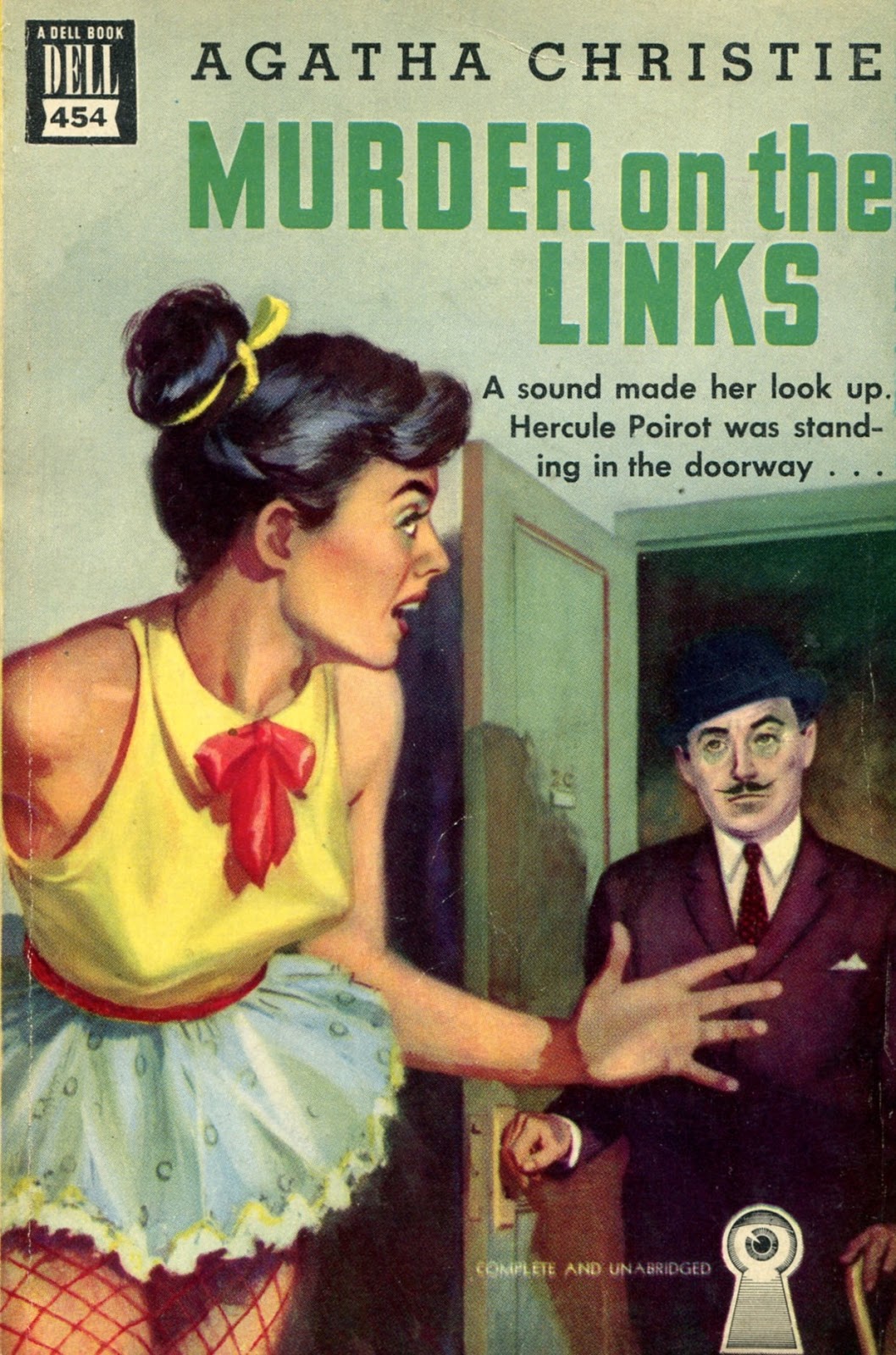
The Murder on the Links
Hallowe'en Party
Passenger to Frankfurt
Elephants Can Remember

Hallowe'en Party isn't that bad, I think, and The Murder on the Links has good points in my view, though I must admit it has never really grabbed me.

Passenger and Elephants--well, what can you say? These do come in for a lot of criticism. I'm just surprised Postern escaped the same fate! Lucy R. Fisher has made an interesting case for it, though.

It ain't over 'til the fat lady sings!
Thanks to everyone who participated!

And now I want to announce the formation of The Tuesday Night Bloggers: an international blogging "club" comprised of myself, Bev Hankins, Brad Friedman, Helen Szamuely, Jeffrey Marks Moira Redmond and Noah Stewart.

Each of us will do a Christie-related post every Tuesday night for the next six weeks (or so the theory goes).

I will post links to everyone's pieces here, so make sure you tune in on Tuesday and see what's being discussed!

And, yes, if this format reminds you of a certain Christie book, you may just be on to something!

Also, any other bloggers who may want to participate in the club, just let me know.

Thursday, September 24, 2015

The Christies That Didn't Make the Cut

Eighteen Agatha Christie mystery novels did not receive any mention on the 31 Favorite Christie lists I recently compiled. Here are the unloved (comparatively) Christie mysteries:

Seven Dials Mystery: clocked out
From the Twenties
The Murder on the Links (1923)
The Man in the Brown Suit (1924)
The Big Four (1927)
The Mystery of the Blue Train (1928)
The Seven Dials Mystery (1929)

From the Thirties
Lord Edgware Dies (1933)
Dumb Witness (1937)

From the Fifties
They Came to Baghdad (1951)
They Do It with Mirrors (1952)
Dead Man's Folly (1956)
Cat among the Pigeons (1959)


From the Sixties
The Clocks (1963)
At Bertram's Hotel (1965)
Third Girl (1966)
Hallowe'en Party (1969)

From the Seventies
Passenger to Frankfurt (1970)
Elephants Can Remember (1972)
Postern of Fate (1973)

Let's give these uncosseted Christies another chance!  If you had to pick your favorites--let's say your Big Four--from this bunch, what would they be?  I'm sure Lord Edgware is dying to know!

Favorite Christie Novels: Runners-Up

Here are the eighteen Christie novels in the recent lists compilation I did that didn't make the Top 20, but nevertheless made more than one list:

On Four Lists:
Hickory, Dickory, Dock
Murder Is Easy
One, Two, Buckle My Shoe
Ordeal by Innocence
Sleeping Murder
Towards Zero

On Three Lists:
Death Comes as the End
Mrs. McGinty's Dead
Peril at End House
Sad Cypress
Murder in Three Acts (Three Act Tragedy)

One Two Lists:
Death in the Clouds

Destination Unknown
The Mirror Crack'd from Side to Side
Nemesis
The Secret Adversary
Sparkling Cyanide
Taken at the Flood

The play The Mousetrap also got multiple mentions, as well as the short story collections The Labours of Hercules and The Mysterious Mr. Quin.

Poirot wasn't quite as dominant here as he was on the Top 20 list, accounting for eight of the titles. Miss Marple accounted for three, Tommy and Tuppence one, and six were non-series.

searching for favorite Christies
The ten Christie titles that received only single mentions on the lists were:

Why Didn't They Ask Evans?
The Secret of Chimneys
Appointment with Death
Murder in Mesopotamia
The Sittaford Mystery
N or M?
A Pocket Full of Rye
A Caribbean Mystery
By the Pricking of My Thumbs
The Pale Horse (that would be my list)

Poirot was only in two of these, Miss Marple two, Tommy and Tuppence two and the remaining four were non-series.

The plays The Patient and The Witness for the Prosecution showed up too.

So, 48 novels were mentioned on at least one list.  That's a bit over two-thirds of her crime novels. Next time I will look at the twenty novels that made nobody's list!

The Results: Favorite Agatha Christie Novels

The results of 31 favorite Christie lists are in (including the list Christie herself once made) and the final results are posted below.  How close are these to the World's Favorite Christie list?  Pretty close, it turns out!

Top 11 Favorite Christie Novels According to the Passing Tramp's Compilation of Lists (ranked in order of popularity, ties included; the number of lists that each Christie novel appeared on follows in parenthesis):

1. And Then There Were None (24)
2. Murder on the Orient Express (23)
3. Death on the Nile (21)
4. The Murder of Roger Ackroyd (18)
5. Five Little Pigs (15)
6. A Murder Is Announced (14)
7.-8. TIE Evil under the Sun and The Hollow (10)
9. Curtain (9)
10.-11. Crooked House and The Moving Finger (8)

The next 9, making the top 20, are as follows:

12.-14. TIE The ABC Murders, The Body in the Library and Endless Night (7)
15.-18. TIE After the Funeral, Cards on the Table, 4.50 from Paddington and Hercule Poirot's Christmas (6)
19.-20. TIE The Murder at the Vicarage and The Mysterious Affair at Styles (5)

12 Poirot novels, 5 Marples and 3 non-series.  Tut-tut, Tommy and Tuppence, better luck next time! As a reminder, here's the World's Favorite Christie Top Ten:

1. And Then There Were None (21%) 
2. Murder on the Orient Express (16%) 
3. The Murder of Roger Ackroyd (8%)
4. Death on the Nile
5. The ABC Murders 
6. A Murder Is Announced
7. 4.50 from Paddington
8. Evil under the Sun
9. Five Little Pigs
10. Curtain