Monday, April 16, 2012

An Orgy of Death: Desire to Kill (1934), Alice Campbell


In his interesting and influential but in my view often rather biased and one-sided analysis of classical English detective novels and thrillers, Snobbery with Violence: English Crime Stories and Their Audience (1971), Colin Watson portrays the Golden Age English mystery as quite straight-laced, sexually speaking, with blushing crime fiction writers of the day able to bring themselves to refer only “obliquely” to “coital encounters.”

"The political tone [of the between-the-wars English mystery novel] was conservative save in a handful of instances,” pronounces Watson.  He expounds:

As for morals, it would be difficult to point to any other single branch of popular entertainment that conformed more strictly to current notions of decency. [...] An almost Victorian reticence continued to be observed in crime fiction for decades after treatment of unsavory topics had come to be accepted, within limits, as a legitimate feature of the straight novel.

Colin Watson likely never read Alice Campbell’s 1934 crime novel Desire to Kill.

Admittedly, the novel is set in France (specifically Paris), where, as I mentioned in the other's day's Virgil Markham piece, many Anglo-American readers no doubt could more easily accept the presence of moral decadence in human life. Still, the plot itself quite strikingly involves elements (drugs, homosexuality, prostitution and sexual voyeurism) that would be right at home in the unbuttoned and unzipped modern mystery.

Alice Ormond Campbell (1887-?) herself was an American, though, like John Dickson Carr, she is associated with the English school of mystery. Originally she came from Atlanta, Georgia, where she was part of the socially prominent Ormond family.

Alice Ormond moved to New York City at the age of nineteen and quickly became a socialist and women’s suffragist (this according the blurb on a 1939 Penguin paperback edition of one of her books — evidently Penguin did not deem it necessary to shield potential readers from knowledge of this author’s less than conservative background).

The adventurous Ormond moved to Paris some time around 1910 ("Paris was where the twentieth century was," memorably declared Gertrude Stein).  There she married the American-born artist and writer James Lawrence Campbell and had a son in 1914. After World War One, the family left France for England, where Campbell continued writing crime fiction until 1950 (the year The Corpse Had Red Hair appeared).

The first Alice Campbell mystery novel was Juggernaut, a highly-praised tale of the murderous machinations of a villainous doctor.  Some delighted critics compared it to works by Wilkie Collins, A. E. W. Mason and Marie Belloc Lowndes.  Additionally, Juggernaut was adapted into a film starring Boris Karloff in 1936--see left.)

Throughout the rest of the pre-WW2 period, most of her crime tales were set, like Juggernaut, in France.  Desire to Kill is one of the French novels. Like many Alice Campbell crime stories, it is more a tale of suspense, though there is notable detection in the form of attempts by a couple amateur investigators to pin the crime on the true villain (after World War Two Campbell was admitted to England's prestigious Detection Club).

The Sunday Referee pronounced that Desire to Kill "denotes a master craftsman of the mystery genre," due to lifelike characters, brilliant dialogue and "unusually ingenious" plot; while Dorothy L. Sayers praised the novel “for the soundness of the charactersation and the lively vigor of the writing,” which helped lift the narrative out of “sheer melodrama.”

And melodramatic the tale is! The opening sequence, which concerns the events at socialite heiress Dorinda Quarles’ bohemian drug party, is well-conveyed. Sybaritic “Dodo” Quarles imbibes deeply and frequently at the well of moneyed decadence:

The girl was by all accounts coarse, flamboyant, untrammeled by scruples or breeding; indiscriminate in love, and with a capacity for drink which led her to the open boast that, like a certain gentleman of Half-Moon Street, she never breakfasted, but was sick at eleven….

Dodo’s latest wicked pash is the cult-like new religion of the Bannister Mowbray--obviously, in the eyes of the respectable, an utter charlatan and degenerate (Mowbray almost assuredly is modeled after the infamous occultist Aleister Crowley, 1875-1947):

Rumour had it he came of a good Highland family, his mother a Greek, and that in a remote past he had been sent down from his university for dubious practices. At all events he was known to have delved deep into mysteries the normal being eschewed, and to have founded a cult which, after being hounded from place to place, was now domiciled in Corsica. Just what went on in the circle of his initiates no outsider could definitely state, but credible report declared the man’s readiness to prey on the infatuated disciples who clung to him with a strange devotion.

Bannister Mowbray sounds suspiciously
like Aleister Crowley
Bannister Mowbray’s current “henchman and slave” is Ronald Cleeves, the handsome son and heir of Lord Conisbrooke. The author compares him, in a suggestive image, to a “pure Greek temple…invaded by a band of satyrs.”  

Later on Campbell’s amateur detective, the brash, American-born freelance journalist Tommy Rostetter, visits the two men at Ronald’s Parisian abode and finds them “wearing dressing-gowns” and sitting “close together, in earnest discussion over bowls of café au lait.”  

About the nature of the relationship between this pair the author dares everything but shriek its name--surely even the most ingenuous 1930s reader got the idea!

Other characters in the novel — all guests as Dodo’s party — include:

Peter Hummock, originally of South Bend, Indiana. “Ranked as the most pestiferous social nuisance in Paris,” Hummock nominally deals in antiques and designs tea-gowns “for middle-western compatriots” but spends most of his time “in a tireless dash from one gay function to another, impervious to snubs, detailing scandal.”

Mrs. Cope-Villiers, “familiarly known as Dick…a reputed addict to cocaine.”

“The glum and taciturn Australian poetess, Maud Daventry.” A neighbor of Tommy’s first mentioned in Campbell’s earlier Rostetter mystery, The Click of the Gate (1932), Tommy has “nothing against her, little alluring as she was her soggy complexion, mannish dinner-jacket, and untidy mop of hair invariably flecked with cigarette-ash."

Announcing that Dodo’s party guests have consumed a powerful hallucinogenic drug, Bannister Mowbray promises them the thrill of intense dreams:

They will tend toward wish-fulfillment, of course, but the character will vary with the individual. All I can predict is that if any one of you cherishes a desire ordinarily forbidden, he may…taste an illusory joy of accomplishment.

This one involves drunks, not dopers.
During the period when all the guests at Dodo’s party are ostensibly in drug-induced stupors, Dodo is brutally stabbed to death—a rather Manson-like culmination of events (the situation also resembles that found in Adam Hobhouse's The Hangover Murders, published the next year--though in that novel the particular sybaritic group stupor is alcohol induced).

Apparently someone indeed had cherished an ordinarily forbidden desire, a desire to kill; and its accomplishment in those dark hours was not at all illusory.

When a woman he believes innocent is implicated in Dodo’s murder, Tommy investigates to discover what truly happened at this decadent affair. He finds that the dead Dodo is not exactly missed:

“Who cares a hoot if she did stick a knife into the worthless bitch?”
“David!”
 “Well, what was she, then? You tell me a nice name for her.”

Despite encountering indifference and resistance on almost all sides, Tommy perseveres in his investigation and eventually discovers an amazing answer to his problem. Proving it, however, becomes a perilous endeavor indeed for him.

Desire to Kill looks at numerous naughty
aspects of Parisan nightlife
Much of the later part of the novel involves goings-on at a house of prostitution where, for a price, the madam allows those voyeurs who like to look but not touch access to strategically placed peepholes, so that they may watch the house’s illicit couples coupling. The lingering look that Alice Campbell provides of sexual voyeurism strikes me as unusual fare for a book published by the respectable Collins Crime Club!

Though Campbell never directly describes sexual acts, reticent she is not in Desire to Kill.  In terms of subject matter the novel certainly offers something outside the beaten Golden Age track — and the mystery is not at all a fizzle either.  I found the tale superior to the immediately preceding Tommy Rostetter mystery, The Click of the Gate (a suspense thriller about a kidnapping, also set in France).


Desire to Kill is herewith recommended as an antidote to conventional wisdom about the detective fcition genre in its Golden Age and for its sheer entertainment value as an intriguing and exotic mystery.

Saturday, April 14, 2012

"It's French this time, but don't let that dismay you": Red Warning (1933), by Virgil Markham

Virgil Markham (1899-1973) spent over half his life in the shadow of his father, the once renowned and much beloved poet and man of letters Edwin Markham (1852-1940), author of "The Man with the Hoe," in the first half or so of the twentieth century one of the most celebrated American poems (it was inspired by the famous Jean-Francois Millet painting).  Actually, I should say more than half his life, because even after his father died, Virgil Markham was the tender of his father's literary reputation, still best known for being the son of Edwin Markham.

Virgil Markham's fourth mystery novel takes place in France
--a good part of the time on a train

Yet Virgil Markham was an interesting person in his own right.  He received a B.A. from Columbia University and an an M.A. from the University of California at Berkeley (his 1923 thesis was titled The Satirical Method of Addison and Steele).  In the 1920s he taught at UC-Berkeley's Cora L. Williams Institute for Creative Education and the University of California Extension Division. Under the auspices of the latter Markham in 1929 launched what was called the first university class on mystery literature, "The Development and Technique of the Mystery Story."

The Markham Home in Staten Island
After traveling in Europe for half of 1925, Markham in 1926 published The Scamp, a picaresque historical novel set in Europe.  He would use European settings as well for six of the eight mystery novels he published between 1928 and 1936.

These are:

Death in the Dusk (1928)
The Black Door (1930) (in England, Shock!)
The Devil Drives (1932) (reprinted by Ramble House)
Red Warning (1933) (in England, Song of Death)
Inspector Rusby's Finale (1933)
The Dead Are Prowling (1934)
The Deadly Jest (1935)
Snatch (1936)

Markham's work often won positive critical notice (his last six novels were published in England by the prestigious Collins Crime Club), but are little remembered today.  I suspect the books may have been victims of their own originality (not to say strangeness).

Virgil Markham obviously was not content to do the same old thing with the mystery story, to steer his narratives over worn-out ruts, but rather was looking for different and exciting ways of working with the form.

Edwin Markham (1852-1940),
famous father of Virgil Markham
He certainly found them!  In a very interesting piece on Markham's first and best-known mystery novel, Death in the Dusk, blogger TomCat asserts that it rivals Joel Townsley Rogers' The Red Right Hand (1945) and Frederic Brown's Night of the Jabberwock "in the race for most outlandish detective story ever contrived."*

*(see"The Grim Fairy-Tale of Parson Lolly")

On the other hand, that great detective fiction traditionalist Jacques Barzun lauded Markham's novel Inspector Rusby's Finale in the highest terms and more reservedly praised another, The Black Door.

So!  What,do I think of the Markham title under review here, Red Warning?

Inscribing a copy of Red Warning to an American friend, Markham humorously warned him, "It's French this time, but don't let that dismay you."

Certainly the novel is unbridled in its modernism, doubtlessly owing something to its French setting (Anglo-American readers seem to have had an easier time accepting that racy things happen in France).

Dust jacket flap
of Snatch
showing a photo of
Virgil Markham
Jack Bishop, the hero of Red Warning, is a former California philosophy professor gone to seed, living his life among cafe inebriates and prostitutes due to a failed love affair with rising American opera star Elsie Ritter.

Jack clearly is not a model mystery genre hero for the day, nor is Elsie a typical heroine, being that rarest  of things among Golden Age putative good girls, a girl who is CNAV (Clearly Not A Virgin). For good measure she also smokes, drinks and swears (how long will she keep her voice?).

During the course of the novel these two--who their despite their falling-out are still madly in love with each other--are thrown back together by criminal circumstance. Someone has been sending Elsie "red warnings"--threats of danger and impending death, all with something red in the design.

There is also the matter of the fantastically valuable emerald necklace given to Elsie by one of her most infatuated admirers, the wheelchair-bound American millionaire Waldo Torrens.

The necklace is the object of desire of the Fox, the greatest jewel thief in Europe.  Rather worrisomely, it appears that the Fox not only has the habit of theft, but also that of strangling his victims, all the while singing operatic totenlieder in the most superb basso profundo.

the suspects, erm, passengers board the death train

Also in the character mix is the enigmatic Baron Gluck, yet another of Elsie's admirers. What is his game, exactly?  And are Torrens' valet and secretary really what they seem to be?  Is Madame Torrens, the millionaire's addled mother, quite all there?  And what about Elsie's doctor and another American who is so obviously American as to seem ersatz? Or the mysterious scientific researcher, M. Roche?

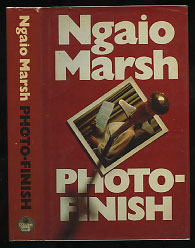
The plot device of the red warnings reminds me a great deal of two detective novels from the 1980s, Photo-Finish (1980) by Ngaio Marsh (threatened opera star again) and The Skull Beneath the Skin (1982) by P. D. James (threatened actress).

However Markham's narrative unfolds much more impressionistically and confusingly, as the scene shifts from Paris then to a night train then to a villa in Avignon.  The reader sometimes may wonder whether everything that is happening is really happening. Red Warning reads less like a classical detective novel and more like an Edgar Wallace mystery thriller, with heavy lashings of Georges Simenon and William Faulkner.

The basic plot of this 1980
Ngaio Marsh detective novel
resembles that of Red Warning--
but oh! what different places they go!
Yet when the explanation is offered at the end, one realizes there were clues embedded in the text.  I think I understood it all by then, though I am not completely sure.

I may have to read The Psychology of Thought, by American psychologist and college professor Harry Levi Hollingsworth (1880-1957), apparently a former teacher of Markham's at Columbia University.  This book gets quite a work-out from the author in the final pages of Red Warning.

Red Warning is quite a sophisticated book for the period--not an easy read, but an interesting one.  I am glad I read it, and I will read more works by this author--no matter the country in which they happen to be set!

Note: The tour of France will continue the upcoming week with reviews of works by Alice Campbell, Georges Simenon and Stanislas-Andre Steeman.  See you soon!--The Passing Tramp.


Tuesday, April 10, 2012

"Bosh!": The Marvelous Marginalia of Lieutenant-General Coote Synge-Hutchinson (1832-1902), Part 2


Note: For Part One of Bosh! see here.

In his personal copy of Great Porter Square: A Mystery (1885), Benjamin Farjeon's first sensation novel, Coote Synge-Hutchinson writes words in the margins of sixty-nine out of 372 pages, nearly a fifth of them.  Additionally, there are copious lines, question marks and squiggles.  If the marks are included, scarcely a page is left unscathed.

Coote Synge-Hutchinson found this novel
something less than sensational
Some modern readers have declared over the years that they find the sentimentality and plot contrivances of some Victorian sensation novels unbearable.

Coote Synge-Hutchinson (let's call him CSH from here on out), though a Victorian himself, in this respect appears to belong in the company of the scoffing moderns.

CSH initially contented himself with making question marks challenging the author on a number of points concerning simple logic or matters of politics.

In regard to the latter, CSH questioned, for example, aspersions cast by the author on the police.  When Farjeon writes that

It is a peculiarity of policemen in private clothes that they are always ready to suspect, and that in their eyes every poor-looking person with whose face they are not familiar is a disreputable character.

This earns a ? from CSH in the margin of page 35.

It is not until page fifty, however, that CSH apparently felt compelled to put words to paper to protest the course of the events in the tale.

As represented by Farjeon, the character Antony Cowlrick has been released by the court on the grounds of the prosecution's not being able to present any evidence against him on the charge of murder.

Cowlrick attempts to evade the mob outside the court and is pursued by it, its bloodlust having been stirred. After the chase has gone on a bit, Cowlrick's attorney, Mr. Goldberry, and the novel's heroic reporter character (called our Reporter) step up and defuse the situation.  "How," demands CSH

did Mr. Goldberry and the Reporter manage to be here considering that AC has been represented as running though several streets?

Once he started in this vein, CSH evidently found it hard to stop.  When Farjeon tells of a lady who "was young, and an orphan" and "whose relatives were far away in the country" so that "she was alone in London," CSH responds:

a curious position for a young lady to be in?

Much of Farjeon's novel is told in the form of ostensible newsppaer accounts from our Reporter.  Often CSH doubted the plausibility of these accounts, such as this one:

Amused, and, as he declared to her, charmed out of himself, our Reporter said, somewhat jocosely:
"Why, what would you have done if you had been born a man instead of a woman?"
"I am afraid," she said, in a half-whisper, and with her finger on her lips, as though enjoining him not to betray her, "I am afraid I should have been a dreadful rake."

To this CSH dryly declared:

curious conversation to put into a newspaper

Sometimes CSH's protests involve not logical points but philosophical or political ones. When Cowlrick tells Mr. Goldberry that he is not grateful to him for his legal service, because God would not have allowed an innocent man like himself to be convicted of the murder and God does not need the assistance of lawyers, CSH points outs, in a challenge to this piece of high-flown oratory:

Yet he [God] has ordered us to use human means.

When a character pronounces, with fine democratic idealism, that a certain woman is a "daughter of Eve, and therefore the equal of a queen," CSH is disgusted:

What utter rot: I suppose the author goes in for manhood suffrage!

When a character approvingly refers to the United States as "the wonderful country which one day is to rule the world," CSH patriotically is having none of that, vehemently scribbling:

Bah! Stuff! Nonsense!

Unlike Farjeon, CSH seems to hold the press in contempt.  When our Reporter assures Cowlrick that the press will keep covering his story, because newspaper readers are eager for details about anyone "connected with an atrocious crime," CSH disapprovingly queries:

Is not that pandering to a morbid sentiment?

When Farjeon writes "Such is the power of the newspaper.  To convey to remote distances, into village and city, to the firesides of the poor and rich, the records of ennobling deeds," CSH again is having none of it:

Papers, I should say, have been a far greater curse than a blessing.

Farjeon gives us Fanny, the plucky little match girl,
though Coote Synge-Hutchinson disputes
 the contention that more happiness
 is to be found among the poor than the rich
Our Reporter offers what the great anti-Victorian mystery writer John Dickson Carr no doubt would have called a pious hymn, to the effect that "more happiness is to be found among the poor than among the rich" (this in the section where the author introduces to us a sweet-natured street waif named Fanny, who is, I kid you not, a little match girl).  To this CSH scoffs:

Oh really!

After the first 100 pages, CSH was no longer able to restrain himself at what he saw as the novel's illogic and sentimentalism and began openly denouncing various characters as asolute idiots, often adding his seemingly favorite exclamations, "Bosh!" "Rot!" and "Stuff!"  

When CSH finds that the young orphan lady's bonds, her sole source of income, are forgeries and that her prospective banker, Mr. Holdfast, generously declares he will cover her loss, CSH is thunderstruck:

What an idiot he must have been!

When the young lady lightly confesses to Mr. Holdfast that the purse of money he gave her was snatched from her in the streets of London and that she spent her absolutely last coins buying cakes for two poor children, Mr. Holdfast is "almost overcome with delight...at her childish innocence, simplicity, and kindness."  Not CSH, who sneers:

Oh crikey, what an idiot.

When one character reflects that a young man's fondness for a young woman is nothing to worry about, because "He is but a boy," CSH counters:

What an idiot!

CSH frequently was unmoved and unpersuaded by the author's depiction of events.  When the little match-girl Fanny and her protector Becky happen in the streets of London to stumble into each other after some time has passed, CSH is not touched but disgusted:

How is it all these convenient things happen in novels?

In the early 20th century Carolyn Wells
declared that gravity clues were overdone
Coote Synge-Hutchinson would have agreed!
Similarly, when a woman drops a ring and earring at the crime scene and cannot find them (mystery writer and critic Carolyn Wells called these oh-so convenient droppings "gravity clues"), CSH declares:

Bosh.  Why should she not find them.  All these things so conveniently happen in novels.

It is the ingenuous character of Frederick Holdfast (son of Mr. Holdfast) who most gets CSH's goat, however.

Frederick Holdfast informs us that a male character set up a female character, a lady thrown on hard times, in a house in the suburbs, but that the relationship was completely platonic:

"[T]he intimacy between the two was perfectly innocent...Sydney treated and regarded Grace with such love and respect as he would have bestowed upon a beloved sister.  It was not as a sister he loved her, but there was no guilt in their association."

"To believe this of most men would have been difficult," concedes Frederick Holdfast, to which CSH responds knowingly:

I should say so, indeed.

When Frederick explains that Sydney was able to cajole London society into treating Grace respectfully, CSH demurs:

Utter bosh.  London society, however bad it may be, cannot be cajoled.

When Frederick finds the woman his father loves is a ruthless schemer, he holds his tongue, provoking CSH to comment:

What utter stuff.  He must have been a queer son never to have said anything to his father.

When Fredrick like an absolute ninny continues to allow himself to be bamboozled by this adventuress, on account of her womanly pleading, CSH writes disgustedly:

The author appears to have collected about the greatest lot of idiots I ever came across.

A few pages later he simply writes Bah!

When Frederick gets a condemnatory letter ostensibly from his father, CSH sensibly asks:

Was it in his father's handwriting?

Sure enough, it wasn't, but Frederick, like all the nice people in Farjeon's novel, naively steps into the bad people's snare.

"Oh indeed," reiterates a triumphant CSH, "does he not know, as a son, his father's handwriting?"

As perhaps is clear by now, I enjoyed the marginalia of Coote Synge-Hutchinson more than the novel itself.  For me his acerbic commentary made an excessively sentimental tale much more bearable.  But about these matters perhaps I am as cynical as the Lieutenant-General appears to have been.

Monday, April 9, 2012

"Bosh!": The Marvelous Marginalia of Lieutenant-General Coote Synge-Hutchinson (1832-1902)

First, prepare yourself for some Synge-Hutchinson genealogy!

Coote Synge-Hutchinson (1832-1902) was a son of Francis Synge-Hutchinson (1802-1833) and Lady Louisa Frances Synge-Hutchinson.  Coote Synge-Hutchinson's grandfather, Edward Synge-Hutchinson (1756-1846), was an Anglo-Irish baronet. The baronetcy was inherited in 1846 by Coote Synge-Hutchinson's slightly older brother, Edward Synge-Hutchinson (1830-1906).

Coote Synge-Hutchinson went into the British army, a common course for younger brothers not inheriting baronetcies.  This action put him on a path toward momentous events in India in the 1850s.


In his twenties as a Major in the Second Dragoon Guards Coote Synge-Hutchinson was awarded the Indian Mutiny Medal, with Lucknow clasp, for his service with the 2nd Dragoon Guards at the Siege of Lucknow during the Indian Rebellion of 1857 (located in northeastern India, Lucknow today is the capital city of the state of Uttar Pradesh).

detail from "The Relief of Lucknow, 1857," (1859)
by Thomas Jones Barker
see here for a interesting webpage
with this illustration and also that of an
Indian Mutiny Medal with Lucknow Clasp

Eventually Coote Synge-Hutchinson was promoted to the rank of Lieutenant General.  At the age of 56, long retired from bloody colonial contretemps, Coote Synge Hutchinson married Emily Charlotte Jecks, with whom two years later he produced a daughter, Haidee (1890-?). Haidee married and had a twin son and daughter, Patrick and Jean, in 1910.  Five years ago, in 2007, family members sold Coote Synge-Hutchinson's Indian Mutiny Medal, along with a ribbon bar awarded to his nephew Major Edward Douglas Brown, at auction for 2128 pounds.

In 1885, a few years before Coote Synge-Hutchinson achieved the state of matrimony, a contemporary, the prolific author Benjamin Leopold Farjeon (1838-1903), published Great Porter Square: A Mystery, one of his most popular books.  Farjeon himself called the novel "my first great success in sensational fiction."  

Coote Synge-Hutchinson's copy
of Great Porter Square
I am a great admirer of Farjeon's Devlin the Barber (1888) (see my review) and another, lesser-known work by him called The Nine of Hearts (1886), but Great Porter Square is one of those really long Victorian sensation novels--for me too rife with sententious and sentimental utterance--that tends to try my patience.  Farjeon himself reflected that he had no idea where the plot of Great Porter Square was going from day to day: "Each installment of that story ended with a sensation, and I never knew when I wrote it what the sensation was to lead to."  (for Farjeon's comments see Current Literature: A Magazine of Record and Review 26 (July-December 1899), p. 20)

In my view this perhaps is not the greatest recipe for higher artistic success in a murder mystery.

Apparently neither was it for Lieutenant-General Coote Synge-Hutchinson, as we shall most definitely see!

Benjamin Farjeon was described in The Author in 1891 as "below the medium height, with a jolly, round face and small side-whiskers."  Farjeon was a loving, open-hearted family man with a wife, daughter of the American actor Joseph Jefferson, and four delightful, precocious children: Harry, Joe (future Golden Age thriller writer, as readers of this blog will know--see here), Nelly (future children's author) and Bertie.  He also was, one surmises, though a staunch royalist somewhat politically liberal for the day (certainly he was much concerned with the plight of the poor).  All in all, no doubt a wonderful fellow, the best one could expect of a family man at the height of the Victorian age.

Benjamin Farjeon, author of Great Porter Square
Those side whiskers look rather large to me!
Was Coote Synge-Hutchinson more the choleric, conservative, intolerant and imperious ex-Indian army man, so familiar a fictional stereotype to generations of Agatha Christie readers ("Major Porter, late Indian army, rustled his newspaper and cleared his throat. Everyone avoided his eye, but it was no use....")?

I do hope to learn more about Coote Synge-Hutchinson someday; but in the meantime we must judge the man by his fascinating marginalia in his copy of Great Porter Square.  For this, please return for our second installment (coming soon!).

Friday, April 6, 2012

Sensational: Asta's Book (1993), by Barbara Vine

Murder, madness, misalliance, misidentity, missing persons--all these things are the stuff of the classic three-decker Victorian sensation novel so popular in the latter part of the nineteenth century (and currently enjoying a significant revival among fiction readers).

The best of Ruth Rendell's thirteen Barbara Vine novels (a fourteenth will be added this year) in my view all have the richness and depth of works by such great masters of Victorian sensation as Wilkie Collins and Mary Elizabeth Braddon.  And the sixth Barbara Vine novel, the 437-page Asta's Book (1993) (Anna's Book in the United States*), surely is one of the very best Vines--indeed, it is positively sensational! Asta's Book succeeds both as a fascinating, teasing mystery and a sophisticated, immensely moving character study.

Using the device of entries from a set of diaries in modern times turned into bestselling books by the diary writer's daughter, Rendell creates a wonderfully rich and complex mystery in Asta's Book.

The novel opens with entries from the 1905 diary of Asta Westerby, a young Danish wife and recent migrant to England ("When I went out this morning a woman asked me if there were polar bears in the streets of Copenhagen").  Asta has become disenchanted with her business-preoccupied, frequently absent husband, Rasmus, who she has come to believe married her mostly for her dowry ("I suppose I should be thankful Rasmus isn't a Mahometan, otherwise I'm sure he'd be finding another wife...to marry for 5,000 kroner").

Moreover, she is rather indifferent to her two young sons and contemptuous of her illiterate maideservant, Hansine.  Feeling alone and anxious (she is pregnant yet again, this time, she desperately hopes, with a daughter) Asta finds in her diary some solace--and also an outlet for creative art.

In Asta's Book Ruth Rendell combines Asta's story with the modern-day tale of her granddaughter, Ann, who now has charge of the ongoing publication of the diaries, which are worldwide bestsellers.

Ann functions in the novel as a sort of literary investigator attempting to untangle the web of mysteries enmeshing her family over the decades (appropriately she is a professional researcher), although there is a strand of subplot involving her television producer friend Cary that lends a delicious bit of ironic humor to the book.

The third key character is Asta's daughter (the one born back in 1905) and Ann's aunt, Swanhild (Swanny), of great interest in her own right.

In addition to Asta's diary entries and Ann's narrative, there is also an additional section of the book dealing with a famous murder trial.  More about this cannot be said, for so much of the great pleasure of Asta's Book is the page-turning thrill of simply having to find out just what happens (or happened) next.  One has to be careful not to say too much.  Such is the skillful construction of this novel that it functions brilliantly both as a work of suspense and a fair play mystery (the succession of revelations at the end all are genuinely clued).

read those pages closely,
very closely....
Additionally, Asta's Book offers fine character studies, particularly of the central character, Asta Westerby. Not necessarily easy to like, Asta nevertheless is intensely fascinating, from beginning to end.

Like A Dark-Adapted Eye, the Vine that is my second favorite, there is much of interest in Asta's Book about gender and class relations in other times (in Eye, especially during the 1950s; in Book, during the Edwardian era).

Asta's observations about domestic life can be bleak: "Hope is a horrible thing.  I don't know why these church people call it a virtue, it is horrible because it's so often disappointed."  Asta's Book may be a domestic novel, but it is certainly not cozy.

Readers who like the sharp tang of reality in their mysteries get that, as well as a cunningly constructed series of puzzles, in Asta's Book.

American paperback edition
*The reason the title was changed in the United States from Asta's Book to Anna's Book is that Vine's American publisher was concerned the name "Asta" would remind readers of the dog from the Thin Man films!  Did most Vine readers really recall these films in 1993 (let alone today)?

Let us hope a newer edition--of which there certainly should be--will restore the original title (speaking for myself I am over forty and a classic mystery book and film fan and I never once thought of that dog when reading Rendell's masterpiece).

The next installment of The Passing Tramp will explore a genuine Victorian sensation novel, Benjamin Farjeon's Great Porter Square.  

Like Asta's Book the piece will be a double tale, telling about both the book and its owner, who in the book's pages made the most extensive marginal notes that I have ever seen in a novel.  Here is an opportunity to learn not only about a Victorian mystery novel but also a Victorian mystery novel reader!  See you soon!

this dog is not in the book--really!

Thursday, April 5, 2012

Victorian Tableaux Vivants #3, The Wench Is Dead (1989), by Colin Dexter

"The curse is come upon me...."

In the quarter-century from 1975 and 1999, Colin Dexter published thirteen detective novels detailing the adventures of Inspector Morse and Sergeant Lewis.  Most of these novels were filmed as part of the classic British police detective series Inspector Morse, which aired between 1987 and 2000.  The Wench Is Dead was published in 1989 and filmed in 1998, as the penultimate Morse episode in the series.

In contrast with Julian Symons' The Blackheath Poisonings and Peter Lovesey's Waxwork (see previously), The Wench is Dead does not take place in the Victorian era but rather in the present day, 1989.  Morse, in hospital for treatment of a bleeding ulcer, becomes engrossed in a historical mystery: the 1859 murder of Joanna Franks, found floating in the Oxford Canal.  Two men were hanged for the woman's murder and one man transported--all three boatman on the Barbara Bray, on which Joanna Franks had been a passenger. A restless Morse decides the case was mishandled and he investigates it from his hospital bed, with the aid of Sergeant Lewis and Christine Greenaway, a pretty, young librarian from the Bodleian).

The Wench Is Dead surely was inspired by the classic Josephine Tey novel The Daughter of Time (1951), in which Tey's Inspector Grant, in hospital, investigates the famous historical mystery of who murdered the Princes in the Tower.  Like Tey's novel, Dexter's The Wench is Dead is based on a real life mystery.  In the case of the latter novel it is the 1839 murder of Christina Collins, allegedly by canal boatmen when she was travelling on the Trent and Mersey Canal.

Tey's novel explores the more fascinating historical drama, yet Colin Dexter has turned his historical mystery into one of his typically teasing classical murder puzzles, mechanically ingenious in the best style of Dorothy L. Sayers or Freeman Wills Crofts.

Oxford Canal in The Wench is Dead 
The dust jacket blurb for the English edition of The Wench is Dead accurately describes the novel as containing that "which has made [Colin Dexter] and Morse so popular: a superbly crafted puzzle solved by a formidable intellect." Readers who relish a good crime puzzle will enjoy competing with Morse in the attempt to solve it.

One of the delightful things about Wench is the inclusion within the text of so many visualized puzzle pieces.  For example, there's the frontis of the Oxford canal system, scene of the Joanna Franks' fatal boat trip (left).

This reminded me of such splendid Golden Age mystery endpaper maps as this one found in Freeman Wills Crofts' Death on the Way (1932) (below).

Railroad in Death on the Way (1932)

Delightfully, Dexter provides additional visual material, in the way of clues aiding Morse in his deductions: a page of medical testimony; a table of insurance premiums; two tombstones; a marked wall panel.  Great stuff all!  While many modern crime writers tend to loftily disdain this sort of thing as mere mysterymongering showmanship, many of us love it still, not less for its rarity today (Minette Walters is another modern writer who blessedly  indulges us with these sorts of displays).

Trent and Mersey Canal, locale of the actual death
As in many puzzle-focused Golden Age mysteries, character interest in Wench is less pronounced than puzzle interest. Dexter still has young, attractive women falling for the overweight, out-of-shape, ulcerous, over- imbibing, frequently crabby ("Get on with it, Lewis!"), fifty-something Morse. He's just that much more interesting than the men anywhere close to their own age, don't you know.

Time also is spent by the author detailing Morse's alternative bedtime reading, a pornographic item called The Blue Ticket.  In Wench expect the usual references to women's breasts, as well as their knickers (though look closely: the knickers are not mere titillation!).

This aspect of the Morse books is toned down in the television series.  In Wench, the women interested in Morse--a musical academic girlfriend and an American college professor and crime expert--are new characters, within a decade of Morse's age.  Morse spends considerably less fantasy time with the topless, nubile women of blue fiction.  And of course Morse is the late, great John Thaw, whose brilliant performances made Inspector Morse among the most indelible policemen characters in television history

John Thaw as Morse: a classic, like his car

There are some good snippets of dialogue in the book, many of which were wisely picked up for the film adaptation.  The film also does a fine job of visualizing those fascinating old canals, as well as a crucial late trip to Ireland, made after Morse is released from the hospital.

You certainly won't be the loser if you read the book and watch the film.

Colin Dexter

Sunday, April 1, 2012

Victorian Tableaux Vivants #2: Waxwork (1978), by Peter Lovesey

Long before the "period mystery" had become a common feature of the genre, distinguished English crime writer Peter Lovesey gave us the Sergeant Cribb series of Victorian detective novels.  Lovesey published eight of these tales between 1970 and 1978.  Not only were they well-received by critics and lay readers alike, they inspired a popular British television detective series, Cribb.  Waxwork, the eighth and last of these books, ended the series on a high note in 1978.  Since then Peter Lovesey has given us the short-lived but much-loved (certainly by this reader) Bertie, Prince of Wales series and the current, long-running, award-winning Peter Diamond series, as well as such praised standalones as The False Inspector Dew, Rough Cider, On the Edge and The Reaper.

Florence Maybrick
accused Victorian poisoner

In a case of coincidence, Lovesey and Julian Symons in 1978 both published notable Victorian mysteries that center around lovely, enigmatic blondes suspected of poisoning murders: respectively Waxwork and The Blackheath Poisonings (see my recent review of The Blackheath Poisonings).

hardcover American edition of
Waxwork (1978)
Both novels are still in print today, Waxwork in an attractive edition from Soho Press.  Since its publication in 1978 Waxwork has been considered one of the best of the Lovesey Sergeant Cribb titles.

Generally, I think, the Cribb mysteries are seen as lighter in tone: charming rather than dark and somber like Symons' The Blackheath Poisonings. Yet Waxwork strikes me as rather dark and somber too. Ruth Rendell praised the novel for its  depiction of what feels like "an account of a real-life crime." "Nothing strikes a false note," she declared. "Nothing seems contrived."  The late novelist Sarah Gainham asserted that in Waxwork a "feeling of authentic horror is produced."  I agree with both assessments. Waxwork is a gripping, fascinating tale.

In short order in Waxwork the beautiful Marian Cromer (see above left) is arrested and confesses to the crime of poisoning (with potassium cyanide) the assistant of the fashionable society photographer to whom she is married.  Her victim, she explains, had been blackmailing her, on account of his knowledge of certain risque photos she had allowed to be taken of herself several years earlier.  Since the crime was coldly premeditated, Marian has been sentenced to death by hanging.

Soho edition (2010)
As Marian's day of execution nears, new evidence arises leading the police to question whether Marian actually had means of access to the locked poison cabinet from which the cyanide was obtained.  Cribb is put on the case to discover how Marian Cromer got to the keys.  But Cribb comes to suspect that Marian Cromer simply could not have gotten to the keys, and that someone else committed the crime....

Despite the small circle of suspects in his novel, Peter Lovesey manages to present a quite interesting crime problem.  He also builds up a considerable level of suspense (of course the "death row convict" plot is not original to Lovesey, going back at least to Philip Macdonald's The Noose, 1930; but Lovesey does an exemplary job all round with it).

As with The Blackheath Poisonings, I would like to say more about a number of the novel's interesting aspects, but I am constrained by the reviewer's sacred obligation to avoid the offense of spoiling.  Hence I will confine myself to a few comments about Lovesey's handling of the matter of class in the Victorian age.

Class is omnipresent in Waxwork, whether in Cribb's relations with his own smug superiors or Marian Cromer's relations with her jailers (Cromer's jail scenes are grim; Lovesey shows how Newgate prison was one place where members of the lower class could turn the tables on their "betters").  In other books I have read in this series, the class satire was amusing; yet here it more feels depressing.  Eight years into the series Cribb still has not attained  a promotion from sergeant to inspector; one begins to despair with Cribb of this ever actually happening.

Newgate cell
There also is, I should add, a subplot concerning the Newgate hangman and Tussaud's Wax Museum (hence the title), which adds its own macabre note.

Is Waxwork the best of Lovesey's Cribb tales?  It may well be.  It certainly feels the closest in spirit to The Blackheath Poisonings, with its uncozy atmosphere of grim anxiety.

I retain a great affection for my first Cribb (and first Lovesey), the brilliantly titled Wobble to Death, with its fantastically original setting of a "wobble" (read the book to find out what that is!); but all the Cribbs make eminently good reading and all, fortunately, are back in print, courtesy of Soho Press.  Don't miss them.

Peter Lovesey