Friday, July 19, 2019

The World Is too Much with Us: Isms and Phobias in Golden Age Crime Fiction

WARNING: There is offensive racist language in the quoted passages from a vintage crime novel immediately below.  They are quoted without censorship, as they would be in one of my books, in order to give people a clear picture of the perpetually troubling matter discussed in the body of the blog post concerning what I terms "isms and phobias" in Golden Age detective fiction and thrillers.

She found African savagery pitted against Oriental cruelty!
--from the blurb for The Street of the Leopard (1936), by Nigel Morland

I.
The Flying Squad car screamed under the railway bridge and roared up the hill to its destination at the unlawful speed it had maintained all the way from Scotland Yard.

Inside the rocking car, Mrs. Pym, her face black as thunder, sat....

She uttered an entreaty which betrayed the depth of her feelings: "God save us all!  It's positively unholy!  The 'Moon Murders' were enough to drive us insane, but...phew! Niggers and Japs...."

II.
"I think I saw something move out there [said Mrs. Pym]. Do you think the niggers are trying  a flanking movement?

Loddon's natural good spirits were back again, and he grinned.

"Who cares?  If the Japs don't get us, the niggers will."


--from The Street of the Leopard 


Any fan of Golden Age mystery will be used to the criticism that the genre so often has received over the years: that the books are appallingly racist, classist, sexist and homo- and xenophobic, making them hopelessly dated and offensive to a modern audience.  The question of whether modern audiences really are so uniformly enlightened so as not to share any of these sentiments I will leave to the political blogs, though I'll opine that recent world history suggests otherwise. 

In any event, however, I think Golden Age fans get a little tired of their favorite reading material always getting lambasted in this way.  The books are a product of their times, they will counter, we shouldn't hold the authors accountable for the egregious claptrap they sometimes put in their books.  Everybody did it!  They didn't know any better, the poor dears, and expecting anything better from them is unfairly holding them up to our allegedly more elevated modern standards.  Yet in actuality everyone didn't do it back then, or not nearly to the same degree.

I agree that it seems unfair always to single out Golden Age classic mystery writers for these matters.  Often the people doing the singling out are people who don't like classic mystery in the first place.  (What a happy coincidence!)  It's always harder to pluck the mote from one's own eye. 

People will complain, for example, about antisemitism in Agatha Christie or Dorothy L. Sayers, while passing over in silence the nasty homophobia in Raymond Chandler's The Big Sleep (1939) or the needless cruel derision of blacks and Native Americans in Farewell, My Lovely (1940) because, don't you know, Chandler was a "great writer" and apparently thereby deserves to get a complete pass on this sort of thing.  But of course the isms and phobias, if you will, are common throughout hard-boiled crime fiction of the period.  It's just that historically hard-boiled crime fiction has had more influential apologists.

So it's not just one type of mystery fiction where the isms and phobias are an issue.  Yes, on the whole we find more of them in "thrillers" like Nigel Morland's than we do in pure detective fiction.  (For a blogger's encounter with Nigel Morland, see Brad Friedman's review of Death When She Wakes, 1951 ).  However, it even pops up in the pure detective fiction. 

People will be familiar with passages from the aforementioned Christie and Sayers, for example, but perhaps the most appalling instance of antisemitism in GA detective fiction I'm aware of comes from the pages of The Silk Stocking Murders (1928), by Anthony Berkeley Cox [ABC], one of the most highly regarded British crime writers from the Golden Age, celebrated as the author, as Anthony Berkeley, of The Poisoned Chocolates Case (1929) and, as Francis Iles, the influential crime novels Malice Aforethought (1931) and Before the Fact (1932).

ABC thought of himself as an incisive psychological novelist (and he never tired of telling people he was), but the psychological insights he offers in the Berkeley books through the utterances of his surrogate, amateur detective Roger Sheringham, can be embarrassingly puerile, when not actually revolting. Exhibit A: The Silk Stocking Murders.

there's some pretty cross-eyed reasoning in this novel

Initially this tale promises interest as a crime story, with its four strangling murders of women, but its narrative is plodding compared to that of the somewhat similar The ABC Murders (telling title, what?) by Agatha Christie, and its resolution is just plain silly in my estimation.  But the worst, dear readers, is yet to come.

One of the lead characters in The Silk Stocking Murders is a Jewish financier by the name of Pleydell.  ABC actually takes pains to make clear that Pleydell is not one of those objectionable Jewish financiers, don't you know--the sort that with their seemingly inevitable big noses, flashy rings and lisps riddle the pages of Golden Age mystery like they do the pages of Adolf Hitler's incendiary political speeches.  ("Today I will once more be a prophet," thundered the German dictator to the Reichstag in 1941, "If the international Jewish financiers in and outside of Europe should succeed in plunging nations once more into a world war, then the result will not be the bolshevization of the earth, but the annihilation of the Jewish race in Europe!")

However, ABC's explanation of why Pleydell is not so objectionable, despite being a Jew, is itself problematic, though evidently the author thought he was being generously open-minded:

Now that Roger could observe [Pleydell] more nearly than in the court, he saw that the Jewish blood in him not just a strain, but filled his veins.  Pleydell was evidently a pure Jew, tall, handsome and dignified as the Jews of unmixed race often are.

Our suspicion that there's something off here with this praise is later confirmed in this bloodcurdling conversation between Roger Sheringham and the suggestively named Anne Manners, the sympathetic (i.e., non-modern) female character in the tale, in which Pleydell is further anatomized over a British tea:

"I've never met a Jew I liked so much before," Anne remarked.

"The real pure-blooded Jew, like Pleydell," Roger told her, "is one of the best fellows in the world.  It's the hybrid Jew, the Russian, Polish and German variety, that's let the race down so badly."

"And yet he seems as reserved and unimpassioned as an Englishman," Anne mused.  "I should have thought that the pure-blooded Jew would have retained his Oriental emotionalism almost unimpaired."

Roger could have kissed her for the slightly pedantic way she spoke, which, after a surfeit of hostesses and modernly slangy young women, he found altogether charming.


Readers today may be forgiven for finding "slightly pedantic" Anne slightly less charming.  What's so creepy about this teatime duologue between these two genteel racists is the way it's presented as a sophisticated, objective, intellectual discussion.  It's a reminder that this was the great era of "scientific" racism, when the "science" of eugenics flourished, with all the tragedies that it entailed.  The problem isn't the pureblooded Jews, you see!  It's only those Russian, Polish and German ones who have "let the race down so badly."  (What others less polite than Roger and Anne referred to as race mongrels.)  Every last one of them apparently.

In 1933, five years after the publication of The Silk Stocking Murders and the year Hitler took full power in Germany, there were, not so incidentally, 9.5 million Jews living in Europe (including the European portion of the USSR).  Over six million of these--nearly two-thirds of Europe's Jews--lived in Russia, Poland and Germany.  It's about the same number of Jews Hitler and his minions succeeded in killing.  It gives a sort of ghastly significance to Roger and Anne's discussion, one which, to be fair to ABC, I'm sure the author never intended.  But it's hard to look past it today.

see Holocaust Encyclopedia United States Holocaust Museum

To HarperCollins' credit, I believe this passage was not whitewashed but rather left in its recent reprint of the novel, which probably is the main reason it has an average rating of only three stars on Amazon.co.uk.  Writes one reviewer, "I found the antisemitism so extensive here as to be sickening...."  I agree, though it's certainly instructive about social attitudes of the time, and thereby has great value for cultural historians.

I's easy to pick on Nigel Morland or Sydney Horler or Sapper, to name a few authors of the sillier thrillers, which are often deemed the tripe of the crime fiction genre (and they deserve criticism, to be sure); yet the works of purportedly "sophisticated" writers like ABC--the filet steaks and truffles if you will--often get a a pass, like those of Chandler.

But how sophisticated was ABC, really?  Let's take a look at another of his books, The Wychford Poisoning Case (1926), also reprinted by HarperCollins.  Like The Silk Stocking Murders, Wychford also averages three stars on Amazon.co.uk.  (Were these really the Berkeley titles that needed to be reprinted?  Why, for heaven's sake?  He wrote much better ones.) 

In Wychford ABC, a noted misogynist, takes on relations between the sexes, managing in the process to sound more like Bobbie Riggs than Sigmund Freud.  The novel is subtitled, rather grandiosely, "An Essay in Criminology."  As in a lot of essays (not this one I hope) there's a lot of pontificating, much of coming from our old friend Roger Sheringham.  Many of his expressed sentiments are positively loopy.  In particular Sheringham's thoughts on women suggest that, when it comes to psychiatry, Roger would have made a much better patient than practitioner.

In truth Wychford mainly seems to be about Roger's (and the author's) extreme antipathy toward the modern woman of the Roaring Twenties (an antipathy glimpsed as well in The Silk Stocking Murders), as embodied in the tale by a flippant flapper named, naturally enough, Sheila.  "I'm simply reveling in all this!" sheila burbles at one point.  "It's fun being a detective."  Sheila, take a bow!

At various points Roger takes time to recommend spanking as the way the solve the problem of forward modern women like Sheila (and this recommendation is resolutely adopted in one nauseating passage) and to fume over these shameless females being so brazen as to don "male" garments like pajamas.  How dare they!  But Roger absolutely grabs the chauvinism cake with both hands with his jaw-droppingly misogynistic soliloquy on page 124 of my edition:

Sheila, take a bow!
And prepare for a spanking.
"Nearly all women...are idiots....charming idiots, delightful idiots, adorable idiots, if you like, but always idiots, and most damnable idiots as well; most women are potential devils, you know.  they live entirely by their emotions, both in thought and deed, they are fundamentally incapable of reason and their one idea in life is to appear attractive to men."

It may not surprise you to find that ABC in his life had difficult relationships with women.  Though to be fair a lot of men came to dislike him as well.  ABC, who grew increasingly querulous and disputations over the years, became a terror to both sexes in the Detection Club.

Now I know that some of you will say Roger Sheringham often is made to look a fool in the books, and that, I'll admit, is true.  I think there was a part of ABC that was aware to an extent of his own personal flaws and who satirized those flaws in his books by making fun of Roger.  But it's also clear that ABC could behave like a real ass, just like Roger, and, it appears, in a similar way.

No doubt Anthony Berkeley's crime fiction oeuvre has more worth than that of the prolific but not enthralling Nigel Morland, but a lot of the sentiments you find in ABC's works frankly are no more sophisticated than those in Morland's.  There's nothing really sophisticated about the isms and phobias, no matter how much people may have tried to dress it up in finer attire.  You can put lipstick on a pig, but it's still a pig.

Nigel Morland, incidentally, once was considered for membership in the Detection Club.  What happened?  Check in with the next post to find out if you don't know.  There will be more about our dear Mr. Morland.

Wednesday, July 10, 2019

A Fondness for French Film: An Interview with Writer Brendan Foley about "Inspector French"--the New Freeman Wills Crofts Television Detective Series

American first ed.--which case truly was
Inspector French's Greatest Case? 
Last week at The Passing Tramp I discussed the exciting announcement of the "Inspector French" detective series, based on the classic Golden Age detective novels of Anglo-Irish railway engineer turned world-renowned mystery writer Freeman Wills Crofts (1879-1957), which is now in development with writer Brendan Foley (Cold Courage) and producer Free@Last. 

Brendan's writing has included features journalism, TV drama, books including Random House bestseller Under the Wire and feature films with Derek Jacobi and Vanessa Redgrave. He grew up in turbulent times in Belfast, Northern Ireland, a happenstance which eventually drew him to the mystery writing of the Anglo-Irish Freeman Wills Crofts.

Although he was born in Dublin, Crofts lived most of his life in Northern Ireland, up to his retirement from the engineering profession in 1929, when he moved to the English village of Blackheath near Guildford, Surrey and devoted himself to church, woodworking and the continued construction of his highly intricate and lucrative crime fiction. 

For around thirty years, from 1920 to 1950, Crofts was one of the most popular and critically acclaimed true detective novelists in the world, and even after his popularity waned in the post-WW2 years his name survived as the greatest representative of the meticulous school of so-called "pure puzzle" detective fiction (dubbed "Humdrum" by once-influential detractor Julian Symons). 

In 1920 Crofts's seminal debut crime novel The Cask helped launch, along with Agatha Christie's The Mysterious Affair at Styles, the celebrated Golden Age of detective fiction, the hundredth anniversary of which arrives next year. 

Brendan Foley
(International Emmy Juror, Shanghai)
How appropriate it is, then, that the revival of Golden Age detective fiction which we have seen in the last few years has now encompassed an in-development series about the investigative exploits of Crofts's famous series detective, Inspector Joseph French, who debuted in 1924.  Once French was as well-known as such sleuthing stalwarts as Hercule Poirot, Lord Peter Wimsey and Phillip Marlowe.

But enough of the fanfare.  Let's see, if I have piqued your interest, what Brendan has to say about the series.  I talked with Brendan, who was in Los Angeles, over several days last week, in an interview which culminated on July 4, the day of the California earthquake.  But don't worry, Brendan reported that, "like Bond's martini, we were shaken but not stirred."  Like Inspector French, Brendan is not easily put off the track.

Now to the interview!

Derek Jacobi with Brendan Foley during filming of The Riddle

Brendan, the news of an "Inspector French" TV series is truly thrilling to me.  How did you come to be interested in the detective fiction of Freeman Wills Crofts?

Originally Stephen Wright, then at BBC Northern Ireland, was looking for crime material with a local angle.  I had written crime thriller films, including The Riddle with Derek Jacobi and Vanessa Redgrave, and written books myself but never done TV crime.

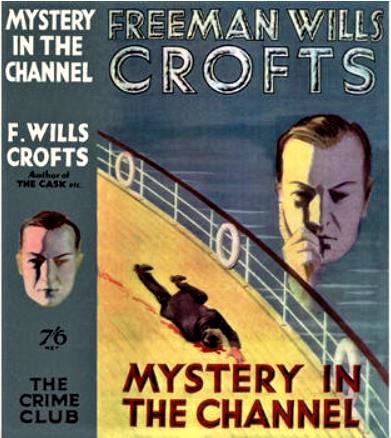
the first British dust jacket
conception of Freeman Wills Crofts's
Inspector French on his
"greatest case"--note the
similarities to the American edition
So I researched crime writers in Northern Ireland and stumbled across Freeman Wills Crofts, a Belfast Railway engineer who started scribbling when he was laid low by flu.  His very first book, The Cask, hit the jackpot and he went on to write about one book a year for the next thirty years including many bestsellers.  Yet neither I nor anyone I knew had ever heard of him.

I unearthed one or two long out of print books with splendid 1920s covers and was astonished by how good the plotting was.  Crofts wasn't overly concerned with character development, but for a screenwriter adapting something from book to TV for a modern audience, that was perfect.  I get to evolve the characters in a way that appeals to a present-day audience while keeping the complex plots and red herrings that make his work so enjoyable. But before that I had to find and secure the TV rights.

How did that process work?  After World War Two Crofts gradually had gone from a world-renowned name among classic mystery fans, up there with Agatha Christie and Ellery Queen, to someone mostly forgotten outside of hardcore vintage mystery collectors, as I found when researching Crofts and other writers for my 2012 book on so-called "Humdrum," or pure puzzle, mystery writers from the Golden Age of detective fiction.  Although this situation has altered drastically in the last few years, to be sure, with Crofts being reprinted by Harper Collins and the British Library.

This Joseph French, appearing on the cover
of Crofts's second French detective novel,
The Cheyne Mystery (1926), matches
the original (note the hand on chin gesture
as he surveys another crime scene).
It was a long and winding road.  Actually, Curt, the process led me to that book of yours, Masters of the Humdrum Mystery. 

I was previously a journalist, so I enjoyed tracking the rights down to where they were lying in state with the Society of Authors in London.  Since then I've optioned and re-optioned them as I have had faith in the stories. 

As you say, in the last few years the whole field of Golden Age detective fiction has boomed.  And there is so much good material out there!  The world is crying out for more storytelling, not just retreads of the same half dozen Agatha Christie stories, great though they are.

After all the searching I found myself sitting next to a stack of intricately-plotted crime books by a locally and internationally relevant, bestselling long-lost author.  So I feel very lucky--and thanks to you for leaving something of a "treasure map" with your book.

I'm very pleased that the book proved useful to you.  When you say locally and internationally, do you mean the locations?  Inspector French sure got around!

Locations and audience.  TV series are an expensive undertaking.  They need local specificity with international appeal to a wide audience.  While most of the original stories are set in Ireland, Scotland, England, Wales, and France, we decided to anchor the series in poor old Inspector French being banished to post-partition Northern Ireland where he becomes a big fish in a small pond.  At first he itches to get back to Scotland Yard, but he gradually sees that he can run his little empire with very little interference, while introducing all sorts of new techniques.

An older French appears on Crofts's third
French mystery, The Starvel Tragedy (1927)
Unlike standalone books, a series needs an arc and some continuity.  We will probably set individual episodes all over the UK and Ireland, maybe with some forays into Europe an in the novels.  But we well have a home base in northern Ireland.

We had great support from Northern Ireland Screen's Andrew Reid and Richard Williams.  NI Screen has really transformed the local media landscape into a great production hub of skilled crews and great locations, including The Fall, and most noticeably by backing Game of Thrones, 85% of which was made locally. 

More recently I teamed with Barry Ryan and David Walton, two great London-based producers behind the success of Emmy-nominated "Agatha Raisin."  They have a great feel for Golden Age crime tailored to a modern audience.  That will allow me to focus on the creative side, particularly making Inspector French a compelling and conflicted character that a contemporary audience really wants to get to know, beyond solving an interesting puzzle in each episode.

Thinking up another perfect murder: Freeman Wills Crofts (1879-1957)
He strikes a pensive pose like Inspector French.

Freeman Wills Crofts was considered the "Alibi King" and as you note one of the great masters of plotting during the between-the-wars Golden Age of detective fiction, praised by Agatha Christie and Raymond Chandler and Cecil Day Lewis and T. S. Eliot among others.  So it's wonderful indeed to hear that you plan to do justice to the Master's fiendish plots while fleshing out the people and enhancing character development to make for a dramatically compelling series.

Down these quaint streets a man must go:
Inspector French solves a village mystery in
The Affair at Little Wokeham (1943)
I was struck by your comment in the Deadline article that "Inspector French" would be "as if Peaky Blinders invaded Downtown Abbey."  Well, that is an image!  And intriguing.

Golden Age British mystery has been characterized by some detractors simply as so-called "cozy" mystery, all tea and twittering if you will, but Crofts as your publicity material notes has been credited with fathering the police procedural and Inspector French, one of the archetypal Golden Age detectives, was a workaday cop with none of the eccentricities of an Hercule Poirot or Lord Peter Wimsey.  How do the mysteries of Crofts have modern elements associated with today's crime fiction, which you plan to draw out in the series?

Big question!  I think the starting point is that as a writer you have to love and respect the genre--or at least the best part of the genre.  No amount of sniffing, sneering or hipster irony will get past an audience who love good mysteries.  Freeman Wills Crofts was a very down to earth man, even at the height of his fame.  He kept his day job as a senior engineer on the burgeoning local railway long after most authors would have given it up.  My Dad was an engineer in Belfast, a skilled working man, and there is a practicality and pride in that world which seeps into Crofts's writing. 

The most obvious connection can be seen by the great poster of the railway viaduct--a classic of its time.  I had decided to use it as part of my original presentation to the BBC as a killer "travel poster" of the industrial optimism of the age.  Then I found out that the designer of the magnificent railway viaduct was also the author of the books, working his "day job." 

So the meticulous interconnected arches of his plots and twists are maybe not that different from the span of his viaduct with a steam train thundering into the future.

That's where Crofts gets off the bus that leads to twee tea and chattering.  That world does exist in his books, but the old squireocracy is often overshadowed by industrialists--some noble, some greedy, some desperate, drowning in gambling debts. 

French solves a grim case of serial killings
of young women in
The Box Office Murders (1929),
 one of his most sinister cases
Inspector French himself is a product of the industrial age.  He believes in deploying new technology and techniques to outwit the villains.  He knows his way around a railway timetable when he wants to bust an alibi.  Above all he hates intuition and mystical hunches. 

Even the word procedural conjures up the industrial processes that were transforming the world just as the industrialization of warfare had obliterated much of the old order a few years earlier.

With French, Wills Crofts, even though he was not that concerned with characterization, gave us the bones of an amazing character: the first modern professional detective. 

I like the fact that French is working methodically and procedurally to get his man or woman.  He grinds on despite all obstacles, with flashes of inspiration as well as stubborn logic and efficiency.  He doesn't have much time for dilettante amateur sleuths!

Well, it doesn't quite sound entirely like Miss Marple nibbling finger sandwiches in the vicarage garden, but that's something I argue in Masters of the Humdrum Mystery: that Golden Age detective fiction is not simply country houses and quaint villages, caught in a genteel Edwardian age, like a fly in amber.

Inspector French travels to
Northern Ireland to investigate
the case of a missing magnate in
Sir John Magill's Last Journey (1930),
another of his greatest cases, which
will be the premier episode of
"Inspector French"
We have the series opening in post-partition Ireland, not just as Crofts's own formative world, but one where new borders, industry, old traditions and vast wealth all jostled for a place in the future.  Everything was changing.  Sexual politics, the place of women in society, ever faster, sleeker modes of transport.  Yet grinding poverty, teeming factories and gambling cads still fill this world like details in a Hogarth painting.

In short I have honored the plots, the era and the genre, but re-imagined the characters so that they are true to the time but also hopefully resonate with a very modern audience who love a good mystery and an interesting cast of evolving characters.  I think Joseph French, as a modernist man who uses logic and science to tackle violence and greed, might approve.

I think so, Brendan!  That's fascinating too about the railway viaduct.  I know there's one Crofts's mystery with these meticulous end paper maps of the railway lines that play a prominent role in puzzle.  Everyone knows Christie's Murder on the Orient Express, but trains certainly speed through Crofts' mysteries too.  Along with other forms of modern transportation: planes, trains and automobiles you might say.  Also boats.  No hansom cabs and dog-carts as I recollect--leave them to Conan Doyle!

poster for railway viaduct engineered by Crofts

I love these old transport posters.  Mechanized travel was very important to Crofts--it is a world of sleek racing cars and competing nationalities in races like the Mille Miglia and a huge now-forgotten event, the Ards TT in Northern Ireland, which attracted glamorous entries from all over the world.

And of course Crofts lived and breathed steam trains that crisscross his stories, from deadly sleeper cars to dining carriages and complex plots involving getting in or our of trains unseen.  He also loved ships, from elegant liners and floating gambling palaces to small yachts and fishing vessels.  All part of the world we will be recreating.

Crofts's detailed end paper map in his railway mystery Death on the Way (1932)

I take it that Sir John Magill's Last Journey (1930), one of Crofts's most highly-regarded mysteries and one I praise in my book on him, must have struck you as the ideal starting point for the series, because it takes French to Northern Ireland.  Apparently French, about whose back story we never learn that much in the books, will have some connection in the past to Ulster?  I'm intrigued!  What can you tell us about that?

I can't say that much about the inspector's TV back story at this stage.  The original inspector had a rather static character and modern series characters have to grow and evolve.  While preserving French's core traits of doggedness and decency, with a good helping of confidence, the TV character will have room to grow and evolve.  Some dark events in his past are constantly threatening to challenge his hard-won image as the perfect sleuth.  It gives the character an honesty and three-dimensionality that is really what modern audiences demand.

I understand.  I agree Crofts left his characters room for development.  Over the years he even forgot whether he had given French any children--the inspector had a son killed in the Great War in fact--though there is French's wife Emily, or Em for short, who appears in a few of the novels as a "motherly body" who constantly knits and occasionally offers her husband her intuitions, or "notions," about his cases.  She's a highly traditional, domestic woman.

Sudden Death (1932)
one of Crofts's domestic cases
That's another important evolution for a modern audience.  The female characters will be as diverse as the men, sharing all their noble traits and human failings, while being true to the time.  Most of the recurring characters spring from Crofts's stories, but some grow and flourish across a series.  Women range from industrialists to femmes fatales, cops from heroic to crooked, from working class to middle class to aristocracy, all with their own agendas and motivations rather than ciphers merely there for plot advancement. 

For a modern TV audience, character development and getting inside heads and human motives is as important as the question of whether it was Colonel Mustard in the conservatory with the candlestick.

Um, I think it was Professor Plum in the study with the pipe cleaner!  Is that a murder weapon in the English version?  Seriously, though, I hear you.

When I was writing my book one thing which did strike me very positively about Crofts' writing was the sense of moral fervor behind it.

Willful and Premeditated, the American
edition of The 12.30 from Croydon (1934)
This inverted mystery was one of
Crofts's most celebrated crime novels.
Crofts was writing at a time of massive economic depression and the rise of monstrous totalitarian regimes in Europe, a time when people were feeling, with some justification, like the social and moral framework of the world was collapsing all around them. 

I detected a change over time in Crofts's books, where he starts really looking at issues of moral corruption among the rich and powerful--in the business world, for example, with which he as a railroad man was very familiar. To me this lent a modern and relevant feel to his books and it's exciting to think you will be capturing that.


Yes, Crofts and his creation Inspector French share a very strong sense of justice.  That core character will hopefully shine through in the TV version as well.  The elements that will be different will have more to do with how the character evolves and changes, from backstory to shifts in tone from the Roaring Twenties to the Hungry Thirties as storm clouds gather over Europe.  It gives us great scope for evolution.

I was struck reading Crofts how there's some nasty stuff spilling out of the woodsheds in his books.  Not of Peaky Blinders proportions, to be sure, but still pretty visceral stuff for the Golden Age: Crated putrefying bodies, serial killings, dramatic shoot-outs and explosions where French is desperately fighting for his life against remorseless murderers.  Are we going to be seeing that in the series?

Crofts was less squeamish than some of his contemporaries about murders, autopsies and crafty villains.  Modern TV audiences obviously have a different tolerance level to sex and violence.  But having said that, I don't envisage anything too extreme.  Classic crime has its own charms.  We have a modern edge for a modern audience, but also respect the core joy of the Golden Age genre, which is as much about the journey and the tone as the crime destination.

Crofts as you know loved nature and traveling and so does his sleuth Inspector French.  There's even one Thirties novel that takes place on a Mediterranean ocean liner.  Too bad French never met Poirot!  Will you be looking at doing some of these overseas locales at some point?

Absolutely!  Though I fear that if French met Poirot on a luxury liner there might be a man overboard before long.

Crofts's love of nature and travel are actually core character traits that a modern audience very much shares.  While our starting point will be establishing a story world with some recurring locations, I hope we will be able to branch out to crime locations in Britain, Ireland and Europe, just as the books do.  First seasons in modern TV tend to be fairly short, six or eight episodes, with room to grow.

What are the Crofts novels you are planning for the first season?  You're leading off with Sir John Magill's Last Journey and then....?
Magill is a great jumping-off point with steam trains, great houses, industry, sneaky villains and stunning scenery, along with great plotting.  There are so many visually strong stories in Crofts's repertoire and we will be choosing titles that offer the best springboard for a brand new TV audience to get to know the dogged Inspector, possibly including The Starvel Tragedy, The Cask, which originally did not have French, and The 12.30 from Croydon.  We really are spoiled for choice.

In the Deadline article about the Inspector French series, it states that your series producer Free@Last has concluded a deal with Harper Collins to "develop TV movies and series from some of the fifty books in their Classic Crime Club imprint."  

This is a fine imprint of republished Golden Age crime novels, to which I contributed the introduction to book #50 incidentally.  How exciting it is to hear this!


I was delighted to see the news of Free@Last's deal with Harper Collins and Quadrant.  Barry Ryan and David Walton are great, adventurous producers, with really sound instincts for the material and a contemporary audience. 

The Classic Crime Club imprint has so much great material.  Harper Collins clearly sees the same potential for their might collection as we do with Inspector French--timeless stories and characters from the Golden Age of crime fiction that can have a much wider international TV audience.

It looks like you may have really started something here, Brendan, that honestly I wouldn't have expected to see nearly a decade ago when I published my book on Crofts and other vintage crime writers from the Golden Age of detective fiction.  Why do you think more people every year seem to be embracing classic mystery, including of course in new Agatha Christie adaptations for television and on the big screen, but also now with other authors from the period who had long been out of print, like Freeman Wills Crofts?

Will ruthless James Tarrant
meet his match in Inspector French?
Thanks very much, Curt, and I have to say if it wasn't for you and your book, I might never have tracked down the case of the missing Inspector. 

I think the interest in new material is partly a product of the boom in TV drama caused by the arrival of so many outlets via cable and streaming.  There is a real appetite for classic crime.  Of course there will always be Agatha Christie, but like out forbears, we are discovering that there is a great world of detective fiction out there, and you need more than one writer to make a Golden Age. 

So hats off to you for planting the flag, and cheers to all the people who enjoy Crofts's work past, present and future.

Brendan, I wish you and the series the best of luck.  I'll be looking forward to it, and I think other classic mystery fans will be too.  And I very much enjoyed having this talk with you.

Saturday, July 6, 2019

A Store of Rath: Death at Dayton's Folly (1935), by Virginia Rath

Someone had finally gone out to the kitchen and brought in enough wood to build up the fire.  Red and yellow flickered in warm shadows across the room.  But it was false warmth: you didn't forget for an instant that the house was circled with cold; that there was a deeper chill of fear in the room.--Death at Dayton's Folly (1935), by Virginia Rath

Californian Virginia Rath (1905-1950) published thirteen detective novels between 1935 and 1947, all of them set in the Golden State, all of them shortly to be reprinted by Coachwhip.  The first five of the novels comprise the Sheriff Rocky Allan series and the second eight the Michael Dundas series, though the second novel in the Dundas series, Murder with a Theme Song (1939), might arguably be seen as a Rocky Allan novel, for the lawman plays a large part in the proceedings. 

Rocky Allan is a handsome and homespun sheriff in a rural mountainous northern California county based, I believe, on the real life Plumas County, where Virginia Rath lived and taught school for five years. 

Michael Dundas is a couturier--the resolutely straight Dundas doesn't like to be called a dressmaker--in San Francisco, where Rath lived as a child from 1906 to 1912 (her family moved there, about six months after the San Francisco earthquake, when she was a year old) and as an adult from 1931 until her untimely death at the age of 45 in 1950.

In their day Rath's mysteries were praised by critics for their complex fair play puzzle plots and believable characters and authentic settings.  Indeed, the author is one of the important regional, or "local color," mystery writers of the period, her settings playing a key role in her tales. But where a lot of vintage mystery fans probably are familiar with Golden Age American mysteries set in New England or the South, say, they may not have read many (or any) detective novels from the period set in rural northern California. 

For me this unusual setting greatly enhances the Rocky Allan mysteries.  Noted crime writer mystery genre authority and Bill Pronzini felt the same way, praising both of Rath's series but saving particular praise for the Allans.  Conversely Don Herron, author of The Dashiell Hammett Tour (1991; rev. ed. 2010) and The Literary World of San Francisco (1985), has lauded Rath's Michael Dundas mysteries, many of them set in the City by the Bay:

For around a quarter of a century I had a nice little hobby going, collecting crime fiction set within the San Francisco city limits.  Hammett started that one off, of course, but I discovered quite a few other writers I liked in addition to the creator of the Continental Op--Samuel W. Taylor, David Dodge, and Virginia Rath personal favorites among them. 

Rath is far away my favorite of her contemporary group of women crime writers--Mary Collins, Lenore Glen Offord and company.  Her mysteries especially good use of the stair-streets on Russian Hill where she lived, making Rath a solid precursor to the end of the film
Sudden Fear (1952), where Jack Palance chases Joan Crawford around the same steep grades. 

I'll have more to say more at Rath's life in future posts, but today I want to look at her delightful debut Rocky Allan mystery, Death at Dayton's Folly [DADF], which Rath dedicated to her strapping, German-heritage husband, Carl Rath, a telegrapher on the Western Pacific Railroad.  (Her dedication admits that Carl "does not like detective stories," but happily he was a supportive husband.)

As befits a first mystery, DADF is Rath's most conventional book, employing the classic snowbound country house party setting--but what classic mystery fan doesn't like a snowbound country house party with a ruthless and cunning murderer running amok among the hapless house guests?  It's like Cyril Hare's An English Murder (1951), except that its murders are most decidedly star-spangled ones.


Rocky Allan, merely a young deputy sheriff and railroad employee in this one, is on hand to help his friend, trucker Dick Barnes, when Dick needs a wing man.  Dick, you see, has to carry a load of heating oil through a fierce sudden snow to Dayton's Folly, a rambling defunct hotel located near Greenleaf, a former lumber mill town apparently a few miles from Rio Linda, a small town north of Sacramento, the state capitol. 

A 1993 article in the Sacramento Bee describes Rio Linda as a "sleepy, dusty rural community" characterized "bloody family feuds, witchcraft, biker gangs...and active methamphetamine labs."  Not your typical cozy mystery town!  Well, except maybe for the witchcraft.  Golden Age British mysteries love their witchcraft, which manages to fall into the "quaint" category somehow.

The aforementioned SacBee article notes that Rio Linda then was a mostly white, blue-collar town with a substantial number of households living below the poverty line, but that there were in the area "a few country estates worth close to a million dollars."  In Rath's novel, one of these estates back in 1935, when the novel was published, would have been Dayton's Folly.  The house and property has recently been purchased by millionaire San Francisco lumber man Alfred Leale, and, when the novel opens, he is holding a weekend family house party there.  Locals say the house should now be named Leale's Folly, and how right they prove.

Rocky Allan comes from a county with two towns that are constantly mentioned: Brookdale, the county seat, and Merton.  I think in the books this comes to be Plumas County, and the towns respectively of Quincy and Merton, but in this first book it's stated that Brookdale is about forty miles from Greenleaf and that would make Rocky's county more likely to be Butte County, I think, which neighbors Plumas to the southwest.  But in a later book Butte is mentioned specifically as an adjoining county to Rocky's County and for that and other reasons, I'm sticking with Plumas, where Rath actually lived.  (She also lived as a teenager on her parents' ranch in Colusa County, over to the west in the Central Valley, but that's a story for another time, though I should mention that Sutter County, immediately east of Colusa is another possible setting for this first mystery.)

Anyway, that's enough California geography.  The point to get here is that when Rocky and his friend Dick make it to Dayton's Folly, they encounter a gay sledding party outside the house, headed by Alfred Leale.  But it's only gay for a page or so.  Rath is not wasting her readers' time, for the millionaire promptly keels over and dies on page 11, after taking a fatal swig of brandy from his liquor flask.  Yes, the man's been poisoned!  Cyanide it seems.  And this being a very traditional mystery in many ways, it turns out that about everyone in the house party had reason to kill him.  Oh, those Golden Age house parties!  Ever so cozy, aren't they?


Rocky sends Dick back to Greenleaf to alert the local medico, Dr. Ames, and then get home before the snow accumulates too much for road travel.  That leaves Rocky, until Dr. Ames shows up, alone with the suspects.  These are:

  • Alfred Leale's children (Leale, who was in 50s, was a widower, twice over): homebody elder sister Beatrice, daughter of the first marriage; hotsy-totsy Norma, the younger sister who makes the men go ha-cha-cha; and Joseph, one of those weak millionaire's sons you have in these books, whom you can spot right off by his "indecisive mouth."  Norma and Joseph are the children of the second marriage.
  • Miss Georgina, Alfred's spinster sister, a hypochondriac and all around buttinsky.  She's fun--for the reader.  The other characters hate her.
  • Harold Dunn, a ne'er-do-well cousin, who hangs-on as a houseguest.
  • Austin, the butler (yay! a butler), who seems above butling somehow.
  • Sarah Powers, the plus-sized cook, who had to be hired locally, because the Leales' San Francisco cook, Lupita, refused to practice her culinary art out in the snowbound boonies.
  • Eleanor Gannon, the beautiful, red-haired nurse attending Miss Georgina, who went into nursing after her swank San Francisco papa lost all his dough (the Crash don't you know).

Oh, and there's Alfred's private secretary, Pope, who you learn almost immediately is not a private secretary at all, but rather an undercover detective (of the genteel English type).  He was hired by the late Alfred Leale, who was worried someone was trying to murder him (smart man). 

Pope works with Rocky to solve the case and actually plays a major role in this capacity. Virginia Rath once commented that Pope was supposed to be her main sleuth, but Rocky kept grabbing more and more of the limelight.  Pope would appear with Rocky in the next Rath mystery, Murder on the Day of Judgment, but by that time Rocky had decidedly gained the upper 'tec hand.  It would mark Pope's last appearance in the series.  I think Rath decided she wanted a more American sort of sleuth.  After all, the age of Philo Vance was fast waning in America. (Rath's mysteries were not to my knowledge published in the UK.)

1911 schoolhouse in Quincy, Plumas County
Virginia Rath taught school at Portolas in the same county

This is a delightful Golden Age detective novel, indeed one which holds it own, I think, with better known, upper-tier books from the period.  There's a good plot with a lot of nice twists, good tension (phone and power lines both fail, as there's further murder and attempted murder), well-managed love interest (including for Rocky himself), a refreshingly adult attitude to sex and some wry humor.  Rath knows she's dealing with a classic bookish setup here and her characters comment on it:

"This is just like a book.  They always kill 'em just before they get around to changing their wills." (Rocky)

"There always seems to be--shall we call it love interest--mixed up with murder cases.  I am sentimentally inclined, but I don't like to have my attention distracted too much from more serious matters." (Pope)

There's also a cute bit where we learn Pope's and Rocky's true full names, Rocky being just a nickname.  I won't spoil!

Several people in the novel comment about how handsome Rocky Allan is: blonde, muscular, broad-shouldered and narrow-hipped.  Gracious, can this miracle man remain single for long?  I was almost waiting for the author to dub him "Handsome Allan."

Speaking of which, read DADF and see whether you like Virginia's Rocky Allan or Ngaio's Roderick Alleyn better.  In either case, I feel sure you'll like the novel; I certainly did.  I'll be reviewing the second novel in the series soon, I hope.  It's already been ably reviewed by John Norris on his blog, but I'll have a few things to say about it too.

Tuesday, July 2, 2019

All Aboard! Inspector French to Ride Again in a New Detective Drama Series

All aboard! The Crofts train is coming to the station.
I alluded to this at the end of my blog post of this morning, and now I free to talk about it at greater depth.  Deadline reports that an Inspector French series, based on the Golden Age Inspector French mysteries of Freeman Wills Crofts, is in development.

From the article:

Set in 1930s Ireland, Scotland and England, Inspector French is a dogged world class detective banished from Scotland Yard to post-partition Northern Ireland where he battles to introduce modern policing techniques to a reluctant force....

[Freeman Wills] Crofts was a Belfast railway engineer who became a bestselling crime author...Critics describe him as "the father of the police procedural."  TS Eliot was a fan, and Raymond Chandler described him as "the soundest builder of them all," said (writer Brendan] Foley. 

"The backdrop to Inspector French's investigations are the great houses and factories of the new industrialists as well as the mean streets of Belfast and the country estates of the fading aristocracy," said Foley....

"The series is crammed with interesting characters, none more so than Inspector French himself ,who hides secrets of his own as he cracks cases."


Would you ever have expected this ten years ago?  I've been talking on and off with Brendan Foley about this project for some time now, and now it appears that he has brilliantly brought it off.  Much credit to Brendan, whom I plan to post my interview with this weekend. 

I have read the script of what is to be the first episode, based on a Crofts novel which I write about extensively in my 2012 book about Crofts, John Street and JJ Connington, and I am excited about the whole thing.  Crofts readers will be able to tell just from this article that there are changes being made for the adaptation, changes which will be forthrightly aired here, but I think fans of the book will be pleased, as well as mystery fans more generally. 

I do hope the series will do well, because think of all the locked doors it could send flying open to additional mysteries series adaptations of Golden Age detective novels, as the Deadline article hints concerning possible filming of additional Harper/Collins Crime Club reprints.  Incidentally, I contributed an introduction to the last of the series: Carolyn Wells' Murder in the Bookshop.  Anyone up for "The Fleming Stone Mysteries"? 

Or, heck, how about my cherished John Rhode?  Phlip Macdonald?  JJ Connington?  Brian Flynn?  John Bude?  ECR Lorac?  Moray Dalton?  Who knows, folks?  These are golden days to dream, mystery dreamers, so dare to dream big!

The adaptation would be as if "Peaky Blinders invaded Downton Abbey," says Brendan Foley.  There will be more said here about that in that in the coming days, believe me!  Personally I think it fits with a point I made in my book and in this prior blog post about Crofts, in which I compared him in some ways (and contrasted him in others) with modern crime writer Ian Rankin.  Read the post and see what you think of my reasoning.

Gold Rush! New Developments in the Revival of Golden Age Detective Fiction


Readers of The Passing Tramp blog may have noticed that I haven't been posting so much the last few weeks, but it has been such a very busy time.  In this post I want to catch you up on some of what I have been doing.

This year I have written introductions, and helped bring about the publication of, mysteries by our old friends Richard Webb and Hugh Wheeler (but naturally), as well as multiple Bernice Carey, Moray Dalton, Joan Cowdroy, Gordon Meyrick, Christopher Bush and Virginia Rath.

The Dalton, Cowdroy, Meyick and Bush books were all reprinted earlier this year by Dean Street Press, who is giving me a break this August when they publish Brian Flynn, where the introductions are ably provided by the person who surely is his #1 fan and advocate.  But I plan to be back this winter with the good people at DSP, who have done so much to bring back fine vintage crime fiction. More Daltons and Bushes are coming, for sure, along with I'm have no doubt, those fine Flynns.

The Bernice Carey book is a twofer by Stark House, publisher of fine noir, hard-boiled and domestic suspense, and includes the frightening inverted The Man Who Got Away with It and the mordantly ironic The Three Widows.  Carey was a terrific crime writer, a precursor to all that is good in modern crime fiction, and it is a thrill to welcome her back after decades of being oop.  This book has been getting some really nice reviews--see here and here.  I love the cover, which actually manages with one illustration to depict both dissimilar novels.

I just received copies of the Webb and Wheeler (aka Q. Patrick) book, which I co-edited with the great Doug Greene.  It's called The Cases of Lieutenant Timothy Trant, and it is a beaut! 

The grey color scheme of the book, done by the talented Gail Cross, was inspired, I'm sure, by the grey eyes of the posh detective Trant, and Trant himself, shown on the streets of New York on the cover, bears a certain resemblance to Hugh Wheeler, as you will see from Hugh's picture on the front flap.  There is also a frontis photo of Hugh and Rickie together (with their Scottish terrier Roddy), the first quality image of them ever published to my knowledge.

On to the text of the book, which is 330 pages (!), there is my 7-page intro, followed by 22 stories of the detective feats of Lieutenant Trant.  The first tale is She Wrote Finis, a full novella of 70 pages, originally serialized in 1940-41, after the publication of Q. Patrick's Trant novel Death and the Maiden (1939), to which it bears a certain resemblance in its sophisticated milieu.  Perhaps it would have been expanded into a full novel, had World War Two not unhappily intervened.

Next longest, at 57 pages, is The Wrong Envelope, which rather resembles a Mignon Eberhart opus.   (It could almost be called a pastiche.) Then there is the 24 page The Plaster Cat, a sad and moving account of fatal misdoings, and the 17 page White Carnations (not to be confused with Rex Stout's Black Orchids), a clever story indeed.  The remaining 18 tales, taking up about half the book and running from 4 to 12 pages apiece, are:

The Corpse in the Closet
Farewell Performance
Murder in One Scene
Town Blonde, Country Blonde
Who Killed the Mermaid?

Woman of Ice
Death and Canasta
Death on Saturday Night
Death on the Riviera
Girl Overboard
This Looks Like Murder
Death Before Breakfast
Death at the Fair
The Glamorous Opening
Murder in the Alps
On the Day of the Rose Show
Going...Going...Gone!
Lioness vs. Panther

It's a remarkably rich collection (taking us around New York, New England, the Atlantic Ocean and Europe), from the shortest to the longest story.  The way Rickie and Hugh planted clues in even the briefest stories to make them sparkling examples of fair play detection is impressive indeed.  In Edgar award-winning The Ordeal of Mrs. Snow story collection, reviewed by me here, Rickie and Hugh went all in for suspense, shocks and even horror, but here the emphasis is on the sweet delights of detection.

The thirteen Thirties and Forties detective novels by the fine American mystery author Virginia Rath, praised by such lights from yesteryear and today as Anthony Boucher, Lenore Glen Offord, Bill Pronzini and John Norris, will shortly be published by Coachwhip, and I will have much more to say about these soon.

Also I have some very exciting news (only incidentally involving me) for GA mystery fans, but I have to sit tight about it for a few more days.  Stay tuned to this mystery channel.

Sunday, June 30, 2019

Drawn and Quartered: The Case of the Fourth Detective (1951), by Christopher Bush


“People will do all sorts of things for money.  It’s still the best motive for murder.”
--Christopher Bush, The Case of the Fourth Detective (1951)


          During the nineteenth century canny newspaperman William Henry Smith and his equally canny son, likewise named William Henry Smith, established a remarkable newsstand and bookstall empire--named, appropriately enough, WH Smith & Son--at railway stations across the United Kingdom.  Train commuters avidly devouring detective fiction and thrillers in the form of Hodder & Stoughton yellow jackets and green and white Penguin paperbacks during the twentieth century heyday of classic crime fiction in the Thirties, Forties and Fifties often had purchased their prose treasures at WH Smith & Son bookstalls.  The company remained privately held until 1948, when, upon the death of the third Viscount Hambleden (the original William Henry Smith’s great-great grandson), shares had to be sold publicly in order to cover the costs of the ravaging inheritance tax (aka “death duties”) that had laid waste to the company’s once burgeoning coffers.  This event--much noted at the time, when the tax policies of Britain’s lately-installed Labour government were the subject of contentious debate--inspired Christopher Bush’s 39th Ludovic Travers detective novel, The Case of the Fourth Detective (1951). 
          In previous detective novels that Christopher Bush had published since the Labour Party took power in 1945, the author through his genteel sleuth Ludovic Travers had taken potshots at Labour’s confiscatory tax policies, making withering asides about the depredations of “Comrade” Hugh Dalton and Stafford Cripps, successive Chancellors of the Exchequer in the Labour government during the years 1945-50.  However, in The Case of the Fourth Detective, Bush, like contemporary crime writer and Detection Club member Henry Wade in his detective novel Diplomat’s Folly, likewise published in 1951, put Labour tax policy front and center in his book.  Some writers of classic British crime fiction felt so strongly about the estate tax issue that they continued to elaborate upon the dread theme even after Winston Churchill and the Tories were restored to power in 1951, the modern British welfare state having proved a hungry creature indeed—see, for example, Henry Wade (yet again) in Too Soon to Die, 1953, and Margery Allingham in The Estate of the Beckoning Lady, 1955, whose titles suggest their author’s agendas (as does “Taxman,” the title of a 1966 Beatles song about the 95% supertax introduced by the government of Prime Minister Harold Wilson, Labour having finally ousted the Conservatives from power again two years earlier).  However, in The Case of the Fourth Detective tax policy feels like more like a key plot point than an occasion for a jeremiad. 
          In the novel Ludovic Travers--now the owner, since the sudden demise from a heart attack of Bill Ellice, of the Broad Street Detective Agency--finds his firm called in by Owen Ramplock, who has succeeded to the chairmanship of Ramplocks, the chain of thirty-four provision shops he has inherited from his late magnate father, old Sam Ramplock.  By the time Ludo arrives at Warbeck Grove, the block of palatial flats where Owen Ramplock resides when in the City, however, Ramplock lease on life has expired.  Ludo finds him on the floor of Flat 5 “as dead as they make them: deader than last year’s hit-song.  At the side of the skull was a bloody gap where the bullet had done its work.  Messy work, but only too efficient.”     Ramplock’s call was taken by the Agency’s manager--Jack Norris, formerly a Chief Inspector at Scotland Yard—and he reports that Ramplock’s last words on the phone were Prince!...What the devil are you doing here!  So now Travers, rather than taking on a juicy job with posh Owen Ramplock, is tasked with trying to find Ramplock’s killer, by helping his old friend Superintendent George Wharton and young Sergeant Matthews of Scotland Yard to discover the identity and whereabouts of the mysterious man named Mr. Prince, who left behind him at the scene of the crime a cryptic calling card.  In bold letters on the back of the card is a terse message warning You’ll be Sorry.  
          Certainly there were plenty of people whom Owen Ramplock--a former playboy turned POW in Italy who until recently had never faced up to real work in his civilian life--had antagonized.  There are, for example, his wife Jane, from whom he was estranged (it appears Ramplock may have had a mistress) but with whom he had recently tried to effect a reconciliation, and Jane Ramplock’s uncle, lately returned from Canada, a character with a large stock of (tall?) stories by the name of Solverson.  Then there are various officers and staff at Ramplocks: Henry Dale, managing director; Richard Winter, head of sales; Charles Downe, chief accountant; and Miss Haregood, Ramplock’s highly efficient secretary.  “A schoolmarm to the life was what I thought her,” dismissively comments Ludo of Miss Haregood.  He is rather more taken with company typist Daisy Purkes, whom he deems “cute as a kitten with a black nose,” and he finds opportunity over the course of the case to interview Miss Purkes more than once on the premises of Ramplocks.  It seems that the company’s directors were trying to determine just how to deal with the crushing death duties imposed on the business after the demise of old Sam Ramplock.  Before his untimely demise was Owen Ramplock trying to cut a deal for survival with Herringswoods, a mammoth concern with over one hundred shops in London and the Home Counties?
          Kevin Burton Smith of the Thrilling Detective website, a devotee of the American school of tough crime fiction, has asserted that while Travers’ murder cases “may lean towards ‘hard-boiled’ they don’t lean far enough.”  For murder fiction fans happily steeped in the more genteel traditions of Anglo-American detective fiction of the between-the-wars period, however, Bush may have timed things just right.  Certainly in The Case of the Fourth Detective Ludo seems to have developed something of the more casual attitude about sex which is associated with American hard-boiled detective fiction.  “Ramplock’s morals didn’t interest me beyond their possible connection with his death,” Ludo confides at one point.  “I’ve skidded about a bit myself in my time and in my furtive moments I’ve thought monogamy a harshly Christian virtue.”  Recalling Ludo’s romantic revelations in The Case of the Magic Mirror (1943) and Christopher Bush’s own amorous flings (at least before he settled down with his longtime partner Marjorie Barclay), this seems an honest enough assessment.  Perhaps now we know why Ludo’s wife Bernice appears to spend so much of her married life away visiting friends.
          By this time, indeed, Ludo seems in many ways to have merged with his creator.  In The Case of the Purloined Picture (1949), for example, we are reminded that Ludo’s native ground is found in East Anglia, just like the author’s, and it is claimed that Ludo is “middle class,” putting him closer in social origin to Bush, who was descended from generations of humble Norfolk farming stock (though the claim that Ludo is of middle class origins is belied by earlier novels).  On American book jackets in the 1950s, underneath photos of the author, readers were informed that Bush was, like Ludo, a Cambridge man, though in fact this claim was untrue.  Bush himself admitted in his memoirs that he had missed his chance to go to Cambridge; evidently that lost opportunity long rankled. 
          In having to forego his chance at obtaining an elite English education, Christopher Bush resembled another prolific mystery writer and Detection Club member who created a popular genteel surrogate detective and has been reprinted by Dean Street Press: E. R. Punshon.  With his Newcastle sugar broker father having gone bankrupt and apparently left his family, Punshon at the age of sixteen was forced, he recalled in mid-life, “to work in the accounts office of a railroad….After a year or two my office superiors told me gently that they thought I was not without intelligence but that my intelligence and my work did not seem somehow to coincide. So I thanked them for the hint, gracefully accepted it, and departed to Canada…”  During the waning years of the reign of Queen Victoria, Punshon had a great many larger-than-life adventures in Canada and the American West—including, he claimed, an escape from a ravening pack of wolves—before he returned to England and settled down to a writing career of over a half-century’s duration.  As any good novelist would, Punshon drew on these New World experiences in one of his early novels, Constance West (1905).
          In his later years, ill with a wasting terminal disease, the now elderly Punshon spent some time, in the fall of 1949, recuperating from an operation at Little Horspen, the charming East Sussex Tudor home of Christopher Bush and Marjorie Barclay.  (Later that year Bush succeeded ER Punshon as the Detection Club’s treasurer.)  The next year, when Bush was writing The Case of the Fourth Detective, he amusingly included, in the person of Jane Ramplock’s uncle Matthew Solverson, a character that may well have been partly modeled on Ernest Robertson Punshon:

          “He’s a delightful person but you may find him…well, just a bit original….He was a natural born wanderer.  He tells the most marvelous stories of all the things he did in Canada and the States.”
          “I know,” I said.  “Bar-keep, prospector, hobo, farm-hand—everything.”
          “But how did you know?”
          “I didn’t,” I said.  “But they always do, at least in books.”

 
        As for the matter of identity of the titular fourth detective, there are Ludo, Wharton, Matthews and….Well, why don't you see for yourself.  The novel has been reprinted by Dean Street Press, along with numbers 31 to 40 in the Christopher Bush series.