In 1987 Hugh Wheeler likely died from AIDS complications (as far as I know he was the only vintage crime writer to die as a result of AIDS), less than two years after the demise of actor Rock Hudson from AIDS shook up the country. Hugh never did come out, although he lived successively and intimately with two men for over half a century, remaining closeted from the straight world to the end.
Sunday, June 26, 2022
How Queer Is Classic Mystery? Perhaps It's a Question of Suspense!
In 1987 Hugh Wheeler likely died from AIDS complications (as far as I know he was the only vintage crime writer to die as a result of AIDS), less than two years after the demise of actor Rock Hudson from AIDS shook up the country. Hugh never did come out, although he lived successively and intimately with two men for over half a century, remaining closeted from the straight world to the end.
Monday, May 9, 2022
My New Facebook Group: Vintage Mysteries
Some of you may be aware that I was a founding member, about a decade back, of a Facebook group called Golden Age Detection, which in turn started as an offshoot of an even older Yahoo (remember them) group by that same name, which goes back two decades now, nearly to the last century.
Because of newly imposed posting guidelines at the GAD group by the administrator there, I am unable to post more than two posts a month of what the administrator deems a "commercial" nature. This seems a unique problem for me because I write a lot of book introductions (more this year than ever) and apparently the administrator at GAD deems any post I make about a book to which I have written an introduction to be commercial and subject to deletion, even though I personally don't make any money off the book sales.
Let me illustrate the problem. Here are the books coming out soon (or have already) to which I have written introductions:
Cat's Paw, Roger Scarlett (Mysterious Press)
The John Rhode reissues (Mysterious Press)
The last Christopher Bush reissues (Dean Street Press)
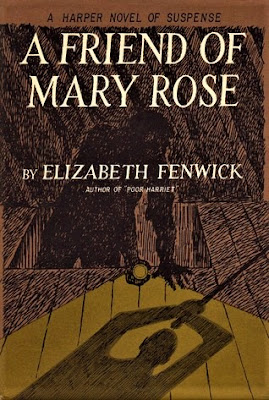
The Make-Believe Man/A Friend of Mary Rose, Elizabeth Fenwick (Stark House)
The Diehard/My Brother's Keeper, Jean Potts (Stark House)
Death on Herons' Mere, Mary Fitt (Moonstone)
The Edith Howie reissues (Coachwhip)
Death of an Intruder/Twice So Fair, Nedra Tyre (Stark House)
The Beautiful Stranger/The Missing Heiress, Bernice Carey (Stark House)
Death and Mary Dazill, Mary Fitt (Moonstone)
Death Freight, Patrick Quentin (Stark House)
The Alice Campbell reissues (Dean Street Press)
The Complete Short Stories of Leo Bruce (Japan)
And that's just so far this year. There's a lot more on the way, dear readers! So as I understand it, I will not be able to post about most of these books at the GAD group, on pain of expulsion, even though I think they are of genuine interest to members of the group. Thus I decided I would have to form my own group, Vintage Mysteries, which I will administer with a gentler hand. If anyone wants to join just friend request me on Facebook (if we aren't friends already) and I will let you in. I hope other people will post there too.
I certainly enjoy talking about detective fiction, as PD James put it (and crime fiction too); but I listen as well. I'll still comment at the GAD group as long as I am able to do so, but from now on I am going to be doing most of my Facebook posting at Vintage Mysteries. If you enjoy my Passing Tramp blog, I hope that you will find your way over there, as you might like Vintage Mysteries too. But, rest assured in any event, the blog will carry on here as usual. In fact I expect to be posting here more than I have been been the last few years,
Monday, February 14, 2022
Happy Valentine's Day!
Thursday, February 10, 2022
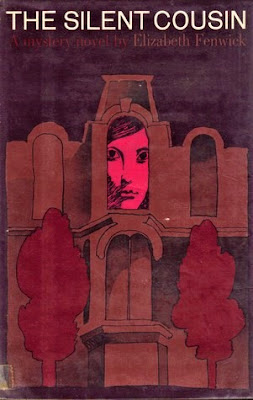
Mid-Century Gothic: The Silent Cousin (1962) by Elizabeth Fenwick
Elizabeth Fenwick has written four thrillers since her first, Poor Harriet, marked her as one of the most promising newcomers of 1958. Her careful technique and her ability to arouse a sense of pity--rare enough among the run of thriller writers--are evident in all of them. This, her latest, is well up to standard. It is a family drama set in the American countryside. Miss Fenwick takes her reader along quietly, with just hints and shadows of impending doom, and the macabre and unexpected climax hits all the harder for that.
--G.H., Sydney Morning Herald
The Silent Cousin, by Elizabeth Fenwick is a leisurely atmospheric tale of personalities, from the murderously warped to the seriously frustrated. The scene, surprisingly, is the Hudson River Valley. It seems like English countryside and the "goblin mansion" could have housed Charlotte Bronte. Miss Fenwick is skillful in motivation as well as characterization and binds a fine spell.
--Vivian Mort, Chicago Tribune
Suspense gradually creeps in as Elizabeth Fenwick skillfully begins what at first appears to be an interesting and well-written [straight novel] about remnants of a family and their vast decaying estates. While family relationships are somewhat complicated, what begins as simple interest gradually progresses to apprehension and then to breathless suspense which demands quite a bit of willpower not to skip ahead to end the anxiety.
--E.A.O., Sacramento Bee
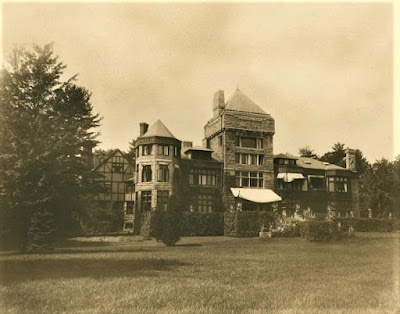
| the mansion at Yaddo, the famous artists' retreat, surely the inspiration for the setting of The Silent Cousin |
Elizabeth Fenwick's The Silent Cousin was published during the mid-twentieth century (1962 in the U. K., 1966 in the U. S.), but it takes place on a grand Hudson Valley, New York estate constructed during the American Gilded Age--a grand setting for a tale which harks back to the Gothic tradition in mystery literature.
There are at least four houses on the estate: the massive Long Acre, where no one actually lives; the Hall, where reside the remnants of the Onderdonk family; the farmhouse, home of the Onderdonk estate manager MacDonald and his family; and, lastly, a cottage which serves as the dwelling of an Onderdonk demi-relation, Professor Paul Potter, when he visits the estate in the summer, on vacation from his university post in Indiana.
I greatly enjoyed this novel, but I will admit it needed a family tree, so here 'tis (I made it out in my copy at the heading of Chapter Five; starred characters are still alive--for the moment--when the novel opens):
Grandfather Onderdonk, who built Long Acre in the 1890s and with his wife Millicent I, had three children:
Millicent 2, the second wife of Paul Potter's father and the stepmother to
*Paul "Polly" Potter (36), who married *Vinnie, from whom he is estranged when the novel begins, and produced a daughter
*Cressa (8), who comes to visit him at the Estate
*Humphrey Onderdonk who married *Cora and had two daughters, both of whom are unmarried
*Millicent 3, aka Millie (40)
*Louisa (38)
John who moved to Chicago and by *one of his several successive wives fathered a *daughter who married a man named Watson and with him produced
*John Onderdonk Watson (22), who comes to visit the Estate
Estate manager *MacDonald who took a wife and with her produced
*Jenny, who married *Pete
When the novel opens Paul is staying at the cottage expecting the imminent arrival of his daughter Cressa for a visit. He learns of the sudden demise of Mrs. MacDonald, a death which was unexpected, though the woman had been ailing.
Soon another character is found dead in the fishpond (there's a classic death for you) and we are off to the murder races!
I don't know that I would call The Silent Cousin leisurely, as it, like Fenwick's other crime novels, is quite short (about 60,000 words); but it builds subtly to a tremendous climax, giving us a chance to immerse ourselves in the characters, as seen through the eyes of the contemplative not-quite-relation Paul.
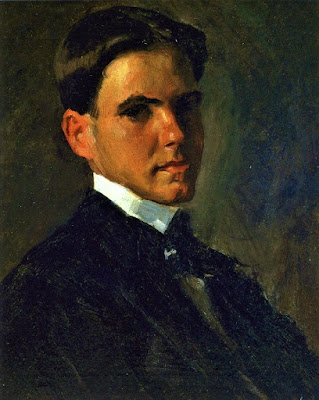
| Julian Onderdonk (portrait by William Merritt Chase) |
The central dramatic situation is that the family money is tied up in in a trust which keeps the estate going, but also keeps the remaining Onderdonks effectively wards of that estate. It's rather like the situation in S. S. Van Dine's The Greene Murder Case, but the climax may remind you more of Edgar Allan Poe (a specific short story which shall go unmentioned here).
It seems obvious to me that Fenwick based the Onderdonk estate on Yaddo, the artists' retreat outside Saratoga Springs, New York, where Fenwick spent the summer of 1948 working on her second mainstream novel. (This is where she met, and became lifelong friends with, writer Flannery O'Connor, who herself could do some mean Gothic.)
The great mansion at Yaddo was built by Spencer and Katrina Trask, an ill-starred couple who lost all four of their children at young ages so bequeathed their home to creative artists.
The name Onderdonk, I would hazard to guess, Fenwick derived from the Onderdonks of Texas, another distinguished artistic family. Julian Onderdonk, known as the father of Texas painting, was a prominent impressionist painter who died in 1922 in San Antonio, where Elizabeth Fenwick would graduate from Jefferson High School a dozen years later. Of course Onderdonk is a grand old Dutch name and there were Onderdonks in New York, the setting of The Silent Cousin, but I feel sure that when Fenwick wrote the novel she thought back to that Texas branch of the family.
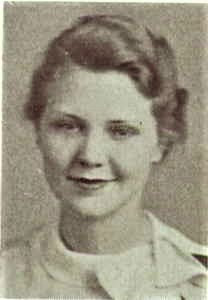
| poetry enthusiast Betty Phillips, aka Elizabeth Fenwick, as a high school senior |
At Jefferson Hugh School, by the way, Elizabeth Fenwick, then known as Betty Phillips, revealed an early literary bent, winning the state poetry contest two years in a row. In high school she belonged to the Scribblers, the Poetry Club and the Quill and Scroll, the high school honors society for student journalists. Smart girl, Betty!
This intelligence and sensitivity comes out in her novels, like The Silent Cousin, a fascinating tale of repression which in its final pages reaches a shattering crescendo of doom. I've mentioned Van Dine and Poe and I should also mention Shirley Jackson, whose great Gothic novel We Have Always Lived in the Castle appeared the same year as The Silent Cousin was published in England. Certainly a criminal coincidence, that! Fenwick's Long Acre also could be said to bear some resemblance to Jackson's Hill House, from another of her novels.
There's also a clever reference to a certain Dorothy L. Sayers detective novel, but I'll leave you to see this for yourselves when The Silent Cousin is reprinted.
Why Harper passed on The Silent Cousin is beyond me, unless it was too slow burning for editor Joan Kahn, who was known to be quite cutting in her judgments. (She also gave fits to Patricia Highsmith, who eventually left Harper in a huff.)
Cousin finally appeared four years later in the U. S. with Atheneum, who also published Eric Ambler and P. M. Hubbard, another great exponent of unease whom Fenwick bears some resemblance to as well. Personally I think Joan Kahn's pass on The Silent Cousin reflects much worse on her than Fenwick.
And I will say that out loud!
Wednesday, February 9, 2022
Miss Fenwick Returns: Elizabeth Fenwick's Crime Novels Are Coming Back in Print after Nearly Half a Century
Over her life Elizabeth Fenwick (1916-1996), whose real name was the somewhat more prosaic Elizabeth Jane Phillips, published fourteen detective and crime novels and three mainstream novels, which I will list farther down the page. (There are usually some errors on the publication years.)
After publishing a trio of wartime detective novels as E. P. (presumably Elizabeth Phillips) Fenwick and a trio of postwar mainstream novels as Elizabeth Fenwick, the author published in 1957 Poor Harriet, her first novel of "domestic suspense" (her own term for it, interestingly enough, was "domestic unease"). Ten more suspense novels followed, the last of these being The Last of Lysandra in 1973. Here is the list:
Detective Novels
The Inconvenient Corpse 1943 (as EP Fenwick)
Murder in Haste 1944 (as EP Fenwick)
Two Names for Death 1945 (as EP Fenwick)
Mainstream Novels
The Long Wing 1947
Afterwards 1950
Days of Plenty 1956
Crime/Suspense Novels
Poor Harriet 1957
A Long Way Down 1959
A Night Run 1961
A Friend of Mary Rose 1961
The Silent Cousin 1962
The Make-Believe Man 1963
The Passenger 1967
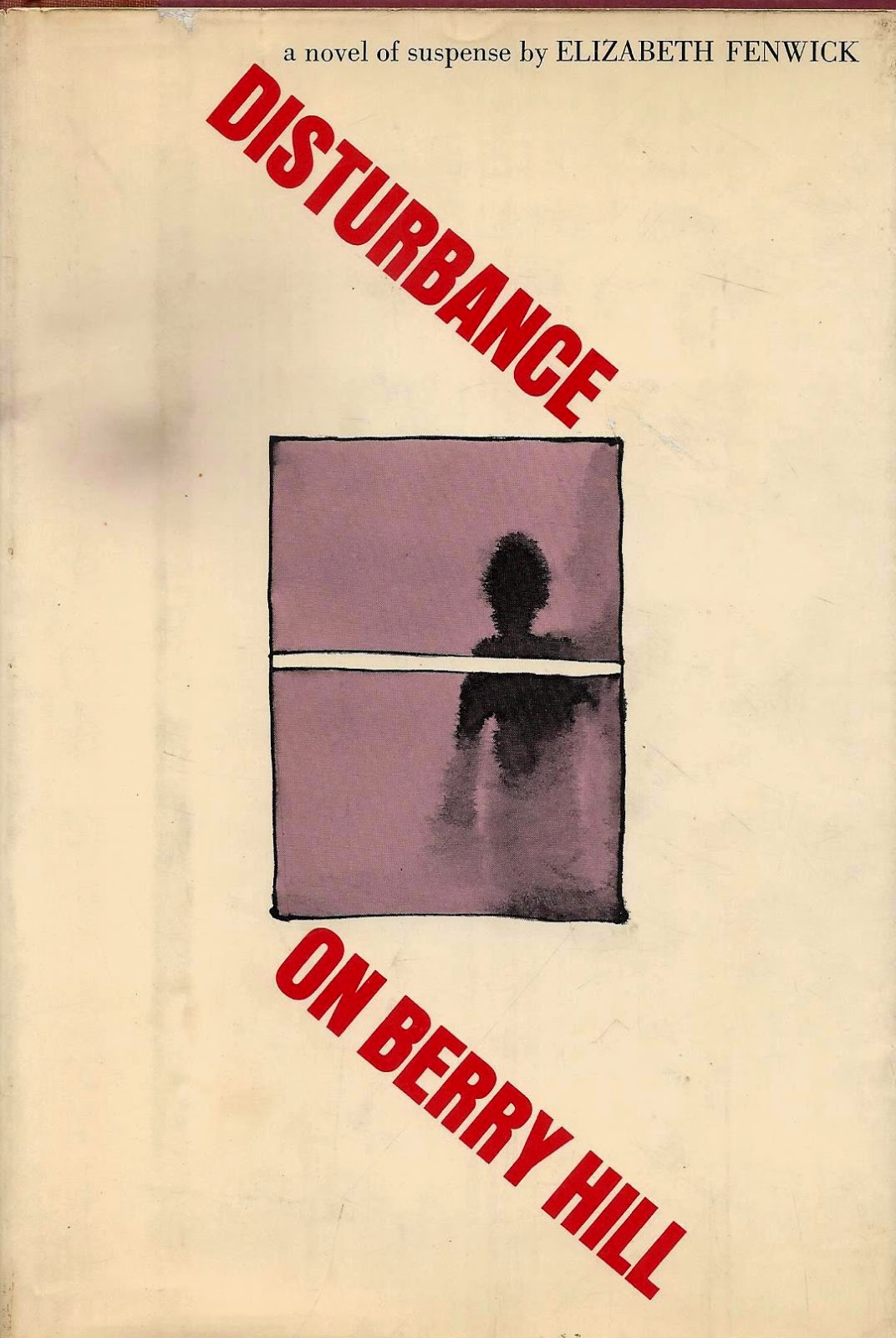
Disturbance on Berry Hill 1968
Goodbye, Aunt Elva 1968
Impeccable People 1971
The Last of Lysandra 1973
I first starting writing about Elizabeth Fenwick back in April 2015, when I reviewed her debut suspense novel Poor Harriet (1957), surely one of the best-received "debuts" in American crime fiction. I say debut because most people had forgotten about E. P. Fenwick, longtime Fenwick fan Anthony Boucher excepted. Indeed, Boucher had compared the early Fenwick detective novels, when he reviewed them at the San Francisco Chronicle, to the work of Elisabeth Sanxay Holding.
Now posted with the New York Times, Boucher called Poor Harriet "the work of a highly skilled novelist." And indeed it was.
Fenwick's first mainstream novel, the semi-autobiographical The Long Wing, had received a great deal of praise from critics and led to her being invited in 1948 to spend a summer at the Yaddo artists' retreat in upstate New York to work on her second novel.
This was the same summer Patricia Highsmith, Chester Himes and Flannery O'Connor were there. O'Connor, who became one of the great 20th century southern regional writers, was at Yaddo the longest of these individuals, I believe, and encountered all of them, with varying reactions. While O'Connor and Highsmith decidedly did not get along (Highsmith was quite contemptuously explicit about this), O'Connor and Fenwick became good friends up through O'Connor's early death in 1964. After being diagnosed with lupus, O'Connor retired to live on a farm in Georgia, but the two women regularly corresponded. O'Connor always referred warmly to her friend as "Miss Fenwick."
Fenwick had a knack for getting into the company of great writers. When she lived in St. Louis, Missouri in the 1930s, where she was working as a secretary, she became a member of a Washington University poetry circle which included among its members the future famed playwright Tennessee Williams and her own future husband, modernist poet Clark Mills McBurney. Unfortunately Williams didn't remember Fenwick later in life, mentioning merely that the group had some pretty female members, all of them from good families, who provided excellent comestibles and decorations. Yes, the snobbery and sexism comes through loud and clear.
Williams aside, the admittedly quite attractive Fenwick, now in her forties, quickly established herself after 1957 as one of the mid-century's most noted domestic suspense novelists, along with such greats as Margaret Millar, Celia Fremlin, Shelley Smith, Charlotte Armstrong, Ursula Curtiss, Jean Potts and Dolores Hitchens. Her strength as a pure novelist proved both a positive and a negative for her as a crime writer, however, in terms of popularity, I believe, with some her books being too subtle, perhaps, for the American market.
Her third crime novel, A Night Run, was never published in the U. S., while her fifth, The Silent Cousin, did not appear in her native country until 1966. Her last two crime novels were not published in the U. S. either. All of them appeared in the U. K., however, under the auspices of Gollancz, which had a great appetite for the work of American suspense writers.
Despite these misses, Fenwick probably achieved her height of popularity in the U. S. with the early Sixties publications of A Friend of Mary Rose and The Make-Believe Man, both of which, I'm happy to say, are being reprinted this year by Stark House, with a long introduction on Fenwick's life by me. (There will also be a piece on Crimereads.)
It was at this point that Anthony Boucher referred to Fenwick as a generally recognized equal of Shelley Smith and Celia Fremlin. (In 1966, however, when she had not published a novel in the U. S. for four years, he pronounced that she was underappreciated.)
Mary Rose is about an 83-year-old man named Mr. John Nicholas who through a strange twist of fate finds himself becoming the protector of an eleven-year-old "tomboy" menaced by a violent man with the most malign of designs upon her. It's true there have been other blind sleuths in fiction, like Ernest Bramah's Max Carrados, but as far as I'm aware they have all been some variation of great detectives. Mr. Nicholas, in contrast, is just a regular man, who suffers the indignities of the aged and infirm like everyone else of his sort. Realism is a hallmark of this and other Fenwick novels, as is a sympathetic understanding of the problems everyday human beings.
The Make-Believe Man concerns a recently-widowed woman, Norma Hovic, who has returned with her eleven-year-old son to Detroit to live at her old home with her mother. When her mother leaves to stay with Norma's "expecting" sister and her family in another town, Norma is pleased to have the house to herself and her son for a while. But then her mother's former roomer, a nice young man named Cliff whom Norma displaced when she returned home, shows up at the door....
This is a sort of psychological home invasion story with many twists and turns and another appealing everyday protagonist and like Mary Rose it was highly praised on both sides of the Atlantic.
Both novels have as well, I should add, very well-conveyed children, both of them eleven years old, around the same age as the author's own daughter, Deborah, who herself was about eleven when Mary Rose was published.
Fenwick was very close to her daughter from her second marriage, all the more so because both of her marriages can fairly be termed disasters and Deborah was all she had out of them. Fenwick was apparently married to Clark Mills McBurney for five years, between 1941-46. He went away to serve in the Second World War and just stopped communicating with her after a time, forcing her to get the marriage annulled. As far as I know, she never saw him again. Classy, Clark!
| Elizabeth Fenwick around the time of the annulment of her first marriage in 1946 |
Fenwick stayed married to her second husband, small publisher David Jacques Way, for sixteen years, from 1950 to 1966, when he left her for a 23-year-old graphic designer in his company, just few years older than his own daughter.
What makes this even more deplorable is that over the duration of the marriage he had been a rageful and violent husband, whom Elizabeth herself had wanted to leave with her daughter but couldn't, she felt, because she did not make a enough money from her writing to support them. She only earned about $20,000 a year from her books (in modern value) and her husband, she feared, would not have been a reliable provider of alimony and child support if they parted.
Certainly Fenwick's is a striking testament to the financial insecurity of writers, even critically-esteemed ones, which perhaps may surprise some people.
I write about all this in greater detail in my introduction. I found Elizabeth Fenwick's life really fascinating because even though she was a much-praised writer she herself faced a lot of problems which domestic suspense authors wrote about in their books, in terms of her relationships with men.
Fenwick's life also illustrates how callous and dismissive even the ostensibly "enlightened" intellectual males of the era could be, in regard to women. Even Tennessee Williams, who had no interest in women sexually, comes off as rather an ass. I was somewhat reminded of the domestic situation of Shirley Jackson, a writer Fenwick somewhat resembled, especially in her 1962 novel The Silent Cousin, inexplicably turned down by her American publisher, about which I will be blogging next, I think. See you again soon.
Sunday, January 27, 2019
The "E. P. Fenwick" murder trilogy (1943-45), by Elizabeth Fenwick
As far as I'm aware, Fenwick's last book to see a print issue was the 1987 paperback Academy Chicago edition, now itself rare, of Goodbye, Aunt Elva (1968), which just missed being made into a film by Robert Aldrich, maker of the classic so-called "deadly biddy" films What Ever Happened to Baby Jane? (1962), Hush...Hush, Sweet Charlotte (1964) and What Ever Happened to Aunt Alice? (1969), the latter starring Geraldine Page and Ruth Gordon and based on the excellent crime novel The Forbidden Garden (1962) by domestic suspense doyenne Ursula Curtiss.
Impresario Aldrich planned to follow Alice with What Ever Happened to Dear Elva?, based on Fenwick's novel, but Aunt Alice had lost money and plans for Elva accordingly were shelved in the early Seventies. Today, some fifty years later, Elva remains unmade and Fenwick's books most regrettably are out-of-print. The film may never be made, but I hope that the books come back in print soon.
It has taken me a while to untangle Elizabeth Fenwick's personal history, but now I have, or much of it at least. I shall be reporting more on that soon, but here I wanted to talk about the author's first crime novels, what I call her "E. P. Fenwick" trilogy, published in the US by Farrar & Rinehart between 1943 and 1945, when Fenwick was in her late twenties.
![]() |
| It's not Lord Peter, but rather Sammy on the case in The Inconvenient Corpse. |
These are, as mentioned, three in number, which I call a trilogy, although in fact they are non-series tales. The titles are The Inconvenient Corpse (1943), Murder in Haste (1944) and Two Names for Death (1945).
The first two novels take place in New York City and suburban/rural New York, the last in Boston. All three seem to have been generally well-received. The Saturday Review, for example, called Corpse an "exciting and well-written exercise in untrammeled emotions" and declared of Haste that it was "good," with "competent" sleuthing and a "surprising" conclusion.
Especially interesting, as is often the case, are the reviews of the E. P. Fenwick books by noted American crime writer and critic Anthony Boucher. The soon-to-be mystery reviewer for the New York Times had reservations about Corpse, observing that while it made smooth reading it was "unconvincing in characterization and solution." However, with Haste Boucher heralded this "disquieting story of odd psychologies and obscure menaces" as "not unworthy of [American crime writer] Elisabeth Sanxay Holding." Indeed, he opined that "you might call it the first novel of the Holding school, hitherto represented solely by Mrs. H; and a fine foundation for a school it is."
When Two Names for Death was published, Boucher concluded that the novel enhanced Fenwick's good criminal name even further: "simply and subtly written, with knowable characters and plausibly complex motivations, this won't disappoint those who recognized Fenwick in Murder in Haste as a possible major contender."
A review like that would have made me want to keep at it, but apparently in Fenwick's case it spurred her to try for the "real thing": mainstream fiction. (Events in her personal life may have been a factor as well.) A dozen years passed before Fenwick published her next crime novel. Yet even the three E. P. Fenwick books alone would have constituted a more than respectable crime writing legacy.
In the first of these novels Fenwick makes use of many of the beloved devices of classic mystery: the isolated snowbound house party, the solitary woman in peril and the vanishing corpse (a most "inconvenient" one indeed). Maggy Simon, assistant to noted NYC journalist Sebastian Evers, with her loyal Boston terrier Sammy and her dashing boss--to whom the reader will conclude she has formed a (one-sided?) romantic attachment--attend a reunion of Sebastian's old high school friends in rural New York, probably around Ithaca, home of Cornell University, where Fenwick was living with a poet and instructor of French at the college.
Also showing up for the event is Sebastian's bold, bibulous and blonde lady friend, Anna Rose:
"That's my whole name, you know--like Annabella, in the movies, and that French actress, I forget her name."
"Mistinguette?" suggested de Vries, with a Gallic gesture.
"That's it," agreed Anna Rose, showing all her beautiful teeth."
![]() |
| native French actress Annabella with her matinee idol husband at the time, Tyrone Power |
The house in the country is owned by Freddy and Susan de Vries, Freddy being the editor of the highbrow quarterly review The New Age ("'Oh, that one,' said Maggy, who had been filing away unread copies of The New Age for several years."). The morning after everyone's arrival there, Anna Rose disappears. Supposedly she stormed out into the snow in a huff, determined to go back to New York even though the nearest town with trains and a bus station is twelve miles away.
The De Vries couple and their other guests, Professor Harold Jameson and Morgan Dillard, formidable daughter of a judge and a former girlfriend of Sebastian's, downplay Anna Rose's disappearance, but Maggy has her doubts about the "official" story, doubts which are confirmed when she stumbles over Anna Rose's brutally bludgeoned body in a storage shed! With Anna Rose's corpse later vanishing and the telephone line getting snipped, Maggy begins to find her stay in the country rather an unpleasant one. Who can she trust? Perhaps no one but her steadfast Sammy! (If you want a friend, get a dog.)
This is a briskly paced and suspenseful crime novel that reminded my quite a bit of Anita Boutell's Tell Death to Wait, a crime novel which was published four years earlier, though Corpse actually is a rather warmer and more human book, despite both the cold weather and people (Boutell, an American living in England, wrote a convincingly frosty British book.) Maggy finds herself opposed by Sebastian's old friends in her attempts to get at the truth about Anna Rose and the motivations of Sebastian himself are not always clear to her; yet she defiantly soldiers on until the truth comes to light. She's an appealing heroine, not a dithering wet noodle like so many of the protagonists in Mignon Eberhart's hugely popular mysteries from the period. The continued popularity of those young women has always rather mystified me.
Three months later the lad's corpse turns up at the bottom of the river bluff behind the school. The body shows wounds consistent with a fall--but did he fall, or was he pushed? Or something else entirely? It's up the local sheriff Thad Shaw to find out, with the help of the headmaster's brainy unmarried thirtyish daughter, Eunelda.
This one rather reminded me of a Q. Patrick or Patrick Quentin mystery, including the Q. Patrick public school mystery, Death Goes to School (1936). It's a sophisticated story with some compellingly dark psychological portraiture, particularly concerning the odd Chase family and its satellites. I just wish the denouement had been a little tighter.
Everything, however, comes together beautifully in the final "E. P. Fenwick" mystery, Two Names for Death, which has the complexity of Haste and the narrative fleetness of Corpse. This one was a real corker of a classic mystery, I thought.
Set in Boston, the novel's main focal character is young Barney Chance, a college student working as a cabdriver over the summer, when the deathly events take place. Barney becomes involved with a police case when one of his fares, an enigmatic woman named Lenore Bellane Schafft, is found dead in her hotel bedroom, with both of her wrists slit. Suicide or murder?
By coincidence (indeed!) this woman is closely connected to the household where Barney himself rooms, along with the owner of the cab company for whom he works, a fifty odd bachelor named Edward J. Bottman.
Midway through the novel another death occurs, this time that of a man who falls fatally from the window of his six-story hotel room, and again the police (and the reader) are left with the question, suicide or murder?
I don't want to say too much about the involved family dynamics in this story, for fear of spoilage, but I found Names an immensely enjoyable detective novel, complexly yet cleanly plotted with characters that actually live (until they die, that is). For someone who later excelled at the stripped down mid-century crime novel, Fenwick here produced a densely packed true detective tale with quite credible police investigation. I fully agree with Anthony Boucher's opinion of the novel and highly recommend it to vintage mystery fans.
Fenwick could have gone from here to write a whole series of Boston set mysteries but instead she produced only three mainstream novels over the next dozen years. I will look at this matter, as well as the mysteries in Fenwick's own life, in an upcoming post.
Like just what does "E. P." stand for? Elizabeth...??? More soon.
Saturday, April 11, 2015
Elizabeth Fenwick in Pictures: From Detective Writer to Mainstream Novelist
Here are the jackets to her early detective novels:
All three novels were published by Farrar & Rinehart, between 1943 and 1945. Biographical information is nil, with war messages occupying the entire back covers of the dust jackets:
However, the publisher emphasizes on the jacket flaps Fenwick's merit as a novelist. With The Inconvenient Corpse we're told that Fenwick's novel "combines lively characterization with clever plotting" and thus "isn't just another mystery." Murder in Haste "marks the author as a writer with imagination, wit and skill--a first-rater."
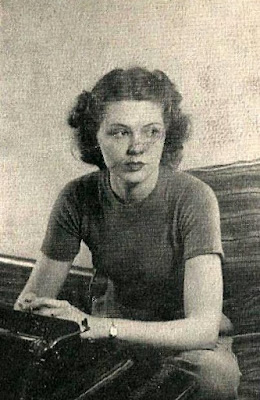
After the publication of Two Names for Death, Fenwick abandoned crime fiction for a dozen years. Her next novel, published in 1947, was a "straight" novel called The Long Wing. On the back there is a great photo of her and some biographical information:
![]() |
| young author at work |
After graduating from high school, she spent a year and a half living in three states and learning to be a writer. The results were one novel, burned after its first rejection, and many poems. After this came business school and two years as a secretary and French translator.
After her marriage she moved to Ithaca, New York, and began a period of intensive notebook keeping, out of which The Long Wing developed.
It's interesting that Fenwick's biographical blurb failed to acknowledge her three detective novels. Did she view them as 'prentice works, now to be disowned?
We also learn that Fenwick already had already married when she was at Yaddo in 1948, where she met, and became lifelong friends with, Flannery O'Connor, as discussed earlier.
My guess is that Fenwick married Clark Mills McBurney around 1945. As mentioned in a previous post, McBurney, a poet and Cornell University professor of French, grew up in St. Louis, where Fenwick was born, and was a college friend and mentor of Tennesse Williams. Note that Fenwick had worked as a French translator.
When Days of Plenty was published in 1956 (another novel, Afterwards, appeared in 1950), this picture of Fenwick (right) was included on the back cover of the dust jacket.
The biographical blurb claimed that Fenwick was born in 1920 and that Days of Plenty was her third novel.
Neither claim was true. Fenwick was born in 1916 (she left St. Louis in 1920), and Days of Plenty was her sixth novel. But then the early trio of detective novels seems to have been officially scrubbed from her biography by this time! Of course she made a big return to crime fiction, as I have discussed, in 1957. But by then it was labeled "suspense."
Wednesday, April 8, 2015
Gone Grandam: Poor Harriet (1957), by Elizabeth Fenwick
What happened in the intervening six fallow years between Afterwards and Days of Plenty? One thing I know from correspondence of Fenwick's good friend from Yaddo, Flannery O'Connor, is that Fenwick had married by 1952. Her husband was Clark Mills McBurney (1913-1986), a modernist poet (under the name Clark Mills) and 1930s friend and mentor of the playwright Tennessee Williams. The two young literary aspirants both had been students at Washington University in 1935-37 and during that time had outfitted the basement of Mills' parents' house as a "writing factory," in Mills' words.
![]() |
| Cover Girl: Flannery O'Connor thought Elizabeth Fenwick lucky with her book jacket art |
Certainly Poor Harriet, Fenwick's first essay in this subgenre, suited the critics. For example, Margaret Millar, one of the finest twentieth-century crime novelists, declared, in a penetrating and pithy sentence, that the novel had "some of the most macabre mood writing since the Gothic tale looked under the bed and found Freud."
Male critics agreed with Millar. Anthony Boucher proclaimed Poor Harriet "the work of a highly skilled novelist" and James Sandoe deemed it "an astonishing evocation."
From Georgia Flannery O'Connor joined in the chorus as well. Writing Fenwick from her country home outside Milledgeville on August 4, 1957, a few days before the novel was officially published, O'Connor wrote praisefully (and amusingly):
Well cheers for Poor Harriet! I enjoyed her and also my mamma enjoyed her and I must say you are lucky on your [book] jackets....I have never read anybody else's mystery stories....My mother read Poor Harriet straight through and kept saying, "Well I just don't see how she figured all this out, I just couldn't do it."
![]() |
| often in 1950s crime fiction publicity suspense was emphasized and detection downplayed |
The novel follows the dire events that occur after Marianne Hinkley, a loyal office manager for a Connecticut contracting firm, embarks on an errand in New York City on behalf of Irma, the demanding, high maintenance wife of her boss, Tom Bryce.
Irma tasks Marianne with selling the diamond bracelet that Tom recently gave her (she's had financial reverses, she says). In New York Marianne encounters an odd, old woman named Harriet, setting in motion a succession of events that culminate in violent death.
I found Poor Harriet an excellent fifties "novel of suspense," with interesting characters and a teasing plot. Flannery O'Connor's mamma got it right.
Note: I hope to review another Fenwick novel next week, one of her early detective novels; and when I do I expect to have her photo posted here. In the meantime, here is a photo of her at Yaddo in 1948 (Fenwick is the blonde in white on the left).
Flannery's Favorite? Flannery O'Connor and Elizabeth Fenwick
If there is ever an additional volume in the series, another good candidate for inclusion might be Elizabeth Fenwick (1916-1996), an author who offers an interesting example of the writing path taken by a number of mid-century American women crime writers, as the puzzle-oriented detective novel lost its predominance within crime fiction. Here is a list of the fourteen novels Fenwick published over a quarter century period:
The Inconvenient Corpse 1943
Murder in Haste 1944
Two Names for Death 1945
The Long Wing 1947
Afterwards 1950
Days of Plenty 1956
Poor Harriet 1957
A Long Way Down 1959
A Friend of Mary Rose 1961
The Make-Believe Man 1963
The Silent Cousin 1966
The Passenger 1967
Disturbance on Berry Hill 1968
Goodbye, Aunt Elva 1968
The first three of these novels, published under the androgynous name E. P. Fenwick when the author was in her late twenties, are relatively traditional detective stories, while the next three, published, like all this author's later novels, under the more revealing name Elizabeth Fenwick, are "mainstream" novels. Finally, the last eight novels are all crime thrillers, or psychological suspense tales, for which Fenwick became best known.
Presumably Fenwick deemed the first detective novels, which were well-reviewed but never well-known, as something of an apprenticeship to her main interest, "straight" novel writing (although in the late 1950s she apparently abandoned straight novel writing for tales of psychological suspense).
In 1948, shortly after the publication of her first "serious" novel, Fenwick was accepted at Yaddo, the famous upstate New York artists' and writers' colony. There she completed her second mainstream novel, Afterwards. In a 1950 Saturday Review notice of this book Kathleen Sproul advised: "Those who are bewailing the lack of successors to our aging, and in some instances, declining novelists, would do well to contemplate Elizabeth Fenwick."
![]() |
| Yaddo |
Two years before Fenwick came to Yaddo Truman Capote had worked there on his novel Other Voices, Other Rooms, while the same year that Fenwick was at Yaddo, Patricia Highsmith and the great American novelist and short story writer Flannery O'Connor were guests there as well (Highsmith was working on Strangers on a Train, Yaddo have decided to accept a writer working in a "lower" form of writing because she was deemed a better stylist than many "serious" writers).
Apparently Fenwick's and Highsmith's time at Yaddo did not overlap, but Fenwick's and O'Connor's did; and the two became good friends, which is more than you can say for O'Connor, who was religiously devout, and Highsmith, who was...anything but.
"In any collection of so-called artists you will find a good percentage alcoholic in one degree or another," O'Connor wrote sardonically to a friend in a 1959 letter. "In such a place you have to expect them all to sleep around. This is not sin but Experience, and if you do not sleep with the opposite sex, it is assumed that you sleep with your own" (see Brad Gooch, Flannery: A Life of Flannery O'Connor).
![]() |
| Patricia Highsmith |
Many years later Highsmith is said to have complained that O'Connor never socialized with her boisterous crowd (O'Connor in 1959 wrote, "I went to one or two of these [Yaddo parties] but always left before they began to break things").
On coming back to Yaddo from one such party, so this story goes, Highsmith found O'Connor kneeling on a porch, raptly staring at a knot of wood and declaring that she discerned in it the face of Jesus.
"And ever since then I've not liked that woman," Highsmith is said to have told a young friend, in the story's punch line (see Joan Schenkar, The Talented Miss Highsmith). Whether or not this event actually took place, it certainly reeks of antipathy for O'Connor on Highsmith's part.
![]() |
| Flannery O'Connor |
Sally Fitzgerald, a friend of O'Connor's and editor of The Habit of Being, a collection of O'Connor's letters, recalled that "Flannery spoke of Elizabeth, whom she always referred to as 'Miss Fenwick,' often and fondly."
In 1960 O'Connor wrote rather a paean to Fenwick, in correspondence with another friend:
She writes novels, writes one to suit herself and then one mystery novel to make money, then one to suit herself, etc. She lives by a kind of rhythm, has nothing to say but is full of lovely feelings, giggles, is a big soft blond girl and real nice to be around except that she bats her eyelashes....She is kind of a complement to me, and we get on famously.
In another letter, one to Fenwick, O'Connor discussed Fenwick's first psychological suspense novel, the highly-praised Poor Harriet (1957). I'll be having more to say about this novel, and O'Connor's discussion of it, for Friday.
And for more on Patricia Highsmith in the 1940s, see this Passing Tramp post from last year.
Friday, March 27, 2015
Neighbors! Disturbance on Berry Hill (1968), by Elizabeth Fenwick
![]() |
| I never can resist a map.... |
Elizabeth Fenwick (1916-1996) is an interesting author in that she illustrates the case of talented mid-century women mystery writers who in the 1940s and 1950s moved away from true detective novels to "psychological suspense," or "domestic suspense," as Sarah Weinman calls it.
Fenwick published three detective novels during World War Two, the several straight novels in the 1940s and 1950s, before moving into suspense crime fiction with Poor Harriet in 1957. Over the next dozen years she published seven additional crime novels, ending the run with Goodbye, Aunt Elva in 1968.
Fenwick's crime fiction was quite praised in its day by critics, including the influential reviewer Anthony Boucher. However, since then she seems to have been mostly forgotten, although Academy Chicago reprinted one or two of her books in the 1980s or 1990s.
Unfortunately, I have to admit that Disturbance on Berry Hill, her penultimate crime novel, was a a disappointment to me. In some ways it reminds me of Mary Roberts Rinehart's crime novel The Album (1933), which I also found disappointing. Both have excellent closed settings in exclusive suburban northeastern U. S. neighborhoods, rather resembling what we Americans call "gated communities" today; but the mystery plots fall flat (that in The Album is too convoluted, that in Berry Hill too predictable).
Someone in Berry Hill is causing disturbances, prowling about and sneaking into homes, etc., causing people in the neighborhood to lock their doors for the first time (this was along time ago). Eventually there's a death, which is an even greater disturbance. Who is behind all this? The answer, I must admit, was not a great surprise to me.
Berry Hill is a short novel, probably not too much over 40,000 words, and although I thought the setting was interesting, the characters were not as developed as I would have liked. I did note how "traditional" Berry Hill was, with all but one of the adult women residents being homemakers (one with a live-in maid) with commuting husbands; the one middle-aged career woman is sympathetically presented, but exceptional.
I wanted to like this novel more than I did, but the suspense is a tad tepid and the characters insufficiently engaging. However, from past reading I have a good opinion of Elizabeth Fenwick's writing, so I will take another look at her work, in a post that will have more about the author herself. Also there's exciting news about Sarah Weinman and domestic suspense fiction, which I will be writing about more next week too.
Friday, September 28, 2012
It Was a Dark and Snowy Night....The Doll's Trunk Murder (1932), by Helen Reilly
The beginning of The Doll's Trunk Murder reads like an Old Dark House thriller, as traveler after traveler descends on a snowbound rural house in western Pennsylvania. Of course, murder has been done in the house, and murder will be done again....
I thought this novel had a tour de force opening section, detailing the (natural???) death of Mary Alice Greer, the elderly owner of isolated Three Mile House (I kept thinking of Three Mile Island); the house's subsequent purchase by the mysterious Miss Fenwick, the flight of Miss Greer's former maid, Minnie Stern; the sudden merciless snowstorm; and the arrival of the stranded "guests."
This part is magnificently Old Dark House-ish, with suspenseful prose and mysterious goings-on. There is a very unpleasant murder too, something nasty in the storage closet....
Helen Reilly has a good way with words, as in this description of Minnie Stern:
She always wore decent black that smelled faintly of camphor, had hard gnarled hands that never quite closed and a high stomach. Her corsets were something with which to frighten children....
Happily, Sheriff Craven is one of the people who turns up at Three Mile House and he is able to do some ad hoc crime investigating.
On hand too is a middle-aged bachelor named Richard Brierly, who for no particularly credible reason that I could ever figure out, is the narrative focal point of the tale. He's the Watson figure, I suppose (although the narration is third person); yet he's not particularly interesting, nor could I figure why Craven would allow him to be in on the entire investigation! Heck, Craven even delegates important parts of the investigation to Brierly!
This suggests to me that at this point in her career Reilly did not quite have a firm grip on the police procedural. However, after the night spent at Three Mile House, this essentially is what the book becomes: a police investigation (with some improbable amateur bits by Brierly).
Unfortunately, the ending is what Jacques Barzun and Wendell Hertig Taylor in A Catalogue of Crime call huddled. There's a lot of explanation from Sheriff Craven, right up to the last paragraphs and the rather abrupt close. I couldn't really see how the reader is given a fair chance to deduce much of the (very involved!) solution. Which means that The Doll's Trunk Murder really is more a mystery than a fair play detective novel, making it something of a disappointment to me, despite its other admirable qualities.
![]() |
| A cover that might have made even Mickey Spillane blanch! Well, probably not, but still... |
There really is a scene like this in the book too, although it's only described at second-hand after the event. Also the victim is a dowdy, middle-aged woman. There is an attractive young woman in the novel, but she is never subjected to this! But I suppose Popular Library knew how to sell paperbacks after World War Two.
This cover and the author are profiled over at the Killer Covers blog.
Also, here's John Norris' review of Helen Reilly's Murder in Shinbone Alley.
Note on my Todd Downing book: Everything finally done but the bibliography. This should be ready to go to press in October! I hope to have more detail on it soon, plus more blog posts every week. There has been a bit of a lag this week, I know.