Thursday, January 29, 2015

Golden Age Serial Murder: The Series Continues....

In my earlier post, I commented on the lack of American Golden Age mysteries dealing with serial murder on my short list of Golden Age serial killer novels.  Well, here's one that would certainly qualify, I think, The Bishop Murder Case, by the once highly popular S. S. Van Dine, creator of the once-famous Philo Vance (of Ogden Nash "needs a kick in the pance" fame).


In this one there are a series of bizarre murders seemingly linked by nursery rhymes (Christie was not the first to use nursery rhymes).  Bishop was a bestseller in the U. S. and there was a film version starring Basil Rathbone as Philo Vance (I believe he played some other fictional detective later in his career).


John Norris suggested The Grindle Nightmare (1935), by Q. Patrick (then collaborative authors Richard Wilson Webb and Mary Louise White Aswell), and that one certainly is a doozy!  Q. Patrick, who was also Patrick Quentin and Jonathan Stagge (well, Richard Webb was all of them; his writing partners varied) was often very good indeed and has been reviewed is his various incarnations several times on this blog. John has reviewed Grindle here.


Noah, TomCat and Yvette all mentioned Ellery Queen's Cat of Many Tails (1949), which comes outside the Golden Age proper, as usually defined, but Ellery Queen certainly is one of the great Golden Age authors and Cat is one of their great books. Indeed, the trio of Van Dine, Queen and Quentin/Patrick/Stagge is a most impressive one all round for the classic mystery fan.


Going back to England, our England, Moira mentioned Francis Beeding's excellent Death Walks in Eastrepps (1931).  As I recollect they have two or three others from the Thirties that could qualify as serial killer tales as well.  The two men behind Francis Beeding primarily produced spy novels, but they authored some excellent classic mysteries and thrillers as well.


Christian mentioned Neil Gordon's The Silent Murders (1929). This indeed is another serial killer story, but it was unfortunate at the time in using the same plot gimmick as John Rhode's The Murders in Praed Street, which preceded it by a year.  "Neil Gordon" is much netter known as the English satirical novelist A. G. Macdonell.


Christian also mentioned Phlip Macdonald's X v. Rex (1933), written under the pseudonym Martin Porlock, at a time when Macdonald was so prolific he needed a pseudonym or two.


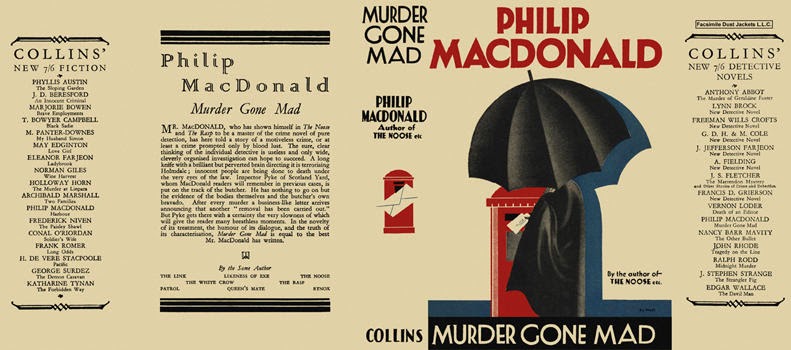
As I recollect, this one was about a serial killer of police.  For some reason I recall liking this less than Murder Gone Mad, but I can't really remember why....

Yvette mentioned New Zealander Ngaio Marsh's Singing in the Shrouds (1958), a later entry by a Golden Age Crime Queen, which intriguingly combines shipboard mystery with serial murder.

And what about Agatha Christie's bestselling novel, even more popular than The ABC Murders, And Then There Were None (1939)? I suppose this one doesn't qualify, because the setting and the time frame are too compressed, but in a way this punishes the killer for quite amazing efficiency.

So this nets us seven (eight?) more serial killer mysteries published by Golden Age authors between 1920 and 1960, to go with the original half-dozen tales I listed.

Keep them coming!  I'm sure there are others lurking out there in the dark, with additional intriguing forgotten mysteries....


Saturday, January 24, 2015

Golden Age Serial Murder

Over the last quarter-century or so the serial killer has been a common feature of the crime novel--to a great extent, one assumes, because of this guy:


Still, there were serial killers in Golden Age crime fiction.  Two early ones, John Rhode's The Murders in Praed Street and Anthony Berkeley's The Silk Stocking Murders, appeared in 1928.


Two of the best serial killer novels from this period, surely, are Philip Macdonald's frantic Murder Gone Mad (1931) and Ethel Lina White's eerie Some Must Watch (1933), filmed as The Spiral Staircase.


We know Agatha Christie made a great splash in 1936 with her ingenious The ABC Murders. Appearing just a couple months after Christie's celebrated novel was Christopher Bush's The Case of the Monday Murders (in US, Murder on Mondays).


It's odd how similarly plotted novels can crop up at nearly the same time like this.  Both The ABC Murders and The Case of the Monday Murders involve letters promising a thematically linked series of murders in the near future.  In ABC Murders the killer's pattern involves the alphabet, while in Monday Murders it's the calendar that inspires our killer.

You know about The ABC Murders, of course, but what about The Case of the Monday Murders?  I'll be reviewing it next week.  Until then, what are your favorite serial killer novels, Golden Age or otherwise?

Friday, January 23, 2015

Drowned in Deceit: The Watersplash (1951), by Patricia Wentworth

The village of Greenings lies about a mile and a half from the country town of Embank. Some day the town will swallow it up....But that day is not yet....The village is, in fact, extremely rural....But into the quietest back water a stone may fall, disquieting ripples may spread....

The Watersplash, published two years after Miss Silver Comes to Stay, the last Patricia Wentworth novel reviewed here, returns readers to the cozily criminous village milieu the author portrayed so often and so well in her 1940s and 1950s mystery fiction.

This time the village is Greenings, presided over by a bigwig family, the Randoms, and populated by assorted quaint and quirky characters. The genteel folk hang on, while the servant population, though diminished, hovers about. There are occasional references to the Labour party, but Lord Burlingham, the local Labour peer ("a self-made man" who "had run barefoot" as a boy, selling "papers in the streets") is a peripheral character (sympathetically presented).

Wentworth excels at portraying the women of this village: the distracted cat-lover Emmeline Random, living off her brother-in-law's grudging hospitality at the Hall's south lodge; the Misses Blake, hypochondriac Ora and acidulous Mildred; Mrs. Ball, the kindly vicar's wife and a daughter of one of those seemingly innumerable old school friends of Wentworth's series sleuth, Miss Silver; nice Susan Wayne, who left the village to work as a personal secretary for a Professor Postlethwaite after her aunt's death, but has returned to catalog the library at the Hall while the professor is visiting the US; and even old Mrs. Stone, who at vicarage sewing parties for displaced children surreptitiously slips into her "rather distressing work-bag" slices of Mrs. Ball's luscious fruitcake, to take to her own daughter, another village hypochondriac.

fatal phone call
Clarice Dean on Greenings'
"party line"
Of course there are ill deeds done in the novel, with two conflicting wills and two nasty murders, both drownings in the local watersplash (a ford over a stream). The first to die is a local ne'er-do-well and discharged servant, William Jackson, and the second pretty Clarice Dean, a designing young nurse, not native to the village (she's very accurately captured on the cover of the latest English edition of the novel; see right).

Into this troubling case comes Scotland Yard, in the person of "posh" Inspector Frank Abbott (a desk bound Chief Inspector Ernest Lamb makes only a brief appearance); but it is, of course, Miss Silver who saves the day when she comes to visit.

The mystery itself is fairly clued, so fairly, indeed, that I doubt it fools many readers. But is fooling readers what Wentworth really intended?  Or did she simply want to tell a good tale of mystery and murder?

The Watersplash is a suspenseful story, well-told, with a pleasing sense of people and place. It is also superbly classical, according to W. H. Auden's formulation, with, at the end, the magical figure of the Great Detective having cast out evil and restored order, so that nice lovers can love and the good and the just reign again over the village. As Frank Abbott says to his beloved Miss Silver:

You know, the Chief really does suspect you of at least white witchcraft.  I don't think it would surprise him if you were to fly out of the window on a broomstick.

Wednesday, January 21, 2015

2015 Edgar Nominations (Critical-Bio Category)

Well, I only predicted four books, based on the smaller number of submissions this year, but the anonymous committee that makes the Edgar nominations for best critical-biographical work went ahead and nominated five this year.  Had I done five I would have predicted Kiss the Blood off My Hands--On Classic Film Noir as well, but of the four I predicted, only two made it:

J. W. Ocker, Poe-Land: The Hallowed Haunts of Edgar Allan Poe (Countryman)

Francis M. Nevins, Judges & Justice & Lawyers & Law: Exploring the Legal Dimensions of Fiction and Film (Perfect Crime)


The other three nominated books are:

James Mancall, James Ellroy: A Companion to the Mystery Fiction (McFarland)

Robert Miklitsch, ed. Kiss the Blood off My Hands--On Classic Film Noir (University of Illinois)

Charles Brownson, The Figure of the Detective: A Literary History and Analysis (McFarland)

I'm most surprised about the omission of the posthumously published Donald Westlake essay collection, which was really charming, I thought, and has sold well.  Was the fact that there were a lot of previously published pieces in it held against it?  In any event, it's an interesting volume from a man who knew this business down to the ground and I plan to review it soon.

My guess for the winner, as my last post indicated, would be Poe-Land.  Nevins is a two-time winner, I believe, back with another book (see my view of his Cornell Woolrich biography here) and James Ellroy is always popular with the Edgars.  But my bet with the Edgars is Mr. Poe.  Plus Poe-Land looks like a very good book, which surely can't hurt!

Tuesday, January 20, 2015

2015 Edgar Nominations Predictions

Tonight I make my 2015 Edgar nominations predictions, but only for the critical-bio category, which, of course, is near to my heart.  It would be nice to see Mysteries Unlocked get nominated, but I'm only predicting four nominees and am leaving MU out of the tally (my fifth prediction, incidentally, would be Kiss the Blood Off My Hands--On Classic Film Noir.

So here they are:

Marvin Lachman, The Villainous Stage: Crime Plays on Broadway and in the West End (McFarland)

Francis M. Nevins, Judges & Justice & Lawyers & Law: Exploring the Legal Dimensions of Fiction and Film (Perfect Crime)

J. W. Ocker, Poe-Land: The Hallowed Haunts of Edgar Allan Poe (Countryman)

Donald Westlake, The Getaway Car: A Donald Westlake Nonfiction Miscellany (University of Chicago)

Lachman and Nevins are longtime vets in the field, but the battle for the win should be between Ocker and Westlake, I think (assuming all are nominated). The Edgars naturally love Poe and the Ocker book sounds fascinating (though does it wander too far afield from mystery proper) and of course the late Donald Westlake (1933-2008) was a hugely admired American crime writer, whom the community gets another chance to honor now, in 2015.

Monday, January 19, 2015

Carole Lombard Thriller Double Feature, Part 2: Supernatural (1933)

Supernatural (1933) merits points for its theme, spiritual possession, but I found it, in contrast with the recently-reviewed White Woman (1933), something of a fizzle. The film was directed by Victor Halperin, who helmed the previous year's White Zombie, which starred Bela Lugosi and deservedly is a much better-known film than Supernatural. Hollywood scripter, playwright and occasion mystery novel writer Garnett Weston was involved with both films, although apparently he contributed only the story to Supernatural and the actual screenplay was written by others (let's hope so).


Serial strangler Ruth Rogen (Vivienne Osborne, in a spirited performance) is to be executed for killing three of the men in her life (unimpressed by her incessant peals of maniacal laughter, authorities have declared her sane). Rogen gives custody of her body after her death to eminent scientist Dr. Carl Houston (H. B. Warner, later to receive a supporting actor Oscar nomination for Lost Horizon, but the real stiff in Supernatural in my opinion).  Dr. Houston plans to conduct on Rogen's corpse a series of experiments, based on his theory that violent souls can leave bodies after death, possess the living and continue to wreak havoc though their new fleshly vessels.  He wants to stop this from happening, as well he might, but the best-laid plans....


Meanwhile, beautiful heiress Roma Courtney (Carole Lombard) is in mourning because her twin brother has suddenly died, which is tough breaks for their handsome friend Grant Wilson (Randolph Scott, immediately forgettable), who had been planning to propose marriage to her; but loyally he still hangs around in constant attendance at her side.  Also devoted to Roma are family friend Dr. Carl Houston (small world!) and family lawyer Nick "Nicky" Hammond (William Farnum, in an underwritten, semi-comedic role).

Roma is contacted by a sham spiritualist, Paul Bavian (Alan Dinehart), who tells her he has been getting urgent spirit messages from her beloved dead brother.

Now, hold onto your hats, my friends, but it also seems that Bavian was another one of Ruth Rogen's lovers and, indeed, the man who tipped off the police about her penchant for performing fatal finger exercises.

"Nicky" calls Bavian to tell him as the family lawyer he won't allow Roma to be taken in by a phony, but Roma insists on attending Bavian's seance, in company with Grant, who is also dubious about the whole thing.

Meanwhile, Bavian has had to deal with his drunken landlady (Beryl Mercer, convincingly and constantly tipsy) who knows he is a fraud and threatens to reveal all to Roma unless he buys her silence. That matter taken care of, he goes through the paces in an interestingly staged, if fraudulent, seance that convinces Roma he has the real goods in the spirit department.

Bavian, purportedly speaking for her dead brother, tells Roma that Nicky killed her brother, which is understandably unwelcome news to Roma.  She and Grant rush to discuss the whole matter over with wise Dr. Houston in his swanky art deco penthouse apartment--just at the height of his experiments on Ruth Rogen's corpse (creepy).


Here, finally, finally, finally, the premise of the film is realized, as the spirit of Ruth Rogen appears to enter Roma.  And Ruth Rogen has one thing on her wicked mind: getting her murdering mitts on Paul Bavian!

Supernatural is a disappointing film, and has long been considered so, even by fans of Halperin's prior film, White Zombie.  It runs barely over an hour, yet, in contrast with White Woman, which was based on the play "Hangman's Whip" (it's just occurred to me, by the way: was the title of the latter film a deliberate riff on the former one), it feels extremely stagy, static and "poky," if you will.  The climax of the film, which takes place on Roma's luxurious yacht, where she and the lustful Bavian have absconded, provides some thrills, but they are long past due by that point (there's also a good scene in Rogen's old apartment; see below).


Most of the male characters in the cast are either blandly or badly played.  Alan Dinehart as Bavian is an especially unfortunate piece of casting.  Dinehart "specialized in playing blustering or shifty businessmen" and "crooked politicians," his bio tells us, and one can well believe it from this film. Unfortunately it is harder to accept him as the dark source of Ruth Rogen's obsession or as a murderer himself (as far as I could tell he is responsible for two deaths in this film).  Unlike Charles Laughton, say, Rogen just isn't a star, magnificent in his villainy; he a supporting rat, who in this film comes off much more like a deplorable middle-aged roue.  Of course Ruth/Roma is the lead menace in the film, but Bavian needed more evil oomph in my view.

The women are better.  Vivienne Osborne has the needed mania for her character and Carole Lombard, once she is possessed by the crazed murderess, does a creditable job, though she hated the role and the film, evidently.  Still, I can't really recommend this one, unless you are a completist of Carole Lombard and/or Thirties horror/thriller films.

Note: here you will find John Norris's review at Pretty Sinister.  He acknowledges the film's flaws, but still gives it a more positive assessment.

Sunday, January 18, 2015

Carole Lombard Thriller Double Feature, Part One: White Woman (1933)

Film scholars seem not to rate the movie White Woman (based on the play Hangman's Whip) too highly, dismissing it as a lurid "jungle melodrama."  Well, yes, but where in the world would we thriller fans be without melodrama?  I think this film is grand.


Beautiful Judith Denning (Carole Lombard) is shunned by the proper white community in Malaya on account of marital scandal: her recently deceased husband, it is said, committed suicide, believing that she was carrying on with a handsome Australian.  Now impoverished, she has been forced to take employment singing in a club to mixed race audiences, which only makes local society condemn her all the more. Threatened with deportation on account of her "scandalous" behavior, Judith marries vulgar, nouveau riche Horace Prin (Charles Laughton), the "King of the River," the greatest rubber planter in Malaya, and travels upriver with him to the grand converted boat-house where he holds court.

Sadly for Judith, soon the bloom is off this abrupt marriage of convenience (it would have to be; this is only a one hour and nine minute film).  Judith finds that Horace Prin ("Prin," everyone calls him) is an eccentric and sadistic egomaniac with an obsessive need to control everyone around him, including the native workers, his plantation overseers and, of course, his new bride. When Prin notices that his handsome and sensitive overseer, David von Elst (Kent Taylor), has caught Judith's eye, he sends David packing to run a distant plantation, where the previous overseer has just died under highly suspicious circumstances.  Prin replaces David with a brash American--is there any other kind in these films--named Ballister (Charles Bickford).

But the natives are restless and even the scenery-devouring Prin may bite off more than he can chew this time!

What an enjoyable, atmospheric slice of tropical melodrama I found this film! Though of course Lombard found her forte a few years later in screwball comedy, she is quite good in White Woman, reminding me rather of Gloria Stuart, who the year before starred with Charles Laughton (along with Boris Karloff, Melvyn Douglas and Raymond Massey) in one of the great Thirties terror melodramas, The Old Dark House.  Kent Taylor is your classic rather willowy early-Thirties male romantic interest (complete with pencil-thin mustache), but in fact he plays his character, who today we would say is suffering from PTSD, rather well. The fine character actor Charles Bickford, a three-time Oscar nominee, is great as the rough American and pivotal to the film's closing scenes.

Yet, not surprisingly, it most definitely is Charles Laughton who dominates the film, and he is superb in this colorful "fiend" role.  His theatrical Horace Prin is of a piece with his more famous Thirties villains like Dr. Moreau, Nero, Henry VIII, Javert and Captain Bligh. I found the grim final scene of the film, which Laughton plays to the hilt, riveting. Some will call it the purest ham, but I enjoyed every morsel of it.  Incidentally, I was a bit reminded of Laurence Kirk's suspense novel The Farm at Paranao (1935), very favorably reviewed by me here.

Stay tuned for a review of another interesting, if less successful in my view, Carole Lombard thriller from 1933, Supernatural.

the deadly triangle (Taylor, Lombard, Laughton)