Wednesday, September 16, 2015

The Paperback Guises of M. Poirot and Miss Marple

Since the paperback revolution of the 1940s likenesses of Agatha Christie's most famous sleuths, Hercule Poirot and Miss Marple, have of course appeared a good number of times on book covers.

The first Poirot mystery I read, Funerals Are Fatal (After the Funeral), didn't have Poirot on the Pocket paperback cover (he was displaced by a pensive-looking nun), but the second I read, Curtain, certainly did.  This was the first Pocket paperback edition, published way back in 1976. On the cover was a Poirot who was the spitting image of actor Albert Finney, who played the brilliant Belgian detective in the 1974 smash film adaptation of Christie's Murder on the Orient Express. This most definitely was my first mental visualization of Poirot as a young reader, and it stuck for years, until David Suchet came along with the landmark British television series in, I believe, 1989. Now whenever I read a Poirot mystery I see Mr. Suchet.

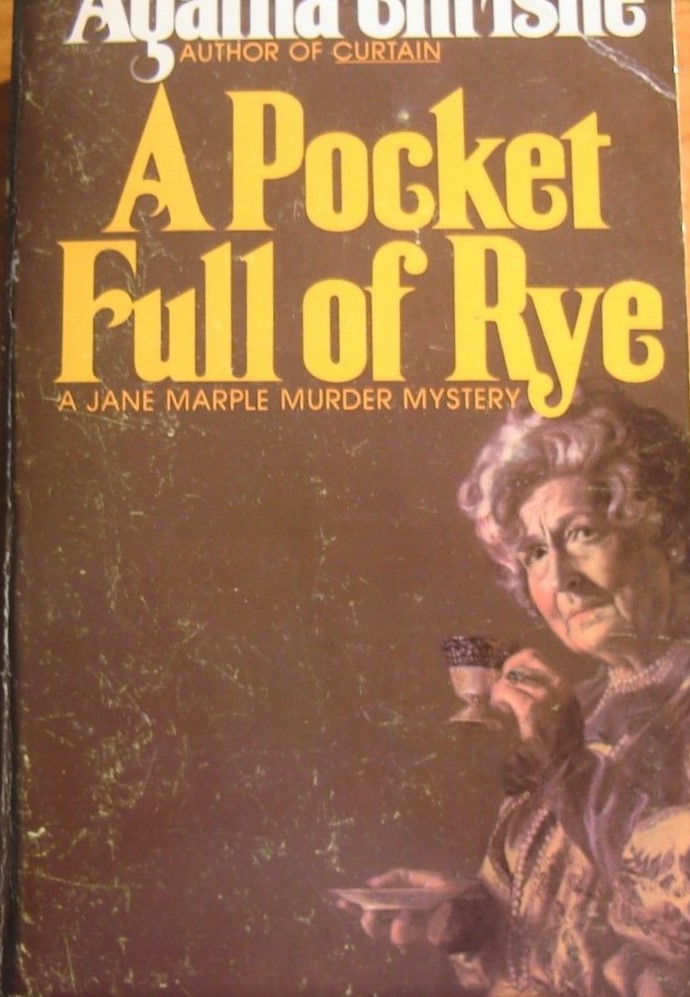
My first Miss Marple visualization also came from the Pocket paperback reissues of the mid- to late-seventies.  I don't know how Pocket came up with this representation.  She's a long way not only from the definitive Joan Hickson character of the 1980s British television films, but also the heavily comical Margaret Rutherford version of the loosely-adapted Sixties movies.


I recently came across a couple of Pocket paperback reissues from the late Sixties/early Seventies and was interested to see how different our Poirot and Marple looked on them. Who could have been the inspiration for this very thin and Gallic Poirot?  (Note: Since posting writer Joseph Goodrich has pointed out to me that the image is drawn from "Giovanni Boldini's portrait of Count Robert de Montesquiou, the primary model for Proust's Baron de Charlus"--no wonder so dandy!)

Once again I have no idea where the inspiration for this Miss Marple was found--not the books, surely!


Giovanni Boldini's portrait of
Count Robert de Montesquiou

I'm not certain Miss Marple appeared on paperback covers before the 1960s.  Let's face it, in the 1950s wise white-haired old ladies were not exactly considered selling points on crime fiction covers. Here are two Fifties editions, one American and one British, of A Pocket Full of Rye that are notable for the absence of Miss Marple and the presence in her stead of a sexy blonde (alive on one cover, dead on the other):


Poirot, on the other hand, had already begun appearing on paperback covers in the 1940s.  Here he is on the hunt on an early edition (a Dell mapback) of Sad Cypress:

In Honor of Agatha's 125th: Brad Friedman's Other Favorite Christies

In Brad's last post he discussed his introduction to Agatha Christie through her bestselling mystery, And Then There Were None.  In Part Two of Brad's post he discusses his three other favorite Christies: Death on the Nile, After the Funeral and A Murder Is Announced.

Here's Brad.

Unlike Agatha Christie herself, I have never tired of Hercule Poirot: his odd appearance, his little mannerisms, the way he plays against xenophobic tendencies in pre-WW2 England, all delight me.  I won't say I prefer Poirot to Miss Marple, for she delights me, too.  I think most Christie fans agree that the Poirot novels are better plotted and clued, while I tend to think that Christie often created more fully rounded sets of characters in her later Marple books.  Maybe it's because Miss Marple doesn't overshadow the suspects the way that Poirot does, with his larger than life personality.

DEATH ON THE NILE

love triangle

The first of my two favorite Poirots is Death on the Nile.  One has to applaud the fascinating variations Dame Agatha devised in her novels on the love triangle/quadrangle.  Some of my favorites include Towards Zero, The Hollow and Five Little Pigs.

Death on the Nile is the most satisfying of all these variations, largely due to the three fascinating young people at its core.  The victim, Linnet Ridgeway, is a "poor little rich girl," not nearly as openly rotten in the novel as she is in the enjoyable film, although her callous disregard for other people provokes her own undoing.  Christie makes Simon Doyle quite likable, even though he is a cad to throw off one person for another.  I think the fact that one can sense in Simon, despite his weaknesses, true adoration for the woman he loves, makes us empathize with and root for him, despite his actions.

And then there is Jacqueline de Bellefort, one of Christie's best, and most tragic, characters.  When Poirot sees her for the first time, he worries about the depth of her passion for Simon: "She cares too much, that little one.  It is not safe.  No, it is not safe."  The simple and dramatic action of one woman stealing another woman's man sets the stage beautifully for a great mystery.

But that is not enough for Christie.  She encircles this romantic triangle with a large cast of supporting characters and transports them to an exotic setting befitting a millionaire's honeymoon. On the steamer Karnac appear many of the threads that one might find in a Golden Age mystery: conniving attorneys, sneering Communists, jewel thieves, even an incognito terrorist!

It takes Poirot to sort though the complicated lives springing from the passenger list and unmask the true nature of a complex murder plot.  One of the things that touches me the most every time I revisit the novel is that, in many ways, Poirot's motive for getting involved here is his strong response to Jacqueline's love for Simon and his desire to protect her.  This leads to one of the most poignant endings in a Christie novel.

AFTER THE FUNERAL

My other favorite Poirot--and to my mind the last great Poirot novel that Christie wrote--is After the Funeral.  It is hard to speak about this one without spoiling anything. Suffice it to say that it contains one of the best examples of misdirection in Christie's fiction.  The plot, the clues, the solution, all are as scrumptious as a full English tea!

That said, there are other delights to be found in the novel, including the depiction of the impact of the postwar dissolution of England's great estates. While the younger generation (and Uncle Timothy) bicker over the late Richard Abernethy's belongings the servants and the older generation (including Uncle Timothy) bemoan the long-gone glorious days of life at Enderby.

The other fun aspect of After the Funeral is seeing Poirot working undercover as M. Pontarlier of UNESCO, adopting his most emphatically foreign persona in order to watch unnoticed as the suspects incriminate themselves.  Every time I reread this one I get a pleasant tingle as each clue presents itself, leading to a thoroughly delightful denouement.

A MURDER IS ANNOUNCED

Finally, I turn to my favorite Miss Marple book, which one would have a hard time arguing is not the best Miss Marple mystery.  Christie's 50th detective novel was A Murder Is Announced, and if it suffers a little from having too many disguised people lurking about the lanes, this is a small price to pay for such a delightful excursion into a small English village right after the war, where the old families have dispersed and people find themselves trying to live the old life among virtual strangers.

It's a situation ripe for a murderer's dastardly plan, and this one unfolds in one delightful scene after another.  Christie was a master at setting up a great premise at the beginning of her books; even the weaker novels at the end of her career often have the most promising hooks.  Here Christie delivers on one of her best plot hooks, and the neighbors who show up at Miss Blacklock's cottage as a result of an open "invitation to a murder" they found in the Much Benham News and Chipping Cleghorn Gazette, along with any lucky readers who show up, are given their money's worth and then some!


I think this is Miss Marple's best clued mystery.  The amateur sleuth relies less on instinct and village parallels and more on her keen powers of observation and some well-placed clues. I am a great fan of those scenes where Christie places a clue in plain sight, fully aware that the causal reader will take no notice of its significance.  A Murder Is Announced contains more than one of the best examples of classic Christie clueing.

Happy birthday, Agatha Christie!  The gratitude I feel for all the pleasure you have give me and all your many other fans for nearly a century now is immeasurable.

The Passing Tramp: Interesting that Brad 's favorite four include And Then There Were None and After the Funeral, two of the four Christie novels I first read, back in 1974.  What are your favorite Christies?  I may just post my own very personal top ten list tomorrow.

Tuesday, September 15, 2015

Agatha's 125th! Guest Post by Brad Friedman on the Occasion of Agatha Christie's 125th Birthday, Part I

Today at The Passing Tramp we commemorate Agatha Christie's 125th birthday.  I know so many of us encountered Agatha Christie's sublime mysteries at young ages.  In my own case it was forty-one years ago in 1974, at Sanborns Department Store in Mexico City, where I was living for a summer with my family. I was all of eight years old and, to be honest, my favorite thing about Sanborns at the time was the milkshakes and cookies I could get at the restaurant.

One of my three "first" Christies
(the actual copy)
Anyone else think that man
looks like the late Rod Taylor?
But one day my Mom was looking at the paperback book racks and you can guess what she picked out: Agatha Christies!  Four Pocket paperback editions, fourteen pesos apiece (about $1.12 each I believe).

These were the days when American publishers still used the American titles of Christie novels, incidentally. The three Christies were Easy to Kill (Murder Is Easy), Funerals Are Fatal (After the Funeral), The ABC Murders and Then There Were None. (I'll just pass here on the original British title of the latter novel.)

I read all four myself in our apartment several stories up, sprawled on a sofa by a window overlooking the street.  I can also recall reading on that sofa a cozy little "twist" story in one of my magazines--Alfred Hitchock's Mystery Magazine?--that I think was called "The Machete Murderer." Is it any wonder I devote so much time as an adult to mystery/crime fiction?  It was fated!

Later that year with my family I saw the film version of Murder on the Orient Express, with Albert Finney as Hercule Poirot. Agatha Christie's place in my mind as this old English lady who had written these incredibly brilliant mysteries was firmly fixed.

My guest blogger today, San Mateo High School drama teacher Brad Freidman, gives us an charming account of his "first time" with Agatha, and includes his own list top four list of Christie favorites. This is just one of several Christie pieces that will appear at The Passing Tramp this week, as we commemorate our undoubted Queen of Crime.

Take it, Brad!

I met the work of Agatha Christie when I was eight or nine.  I didn't actually read a book. Instead, I had a wonderful babysitter named Steve Levy who rightly believed that young boys did not need to be cushioned or coddled with bedtime stories "appropriate" to their age.  Instead, he would create serialized versions of classic Hitchcock movies or murder mysteries that he loved, and he would regale us during each visit with enough of the story line before bedtime that my brother and I found ourselves unconsciously willing our parents to embark on another night on the town just so that we could hear the next chapter of Steve's latest saga.  He was our Charles Dickens, and we were his American fans, clamoring on the shore for the shop to debark with the latest installment on Nicholas Nickleby or Bleak House.

the eye catching one sheet
for the 1965 film version
of Agatha Christie's
most enduringly popular
mystery novel
One night, Steve began a tale about ten strangers trapped on an island with a homicidal maniac. Needless to say, his fertile teenage memory made the murders that occurred more steeped in blood than the actual book would describe (the butler got whacked into many pieces with an axe, I believe!).

This young mind, until then satisfied with The Hardy Boys and Encyclopedia Brown, began a transition into the next phase of mystery reading that would begin in earnest two years later when, on the paperback rack in a local drugstore, I spied Ten Little Indians, newly republished to tie-in with the release of the 1965 film.  I begged my mom to buy it for me, and my lifelong relationship with Christie was sealed.

Is it a surprise that And Then There Were None is one of my four favorite Christies?  To my mind nobody has ever produced a better, more suspenseful, variation on the "old dark house" mystery than this tour de force (though the house in the novel is a sunlit modernist mansion).

In her Autobiography Christie, reticent about her writing process, writes only that she wrote the book "because it was so difficult to do that the idea fascinated me."  We know that books and films about people trapped in a abodes of lurking death abound in the Golden Age.  The Invisible Host, which predates Christie's novel by eight years, has a recorded voice threatening the guests.  But Christie's plotting skill is breathtaking.  In my opinion, it has never been equaled.

Unlike most novels about serial killers, where the motive tying the murders together is often a more interesting puzzle than the murderer's identity, Christie early on unveils a motive to the reader and the characters.  There are clues to the killer's identity, as befits the Mistress of Mystery, but they are really incidental to the novel's growing suspense as, one by one, "justice" is meted out to the victims.


Those who accuse Christie of "cozy" sweetness cannot deny the bleakness of this book from start to finish.  And for a writer often accused of spotty characterization, Christie's work here strikes me as quite brilliant.  She manages to delve with increasing depth into the inner lives of those who survive the longest, letting us peer into these troubled souls without giving away so much that we can ever eliminate one or another as the killer--that is, until just before a character's death.

There is one passage I will always savor when I reread the book: the remaining five guests are sitting in the living room having drinks, and Christie reveals their inner thoughts, including those of the killer. It is clear that all of them are losing their marbles in one way or another, and trying to figure out which thoughts belong to which character is, to say the least, a very challenging proposition.

It is fitting that one of my top four Christies would be a stand-alone book, two would be Hercule Poirots and one a Miss Marple.  Details about my favorite Poirots and Marple will be found in Part Two of this piece.


Thanks, Brad, that was great.  I must say that axe murder in And Then There Were None scared the stuffing out of me when I was a kid reading it forty-one years ago in Mexico City.  Highly sinister!  It was perhaps even more frightening than "The Machete Murderer."

Look for Part Two later today.

Monday, September 14, 2015

Booked: The Book of the Crime (1951), by Elizabeth Daly

Elizabeth Daly's late-blooming but successful mystery-writing career was launched in 1940, when the author was past sixty, and ended, sixteen novels later, in 1951, when she was 73.  Daly lived for sixteen more years, passing away in 1967, so why she stopped writing mysteries I have no idea. Personally, I would have liked some more books from her, but at least she retired on a comparatively high note, with The Book of the Crime.

As I mentioned in my review of Daly's excellent Night Walk (1947), many of the author's detective novels have something of a minimalist feel, much in contrast with many modern mysteries, being rather short and sparely, though very pleasingly, written.  The Book of the Crime is even more minimalist than usual with Daly, by my estimate being around 45, 000 words, barely more than the length of a long novella.  It is set in April 1950 and concerns the travails of a young wife, Rena Austin, married for just a year to a lame war hero husband (wound to the leg), recently widowed when he met Rena.

This being a Daly novel, the husband, Gray Austin, recently inherited from a deceased uncle one of those New York brownstone row houses, wherein he resides in idleness, along with Rena; his siblings, brother Jerome and sister Hildreth (love that name); Irish housekeeper Norah Callahan; and Boston terrier Aby.

One feels that, along with Daly's bibliophile detective, Henry Gamadge, S. S. Van Dine's Philo Vance and Rex Stout's Nero Wolfe might be just around the corner.  This old New York atmosphere, surely already anachronistic in 1951, is a huge part of the pleasure of the Daly mysteries, as noted by one of Daly's biggest fans, Agatha Christie (whose birthday is tomorrow, by the way--more on that soon).

Out taking Aby for a walk, Rena reflects that her quickie marriage to Gray Austin was rash indeed. Her husband has turned into a melancholy and uncommunicative living companion, while her siblings-in-law are snide and condescending and Norah surly and saucy.  When, after returning from the walk with Aby, Rena has an altercation with her husband concerning a certain book in the house, she flees from the house in fear, determined never to return.

Happily, Rena once made the acquaintance of Henry Gamadge, bibliophile and amateur sleuth, and she is able to call on him to help get her out of this pickle.  We once again get glimpses of the Gamadge menage, now including, besides butler Theodore, wife Clara, two young children and a dog and cat, all of whom get along perfectly harmoniously (another part of the escapist pleasure of the Daly tales).

There is a murder, well into the story, of a character the reader never meets while he is among the living, so the emotional impact of this event is distant.  Rather, we are concerned to see that Rena gets extricated from her ill-advised marriage.  But with Gamadge on her side, we can anticipate a happy ending for the nice young woman.

Though more simply plotted than many of the earlier Dalys, The Book of the Crime has a clearly articulated mystery and all the nostalgic charm of vintage Daly.  It is surely a book that all the author's fans will enjoy. The clever last line, the very last line of the Henry Gamadge saga, is particularly to be treasured.  As I discussed in a recent blog post, Daly was not only admired by Agatha Christie, but by Eudora Welty as well.  You scarcely need more recommendation than that, but I very much like Daly too.

The Book of the Crime will be reissued next year, I believe, by Felony & Mayhem, one of the finest vintage mystery presses.  Enjoy!

Friday, September 11, 2015

Thedora DuBois (1890-1986) and Her Sleuthing Couple Anne and Jeffrey McNeill: Guest Post by Lisa Kucharski

Readers of the blog may recall that I disliked Death Is Late to Lunch (1941), the first Theodora DuBois mystery I read.  Particularly grating to me was Anne McNeill, the feminine half of DuBois's sleuthing couple team.  She just seemed too snooty by half. However, I more recently read DuBois's Death Comes to Tea, praised as a "small masterpiece" by Anthony Boucher, and liked it rather better, indeed quite enough to encourage me to peruse other DuBois mysteries.

Yet there's someone out there who has read about all of the McNeill mysteries already and that is my guest blogger, Lisa Kucharski, a friend of mine from Goodreads and the Facebook Golden Age Detection group. (The latter is open to invites for friends of the members, so if you are interested in joining and not already a friend of mine on Facebook, just friend request me on Facebook and I will be happy to give you an invite.)

And now Lisa's guest post about the DuBois's Anne and Jeffrey McNeill mysteries.  I hope you enjoy another take on this series, from someone who is very familiar with it. (We don't totally agree about Anne!)

A LITTLE BACKGROUND

American mystery writer Theodora DuBois (1890-1986) started her sleuth series at the age of 46, in 1936.  She had begun writing commercially after contracting tuberculosis and spending several months in a sanatorium. Little by little she expanded her writing endeavors from stories for magazines to novels and plays.

Ride the pink horse....
With the McNeill series DuBois embeds personal experiences--sailing and her work on plays, estrangement from her stepfather--into an eclectic series of suspenseful mysteries.  She had an ability to conjure characters (was she inspired by people she knew?) who are truly unpleasant or broken.

Her last Anne and Jeffrey McNeill novel, the suggestively titled Seeing Red (1954), was published during the McCarthy Era and met with some backlash because it negatively portrayed the Red Scare, with her heroes, the McNeills, getting called before the House Un-American Activities Committee (HUAC).

FIRST ENCOUNTER

I came across Theodora DuBois's Death Wears a White Coat at a flea market.  It caught my eye because it was an old mystery novel, copyright 1938.  I got it got a couple of dollars.  It languished in a pile of other try 'em out books for a while before I read it.

I was expecting a standard cozy but what I got was a mystery field with creepiness and suspense galore.  I loaned it to two other people and they had the same experience: they could still feel the book a month after reading it.  The hunt was on!  I needed to find more books by this author, Theodora Dubois.

Death Wears a White Coat is the second mystery in the McNeill series by DuBois.  The first novel, Armed with a New Terror (1926), is the only one I haven't read.  It is extremely difficult to find.

According to Colleen Barnett its story line is as follows:

Anne and a child were part of an extended household dependent upon the largess of a dominating grandfather,  Jeffrey McNeill, a neighbor and distant relative intervened when Anne was accused of the murder of a cousin from whom she inherited.  Anne loved Jeffrey, but he did not share his feelings for her until he had unmasked the surprise killer.

THE HAPPY COUPLE

In Death Wears a White Coat, Anne and Jeffrey McNeill are married. Jeffrey works as a medical researcher at an elite Connecticut university. [The Passing Tramp: In real life DuBois's husband, Delafield Dubois, was employed as a medical researcher at Yale.]

Over the series the McNeills reside in various houses--I won't spoil all the why's--on the east coast.  They also sail quite a bit.  (The nautical information in the novels is accurate.)  They have children whom they adore.  In his capacity as a scientist Jeffrey gets involved in government jobs. Anne is a lovely wife with blonde hair and charm to spare.

Of course this happy couple proves a magnet for murder.  The stories are mostly told through Anne's viewpoint, and when Jeffrey is involved he tends to strike me as a bit cold (though he does seem devoted to Anne), in contrast with other husband-and-wife sleuthing teams who are more affectionate, such as the Lockridge's Mr. and Mrs. North.

DuBois's series has some intriguing plotting set-ups, the earlier ones being a bit more interesting than the later books.  DuBois' strength is that she is really good at creeping out the reader, building tension with palpably real characters.

Her mysteries are also a bit quirky as money is not the only reason for murder-- though, let's face it, it's pretty high up on the list!  She reminds me a little of Elizabeth Daly, whose detective uses tiny anomalies to highlight a crime.  Anne McNeill also observes and remembers elements (e.g., the details of a dress) that end up pointing to the murderer.

THE SERIES

The series seems to fall into three categories: mysteries that involve Anne while her husband is buried in work (The Case of the Perfumed Mouse, The Devil and Destiny); mysteries the spouses both encounter while traveling (The McNeills Chase a Ghost, Death Sails in a High Wind); and mysteries that intertwine with Jeffrey's scientific work and involve government secrets. (Murder Strikes an Atomic Unit, Seeing Red, Death Wears a White Coat). There is even one that is not so much a detective novel as a suspense thriller, in which Anne is kidnapped.

AND LAST
A DuBois Half-Dozen (Six Favorite McNeill Mysteries)

1. Death Wears a White Coat (1938)
2. Death Comes to Tea (1940)
3. Death Tears a Comic Strip (1939)
4. The Cavalier's Corpse (1952)
5. Death Dines Out (1939)
6. The Body Goes Round and Round (1942)

Tuesday, September 8, 2015

Family Portraits: Todd Downing (1902-1974) and his great grandfather Dr. James D. Shields (1816-1887)

Todd Downing
1922 college annual photo
when he was a student at
the University of Oklahoma
Longtime readers of this blog will know that I have made a great cause of the fascinating crime fiction of Todd Downing (1902-1974), the Oklahoma Choctaw mystery writer who during the Golden Age of detective fiction published nine detective novels, a body of work much praised in both the US and the UK.

I detail a good deal about his life and family history in my 2013 book Clues and Corpses: The Detective Fiction and Mystery Criticism of Todd Downing, and there's also quite a bit in this blog post here. See also this shorter post about Coachwhip's reprints of his novels and my review of Todd's highly-regarded mystery Vultures in the Sky, along with Michael Dirda's Washington Post review of both this novel and Clues and Corpses.

Todd Downing's Indigenous American ancestry was very important to him, and he is rightly considered an important Native American author; but he was in fact only partly American Indian (probably one-eighth), though he was an enrolled member of the Choctaw Nation and his father, Sam, was a figure of stature in Oklahoma's Choctaw community. 

On the other hand, the ancestry of Todd's mother, Maude (Miller) Downing, was German (on her father's side) and Scots-Irish (on her mother's side), and both sides of her family originally hailed (like my own mother's incidentally), from early European settlers in Pennsylvania.  

Todd's great-grandfather, Dr. James D. Shields (1816-1887), pictured immediately above, originally practiced medicine in the Lawrenceville section of Pittsburgh, Pennsylvania, before moving in the 1850s to Albia, Iowa, where he lived the rest of his life. Recently the son of Todd's sister, Ruth, sent me this photo of a portrait of Dr. Shields, which I naturally wanted to upload to me blog, being the completist that I am!  So here it is.  This portrait used to hang in the Downing family home in Atoka, Oklahoma, pictured below.

Downing family home in Atoka, Oklahoma
(photo by the Passing Tramp)

At the top of this piece I also included a recently unearthed college annual photo of Todd, when he was a student at the University of Oklahoma. Todd would go on to get a BA and an MA at OU and there serve as an instructor of languages--he was fluent in five--for a decade, during which time he wrote his first several detective novels (all in English, though they are set, most atmospherically, in Mexico).

Monday, September 7, 2015

Marian Gallagher Scott (1891-1943): A Return Engagement

Five detective novels by Marian Gallagher Scott were published between 1932 and 1946 (the last one posthumously, Gallagher having passed away at the age of fifty-one in 1943). Four of these novels--Dead Hands Reaching (1932), Tall Man Walking (1936), The Attic Room (1942) and Death's Long Shadow (1946)--have now been reprinted by Coachwhip as dual "twofer" volumes, the first with Dead Hands Reaching and Death's Long Shadow and the second with Tall Man Walking and The Attic Room.

I wrote a single 4000-word introduction to the two volumes, along with a spoilerfiffic afterword to Tall Man Walking/The Attic Room--so make sure you read the afterword indeed after you've first read all the words of the two tales.  For the Coachwhip cover designs, which I think are quite smashingly done, see the bottom of this blog piece. Links to Amazon for each book can be found here and here.  They also are available at Amazon.co.uk.

two strolling players
turned crime writers
Marian and Earl Scott
Marian Scott illustrates the fascinating careers of many of our forgotten Golden Age mystery writers. Born in 1891 in the farming village of Wilsey, Kansas (pop. 153 in 2010), Maude Marian Gallagher, as she was known then, by the turn-of-the-century had moved with her parents and younger sister to the state capital, Topeka, where her father owned a drugstore.  There she appears to have lived the typical life of a middle-class, middle-American store owner's daughter.

After graduating from Topeka High School and a local business college Marian became a stenographer, her many jobs including a stint as a desk clerk for the Kansas State Senate. However, Marian had bigger plans in mind for herself that extended beyond the plains of Kansas.

Spurred on by her local drama class teacher, Marian in 1914 decided to move to Chicago and enroll in the Lyceum Arts Conservatory with the hope of becoming a performer in circuit Chautauqua: traveling shows that played in thousands of venues across small-town America and included lectures, oratory, music acts and performances from famous plays.

Earl W. Scott
During her first year at the Conservatory Marian was chosen to play the female lead in the school's performance of The Taming of the Shrew.  Two years later, she married Earl W. Scott, the dashing young man who had played the male lead in the Shakespeare play, and the enterprising couple formed the Kenilworth Players, a circuit Chautauqua company that would, after Earl's service in World War One, perform all over the United States for the next decade.  (Follow this link to see photos of the Scotts in their signature roles from Shrew).

In 1927 the Scotts retired from circuit Chautauqua and settled in Santa Fe, New Mexico, where they turned to the writing of pulp crime fiction for a variety of magazines, including the fabled Black Mask. (They named their adobe cottage Crooks' Nook.) Occasionally the Scotts wrote stories jointly, but for the most part they published their work independently. The pair was extremely prolific in the short fiction vein, publishing some 200 known stories.

In 1932 Marian Scott published, under the slightly obscuring pseudonym Marion Scott (the name she signed to her pulp fiction), her first detective novel, Dead Hands Reaching, which introduced her series detective, police detective Courtney Brade. He would go on the appear in The Attic Room and Death's Long Shadow, these latter two novels published under the more hoity-toity pseudonym "Katherine Wolffe."

Marion Scott, mistress of pulp fiction
"The Whistling Beast" was just
one of scores of stories the author
published in pulp crime magazines
My favorite of these three interesting mysteries in Death's Long Shadow, where the murder of a mysterious hermit woman in rural Minnesota puts Courtney Brade on the trail of decades-old misdoings in a Massachusetts town. This novel was actually completed by Earl Scott, Marian not having quite finished it before her premature death in 1943.

Marian Scott's Tall Man Walking, also published under her Katherine Wolffe pen name, was her most highly-praised work of fiction. (Her fascinating memoir Chautauqua Caravan was also much lauded.) Detailing the vicious stabbing murder of a hateful woman on her wedding day, Tall Man Walking emphasizes psychological over material clues, foreshadowing the mid-century crime novels of Margaret Millar, Charlotte Armstrong, Ursula Curtiss, Shelley Smith, Celia Fremlin and other post-WW2 suspense writers.

Appropriately, Scott dispensed with the services of her series detective, replacing him, for the duration of this one novel only, with suave psychiatrist Kenneth Borden (the "tall man" of the title).

Marian Scott after she had
become "Katherine Wolffe"
Tall Man Walking received rave reviews around the world.  In Australia, where like in England it was published under the lurid title Bride of Death, one reviewer, drawing a distinction that in the mystery genre would become increasingly pertinent over time, declared of the novel: "As an exciting story of death and crime detection this book is good; as a skillful study in suspense it is remarkable."

Meanwhile, in the United States, the talented crime writer and mystery reviewer Todd Downing deemed Tall Man Walking "one of the trickiest and and most intelligent yarns of the season" and pronounced that "Katherine Wolffe is a name to be watched in mystery fiction."

Unfortunately, "Katherine Wolffe" was forgotten, as was Marian Gallagher Scott, but four of her crime novels now are back, after many decades, for the modern mystery reader's delectation. Enjoy!